
Features
Industries
Who we serve
Resources
Sign in
Get Started - $500/month
No commitment. No implementation fee. Unlimited users. Cancel anytime

A storm response management system must empower field crews to act fast, stay safe, and keep critical documentation intact during emergency storm response operations.
Traditional paper-based processes, fragmented updates, and apps that fail offline slow down crews—and in storm conditions, every minute counts.
Effective systems must:
Storm response during disasters is tough and fast-moving. Power grids fail feeder by feeder, not by area, so every deployment decision matters. Storm rooms need live maps and dashboards, not slow status updates from phone chains, while field crews must keep working even when connectivity drops.
Regulatory and safety compliance such as OSHA, NFPA 70E, DOT, insurance, and inspections can halt operations if crews aren’t verified. Meanwhile, missing documentation delays FEMA reimbursements and contractor payments, often forcing contractors to rely on invoice factoring just to keep crews on the job.
If a platform can’t address these realities, it adds noise instead of helping. Here’s what field teams actually need in the middle of a storm:
Here’s what storm response teams truly need in the field:
Outages, storm movement, pole IDs, feeder lines, substations, and risk zones must be visible on one map. Coordinators can deploy the closest qualified crews faster and reduce redundant travel.
Crews should be able to log photos, GPS locations, hazards, JSA/JHA signatures, hours, and materials without network connectivity. Data sync should automatically once online, preventing lost documentation.
Line trucks, bucket trucks, cranes, generators, and crews must be tracked in real time. Live ETAs reduce confusion and improve dispatch efficiency.
Safety check-ins, stop-work calls, alerts, and urgent updates should allow instant responses from within the system, avoiding scattered SMS, calls, and radios.
Structured work orders should push in seconds using repeat-ready templates for poles, circuits, debris removal, temporary power, and vegetation clearing. AI converts voice notes, paper forms, PDFs, and photos into actionable tasks.
Automatically track OSHA 10/30, NFPA 70E, DOT med cards, CDL status, dielectric tests, bucket truck inspections, MSAs, COIs, and mutual-aid contractor qualifications to prevent unsafe or noncompliant deployments.
Damage records must export with pole numbers, circuit IDs, timestamps, GPS coordinates, materials used, hazards, labor hours, and before/after photos. This ensures clean FEMA claims and regulatory review.
Track bucket truck PTOs, outriggers, generators, spare parts, fuel, rigging kits, first-aid kits, and safety gear to prevent operational pauses.
Before any storm restoration work begins, essential safety checks must be activated first. This includes site briefings, PPE confirmations, JSA/JHA sign-offs, LOTO, hazard tags, permits, and incident logs that must be triggered before work begins, keeping crews safe and compliant.
Rapidly onboard mutual-aid crews, arbor teams, and subcontractors. Assign roles, validate compliance, and push work orders seamlessly, even if the workforce triples or quadruples during major storms.
KYRO AI’s StormShield was designed around field realities, not office theory, making it ideal for utilities, vegetation crews, and emergency storm contractors.
Here’s how StormShield turns storm chaos into coordinated, fast, and safe recovery.
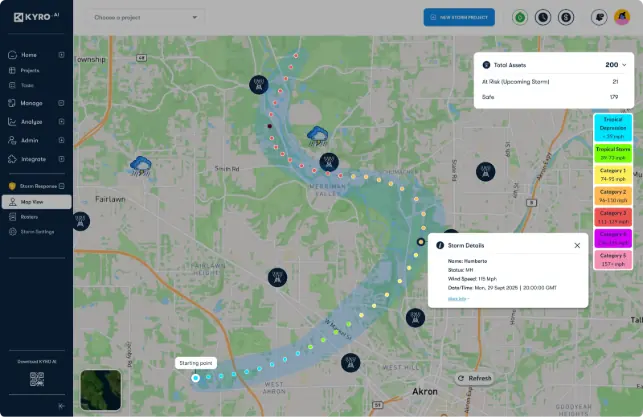
With ArcGIS integrated maps, KYRO AI’s StormShield helps teams track outages, feeder lines, substations, pole IDs, damage reports, crew locations, and risk zones, all in real time. Storm coordinators can make faster, smarter decisions and deploy crews where they’re needed most.
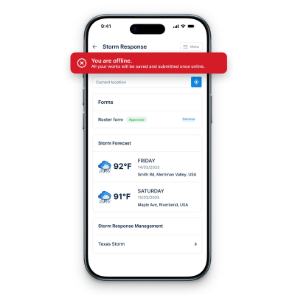
The platform lets crew capture photos (timestamped), GPS locations, hazards, signed JSA/JHA forms, labor hours, and materials, even when offline due to poor connectivity. Everything syncs automatically once the network returns, so nothing gets lost, and work keeps moving.
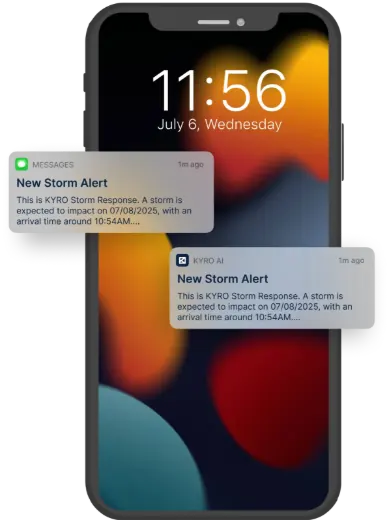
StormShield keeps crews, supervisors, and storm rooms connected through alerts, SMS, push notifications, and in-app messages. Everyone can just fill out the form and respond instantly, updating their availability for the project. Its automated stepper workflows guide crews through each task, ensuring every step is completed safely and consistently bridging the communication gap.
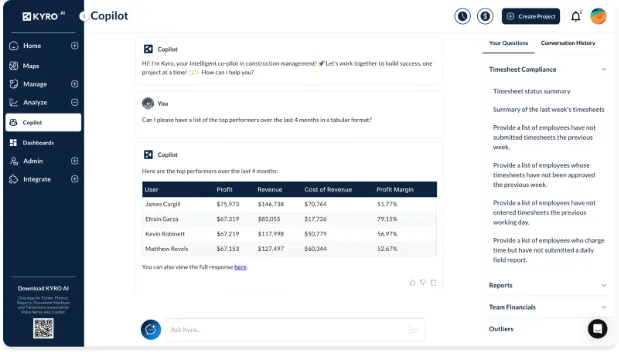
KYRO AI’s StormShield has an in-built AI-powered co-pilot that lets contractors and project managers interact naturally. Simply type or speak a request in plain language, and the system responds instantly.
For example: “Show me the number of crews working on this project” or “List all active hazards on feeder 12.” The AI delivers structured, actionable details—asset IDs, risk levels, required materials, certifications, and more—saving time, reducing errors, and keeping teams focused on restoring power.
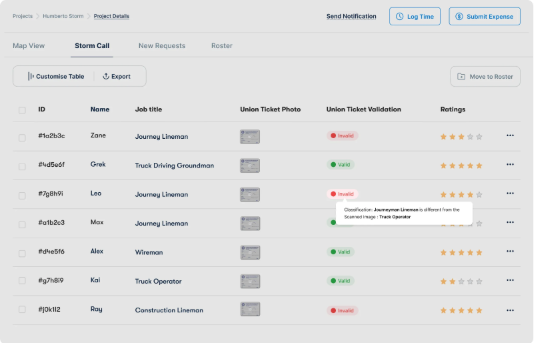
KYRO AI’s StormShield platform automatically verifies OSHA, NFPA, DOT, CDL, bucket truck inspections, MSAs, COIs, and mutual-aid qualifications before crews hit the field. Its AI-powered background checks, combined with integrated I9 workflows, ensure new team members are fully verified and ready to deploy immediately
It helps you keep track of bucket truck PTOs, outriggers, generators, spare parts, fuel, and safety kits in real time. KYRO AI’s StormShield ensures restoration work keeps moving without delays caused by missing or unavailable equipment.
To make the work easier, as soon as the logs are submitted, it automatically creates FEMA-compliant milestone packets and reports with photos, geotags, labor hours, materials, compliance sign-offs, and pole/circuit IDs. This detailed documentation helps approvals move faster, and contractors can easily keep crews on the job without waiting for paperwork.
Storm rooms, field supervisors, and finance teams can easily filter, sort, and group crews, assets, and work orders using AG Grid. Its intuitive interface makes navigating large datasets simple, so even during massive surge operations, everyone gets instant insights without delays.
And best of all, StormShield is super easy to use. Everyone from crews to supervisors can find what they need quickly, build rosters in minutes, fetch data in a few taps, so work keeps moving, and decisions happen fast.
Storm response is chaotic by nature, but KYRO AI StormShield brings order from pre-storm prep to post-storm reimbursement.
With real-time visibility, AI-driven work orders, offline field capture, and automated compliance checks, crews work faster and safer. Supervisors make smarter decisions, and documentation stays organized and audit-ready. Restoration operations remain efficient, reliable, and under control.
If you want to see how modern storm response should work, request a StormShield demo and experience the difference firsthand.

.webp)