
Invoice factoring with KYRO AI

From Field Work to Approved Invoices: Closing the Cash Flow Gap in Storm Response

February 23, 2026
4 min read

Storm Restoration Contractors Can’t Afford to Wait 60–90 Days for Payment

The Cash Flow Reality of Utility Storm Restoration

Storm restoration contractors operate in one of the most capital-intensive segments of the construction industry. After a major weather event, demand spikes instantly, while funding still moves through formal approval and reimbursement channels:
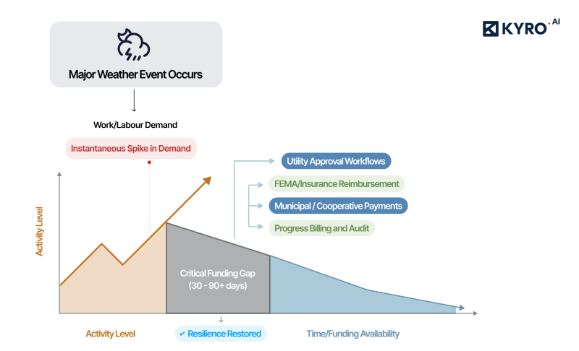
Cashflow reality of Utility Storm Restoration services

  • Utility approval workflows
  • FEMA or insurance reimbursement processes
  • Municipal or cooperative payment schedules
  • Progress billing and audit reviews

Meanwhile, costs are immediate:

  • Labor and overtime
  • Equipment and fleet usage
  • Fuel, lodging, and logistics
  • Subcontractor and supplier payments

Even well-run contractors can feel cash-constraints during extended storm seasons. Not because the work isn’t profitable, but because cash inflow and payments lag far behind execution.

And when cash flow tightens, the consequences show up quickly:

  • Crews can’t stay deployed as long as needed
  • Equipment extensions become harder to justify
  • Suppliers demand faster payment
  • Contractors hesitate to take on overlapping storm work

This is the operational problem invoice factoring is designed to address.

Understanding the Key Players

The Factor: The financial partner who purchases your invoices and provides immediate cash

The Customer: The Prime contractor or the Utility who settles the payment with the Factor.

The Client: The contractor or the Utility who gets the payment from the Factor.

Invoice Factoring: How It Works in Storm Restoration

Invoice factoring allows contractors to access cash tied up in completed, unpaid invoices. The process is straightforward:
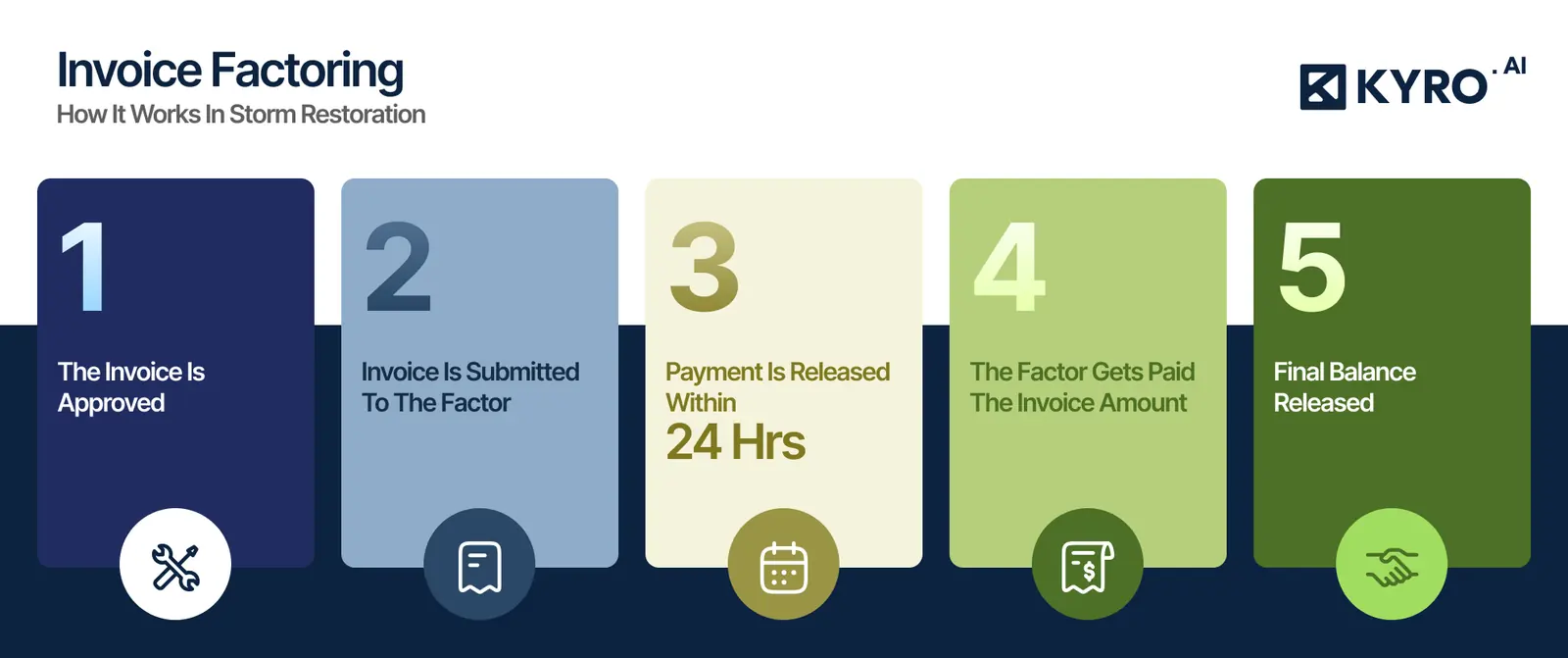
Invoice Factoring workflow

  • Storm work is completed by the client and invoice data is collected.
  • The client gets the invoice approved by the customer.
  • The approved invoice is submitted by the client to the factor.
  • Within 24–48 hours, the factor releases a major portion of the invoice value to the client.
  • The factor collects payment from the end-payer through the Customer.
  • Once payment is received, the factor releases the remaining balance (minus a fee) to the client.

For utility storm restoration contractors, this speed matters. While end-payers may take 60-120 days to process payments through account debtors, factoring ensures immediate cash flow to pay crews, maintain equipment, and mobilize for the next project.

Why Invoice Factoring Matters During Storm Response

1. Keeps Crews Deployed Without Interruption

Storm work pauses when invoices haven’t yet turned into usable cash. Faster access to funds helps contractors cover payroll, fuel, and lodging so crews can stay deployed, and restoration work continues without disruption.

2. Supports Faster, More Predictable Operations

When cash flow is predictable, project managers can plan work, schedule equipment, and coordinate vendors without constant financial contingency planning.

3. Improves Labor and Supplier Relationships

Paying crews and vendors on time builds trust in an industry where experienced storm labor is hard to retain, and supplier's availability is critical.

4. Enables Contractors to Take on More Work

With working capital available, contractors aren’t forced to decline additional utility work simply because multiple invoices are pending. Invoice factoring doesn’t succeed on invoices alone. It succeeds on the quality of the data behind those invoices.

In utility storm restoration, payment delays often stem from:

  • Inconsistent or incomplete timesheets
  • Labor hours that don’t clearly align with scope
  • Missing approvals or supporting documentation
  • Invoices that require follow-up clarification

Factoring partners face the same challenge. If invoices aren’t clear and defensible, advances slow down or shrink. So, how do you make invoices, Factoring Ready?

Making Storm Invoices Factoring-Ready

KYRO AI acts as a trusted source for accurate and validated work data. By standardizing how storm jobs flow from

Storm events → work orders → crew activities → timesheets → invoices

KYRO AI creates a clean, consistent record of all the work performed in a short span of time.  

This structure helps ensure:

  • Labor and equipment hours are captured accurately in real time
  • All documentation is centralized, consistent, and audit-ready
  • Invoices are generated using verified field data
  • Standardized invoice formats move faster through review and approval
  • Approvals happen faster because there are no data gaps or missing records

How does it help?

For contractors and sub-contractors, this means approved invoices are factoring-ready and faster for financing partners to verify, fund, and process.

Closing thoughts: From Waiting on Payments to Predictable Operations

Storm restoration doesn’t slow down when cash flow lags behind the work being done. When field execution, verified work data, and cash flow stay aligned, contractors gain what matters most in storm response: speed, predictability, and control.

By standardizing how work moves from the field to approved invoices, KYRO AI helps contractors get paid faster on approved invoices, keeping crews deployed, projects moving, and operations running without delays tied to payment cycles.

FAQ  

  1. What is factoring?

Factoring, also known as invoice factoring or accounts receivable factoring, is when a business sells its unpaid invoices to a third-party company for immediate cash. Rather than waiting 30-90 days for customer payments, businesses receive 70-90% of the invoice value within 24-48 hours.

This alternative financing method helps companies improve cash flow without taking on traditional debt. Factoring is particularly popular among small businesses, startups, and companies in industries like trucking, staffing, manufacturing, and wholesale distribution.

  1. What is a factoring company?

A factoring company (also called a factor or factoring agency) is a financial services provider that purchases your business's accounts receivable at a discount. These companies provide immediate working capital by buying your unpaid invoices.

Unlike banks or traditional lenders, factoring companies evaluate your customers' credit rather than your business credit score. The best factoring companies offer same-day funding, online portals for invoice submission, and flexible terms without long-term contracts.

  1. How does invoice factoring work?

Invoice factoring works in four simple steps:

  1. You complete work - Deliver products or services and invoice your customer
  1. Submit invoice - Send the invoice to your factoring company for approval
  1. Receive advance - Get 70-90% of the invoice value deposited in 24-48 hours
  1. Customer pays - Your customer pays the factoring company directly; you receive the remaining balance minus fees

The entire factoring process is typically completed within 30-90 days, depending on your customer's payment terms. This process converts slow-paying receivables into immediate working capital.

4. What is factoring accounts receivable?

Factoring accounts receivable is the practice of selling your outstanding invoices (accounts receivable) to a factoring company for quick cash. Accounts receivable factoring allows businesses to unlock capital tied up in unpaid customer invoices.

Instead of using accounts receivable as collateral for a loan, you're selling the actual invoices. This means factoring receivables doesn't create debt on your balance sheet. Common industries using AR factoring include transportation, staffing agencies, wholesalers, and government contractors.

  1. How much does a factoring company cost?

Factoring companies charge 1% to 5% of the invoice value as their fee, with the average factoring rate ranging from 2% to 3% for creditworthy customers.

Factoring fee breakdown:

  • Advance rate: 70-90% of invoice value upfront
  • Factoring rate: 1-5% per month or per transaction
  • Additional fees: Application fees ($0-$500), wire transfer fees ($15-$35), credit check fees, monthly minimums

Factors affecting cost:

  • Your invoice volume (higher volume = lower rates)
  • Customer creditworthiness
  • Industry risk level
  • Payment terms (net 30 vs net 90)
  • Recourse vs non-recourse factoring

For example, on a $10,000 invoice with a 3% factoring fee, you'd receive approximately $8,000-$9,000 upfront and $700-$1,000 later (after the 3% fee is deducted).

From Field Work to Approved Invoices: Closing the Cash Flow Gap in Storm Response

February 23, 2026
4 min read
February 23, 2026
Rabiya Farheen
Content Strategist
Author
Rabiya Farheen
Content Strategist
No items found.
Share on

Storm Restoration Contractors Can’t Afford to Wait 60–90 Days for Payment

The Cash Flow Reality of Utility Storm Restoration

Storm restoration contractors operate in one of the most capital-intensive segments of the construction industry. After a major weather event, demand spikes instantly, while funding still moves through formal approval and reimbursement channels:

Cashflow reality of Utility Storm Restoration services

  • Utility approval workflows
  • FEMA or insurance reimbursement processes
  • Municipal or cooperative payment schedules
  • Progress billing and audit reviews

Meanwhile, costs are immediate:

  • Labor and overtime
  • Equipment and fleet usage
  • Fuel, lodging, and logistics
  • Subcontractor and supplier payments

Even well-run contractors can feel cash-constraints during extended storm seasons. Not because the work isn’t profitable, but because cash inflow and payments lag far behind execution.

And when cash flow tightens, the consequences show up quickly:

  • Crews can’t stay deployed as long as needed
  • Equipment extensions become harder to justify
  • Suppliers demand faster payment
  • Contractors hesitate to take on overlapping storm work

This is the operational problem invoice factoring is designed to address.

Understanding the Key Players

The Factor: The financial partner who purchases your invoices and provides immediate cash

The Customer: The Prime contractor or the Utility who settles the payment with the Factor.

The Client: The contractor or the Utility who gets the payment from the Factor.

Invoice Factoring: How It Works in Storm Restoration

Invoice factoring allows contractors to access cash tied up in completed, unpaid invoices. The process is straightforward:

Invoice Factoring workflow

  • Storm work is completed by the client and invoice data is collected.
  • The client gets the invoice approved by the customer.
  • The approved invoice is submitted by the client to the factor.
  • Within 24–48 hours, the factor releases a major portion of the invoice value to the client.
  • The factor collects payment from the end-payer through the Customer.
  • Once payment is received, the factor releases the remaining balance (minus a fee) to the client.

For utility storm restoration contractors, this speed matters. While end-payers may take 60-120 days to process payments through account debtors, factoring ensures immediate cash flow to pay crews, maintain equipment, and mobilize for the next project.

Why Invoice Factoring Matters During Storm Response

1. Keeps Crews Deployed Without Interruption

Storm work pauses when invoices haven’t yet turned into usable cash. Faster access to funds helps contractors cover payroll, fuel, and lodging so crews can stay deployed, and restoration work continues without disruption.

2. Supports Faster, More Predictable Operations

When cash flow is predictable, project managers can plan work, schedule equipment, and coordinate vendors without constant financial contingency planning.

3. Improves Labor and Supplier Relationships

Paying crews and vendors on time builds trust in an industry where experienced storm labor is hard to retain, and supplier's availability is critical.

4. Enables Contractors to Take on More Work

With working capital available, contractors aren’t forced to decline additional utility work simply because multiple invoices are pending. Invoice factoring doesn’t succeed on invoices alone. It succeeds on the quality of the data behind those invoices.

In utility storm restoration, payment delays often stem from:

  • Inconsistent or incomplete timesheets
  • Labor hours that don’t clearly align with scope
  • Missing approvals or supporting documentation
  • Invoices that require follow-up clarification

Factoring partners face the same challenge. If invoices aren’t clear and defensible, advances slow down or shrink. So, how do you make invoices, Factoring Ready?

Making Storm Invoices Factoring-Ready

KYRO AI acts as a trusted source for accurate and validated work data. By standardizing how storm jobs flow from

Storm events → work orders → crew activities → timesheets → invoices

KYRO AI creates a clean, consistent record of all the work performed in a short span of time.  

This structure helps ensure:

  • Labor and equipment hours are captured accurately in real time
  • All documentation is centralized, consistent, and audit-ready
  • Invoices are generated using verified field data
  • Standardized invoice formats move faster through review and approval
  • Approvals happen faster because there are no data gaps or missing records

How does it help?

For contractors and sub-contractors, this means approved invoices are factoring-ready and faster for financing partners to verify, fund, and process.

Closing thoughts: From Waiting on Payments to Predictable Operations

Storm restoration doesn’t slow down when cash flow lags behind the work being done. When field execution, verified work data, and cash flow stay aligned, contractors gain what matters most in storm response: speed, predictability, and control.

By standardizing how work moves from the field to approved invoices, KYRO AI helps contractors get paid faster on approved invoices, keeping crews deployed, projects moving, and operations running without delays tied to payment cycles.

FAQ  

  1. What is factoring?

Factoring, also known as invoice factoring or accounts receivable factoring, is when a business sells its unpaid invoices to a third-party company for immediate cash. Rather than waiting 30-90 days for customer payments, businesses receive 70-90% of the invoice value within 24-48 hours.

This alternative financing method helps companies improve cash flow without taking on traditional debt. Factoring is particularly popular among small businesses, startups, and companies in industries like trucking, staffing, manufacturing, and wholesale distribution.

  1. What is a factoring company?

A factoring company (also called a factor or factoring agency) is a financial services provider that purchases your business's accounts receivable at a discount. These companies provide immediate working capital by buying your unpaid invoices.

Unlike banks or traditional lenders, factoring companies evaluate your customers' credit rather than your business credit score. The best factoring companies offer same-day funding, online portals for invoice submission, and flexible terms without long-term contracts.

  1. How does invoice factoring work?

Invoice factoring works in four simple steps:

  1. You complete work - Deliver products or services and invoice your customer
  1. Submit invoice - Send the invoice to your factoring company for approval
  1. Receive advance - Get 70-90% of the invoice value deposited in 24-48 hours
  1. Customer pays - Your customer pays the factoring company directly; you receive the remaining balance minus fees

The entire factoring process is typically completed within 30-90 days, depending on your customer's payment terms. This process converts slow-paying receivables into immediate working capital.

4. What is factoring accounts receivable?

Factoring accounts receivable is the practice of selling your outstanding invoices (accounts receivable) to a factoring company for quick cash. Accounts receivable factoring allows businesses to unlock capital tied up in unpaid customer invoices.

Instead of using accounts receivable as collateral for a loan, you're selling the actual invoices. This means factoring receivables doesn't create debt on your balance sheet. Common industries using AR factoring include transportation, staffing agencies, wholesalers, and government contractors.

  1. How much does a factoring company cost?

Factoring companies charge 1% to 5% of the invoice value as their fee, with the average factoring rate ranging from 2% to 3% for creditworthy customers.

Factoring fee breakdown:

  • Advance rate: 70-90% of invoice value upfront
  • Factoring rate: 1-5% per month or per transaction
  • Additional fees: Application fees ($0-$500), wire transfer fees ($15-$35), credit check fees, monthly minimums

Factors affecting cost:

  • Your invoice volume (higher volume = lower rates)
  • Customer creditworthiness
  • Industry risk level
  • Payment terms (net 30 vs net 90)
  • Recourse vs non-recourse factoring

For example, on a $10,000 invoice with a 3% factoring fee, you'd receive approximately $8,000-$9,000 upfront and $700-$1,000 later (after the 3% fee is deducted).

Rabiya Farheen
Content Strategist

Rabiya Farheen is a content strategist and a writer who loves turning complex ideas into clear, meaningful stories, especially in the world of construction tech, AI, and B2B SaaS. She works closely with growing teams to create content that doesn’t just check SEO boxes, but actually helps people understand what a product does and why it matters. With a knack for research and a curiosity that never quits, Rabiya dives deep into industry trends, customer pain points, and data to craft content that feels super helpful and informative. When she’s not writing, she’s probably reading, painting, and exploring her creative side— or you'll find her hustling around for social causes, especially those that empower girls and women.

Discover more related blogs.