.jpg)
Over the last three years, U.S. utilities have suffered roughly $461.6 billion in storm-related damages, and today's customers and regulators demand faster restoration with complete documentation. Hence, an effective storm response plan is essential for utility contractors managing power restoration during severe weather events.
Modern AI-driven platforms like KYRO AI are transforming storm response management, helping contractors build and deploy qualified/verified crews in less than 3 minutes, restore power faster with real-time data and get paid in 24hrs.
This comprehensive guide walks you through an end-to-end storm response plan for utility contractors, from pre-storm preparation to post-storm reporting and getting paid.
Before any storm arrives, contractors and utilities must prepare thoroughly.
Equipment and Supply Staging
Pre-stage critical materials (poles, transformers, fuel, clearance gear) near high-risk areas. Update and inspect utility trucks before storm season. Use KYRO AI to track and store vehicle maintenance logs and safety inspection certificates, so trucks are ready to roll.
Communication & Roles
Establish a Incident Command System (ICS) structure and make sure everyone (utilities, prime contractors, subs, first responders) knows their roles. Hold joint drills or meetings, so crews understand the chain of command and emergency protocols ahead of time.
By completing these steps, a contractor is storm-proofing their operations. Frequent pre-storm planning prevents last-minute confusion.
KYRO AI helps keep this information in one place. It digitizes contractor rosters, asset lists, and can build AI-validated storm rosters in less than 3 minutes, so that when a storm warning comes, dispatchers already have the right crews and equipment ready.
Read more: The first 12 hours of utility storm restoration
As the storm approaches, use all available data to assess impact early. Advanced tools overlay weather forecasts, radar and historical data on your utility's network GIS to pinpoint vulnerable circuits.
Contractors should prioritize work by impact. Critical substations, hospitals, and dense neighborhoods first, rather than simply the closest outage. Modern AI powered tools can analyse and flag circuits with heavy vegetation or aging poles as high-risk and even predict likely failures (like fuse or transformer issues) with close to 80% accuracy.
When that risk data feeds dispatch, crews are moving sooner. The real gain is reducing mean time to respond (MTTR), because the right crews are already staged, assigned, and rolling before the first phone calls stack up.
KYRO's real-time outage maps display storm tracks and asset locations on color-coded ArcGIS dashboards. Crews can see exactly which feeders lie in the storm projected path, and which transformers or lines have known vulnerabilities.

This lets contractors pre-assign crews by priority, ensuring you deploy restoration crews based on impact, not proximity. In practice, as soon as a storm watch is issued, you'd open KYRO AI's StormShield module to watch the storm paths over your grid and automatically highlight zones needing immediate attention.
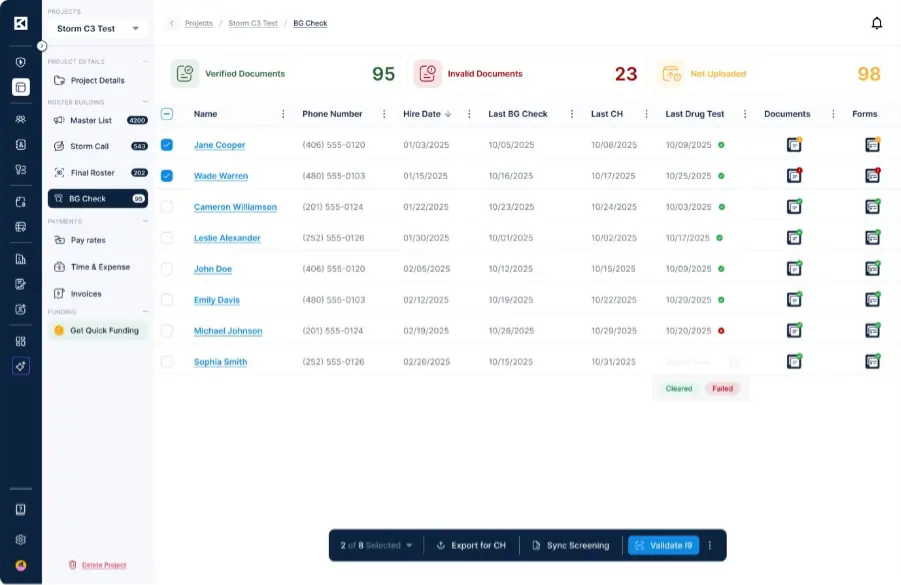
With priorities set, it's time to move people and equipment. Use KYRO AI's mobile platform to alert and assemble crews in under 3 minutes, not hours. KYRO AI StormShield automates callouts to qualified personnel.

Before crews load up, run through a final checklist:
In KYRO AI, all these documents can be stored and timestamped, so any gaps show up immediately.
Follow a strict chain of commands under the Incident Command System (ICS) model. Assign a Crew Chief and Safety Officer at each staging location. Every crew leader knows who to report to, and communication plans are clear.
KYRO AI enforces compliance too: it builds AI-validated DISA and KYRO verified storm rosters so only crews that pass all checks (licenses, union rules, drug screens, hazard training) can be dispatched.

For example, KYRO AI will flag if a truck's DOT inspection is expired or if a lineman's bucket training is missing, preventing preventable delays.
Once everything is green-lighted, each truck departs with the right mix of personnel and equipment, ready to operate safely.
By automating these tasks, the KYRO AI StormShield platform ensures no step is skipped. In essence, crew mobilization becomes a matter of clicking "deploy" in KYRO AI, confident that every checklist item has already been met.
Once on site, safety first. Prioritize isolation of hazards before any restoration work begins. Downed wires, leaning poles, damaged transformers — all must be clearly flagged.
Crews rope off dangerous areas and, if wires block roads, coordinate with police to secure traffic lanes. Always assume a fault could be live. Use KYRO AI's mobile forms to document every hazard. Linemen can photograph each downed line or debris pile (with GPS/time stamps) and fill out digital safety checklists on their phones. This creates a permanent record of what was found and what actions were taken.
In practice, field protocols should include:
KYRO AI can push a "Storm Safety" checklist to every crew member. As workers check off items, supervisors see the progress live on the command dashboard.
By combining disciplined field safety practices with KYRO AI's data capture, contractors keep crews safe and build the documentation needed for audits and reimbursements.
During the response, keep everyone connected. KYRO AI provides real-time visibility on one dashboard: see available crew's GPS location, equipment status, and which tasks they're working on.
If a crew finishes early or a vehicle breaks down, command updates happen immediately. Use the app to route idle crews to nearby tasks based on priority. KYRO AI also helps send instant alerts (SMS or push notifications) for critical updates.
Key Tracking and Coordination Practices
Use KYRO AI's StormShield map to monitor all crews. Supervisors get a live "snapshot" of every worker/lineman available for an immediate incident.
Send push/SMS alerts for changes (new high-priority job, weather changes, supply needs, availability), so crews aren't caught off-guard.
Together, keep your storm room and field crews synchronized, preventing communication breakdowns that can delay restoration.
After the last line is re-energized, the work isn't finished. It's time to document and debrief. First, assemble timesheets and expenses. KYRO AI makes it easy to collect field times and material usage, eliminating the need to chase paper records.
This transparency speeds up cost recovery: regulators and insurers trust digital logs with geo-tags and timestamps.
Next, create post-storm reports. A complete report covers:
These reports should be shared with the utility, local authorities, and any FEMA auditors.
KYRO AI's Reporting Suite – The KYRO PAY
KYRO AI's reporting suite makes this easy. KYRO PAY can generate FEMA-compliant documents and invoices that can be submitted to utilities for approval. And these approved invoices can be moved for factoring, and you can get paid in under 24hrs.
For instance, accurate timesheets and photo-logs reduce disallowed costs, digital tracking reinforces regulatory compliance. This can cut disallowances or invoice rejections by turning incomplete paperwork into complete, auditable records.
Automated Timesheets KYRO's digital time capture means every crew's hours (travel, work, standby) are logged and approved in real time.
Cost Documentation Track expenses (fuel, per diem, rentals) in KYRO so you can send accurate invoices or FEMA claims.
Regulatory Reporting Use KYRO's templates for outage reports and damage analysis to meet utility commission or insurance requirements.
Performance Metrics Review KPIs (e.g., outages/day, crew efficiency, response time). Compare against goals, and improvement in SAIDI/SAIFI is a key sign of success.
This final step turns a completed restoration into a learning opportunity and ensures all funding is captured.
Every piece of this plan relies on having connected information. The KYRO AI Storm Shield platform pulls it all together into one system.
In the office or field, KYRO AI provides real-time GIS outage maps and dashboards so command can see damage zones and crew locations at a glance. Its mobile app gives linemen an always-accessible task list and form library — for example, crews fill out digital safety inspections, O&M forms, and timesheets on their phones, even offline. Supervisors can reassign tasks on the fly as conditions change.
Real-Time Outage Mapping Color-coded GIS maps of feeders, outages, crews, and weather overlays.
Mobile Field Forms Digital templates for all tasks, hazard logs, daily briefs, crew timesheets, safety checklists.
Instant Communication Automated callouts, SMS/push alerts, so no critical update is missed.
Automated Reporting Storm reporting dashboards and downloadable FEMA/utility reports (timelines, cost breakdowns, invoices).
By using KYRO AI, contractors gain a single source of truth during chaos. From the initial storm path tracking to roster callout and factoring the invoices and getting paid in under 24hrs, the contractors can do it all using the platform with confidence.
Ready to Transform Your Storm Response?
Proactive preparation and smart tools are the keys to successful storm restoration. Leading utilities have moved away from paper processes and embraced platforms like KYRO to stay ahead of disasters.
Book a demo today and see how KYRO AI's storm response solution can streamline your entire workflow, from planning to payouts, so your crews restore power faster and safer than ever before.
Schedule Your KYRO AI Demo
1. What should a contractor have ready before storm season starts?
You should already have signed MSAs, verified crew credentials, equipment inspections, insurance certificates, and staging plans completed before any storm alert. The goal is to have zero paperwork during mobilization. In KYRO AI’s StormShield , rosters, equipment records, and certifications stay validated year-round, so dispatch becomes a decision, not an administrative process.
2. How early should crews be staged before a storm hits?
As soon as a watch is issued, not after outages begin. Using storm path overlays and historical failure data, contractors can stage crews near high-impact circuits in advance, reducing mean time to respond (MTTR) once failures occur.
3. How do you decide which outages to restore first?
Prioritize by impact, not distance:
• substations and feeders
• hospitals and emergency infrastructure
• dense population areas
AI analysis helps identify vulnerable circuits (vegetation exposure, aging poles, overload risk) so dispatch decisions happen before customer calls start.
4. How do contractors avoid sending the wrong crews to the wrong work?
Qualification matching is critical. Dispatch should automatically verify licenses, union requirements, safety training, and truck certifications before assignment. KYRO AI’s validated rosters prevent crews from being deployed if any requirement is missing, avoiding rejected work and utility penalties.
5. What is KORY and how does it help during storm response?
KORY is the AI operations agent inside StormShield.
Instead of supervisors manually digging through dashboards, KORY answers operational questions instantly:
• find crews with missing logs
• identify pending or incomplete work orders
• review submitted field reports
• analyze productivity trends
• flag potential delays before they affect restoration timelines
KORY acts like a storm desk assistant, constantly scanning the system so managers focus on decisions, not searching data.
6. What documentation does FEMA require after a storm?
You need verifiable proof of work:
• timestamped crew logs
• GPS-tagged photos
• material usage
• equipment hours
• pre-event contracts and agreements
Digital records significantly reduce disallowed costs because every action is traceable.
7. How do contractors speed up approval and payment after restoration?
The biggest delay is incomplete paperwork. When field data (photos, labor, materials, locations) is captured in real time, invoices can be generated immediately after restoration and submitted for approval or factoring.
8. What safety practices are mandatory during storm restoration?
Always assume equipment is energized. Crews must:
• test before touching conductors
• secure the public work zone
• brace unstable poles
• clear vegetation re-contact risks
• coordinate with emergency responders
Digital safety checklists ensure each step is completed and documented for audits.
9. How do utilities measure contractor performance during storms?
Utilities evaluate contractors using reliability and response metrics:
• response time (crew mobilization speed)
• restoration duration
• SAIDI – outage duration per customer
• SAIFI – outage frequency
Preparation and correct dispatch decisions impact these metrics more than repair speed alone.
10. How does KYRO AI actually make restoration faster?
KYRO AI reduces delays at every stage:
• prepares validated rosters before storms
• stages crews using predictive mapping
• automates dispatch and compliance checks
• captures field documentation instantly
• generates audit-ready reports
The result is faster response, fewer rejected invoices, and quicker payment after the storm.

Over the last three years, U.S. utilities have suffered roughly $461.6 billion in storm-related damages, and today's customers and regulators demand faster restoration with complete documentation. Hence, an effective storm response plan is essential for utility contractors managing power restoration during severe weather events.
Modern AI-driven platforms like KYRO AI are transforming storm response management, helping contractors build and deploy qualified/verified crews in less than 3 minutes, restore power faster with real-time data and get paid in 24hrs.
This comprehensive guide walks you through an end-to-end storm response plan for utility contractors, from pre-storm preparation to post-storm reporting and getting paid.
Before any storm arrives, contractors and utilities must prepare thoroughly.
Equipment and Supply Staging
Pre-stage critical materials (poles, transformers, fuel, clearance gear) near high-risk areas. Update and inspect utility trucks before storm season. Use KYRO AI to track and store vehicle maintenance logs and safety inspection certificates, so trucks are ready to roll.
Communication & Roles
Establish a Incident Command System (ICS) structure and make sure everyone (utilities, prime contractors, subs, first responders) knows their roles. Hold joint drills or meetings, so crews understand the chain of command and emergency protocols ahead of time.
By completing these steps, a contractor is storm-proofing their operations. Frequent pre-storm planning prevents last-minute confusion.
KYRO AI helps keep this information in one place. It digitizes contractor rosters, asset lists, and can build AI-validated storm rosters in less than 3 minutes, so that when a storm warning comes, dispatchers already have the right crews and equipment ready.
Read more: The first 12 hours of utility storm restoration
As the storm approaches, use all available data to assess impact early. Advanced tools overlay weather forecasts, radar and historical data on your utility's network GIS to pinpoint vulnerable circuits.
Contractors should prioritize work by impact. Critical substations, hospitals, and dense neighborhoods first, rather than simply the closest outage. Modern AI powered tools can analyse and flag circuits with heavy vegetation or aging poles as high-risk and even predict likely failures (like fuse or transformer issues) with close to 80% accuracy.
When that risk data feeds dispatch, crews are moving sooner. The real gain is reducing mean time to respond (MTTR), because the right crews are already staged, assigned, and rolling before the first phone calls stack up.
KYRO's real-time outage maps display storm tracks and asset locations on color-coded ArcGIS dashboards. Crews can see exactly which feeders lie in the storm projected path, and which transformers or lines have known vulnerabilities.

This lets contractors pre-assign crews by priority, ensuring you deploy restoration crews based on impact, not proximity. In practice, as soon as a storm watch is issued, you'd open KYRO AI's StormShield module to watch the storm paths over your grid and automatically highlight zones needing immediate attention.
With priorities set, it's time to move people and equipment. Use KYRO AI's mobile platform to alert and assemble crews in under 3 minutes, not hours. KYRO AI StormShield automates callouts to qualified personnel.

Before crews load up, run through a final checklist:
In KYRO AI, all these documents can be stored and timestamped, so any gaps show up immediately.
Follow a strict chain of commands under the Incident Command System (ICS) model. Assign a Crew Chief and Safety Officer at each staging location. Every crew leader knows who to report to, and communication plans are clear.
KYRO AI enforces compliance too: it builds AI-validated DISA and KYRO verified storm rosters so only crews that pass all checks (licenses, union rules, drug screens, hazard training) can be dispatched.

For example, KYRO AI will flag if a truck's DOT inspection is expired or if a lineman's bucket training is missing, preventing preventable delays.
Once everything is green-lighted, each truck departs with the right mix of personnel and equipment, ready to operate safely.
By automating these tasks, the KYRO AI StormShield platform ensures no step is skipped. In essence, crew mobilization becomes a matter of clicking "deploy" in KYRO AI, confident that every checklist item has already been met.
Once on site, safety first. Prioritize isolation of hazards before any restoration work begins. Downed wires, leaning poles, damaged transformers — all must be clearly flagged.
Crews rope off dangerous areas and, if wires block roads, coordinate with police to secure traffic lanes. Always assume a fault could be live. Use KYRO AI's mobile forms to document every hazard. Linemen can photograph each downed line or debris pile (with GPS/time stamps) and fill out digital safety checklists on their phones. This creates a permanent record of what was found and what actions were taken.
In practice, field protocols should include:
KYRO AI can push a "Storm Safety" checklist to every crew member. As workers check off items, supervisors see the progress live on the command dashboard.
By combining disciplined field safety practices with KYRO AI's data capture, contractors keep crews safe and build the documentation needed for audits and reimbursements.
During the response, keep everyone connected. KYRO AI provides real-time visibility on one dashboard: see available crew's GPS location, equipment status, and which tasks they're working on.
If a crew finishes early or a vehicle breaks down, command updates happen immediately. Use the app to route idle crews to nearby tasks based on priority. KYRO AI also helps send instant alerts (SMS or push notifications) for critical updates.
Key Tracking and Coordination Practices
Use KYRO AI's StormShield map to monitor all crews. Supervisors get a live "snapshot" of every worker/lineman available for an immediate incident.
Send push/SMS alerts for changes (new high-priority job, weather changes, supply needs, availability), so crews aren't caught off-guard.
Together, keep your storm room and field crews synchronized, preventing communication breakdowns that can delay restoration.
After the last line is re-energized, the work isn't finished. It's time to document and debrief. First, assemble timesheets and expenses. KYRO AI makes it easy to collect field times and material usage, eliminating the need to chase paper records.
This transparency speeds up cost recovery: regulators and insurers trust digital logs with geo-tags and timestamps.
Next, create post-storm reports. A complete report covers:
These reports should be shared with the utility, local authorities, and any FEMA auditors.
KYRO AI's Reporting Suite – The KYRO PAY
KYRO AI's reporting suite makes this easy. KYRO PAY can generate FEMA-compliant documents and invoices that can be submitted to utilities for approval. And these approved invoices can be moved for factoring, and you can get paid in under 24hrs.
For instance, accurate timesheets and photo-logs reduce disallowed costs, digital tracking reinforces regulatory compliance. This can cut disallowances or invoice rejections by turning incomplete paperwork into complete, auditable records.
Automated Timesheets KYRO's digital time capture means every crew's hours (travel, work, standby) are logged and approved in real time.
Cost Documentation Track expenses (fuel, per diem, rentals) in KYRO so you can send accurate invoices or FEMA claims.
Regulatory Reporting Use KYRO's templates for outage reports and damage analysis to meet utility commission or insurance requirements.
Performance Metrics Review KPIs (e.g., outages/day, crew efficiency, response time). Compare against goals, and improvement in SAIDI/SAIFI is a key sign of success.
This final step turns a completed restoration into a learning opportunity and ensures all funding is captured.
Every piece of this plan relies on having connected information. The KYRO AI Storm Shield platform pulls it all together into one system.
In the office or field, KYRO AI provides real-time GIS outage maps and dashboards so command can see damage zones and crew locations at a glance. Its mobile app gives linemen an always-accessible task list and form library — for example, crews fill out digital safety inspections, O&M forms, and timesheets on their phones, even offline. Supervisors can reassign tasks on the fly as conditions change.
Real-Time Outage Mapping Color-coded GIS maps of feeders, outages, crews, and weather overlays.
Mobile Field Forms Digital templates for all tasks, hazard logs, daily briefs, crew timesheets, safety checklists.
Instant Communication Automated callouts, SMS/push alerts, so no critical update is missed.
Automated Reporting Storm reporting dashboards and downloadable FEMA/utility reports (timelines, cost breakdowns, invoices).
By using KYRO AI, contractors gain a single source of truth during chaos. From the initial storm path tracking to roster callout and factoring the invoices and getting paid in under 24hrs, the contractors can do it all using the platform with confidence.
Ready to Transform Your Storm Response?
Proactive preparation and smart tools are the keys to successful storm restoration. Leading utilities have moved away from paper processes and embraced platforms like KYRO to stay ahead of disasters.
Book a demo today and see how KYRO AI's storm response solution can streamline your entire workflow, from planning to payouts, so your crews restore power faster and safer than ever before.
Schedule Your KYRO AI Demo
1. What should a contractor have ready before storm season starts?
You should already have signed MSAs, verified crew credentials, equipment inspections, insurance certificates, and staging plans completed before any storm alert. The goal is to have zero paperwork during mobilization. In KYRO AI’s StormShield , rosters, equipment records, and certifications stay validated year-round, so dispatch becomes a decision, not an administrative process.
2. How early should crews be staged before a storm hits?
As soon as a watch is issued, not after outages begin. Using storm path overlays and historical failure data, contractors can stage crews near high-impact circuits in advance, reducing mean time to respond (MTTR) once failures occur.
3. How do you decide which outages to restore first?
Prioritize by impact, not distance:
• substations and feeders
• hospitals and emergency infrastructure
• dense population areas
AI analysis helps identify vulnerable circuits (vegetation exposure, aging poles, overload risk) so dispatch decisions happen before customer calls start.
4. How do contractors avoid sending the wrong crews to the wrong work?
Qualification matching is critical. Dispatch should automatically verify licenses, union requirements, safety training, and truck certifications before assignment. KYRO AI’s validated rosters prevent crews from being deployed if any requirement is missing, avoiding rejected work and utility penalties.
5. What is KORY and how does it help during storm response?
KORY is the AI operations agent inside StormShield.
Instead of supervisors manually digging through dashboards, KORY answers operational questions instantly:
• find crews with missing logs
• identify pending or incomplete work orders
• review submitted field reports
• analyze productivity trends
• flag potential delays before they affect restoration timelines
KORY acts like a storm desk assistant, constantly scanning the system so managers focus on decisions, not searching data.
6. What documentation does FEMA require after a storm?
You need verifiable proof of work:
• timestamped crew logs
• GPS-tagged photos
• material usage
• equipment hours
• pre-event contracts and agreements
Digital records significantly reduce disallowed costs because every action is traceable.
7. How do contractors speed up approval and payment after restoration?
The biggest delay is incomplete paperwork. When field data (photos, labor, materials, locations) is captured in real time, invoices can be generated immediately after restoration and submitted for approval or factoring.
8. What safety practices are mandatory during storm restoration?
Always assume equipment is energized. Crews must:
• test before touching conductors
• secure the public work zone
• brace unstable poles
• clear vegetation re-contact risks
• coordinate with emergency responders
Digital safety checklists ensure each step is completed and documented for audits.
9. How do utilities measure contractor performance during storms?
Utilities evaluate contractors using reliability and response metrics:
• response time (crew mobilization speed)
• restoration duration
• SAIDI – outage duration per customer
• SAIFI – outage frequency
Preparation and correct dispatch decisions impact these metrics more than repair speed alone.
10. How does KYRO AI actually make restoration faster?
KYRO AI reduces delays at every stage:
• prepares validated rosters before storms
• stages crews using predictive mapping
• automates dispatch and compliance checks
• captures field documentation instantly
• generates audit-ready reports
The result is faster response, fewer rejected invoices, and quicker payment after the storm.

Rabiya Farheen is a content strategist and a writer who loves turning complex ideas into clear, meaningful stories, especially in the world of construction tech, AI, and B2B SaaS. She works closely with growing teams to create content that doesn’t just check SEO boxes, but actually helps people understand what a product does and why it matters. With a knack for research and a curiosity that never quits, Rabiya dives deep into industry trends, customer pain points, and data to craft content that feels super helpful and informative. When she’s not writing, she’s probably reading, painting, and exploring her creative side— or you'll find her hustling around for social causes, especially those that empower girls and women.