
Features
Industries
Who we serve
Resources
Sign in
Get Started - $500/month
No commitment. No implementation fee. Unlimited users. Cancel anytime

When a major storm hits, there is little time to figure out what resources you have and what you still need. Crew availability changes. Contractors need to be contacted. Equipment has to be moved. Damage information starts coming in from multiple locations.
A storm readiness assessment gives you a clear view of what is ready, what is missing, and where your response could slow down before the storm hits.
It assesses the people, equipment, processes, communication, safety, technology, contractors, and documentation needed for storm restoration.
This guide walks you through the key areas to assess and includes a practical storm readiness checklist you can use before the next major storm.
A storm readiness assessment is a structured review of your utility's ability to respond to a major storm.
You can use it to check crew availability, contractor and mutual aid resources, equipment, communication, safety procedures, mobilization processes, and documentation. More importantly, it helps you identify gaps while you still have time to fix them.
Your storm readiness assessment should cover the areas that directly affect how quickly and safely you can restore service.
Here’s what to review in a Utility’s storm readiness assessment:
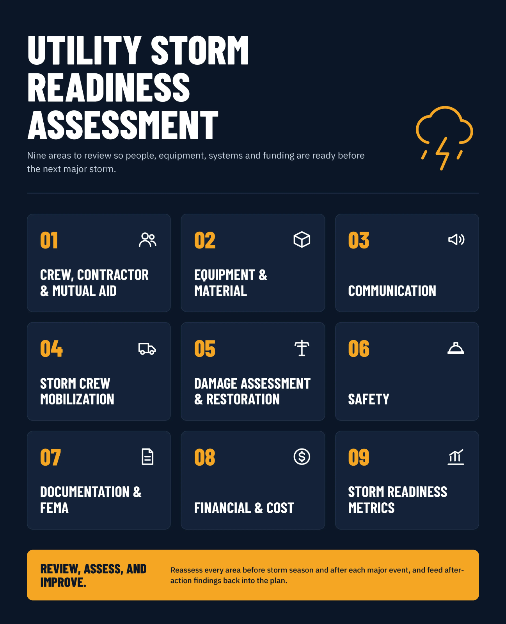
Let's look at each one.
Your restoration plan depends on having the right people available when you need them.
Start by looking beyond your total number of employees or contractors. You need to know how many qualified, available, and deployable crews you can actually put into the field.
Review:
Compare your available crews with the expected work. You may still have gaps in skills, crew types, or coverage.
If your team must search through spreadsheets, emails, or individual contact lists to get that answer, you have a readiness gap to address before the storm.
Having enough crew is only part of being ready. You also need to make sure they have the right equipment, materials, and supplies required to start restoration work.
Review trucks, bucket trucks, generators, tools, transformers, poles, conductors, crossarms, insulators, fuel, PPE, and other storm-response supplies.
Verify what materials the contractors and mutual aid crews will bring and what your utility will need to provide. Identify shortages early. Confirm where equipment and materials will be staged and how they will reach crews when needed.
During a storm, information moves across control rooms, field crews, contractors, mutual aid teams, customers, and utility leadership. If communication breaks down, even a well prepared response can fail.
Review whether you have clear communication channels and contact information for:
You should also check whether your utility has a clear process for:
Also review your emergency contact lists before storm season. Outdated phone numbers, missing contractor contacts, or unclear escalation paths can cause delays when every minute matters.
If you do not meet any of these criteria for communication, mark it as a readiness gap and address it at the earliest.
Once you know which crews are available, you need to know how quickly you can get them into the field. A slow or manual storm crew mobilization process can delay restoration even when enough resources are available.
Review whether your team can:
Storm Damage Assessment is the process of identifying, documenting, and prioritizing damage to your utility infrastructure after a storm.
It gives your restoration team the information they need to decide on where crews should go, what work needs to be done, and which outages should be addressed first.
If damage assessment information is delayed, incomplete, or difficult to access, it could directly impact crew assignments. And it could also lead to the resources being sent to the wrong locations.
Before the storm, check whether your team can access:
Storm restoration often means working in difficult conditions, around damaged infrastructure, unfamiliar locations, and long working hours.
Before the storm hits, verify if everyone's safety training is up to date? Do you have enough certified crew members for the work ahead? Does everyone know the plan and who to call if things go sideways? A quick safety check now can save a lot of trouble later.
Check:
Don't treat crew safetyas a separate activity that starts once crews arrive. It's necessary to prepare Safety as part of your mobilization process.
Storm response can create significant unplanned costs.
Before the storm, review:
You should also know which costs require additional documentation.
This is where a cost tracking process can help you understand not only how much the response is costing, but also where those costs are coming from.
FEMA reimbursement helps utilities recover from certain costs related to disaster response and restoration. But not every storm-related expense qualifies. FEMA approves only the cost tied to eligible work which is adequately documented.
That makes documentation an important part of storm readiness. Keep clear records of labor, equipment, materials, contractor work, damage, and restoration activities. Photos, invoices, time records, work logs, and other supporting documents can help show what work was done, who performed it, when it happened, and what it cost.
Before the storm, check whether your team can:
If records are scattered, incomplete, or collected manually without a consistent process, address those documentation gaps before the next major storm.
Storm readiness metrics are measurable indicators that help utilities understand how prepared they are to withstand, respond to, and recover from severe weather.
It can include SAIDI, SAIFI, CAIDI, restoration time, customer minutes interrupted, vegetation-related outages, crew mobilization time, etc.
Operational readiness shows whether your utility is ready for a storm. Whereas storm readiness metrics show how well that readiness translates into actual storm performance.
Once you have reviewed each area in storm readiness assessment, give each category a readiness score.
A simple five-point system works well. Score each category against 5.
You can calculate an overall score using:
For example, if you assess 10 categories and give each a maximum of 5 points:
Maximum score = 50
Total Points = (sum of [each category score calculated against 5 points])
If your total utility scores 42:
42 ÷ 50 × 100 = 84%
You could then use the following internal interpretation:
This utility preparedness scoring system is a practical internal framework. It is not a regulatory or industry-standard storm readiness rating.
The value comes from using the same assessment consistently and tracking whether your readiness improves over time.
Let's say your utility completes an assessment two days before a major storm.
Total score = 4 + 3 + 4 + 5 + 3 + 4 + 5 + 3 + 4 + 4 = 39/50
Readiness Score = (39 ÷ 50) × 100 = 78%
The utility scores 39 out of 50 points, giving it an overall readiness score of 78%.
A utility readiness score of 75–89% indicates that the utility is generally prepared, but still has some gaps that should be addressed before the storm. In this example, mobilization, equipment, and technology need the most attention because they scored the lowest.
Ready for the Next Storm?
Use this practical checklist to identify gaps in crew readiness, equipment, communication, mobilization, safety, documentation, and cost tracking before the storm hits.
Download the Storm Readiness Checklist
Completing the storm readiness assessment for utilities is only the first step. The real value comes from acting on the gaps you identify.
Once you have your utility storm readiness score, review each category and prioritize the areas that could have the biggest impact on your storm response. You don't need to fix everything at once.
Focus first on gaps that could delay crew mobilization, slow restoration, create safety risks, or affect your ability to track costs and verify documentation.
For each gap, assign:
For example, if a contractor’s availability is unclear, assign someone to confirm each contractor and update the roster. If crew callouts are handled manually, prepare a current callout list or identify where the process can be streamlined.
Finally, repeat the assessment as the storm approaches. Your readiness score should improve as gaps are closed.
Your goal shouldn’t be simply to get a high score. It's to know exactly what could slow your response and fix those gaps before the storm arrives.
A readiness assessment is most useful when it identifies problems that are easy to overlook.
Storms rarely arrive without warning anymore. Forecasts are better than ever, and most organizations know days in advance when severe weather is heading their way. But, the problem is that knowing a storm is coming and being truly ready for it are two very different things.
Storm response often depends on disconnected tools and manual processes. And, important information is usually spread across calls, emails, spreadsheets, and other platforms.
A centralized, end-to-end storm response system, like KYRO AI brings these workflows together in one place. This reduces manual coordination and gives storm managers the real-time visibility they need to make faster decisions and arrive at a storm readiness score.
This helps utilities identify readiness gaps earlier. Teams can see which crews are available, who has responded to a callout, where crews are in the mobilization process, and where additional resources may be needed. As storm conditions change, managers can also reassign crews and keep everyone working from the same information.
By reducing manual coordination and improving real-time visibility, KYRO AI can help utilities move from simply having a storm plan to being better prepared to execute it when the storm arrives.
Ready to simplify your storm response? See how KYRO AI can help your team mobilize crews faster and manage storm operations in one place.
A storm readiness assessment is a structured review of a utility's ability to respond to a major storm. It evaluates areas such as crew availability, equipment, contractors, mutual aid, safety, communication, mobilization, technology, documentation, and financial readiness.
Review readiness before storm season, then run another check when a major storm is forecast. It’s also worth reviewing what went wrong after each major event.
Start with the basics: crews, contractors, mutual aid, equipment, materials, communication, and mobilization. Then check safety, damage assessment, documentation, and financial readiness. If something could slow down your storm response, it addresses that gap.
You can score each area on a simple scale, such as 1–5, and use the results to calculate an overall readiness score. But don’t get too focused only on the number. What matters is knowing where the gaps are and fixing them before the next storm.
Start with the areas most likely to slow you down. Can you quickly confirm crew availability? Do you have up-to-date contractor information? Can you mobilize crews without relying on a long chain of calls and emails? Check your equipment, communication, safety processes, and documentation too. Fix those gaps first, then keep reviewing them as storm season approaches.

.webp)