
Linemen Verified KYRO AI

Lineman Document Verification: How KYRO Verified Gets You Storm Deployed Faster and Paid Without Delays

April 20, 2026
3 min read

SUMMARY:

KYRO Verified is a continuous document verification status/ badge for linemen that validates credentials, compliance documents, and readiness before a storm call arrives, not after. Linemen with verified profiles get storm calls with sign up in 2 clicks, face fewer last-minute de-rosterings from expired credentials, and experience fewer payment delays from documentation errors. It replaces reactive compliance with a standing state of readiness.

Storm deployment is not limited by skill availability. It is limited by documentation readiness.

Two linemen with the same experience, same availability, and same intent to deploy will not move through the system at the same speed. One gets rostered immediately. The other waits. The difference is almost always compliance.

Expired credentials, mismatched records, incomplete forms - each one is a failure point in a process that does not allow time for correction.

IBEW storm-work guidance emphasizes strict roster notification, portability, and referral compliance, which helps explain why credential and paperwork issues can disrupt last-minute deployments.

KYRO Verified addresses that constraint. It establishes a standing state of readiness where documentation is already complete, validated, and current before a storm call arrives. The result is straightforward. Faster rostering. Fewer de-rosterings. Fewer payment delays tied to documentation errors.

What Is KYRO Verified?

KYRO Verified is not a one-time approval or a final step in onboarding. It is a continuous verification state.
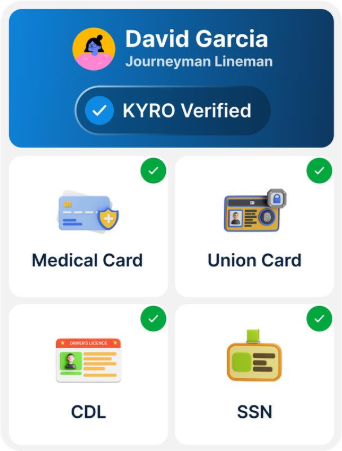
KYRO Verified

It signals that a lineman's profile is complete, current, and ready for immediate deployment consideration.

When a lineman holds KYRO Verified status:

  • Every required document has been submitted and validated
  • Expiration timelines are tracked and enforced automatically
  • Contractors can confirm readiness without manual review

The verification work does not restart with each storm call. It carries forward. What used to be checked under deadline pressure is already resolved in advance.

The Documents That Define Storm Deployment Readiness

Deployment eligibility depends on a complete and valid document set across three categories.

  • Identity and authorization: Medical Card, Social Security Number (SSN), UTN (Union Ticket Number), CDL or Driver's License or State ID
  • Financial and tax documentation: Voided Check, W-4 Form, I-9 Form, Direct Deposit Authorization (DDA)
  • Compliance: Policy Form acknowledgement

Each document supports a specific step in the deployment and payment chain.

The Medical Card confirms DOT physical compliance. without it, a lineman cannot legally operate commercial vehicles in the field. The UTN is required by most utilities for mutual aid credentialing under EEI mutual aid frameworks. The W-4 and I-9 are federal requirements that must be on file before payroll can be processed. Banking details determine whether payment routes correctly. A missing routing number is one of the most common causes of payment delays that linemen attribute to the contractor when the issue originated in their own submission.

Failure in any one of these areas stops progress downstream. Understanding the function of each document is what separates linemen who move through deployment without friction from those who repeatedly encounter delays.

How the KYRO Verified Process Works

Verification is embedded into the deployment workflow. It does not sit outside it. The process follows three stages aligned with how storm deployment actually happens.

Stage 1 — Storm Call Registration

When a storm call is issued, the lineman registers through the KYRO mobile app.

If the profile is already verified: Linemen will be storm ready in 2 clicks. Accept storm call and confirm availability. No data re-entry. No document upload.  

If the profile is new: documents are uploaded once. KYRO's AI extraction reads IDs, medical cards, and licenses automatically, reducing manual entry errors at the point of first submission.

Stage 2 — Availability and Eligibility Check

Once registered, the system validates the profile in real time.

Documents are checked for completeness. Credentials are cross-referenced. Expiration timelines are evaluated. Any issue is surfaced immediately with a specific instruction and not a generic alert.  

"Medical Card expires in 14 days. Update required before the next deployment."

The correction happens before the roster is built. Not after.

Stage 3 — Work Readiness Confirmation

Before final rostering, the system runs a last validation pass. Profiles that clear all checks are marked KYRO Verified for the event.

Contractors see this status directly on the roster board. No calls. No manual verification. No delay. This is where time is saved during the narrow window where roster decisions are made.

Where Most Storm Restoration Deployment Failures Actually Happen

Credential expiration is rarely discovered early. It surfaces at the point of exclusion. A CDL lapses between events. A medical card expires during the off-season. An OSHA certification runs out weeks for before the next call.

None of these failures are intentional. They are the result of managing multiple renewal cycles without a centralized system to track them.

By the time the issue is identified, the roster is already submitted. De-rostering happens. The slot fills. And the deployment is gone.

According to EEI's 2024 mutual aid operational guidelines, utilities require credential verification before any mutual aid lineman begins work. And that verification happens at roster submission, not on arrival at the staging area.

KYRO Verified changes when detection happens. Instead of discovering expired credentials at de-roster, the system flags them weeks in advance, when they can still be renewed without affecting deployment eligibility.

From Documentation to Payment

Payment delays are often treated as downstream problems. In practice, they originate upstream. A contractor cannot process payroll or generate a clean invoice if the underlying records are inconsistent.

Common failure points:  

  • SSN mismatches that trigger payroll holds,  
  • missing W-4 forms that block tax compliance,  
  • incorrect banking details that cause failed deposits.

Each issue adds a correction cycle. Each cycle adds time.

In 2024, slow payments cost the U.S. construction and utility contractor sector $280 billion and 82% of contractors reported more payment delays than two years prior, with documentation errors cited as a primary contributing factor.

When documentation is validated before deployment, these delays do not occur. Payroll processes against clean records. Invoices generate without discrepancies. Payment follows the expected timeline.
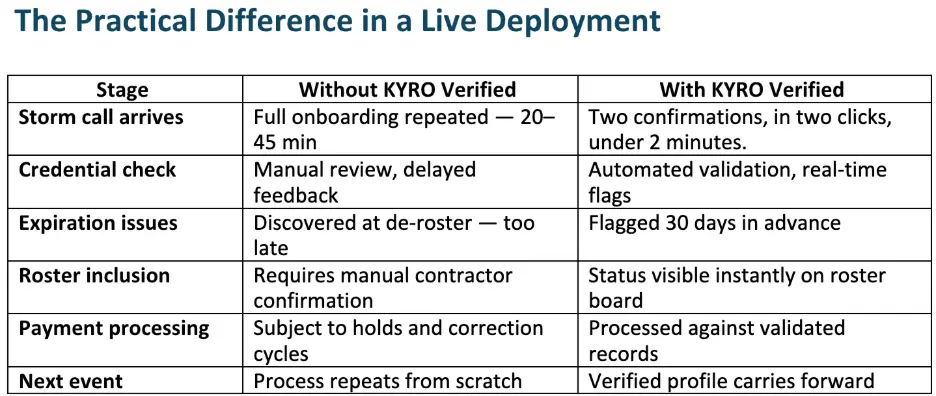
The Practical Difference in a Live Deployment

Before vs After KYRO Verified

Building and Maintaining Verified Status

Initial setup requires uploading and validating all required documents. This typically takes 10- 20 minutes. After that, the system maintains the status automatically.

Expiration timelines are tracked. Alerts are issued before credentials lapse. Updated documents are validated without restarting the process.

Verification is not repeated but maintained.

Over time, completed deployments become part of the profile, adding a record of validated participation, not just submitted documentation. After the first verified deployment, that history signals to contractors not just that the documents are in order, but that this person has been through a real event and the records held up.

Closing

Storm deployment rewards readiness, not intent.

The difference between getting storm deployed and getting passed over is often a single document that's expired, incomplete, or incorrect at the wrong moment.

KYRO Verified changes when that work happens. Documentation is completed before the storm, not during it. Verification is continuous, not reactive. Deployment decisions are based on availability, not paperwork.

By the time the call comes in, nothing needs to be fixed. Only confirmed.

For the full picture of the storm call process:  From first text message through roster confirmation

For how documentation completeness connects directly to payment speed: Storm Contractor Cash Flow: The Hidden Financial Cost →

Get KYRO Verified before the next storm call. Talk to us, today!

FAQ

Q: What is KYRO Verified for linemen?

KYRO Verified is a continuous compliance status confirming that all required documents are complete, current, and validated before a storm call arrives. Linemen with verified status get rostered faster, face fewer last-minute de-rosterings from expired credentials, and experience fewer payment delays caused by documentation errors upstream.

Q: What documents are required to become KYRO Verified?

KYRO Verified requires: Medical Card, SSN, UTN, CDL or Driver's License or State ID, Voided Check, W-4 Form, I-9 Form, Direct Deposit Authorization, and Policy Form acknowledgement. Documents are uploaded once, validated automatically, and monitored for expiration, so the lineman is alerted before credentials lapse rather than discovering the issue at de-rostering.

Q: Why do linemen get de-rostered at the last minute?

Most de-rosterings trace to credential expiration — a medical card, CDL, or OSHA certification that lapsed between events. Per IBEW 2024 workforce data, this is a leading cause of last-minute roster removals. KYRO Verified monitors expiration timelines continuously and sends proactive alerts weeks before credentials lapse, giving linemen time to renew without affecting eligibility.

Q: How does KYRO Verified affect payment speed?

Document errors like mismatched SSN entries, missing W-4s, incorrect bank routing numbers — are a primary cause of payment delays. KYRO Verified validates all payroll and tax records before deployment. Payroll processes against clean data. Invoices generate without correction flags. Payment moves on schedule rather than sitting in a documentation hold waiting for a record that should have been right.

Q: How long does it take to become KYRO Verified?

Initial profile setup, uploading and validating all nine required documents takes approximately 20 to 30 minutes for a first-time submission. After that, KYRO monitors expiration timelines automatically. Once verified, responding to subsequent storm calls takes under 2 minutes, two confirmations, no data re-entry, no document re-upload required.

Q: Does KYRO Verified carry forward to future deployments?

Yes. A verified profile persists across events and contractors within the KYRO network. No repeated onboarding is required. After the first verified deployment, the profile also carries real field deployment history — a signal to contractors that this person's records have been tested in a live event, not just submitted in advance.


Lineman Document Verification: How KYRO Verified Gets You Storm Deployed Faster and Paid Without Delays

April 20, 2026
3 min read
April 21, 2026
David Garcia
Product Manager
Author
David Garcia
Product Manager
Contributor
Srinivas N G
Product Manager

SUMMARY:

KYRO Verified is a continuous document verification status/ badge for linemen that validates credentials, compliance documents, and readiness before a storm call arrives, not after. Linemen with verified profiles get storm calls with sign up in 2 clicks, face fewer last-minute de-rosterings from expired credentials, and experience fewer payment delays from documentation errors. It replaces reactive compliance with a standing state of readiness.

Storm deployment is not limited by skill availability. It is limited by documentation readiness.

Two linemen with the same experience, same availability, and same intent to deploy will not move through the system at the same speed. One gets rostered immediately. The other waits. The difference is almost always compliance.

Expired credentials, mismatched records, incomplete forms - each one is a failure point in a process that does not allow time for correction.

IBEW storm-work guidance emphasizes strict roster notification, portability, and referral compliance, which helps explain why credential and paperwork issues can disrupt last-minute deployments.

KYRO Verified addresses that constraint. It establishes a standing state of readiness where documentation is already complete, validated, and current before a storm call arrives. The result is straightforward. Faster rostering. Fewer de-rosterings. Fewer payment delays tied to documentation errors.

What Is KYRO Verified?

KYRO Verified is not a one-time approval or a final step in onboarding. It is a continuous verification state.

KYRO Verified

It signals that a lineman's profile is complete, current, and ready for immediate deployment consideration.

When a lineman holds KYRO Verified status:

  • Every required document has been submitted and validated
  • Expiration timelines are tracked and enforced automatically
  • Contractors can confirm readiness without manual review

The verification work does not restart with each storm call. It carries forward. What used to be checked under deadline pressure is already resolved in advance.

The Documents That Define Storm Deployment Readiness

Deployment eligibility depends on a complete and valid document set across three categories.

  • Identity and authorization: Medical Card, Social Security Number (SSN), UTN (Union Ticket Number), CDL or Driver's License or State ID
  • Financial and tax documentation: Voided Check, W-4 Form, I-9 Form, Direct Deposit Authorization (DDA)
  • Compliance: Policy Form acknowledgement

Each document supports a specific step in the deployment and payment chain.

The Medical Card confirms DOT physical compliance. without it, a lineman cannot legally operate commercial vehicles in the field. The UTN is required by most utilities for mutual aid credentialing under EEI mutual aid frameworks. The W-4 and I-9 are federal requirements that must be on file before payroll can be processed. Banking details determine whether payment routes correctly. A missing routing number is one of the most common causes of payment delays that linemen attribute to the contractor when the issue originated in their own submission.

Failure in any one of these areas stops progress downstream. Understanding the function of each document is what separates linemen who move through deployment without friction from those who repeatedly encounter delays.

How the KYRO Verified Process Works

Verification is embedded into the deployment workflow. It does not sit outside it. The process follows three stages aligned with how storm deployment actually happens.

Stage 1 — Storm Call Registration

When a storm call is issued, the lineman registers through the KYRO mobile app.

If the profile is already verified: Linemen will be storm ready in 2 clicks. Accept storm call and confirm availability. No data re-entry. No document upload.  

If the profile is new: documents are uploaded once. KYRO's AI extraction reads IDs, medical cards, and licenses automatically, reducing manual entry errors at the point of first submission.

Stage 2 — Availability and Eligibility Check

Once registered, the system validates the profile in real time.

Documents are checked for completeness. Credentials are cross-referenced. Expiration timelines are evaluated. Any issue is surfaced immediately with a specific instruction and not a generic alert.  

"Medical Card expires in 14 days. Update required before the next deployment."

The correction happens before the roster is built. Not after.

Stage 3 — Work Readiness Confirmation

Before final rostering, the system runs a last validation pass. Profiles that clear all checks are marked KYRO Verified for the event.

Contractors see this status directly on the roster board. No calls. No manual verification. No delay. This is where time is saved during the narrow window where roster decisions are made.

Where Most Storm Restoration Deployment Failures Actually Happen

Credential expiration is rarely discovered early. It surfaces at the point of exclusion. A CDL lapses between events. A medical card expires during the off-season. An OSHA certification runs out weeks for before the next call.

None of these failures are intentional. They are the result of managing multiple renewal cycles without a centralized system to track them.

By the time the issue is identified, the roster is already submitted. De-rostering happens. The slot fills. And the deployment is gone.

According to EEI's 2024 mutual aid operational guidelines, utilities require credential verification before any mutual aid lineman begins work. And that verification happens at roster submission, not on arrival at the staging area.

KYRO Verified changes when detection happens. Instead of discovering expired credentials at de-roster, the system flags them weeks in advance, when they can still be renewed without affecting deployment eligibility.

From Documentation to Payment

Payment delays are often treated as downstream problems. In practice, they originate upstream. A contractor cannot process payroll or generate a clean invoice if the underlying records are inconsistent.

Common failure points:  

  • SSN mismatches that trigger payroll holds,  
  • missing W-4 forms that block tax compliance,  
  • incorrect banking details that cause failed deposits.

Each issue adds a correction cycle. Each cycle adds time.

In 2024, slow payments cost the U.S. construction and utility contractor sector $280 billion and 82% of contractors reported more payment delays than two years prior, with documentation errors cited as a primary contributing factor.

When documentation is validated before deployment, these delays do not occur. Payroll processes against clean records. Invoices generate without discrepancies. Payment follows the expected timeline.

The Practical Difference in a Live Deployment

Before vs After KYRO Verified

Building and Maintaining Verified Status

Initial setup requires uploading and validating all required documents. This typically takes 10- 20 minutes. After that, the system maintains the status automatically.

Expiration timelines are tracked. Alerts are issued before credentials lapse. Updated documents are validated without restarting the process.

Verification is not repeated but maintained.

Over time, completed deployments become part of the profile, adding a record of validated participation, not just submitted documentation. After the first verified deployment, that history signals to contractors not just that the documents are in order, but that this person has been through a real event and the records held up.

Closing

Storm deployment rewards readiness, not intent.

The difference between getting storm deployed and getting passed over is often a single document that's expired, incomplete, or incorrect at the wrong moment.

KYRO Verified changes when that work happens. Documentation is completed before the storm, not during it. Verification is continuous, not reactive. Deployment decisions are based on availability, not paperwork.

By the time the call comes in, nothing needs to be fixed. Only confirmed.

For the full picture of the storm call process:  From first text message through roster confirmation

For how documentation completeness connects directly to payment speed: Storm Contractor Cash Flow: The Hidden Financial Cost →

Get KYRO Verified before the next storm call. Talk to us, today!

FAQ

Q: What is KYRO Verified for linemen?

KYRO Verified is a continuous compliance status confirming that all required documents are complete, current, and validated before a storm call arrives. Linemen with verified status get rostered faster, face fewer last-minute de-rosterings from expired credentials, and experience fewer payment delays caused by documentation errors upstream.

Q: What documents are required to become KYRO Verified?

KYRO Verified requires: Medical Card, SSN, UTN, CDL or Driver's License or State ID, Voided Check, W-4 Form, I-9 Form, Direct Deposit Authorization, and Policy Form acknowledgement. Documents are uploaded once, validated automatically, and monitored for expiration, so the lineman is alerted before credentials lapse rather than discovering the issue at de-rostering.

Q: Why do linemen get de-rostered at the last minute?

Most de-rosterings trace to credential expiration — a medical card, CDL, or OSHA certification that lapsed between events. Per IBEW 2024 workforce data, this is a leading cause of last-minute roster removals. KYRO Verified monitors expiration timelines continuously and sends proactive alerts weeks before credentials lapse, giving linemen time to renew without affecting eligibility.

Q: How does KYRO Verified affect payment speed?

Document errors like mismatched SSN entries, missing W-4s, incorrect bank routing numbers — are a primary cause of payment delays. KYRO Verified validates all payroll and tax records before deployment. Payroll processes against clean data. Invoices generate without correction flags. Payment moves on schedule rather than sitting in a documentation hold waiting for a record that should have been right.

Q: How long does it take to become KYRO Verified?

Initial profile setup, uploading and validating all nine required documents takes approximately 20 to 30 minutes for a first-time submission. After that, KYRO monitors expiration timelines automatically. Once verified, responding to subsequent storm calls takes under 2 minutes, two confirmations, no data re-entry, no document re-upload required.

Q: Does KYRO Verified carry forward to future deployments?

Yes. A verified profile persists across events and contractors within the KYRO network. No repeated onboarding is required. After the first verified deployment, the profile also carries real field deployment history — a signal to contractors that this person's records have been tested in a live event, not just submitted in advance.

David Garcia
Product Manager

David Garcia is a Product Manager at KYRO AI, where he leads the platform’s roadmap across Storm Restoration, Vegetation Management, and Construction Management. With a background in Customer Success, he brings a field-first perspective shaped by close work with crews and operators, focusing on building AI-driven technology—like StormShield and KORY—that works in real-world conditions.

Discover more related blogs.