
.jpg)
Storm damage restoration contractors lose revenue in four stages, but the root cause is usually the same. The work gets done. Crews show up. Poles go back up. Yet payments arrive late, come up short, or never arrive at all because there is a gap between what happened in the field and what can be proven when it's time to invoice.
30–90 Days is the standard payment terms for storm restoration invoices, while contractor field costs labor, lodging, equipment, and fuel are incurred the moment crews leave the staging yard. The financing gap between spending and receiving lasts weeks to months per event, and documentation disputes can extend it further.
Read more: KYRO AI invoice factoring analysis
Revenue leakage in storm damage restoration isn't random. It follows a predictable pattern across four stages, and most contractors are losing money at more than one of them simultaneously without realizing it.
When a major utility reviews contractor invoices after a storm, it isn't a spot check.
At large investor-owned utilities, the process is to perform a detailed line-by-line review of contractor invoices to verify compliance with contract terms and rate schedules before any payment is authorized.
Common rejection triggers include:
A rejected invoice doesn't just delay one line item. It delays the entire submission.
The utility's review clock resets, your accounting team spends days chasing down field supervisors who are already on another job, and a payment that might have arrived in 45 days arrives in 90.
The Real cost: Weeks of delayed cash flow, plus internal labor spent on invoice rework eats into margin before any money arrives.
When a utility issues a mutual aid callout, work assignments go to crews who are already verified. If your workers show up at a staging area with expired CDLs, missing OSHA cards, or union credentials that don't match the client's MSA requirements, the utility supervisor stops the work. The worker sits. The clock runs. And you as a contractor absorb the cost.
Credential delays typically cost a contractor one to three productive days per affected worker at the start of a deployment.
On a 20-person crew, even one day of credential-related stoppage across five workers represents 40 hours of labor cost with zero billable output to offset it. That loss compounds across events, because the same credential issue tends to recur until the underlying verification process is fixed.
The subtler version of this problem isn't the outright stoppage. It's the crew that mobilizes a day late because credential verification is being done manually while everyone else is already on the road. Late mobilization means fewer billable days on an event where rates and scope are fixed from the day the callout went out.
The Real Cost: Lost billable days at the front of every deployment where credential gaps exist, recurring at every event until the verification process changes.
Most storm damage contractor agreements carry Net-30 to Net-90 payment terms.
That's the baseline.
It means from the moment your crew sets foot in the staging yard, you are self-financing their labor, their lodging, their meals, their fuel, and their equipment for weeks before the utility owes you anything.
Consider a 3-week deployment with 80 crews. Labor alone, on a deployment of that size, runs into millions of dollars. Lodging, fuel, meals, and equipment staging can push that total significantly higher. Every one of those costs is incurred before your invoice is submitted, and every documentation dispute that delays payment extends your self-financing window beyond the already-long contractual terms.
The most dangerous part of this stage isn't the payment terms themselves. It's how payment term risk interacts with invoice quality.
A clean invoice submitted on day one of the billing cycle gets processed and paid inside the contract window. A disputed invoice that requires two revision cycles gets paid 30 to 60 days after that.
Meaning a Net-60 contract becomes a Net-120 reality. Contractors who don't distinguish between these two scenarios in their cash flow planning consistently run into working capital problems mid-season. This affects bid behavior, crew retention, and growth capacity.
The Real cost: The cost of paying for weeks of field work upfront is made even higher when documentation issues delay invoice approvals.
Storm damage restoration contractors rarely submit FEMA claims directly. But the utility that hired them does. The documentation those contractors provide (or fail to provide) determines how much of the total restoration cost the utility can include in its FEMA Public Assistance reimbursement request.
The most commonly missed reimbursable expenses in contractor invoices include:
When these costs aren't documented with the specificity FEMA requires like GPS-verified locations, daily expense records, receipts tied to specific work orders, they get excluded from the utility's reimbursement package entirely.
The contractor doesn't see this directly. But when a utility's reimbursement falls short because of documentation gaps in contractor records, the contractor's relationship with that utility suffers and future event assignments are at risk. The financial consequence is delayed but real.
The Real cost: Legitimate expenses are excluded from FEMA reimbursement because they weren't documented to the standard FEMA that auditors apply.
For more detail, see our full guide to FEMA reimbursement for utilities.
Understanding how utilities review invoices changes how contractors document work. The review isn't looking for loopholes. It's looking for compliance with the MSA rate schedule and for evidence that the billing reflects actual field activity.
Large utilities use dedicated cost finalization teams that check every invoice line against contract terms and rate schedules.
Work orders must be tied to specific, GPS-verifiable locations. Invoices with "northern district" as a location description fail review.
COIs, union cards, and worker certifications are verified against the MSA requirements. Discrepancies hold the entire invoice.
The documentation standard that clears payment on first submission is specific:
Storm damage restoration contractors who meet this standard routinely get paid faster, dispute less, and maintain better relationships with the utilities that keep calling them back.
COI and union ticket delays are usually the contractor's problem, not the utility's. Utilities require certificates of insurance naming them as additional insured before a contractor accesses the work site. If your COI hasn't been updated to reflect the current event, work stops. The same applies to union affiliation requirements in IBEW-represented territories. These are known requirements in every MSA.
Contractors who treat them as event-day surprises lose billable days every time.
Cash flow example — 80 crews, 3-week deployment
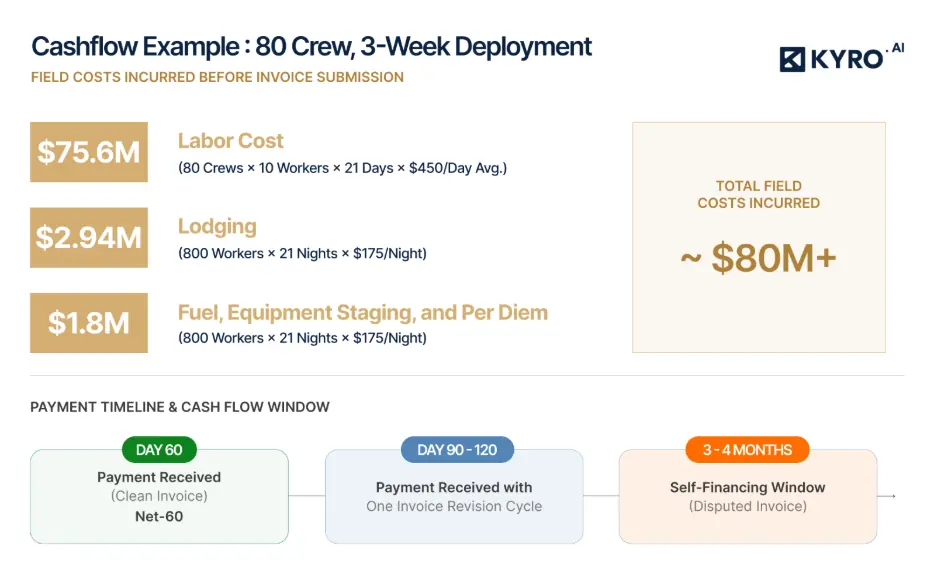
The cash flow math on large deployments is stark. It's why early payment access, whether through invoice factoring or platform-integrated early payment programs, changes not just cash position but bid behavior.
Contractors who get paid within days of submitting an invoice don't have to factor long payment delays into their pricing. Those who wait 90 days often have to charge more or accept lower profits.
Invoice factoring provides advance payment on submitted invoices, from a third-party financier who collects the full amount from the utility when it pays.
Platform-integrated early payment programs, like KYRO Capital, work differently: they are embedded in the same platform used for field documentation, so the invoice that clears documentation review can immediately flow into an accelerated payment request without additional administrative steps. Both solve the same fundamental cash flow problem. The difference is friction: factoring requires a separate relationship and process, while integrated programs work inside the contractor's existing operational flow.
For a deeper look at both, see our full comparison of storm contractor payment options.
The phrase "documentation habit" usually sounds like a compliance lecture. In storm damage restoration, it's a revenue protection strategy. Every item on the checklist below directly corresponds to a line item that utilities audit and a cost category that FEMA reviewers examine.
✓ Crew identification — per crew, per day Crew ID, supervisor name, every worker's name and employee ID for each day on site. Not estimated rosters — actual daily sign-in records.
✓ GPS-verified work location — per work order GPS coordinates or verified address for each location worked, tied to a unique work order. "Northern district" fails review. A coordinate does not.
✓ Time records — timestamped at the field level Start time, stop time, and meal break duration captured in real time, not filled in at the end of the day from memory. The timestamp must match field activity, not office entry time.
✓ Labor classification — at capture, not at billing Regular, overtime, and double-time hours classified correctly when the work is performed. Reclassifying at billing introduces errors that reviewers flag immediately.
✓ Equipment usage — by ID, operator, and work order Equipment ID, operator name, start and stop times, and the specific work order the equipment was assigned to. General "truck used on site" entries don't clear line-by-line review.
✓ Materials consumed — at point of use Material type, quantity, installation location, and work order, captured when materials are installed. Inventory withdrawal records alone are insufficient if they can't be tied to a specific work location.
✓ Reimbursable expenses — collected daily Lodging receipts, fuel receipts, meal per diem, and staging costs, organized daily with work order references. Reconstructing three weeks of receipts at event close is where FEMA-eligible costs regularly go missing.
✓ Photo evidence — GPS-tagged, before and after Photos with embedded GPS metadata for each work location, tied to the work order. Photo evidence is often the strongest documentation in a disputed invoice review because it is the hardest to fabricate retroactively.
The difference between capturing all of this on paper and capturing it digitally isn't just convenience. It's the difference between a record that has to be manually reconciled and entered before invoicing and a record that is already structured for billing the moment it is submitted.
KYRO AI's automated timesheet and expense capture removes the reconciliation step entirely: field data captured during the work day flows directly into the invoice package, with GPS verification, timestamps, and work order linkages already built in. What used to take a week of back-office work after an event close takes hours.
The contractors who protect their revenue in storm damage restoration aren't the ones who work harder. They're the ones who document better.
There is also an important distinction between documentation for utility payment and documentation for FEMA recovery. Utility invoice documentation needs to match the rate schedule in the MSA: correct labor classification, verified locations, signed timesheets. FEMA documentation needs to go further, it needs to establish that each cost was reasonable, necessary, and tied to eligible disaster-related work at a specific location.
Building a field capture process that satisfies both from the same data set is possible, but only if documentation is designed from the start to meet both standards.
See our full breakdown of how FEMA documentation requirements work for utilities and their contractors.
KYRO AI captures GPS-verified timesheets, equipment logs, expense records, and photo documentation automatically from the field, so every invoice you submit is already structured, verified, and ready for utility line-item review.
See how KYRO AI protects contractor revenue →
How do storm damage restoration contractors get paid?
Storm damage restoration contractors submit invoices to utilities against a Master Service Agreement or mutual aid agreement rate schedule. A utility cost finalization team reviews those invoices line by line for compliance before authorizing payment. Terms are typically Net-30 to Net-90, meaning contractors finance their field costs out of pocket for weeks to months before the first payment arrives.
Why do storm contractors not get paid on time?
The most common causes are invoices rejected on first submission due to missing or incorrect documentation, disputes requiring back-and-forth with the utility's audit team, credential verification delays that reduce billable deployment days, and standard Net-60 or Net-90 payment terms that apply regardless of how quickly work was completed. First-submission invoice clearance is the single most controllable variable.
What documentation do utilities require for storm contractor invoice payment?
Utilities typically require signed daily timesheets with hours by employee and labor classification, GPS-verified work locations tied to work orders, equipment usage logs with operator identification and time records, material usage tied to installation locations, valid certificates of insurance and verified worker credentials, and lodging and expense receipts for reimbursable costs. Line-by-line review against contract terms is standard at major utilities.
Can storm restoration contractors recover expenses from FEMA?
Contractor costs can be included in a utility's FEMA Public Assistance claim, provided the documentation meets FEMA's specificity requirements. The most commonly missed reimbursable expenses are lodging and per diem for out-of-state crews, equipment staging and mobilization costs, fuel, and indirect management costs. Missing field-level documentation is the primary reason these costs go unclaimed.

Storm damage restoration contractors lose revenue in four stages, but the root cause is usually the same. The work gets done. Crews show up. Poles go back up. Yet payments arrive late, come up short, or never arrive at all because there is a gap between what happened in the field and what can be proven when it's time to invoice.
30–90 Days is the standard payment terms for storm restoration invoices, while contractor field costs labor, lodging, equipment, and fuel are incurred the moment crews leave the staging yard. The financing gap between spending and receiving lasts weeks to months per event, and documentation disputes can extend it further.
Read more: KYRO AI invoice factoring analysis
Revenue leakage in storm damage restoration isn't random. It follows a predictable pattern across four stages, and most contractors are losing money at more than one of them simultaneously without realizing it.
When a major utility reviews contractor invoices after a storm, it isn't a spot check.
At large investor-owned utilities, the process is to perform a detailed line-by-line review of contractor invoices to verify compliance with contract terms and rate schedules before any payment is authorized.
Common rejection triggers include:
A rejected invoice doesn't just delay one line item. It delays the entire submission.
The utility's review clock resets, your accounting team spends days chasing down field supervisors who are already on another job, and a payment that might have arrived in 45 days arrives in 90.
The Real cost: Weeks of delayed cash flow, plus internal labor spent on invoice rework eats into margin before any money arrives.
When a utility issues a mutual aid callout, work assignments go to crews who are already verified. If your workers show up at a staging area with expired CDLs, missing OSHA cards, or union credentials that don't match the client's MSA requirements, the utility supervisor stops the work. The worker sits. The clock runs. And you as a contractor absorb the cost.
Credential delays typically cost a contractor one to three productive days per affected worker at the start of a deployment.
On a 20-person crew, even one day of credential-related stoppage across five workers represents 40 hours of labor cost with zero billable output to offset it. That loss compounds across events, because the same credential issue tends to recur until the underlying verification process is fixed.
The subtler version of this problem isn't the outright stoppage. It's the crew that mobilizes a day late because credential verification is being done manually while everyone else is already on the road. Late mobilization means fewer billable days on an event where rates and scope are fixed from the day the callout went out.
The Real Cost: Lost billable days at the front of every deployment where credential gaps exist, recurring at every event until the verification process changes.
Most storm damage contractor agreements carry Net-30 to Net-90 payment terms.
That's the baseline.
It means from the moment your crew sets foot in the staging yard, you are self-financing their labor, their lodging, their meals, their fuel, and their equipment for weeks before the utility owes you anything.
Consider a 3-week deployment with 80 crews. Labor alone, on a deployment of that size, runs into millions of dollars. Lodging, fuel, meals, and equipment staging can push that total significantly higher. Every one of those costs is incurred before your invoice is submitted, and every documentation dispute that delays payment extends your self-financing window beyond the already-long contractual terms.
The most dangerous part of this stage isn't the payment terms themselves. It's how payment term risk interacts with invoice quality.
A clean invoice submitted on day one of the billing cycle gets processed and paid inside the contract window. A disputed invoice that requires two revision cycles gets paid 30 to 60 days after that.
Meaning a Net-60 contract becomes a Net-120 reality. Contractors who don't distinguish between these two scenarios in their cash flow planning consistently run into working capital problems mid-season. This affects bid behavior, crew retention, and growth capacity.
The Real cost: The cost of paying for weeks of field work upfront is made even higher when documentation issues delay invoice approvals.
Storm damage restoration contractors rarely submit FEMA claims directly. But the utility that hired them does. The documentation those contractors provide (or fail to provide) determines how much of the total restoration cost the utility can include in its FEMA Public Assistance reimbursement request.
The most commonly missed reimbursable expenses in contractor invoices include:
When these costs aren't documented with the specificity FEMA requires like GPS-verified locations, daily expense records, receipts tied to specific work orders, they get excluded from the utility's reimbursement package entirely.
The contractor doesn't see this directly. But when a utility's reimbursement falls short because of documentation gaps in contractor records, the contractor's relationship with that utility suffers and future event assignments are at risk. The financial consequence is delayed but real.
The Real cost: Legitimate expenses are excluded from FEMA reimbursement because they weren't documented to the standard FEMA that auditors apply.
For more detail, see our full guide to FEMA reimbursement for utilities.
Understanding how utilities review invoices changes how contractors document work. The review isn't looking for loopholes. It's looking for compliance with the MSA rate schedule and for evidence that the billing reflects actual field activity.
Large utilities use dedicated cost finalization teams that check every invoice line against contract terms and rate schedules.
Work orders must be tied to specific, GPS-verifiable locations. Invoices with "northern district" as a location description fail review.
COIs, union cards, and worker certifications are verified against the MSA requirements. Discrepancies hold the entire invoice.
The documentation standard that clears payment on first submission is specific:
Storm damage restoration contractors who meet this standard routinely get paid faster, dispute less, and maintain better relationships with the utilities that keep calling them back.
COI and union ticket delays are usually the contractor's problem, not the utility's. Utilities require certificates of insurance naming them as additional insured before a contractor accesses the work site. If your COI hasn't been updated to reflect the current event, work stops. The same applies to union affiliation requirements in IBEW-represented territories. These are known requirements in every MSA.
Contractors who treat them as event-day surprises lose billable days every time.
Cash flow example — 80 crews, 3-week deployment

The cash flow math on large deployments is stark. It's why early payment access, whether through invoice factoring or platform-integrated early payment programs, changes not just cash position but bid behavior.
Contractors who get paid within days of submitting an invoice don't have to factor long payment delays into their pricing. Those who wait 90 days often have to charge more or accept lower profits.
Invoice factoring provides advance payment on submitted invoices, from a third-party financier who collects the full amount from the utility when it pays.
Platform-integrated early payment programs, like KYRO Capital, work differently: they are embedded in the same platform used for field documentation, so the invoice that clears documentation review can immediately flow into an accelerated payment request without additional administrative steps. Both solve the same fundamental cash flow problem. The difference is friction: factoring requires a separate relationship and process, while integrated programs work inside the contractor's existing operational flow.
For a deeper look at both, see our full comparison of storm contractor payment options.
The phrase "documentation habit" usually sounds like a compliance lecture. In storm damage restoration, it's a revenue protection strategy. Every item on the checklist below directly corresponds to a line item that utilities audit and a cost category that FEMA reviewers examine.
✓ Crew identification — per crew, per day Crew ID, supervisor name, every worker's name and employee ID for each day on site. Not estimated rosters — actual daily sign-in records.
✓ GPS-verified work location — per work order GPS coordinates or verified address for each location worked, tied to a unique work order. "Northern district" fails review. A coordinate does not.
✓ Time records — timestamped at the field level Start time, stop time, and meal break duration captured in real time, not filled in at the end of the day from memory. The timestamp must match field activity, not office entry time.
✓ Labor classification — at capture, not at billing Regular, overtime, and double-time hours classified correctly when the work is performed. Reclassifying at billing introduces errors that reviewers flag immediately.
✓ Equipment usage — by ID, operator, and work order Equipment ID, operator name, start and stop times, and the specific work order the equipment was assigned to. General "truck used on site" entries don't clear line-by-line review.
✓ Materials consumed — at point of use Material type, quantity, installation location, and work order, captured when materials are installed. Inventory withdrawal records alone are insufficient if they can't be tied to a specific work location.
✓ Reimbursable expenses — collected daily Lodging receipts, fuel receipts, meal per diem, and staging costs, organized daily with work order references. Reconstructing three weeks of receipts at event close is where FEMA-eligible costs regularly go missing.
✓ Photo evidence — GPS-tagged, before and after Photos with embedded GPS metadata for each work location, tied to the work order. Photo evidence is often the strongest documentation in a disputed invoice review because it is the hardest to fabricate retroactively.
The difference between capturing all of this on paper and capturing it digitally isn't just convenience. It's the difference between a record that has to be manually reconciled and entered before invoicing and a record that is already structured for billing the moment it is submitted.
KYRO AI's automated timesheet and expense capture removes the reconciliation step entirely: field data captured during the work day flows directly into the invoice package, with GPS verification, timestamps, and work order linkages already built in. What used to take a week of back-office work after an event close takes hours.
The contractors who protect their revenue in storm damage restoration aren't the ones who work harder. They're the ones who document better.
There is also an important distinction between documentation for utility payment and documentation for FEMA recovery. Utility invoice documentation needs to match the rate schedule in the MSA: correct labor classification, verified locations, signed timesheets. FEMA documentation needs to go further, it needs to establish that each cost was reasonable, necessary, and tied to eligible disaster-related work at a specific location.
Building a field capture process that satisfies both from the same data set is possible, but only if documentation is designed from the start to meet both standards.
See our full breakdown of how FEMA documentation requirements work for utilities and their contractors.
KYRO AI captures GPS-verified timesheets, equipment logs, expense records, and photo documentation automatically from the field, so every invoice you submit is already structured, verified, and ready for utility line-item review.
See how KYRO AI protects contractor revenue →
How do storm damage restoration contractors get paid?
Storm damage restoration contractors submit invoices to utilities against a Master Service Agreement or mutual aid agreement rate schedule. A utility cost finalization team reviews those invoices line by line for compliance before authorizing payment. Terms are typically Net-30 to Net-90, meaning contractors finance their field costs out of pocket for weeks to months before the first payment arrives.
Why do storm contractors not get paid on time?
The most common causes are invoices rejected on first submission due to missing or incorrect documentation, disputes requiring back-and-forth with the utility's audit team, credential verification delays that reduce billable deployment days, and standard Net-60 or Net-90 payment terms that apply regardless of how quickly work was completed. First-submission invoice clearance is the single most controllable variable.
What documentation do utilities require for storm contractor invoice payment?
Utilities typically require signed daily timesheets with hours by employee and labor classification, GPS-verified work locations tied to work orders, equipment usage logs with operator identification and time records, material usage tied to installation locations, valid certificates of insurance and verified worker credentials, and lodging and expense receipts for reimbursable costs. Line-by-line review against contract terms is standard at major utilities.
Can storm restoration contractors recover expenses from FEMA?
Contractor costs can be included in a utility's FEMA Public Assistance claim, provided the documentation meets FEMA's specificity requirements. The most commonly missed reimbursable expenses are lodging and per diem for out-of-state crews, equipment staging and mobilization costs, fuel, and indirect management costs. Missing field-level documentation is the primary reason these costs go unclaimed.

Rabiya Farheen is a content strategist and a writer who loves turning complex ideas into clear, meaningful stories, especially in the world of utility, tech, AI, and B2B SaaS. She works closely with growing teams to create content that doesn’t just check SEO boxes, but actually helps people understand what a product does and why it matters. With a knack for research and a curiosity that never quits, Rabiya dives deep into industry trends, customer pain points, and data to craft content that feels super helpful and informative. When she’s not writing, she’s probably reading, painting, and exploring her creative side— or you'll find her hustling around for social causes, especially those that empower girls and women.