How Utilities Protect FEMA Storm Reimbursement Claims

June 9, 2026
4 min read

By the KYRO AI Operations Team, drawn from direct experience supporting electric utilities and contractors through major storm restoration and FEMA Public Assistance claims across the country.

FEMA Public Assistance reimburses utilities for emergency protective measures (Category B) and permanent repairs (Category F) following a presidentially declared disaster. But reimbursement doesn't hinge on what you did during the storm.  

It hinges on what you documented while you did it. Documentation errors made in the field, not at filing, are the leading cause of Public Assistance denials.  
Many utility executives learn too late that FEMA reimbursement is not won during the application process. It is won or lost in the field. FEMA won't tell you what was wrong until they deny the claim. By that point, missing timesheets, incomplete equipment logs, undocumented contractor activities, and poorly organized work orders cannot be recreated with the certainty, FEMA expects.

In this blog, let’s understand what FEMA actually covers for electric utilities, what field documentation must look like to survive review, and the platform-level changes that separate organizations that get paid from those that get audited.
What FEMA Public Assistance Actually Covers for Electric Utilities

Permanent work public assistance  - FEMA
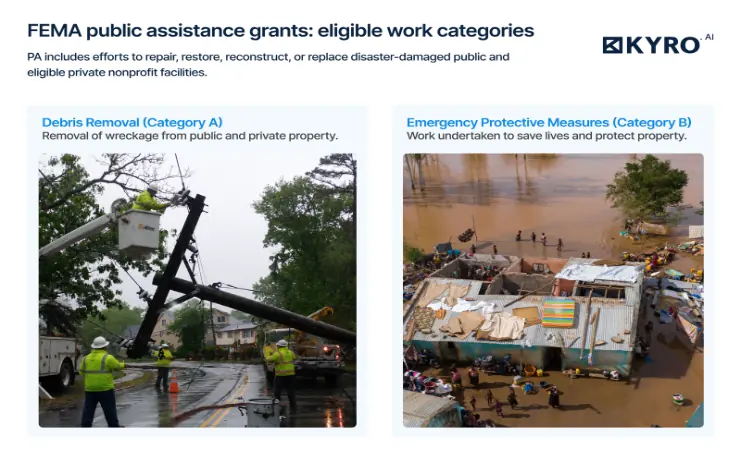
FEMA public assistance grants - Category A and Category B

The FEMA Public Assistance (PA) Program helps eligible public organizations and certain nonprofit utilities recover costs after a presidentially declared disaster. Understanding the distinction between Category B and Category F is the foundation of any utility reimbursement strategy.

Permanent work public assistance  - FEMA
Permanent work public assistance

Category B: Emergency Protective Measures

Category B covers actions taken to eliminate immediate threats to life, public health, and public safety. For electric utilities, this typically includes emergency power restoration activities, hazard mitigation during response operations, temporary repairs to restore critical services, and certain mutual aid activities supporting emergency restoration.  

The determining factor is urgency. Category B work addresses immediate threats rather than permanently restoring infrastructure.  

Category F: Permanent Utility Infrastructure Restoration

Category F covers permanent restoration and repair of damaged utility infrastructure. Eligible work can include pole replacements, conductor replacement, substation repairs, distribution system restoration, and transmission infrastructure repair. Category F claims typically involve larger dollar amounts and more extensive documentation requirements precisely because they concern permanent infrastructure recovery rather than emergency response. FEMA PAPPG

Four Eligibility Tests Every Cost Must Pass

A common misconception is that any necessary restoration cost is reimbursable. FEMA applies four independent tests to every claim, and all four must be satisfied:
  • Applicant eligibility — is the entity eligible to receive PA funding?
  • Facility eligibility — is the damaged asset an eligible facility?
  • Work eligibility — was the work required as a result of the declared incident?
  • Cost eligibility — were the costs reasonable, necessary, and properly documented?

Why FEMA Reimbursement Is Won or Lost in the Field

Most FEMA reimbursement failures are not application failures. They are field documentation failures. By the time finance teams begin assembling reimbursement packages, the damage to the claim has already been done weeks or months earlier.

FEMA consistently favors documentation records created as work happens over reconstructed records assembled after the fact. The reason is straightforward: real-time records are more reliable, more specific, and significantly harder to challenge.  
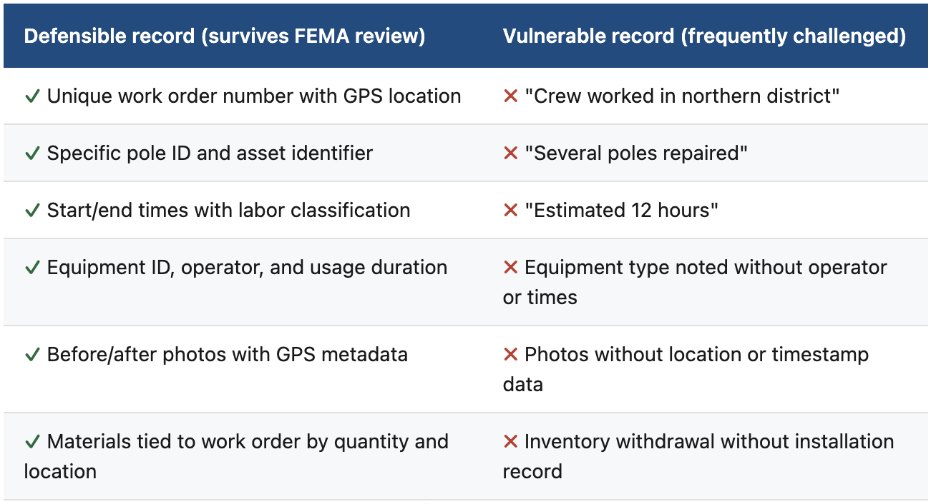
Defensible record vs vulnerable record - FEMA

The Michigan 2025 Ice Storm: What $155M in Recovery Costs Teaches Us

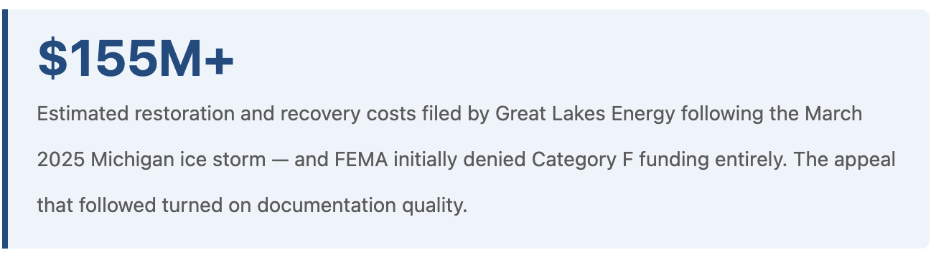
The March 2025 Michigan ice storm is one of the clearest recent examples of the financial stakes involved in FEMA documentation. Great Lakes Energy estimated restoration and recovery costs exceeding $155 million following the catastrophic event, dramatically larger than any previous storm in the cooperative's history. FEMA initially denied Category F funding for permanent utility repairs. Michigan subsequently filed a formal appeal.

The lesson from that case is not whether the appeal ultimately succeeded. The lesson is that documentation remains the foundation of every appeal. No appeal can overcome missing evidence. The utilities that emerge from major events with full reimbursement are the ones that built their documentation system before the storm, not during it.

Building an Audit-Ready Documentation Process During the Event

The best FEMA reimbursement strategy begins before the first crew leaves the yard. Below is the practical framework leading utilities implement during storm response. And the one that produces defensible documentation when FEMA reviewers come knocking.  

For a deeper look at how this connects to the overall storm response lifecycle, see our guide on storm restoration vs. storm response.

  • 1. Structure every work order to tell a complete story

Each work order must capture a unique work order number, GPS location, asset identifier, damage description, labor hours, equipment usage, material consumption, contractor involvement, and supporting photos. If an auditor reads the work order two years later, they should understand exactly what happened without additional explanation.

  • 2. Separate labor by activity type from day one

Utilities must distinguish between regular labor, overtime labor, mutual aid labor, contractor labor, emergency work, and permanent repair work. Mixing categories creates confusion and directly complicates FEMA reimbursement reviews. Reviewers expect clean cost separation aligned with Category B and Category F boundaries.

  • 3. Track equipment usage with equipment ID precision

Equipment documentation must include equipment ID, operator name, start and stop times, work location, and associated work order number. FEMA publishes equipment rate schedules that reviewers use when evaluating reimbursement requests. Accurate equipment tracking lets utilities match their costs to those schedules defensibly. FEMA Equipment Rates

  • 4. Capture materials at point of use, not at inventory withdrawal

Record material type, quantity used, installation location, and associated work order at the moment of installation. This creates a direct chain between inventory consumption and eligible work — a chain that FEMA reviewers can follow without gaps. Common challenged materials include poles, transformers, crossarms, conductors, and hardware.

  • 5. Document mutual aid continuously, not at demobilization

Mutual aid often represents the largest single restoration expense, sometimes 60–80% of total labor costs during catastrophic events. Utilities should collect crew rosters, labor records, equipment logs, invoices, lodging expenses, and fuel receipts throughout the event. Many reimbursement consultants recommend invoice reconciliation on a recurring basis during extended events to prevent documentation gaps from accumulating.  

See our related guide: storm damage assessment and documentation for restoration professionals.

  • 6. Maintain contemporaneous records — the longer you wait, the weaker the evidence

Contemporaneous records provide greater credibility, stronger audit support, reduced reimbursement disputes, and faster claim processing. This is the primary reason leading utilities have moved away from paper-based systems toward digital field platforms.  

See how real-time field data accuracy directly affects claim defensibility.

What to Configure in Your Field Platform Before Storm Season

The worst time to design a documentation process is during a major outage. Storm readiness must include documentation readiness. And that means configuring your field platform before the season begins, not after the first weather alert.  

For a full breakdown of what to look for in a storm operations platform, see our 2026 storm response management software buyer's guide.

Mandatory data fields that eliminate incomplete records

  • GPS location on every work order and photo
  • Crew identification linked to labor entries
  • Equipment assignment with usage times
  • Labor classification (regular, overtime, mutual aid, contractor)
  • Work category (Category B emergency vs. Category F permanent)
  • Asset number tied to facility records
  • Automatic timestamp on all submissions

Photo standards that support FEMA claims

Photos should include date and time metadata, GPS coordinates, asset identification where possible, and both before-condition and after-condition evidence. Photos with automatic metadata are among the strongest forms of supporting documentation because they visually connect work performed to damaged infrastructure, and they're nearly impossible to challenge if captured in real time. See our storm response safety checklists for a practical field documentation framework.

Cost coding configured before the first storm call

Every restoration activity should map to predefined cost codes covering emergency work, permanent work, internal labor, contractor labor, equipment, materials, and mutual aid. Preconfigured cost structures dramatically reduce post-event reconciliation efforts — and ensure clean Category B vs. Category F separation from day one.
KYRO AI Stormshield management

Understanding "Reasonable and Prudent" — FEMA's Most Common Disallowance Standard

One of FEMA's recurring eligibility tests is whether actions and costs were reasonable and necessary given the scope of the disaster. In practice, reviewers ask: Was the labor required? Was the equipment necessary? Were contractor rates competitive? Were materials actually installed at the claimed location? Can costs be directly tied to disaster-related activities?

Utilities that cannot answer these questions with contemporaneous documentation often face delays, cost reductions, or outright denials. The "reasonable and prudent" standard is subjective — which means the quality of your supporting documentation is the primary variable that determines how a reviewer applies it. FEMA PAPPG v5.0

The Appeal Process: What to Do When FEMA Denies a Claim

Even well-documented claims can encounter challenges. Understanding the appeals process before you need it is critical.

  • First appeal

Applicants generally have 60 days after receiving FEMA's determination to submit a first appeal. The appeal should include detailed justification, supporting documentation, cost validation, and a direct response to each specific reason for denial. The objective is not to add new claims — it is to address FEMA's stated concerns with evidence that was either missing from the original submission or not properly presented.

  • Second appeal

If the first appeal is unsuccessful, applicants may pursue a second appeal through FEMA's established process. Second appeals require even more rigorous documentation and often benefit from legal or professional claims support. The Michigan Category F case demonstrates that even large, well-resourced utilities operating under extreme circumstances face the full appeals process, documentation quality remains the deciding factor at every stage.

Working with FEMA Regional Offices

Many PA determinations are resolved through FEMA regional structures before escalating to formal appeals. Utilities that maintain organized documentation repositories, consistent communication records, clear cost allocation methodologies, and audit-ready supporting evidence often resolve reviewers' questions before they become formal disputes.  

Why CFOs and Emergency Managers Need to Treat Documentation Like Restoration Work

Storm restoration and FEMA reimbursement are often treated as separate activities managed by separate teams. They are not. The reimbursement process begins the moment the first crew is dispatched, and every hour of undocumented work is a dollar at risk.

For CFOs, documentation protects financial recovery. For emergency managers, it protects operational credibility. For ratepayers, it protects them from absorbing costs that should have been reimbursed by the federal program they fund through taxes.
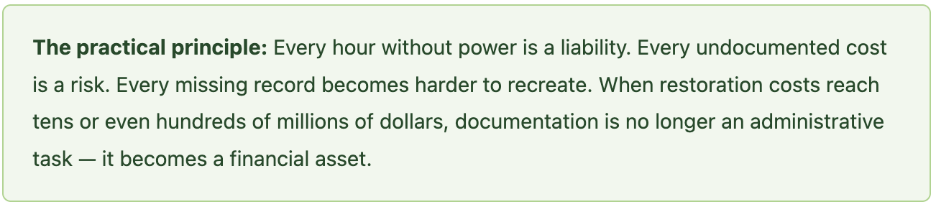
The most successful utilities build reimbursement readiness into their storm response process before the event begins. That means configured field platforms, mandatory data fields, trained crews, and a documentation culture that treats every work order as a future FEMA exhibit.  

For a broader look at how digital field operations support this from mobilization through closeout, see our guide on utility digital transformation and closing the field-to-office gap.

Frequently Asked Questions

How does a utility get FEMA reimbursement after a storm?

A utility must document eligible labor, equipment, materials, contractor costs, and work locations in real time during a presidentially declared disaster. The utility then submits those costs through the FEMA Public Assistance process for review and reimbursement. Documentation must be contemporaneous, records created weeks after the event are significantly harder to defend and frequently result in reduced or denied reimbursements. FEMA Public Assistance overview →  

What is the difference between FEMA Category B and Category F for utilities?

Category B covers emergency protective measures taken immediately to address threats to life and public safety — such as emergency power restoration and temporary hazard mitigation. Category F covers permanent restoration and repair of damaged utility infrastructure, including pole replacements, conductor replacement, and substation repairs. Category F claims involve larger dollar amounts and require more extensive documentation because they concern permanent infrastructure recovery, not emergency response.  

What is the most common reason FEMA denies utility reimbursement claims?

Documentation deficiencies are the leading cause of FEMA reimbursement denials. Missing labor records, incomplete equipment logs, costs that cannot be tied directly to eligible disaster activities, and insufficient proof of work performed are the most common gaps. A legitimate restoration activity can be denied entirely if the supporting documentation doesn't meet FEMA's contemporaneous evidence standard.  

Does FEMA reimburse mutual aid costs for electric utilities?

Mutual aid costs may be eligible when properly documented and tied directly to eligible disaster-related work. Utilities should maintain detailed labor records, equipment logs, lodging and fuel receipts, and invoices throughout the event — not just at demobilization. After catastrophic events, mutual aid can represent 60–80% of total restoration labor costs, making it one of the highest-value documentation priorities.  

What happens if FEMA denies a utility's Category F claim?

Applicants typically have 60 days to submit a first appeal after receiving FEMA's determination. The appeal must include detailed justification, supporting documentation, and direct responses to each reason for denial. If unsuccessful, a second appeal may be pursued. As the 2025 Michigan ice storm case demonstrated, even large utilities with catastrophic costs face full appeals scrutiny — documentation quality is the deciding factor at every stage.  

What field documentation does a utility need for a FEMA audit?

A defensible FEMA audit package includes: GPS-verified work locations, unique work order numbers, labor records with hours by employee and activity type, equipment IDs with operator and usage times, material quantities tied to installation locations, contractor invoices, mutual aid crew rosters, before/after photos with metadata, and timestamped safety records. Electronic records with automatic audit trails are substantially more defensible than paper logs, particularly two or more years after the event.  

How long should utilities retain FEMA documentation?

Utilities should retain all documentation in accordance with FEMA requirements and organizational records policies — typically several years after final grant closeout to support audits and future reviews. Electronic records with automatic timestamps are significantly easier to maintain, organize, and produce on demand compared to paper-based systems.  

How Utilities Protect FEMA Storm Reimbursement Claims

June 9, 2026
4 min read
June 10, 2026
Rabiya Farheen
Content Strategist
Author
Rabiya Farheen
Content Strategist

By the KYRO AI Operations Team, drawn from direct experience supporting electric utilities and contractors through major storm restoration and FEMA Public Assistance claims across the country.

FEMA Public Assistance reimburses utilities for emergency protective measures (Category B) and permanent repairs (Category F) following a presidentially declared disaster. But reimbursement doesn't hinge on what you did during the storm.  

It hinges on what you documented while you did it. Documentation errors made in the field, not at filing, are the leading cause of Public Assistance denials.  

Many utility executives learn too late that FEMA reimbursement is not won during the application process. It is won or lost in the field. FEMA won't tell you what was wrong until they deny the claim. By that point, missing timesheets, incomplete equipment logs, undocumented contractor activities, and poorly organized work orders cannot be recreated with the certainty, FEMA expects.

In this blog, let’s understand what FEMA actually covers for electric utilities, what field documentation must look like to survive review, and the platform-level changes that separate organizations that get paid from those that get audited.

What FEMA Public Assistance Actually Covers for Electric Utilities

Permanent work public assistance  - FEMA
FEMA public assistance grants - Category A and Category B

The FEMA Public Assistance (PA) Program helps eligible public organizations and certain nonprofit utilities recover costs after a presidentially declared disaster. Understanding the distinction between Category B and Category F is the foundation of any utility reimbursement strategy.

Permanent work public assistance  - FEMA
Permanent work public assistance

Category B: Emergency Protective Measures

Category B covers actions taken to eliminate immediate threats to life, public health, and public safety. For electric utilities, this typically includes emergency power restoration activities, hazard mitigation during response operations, temporary repairs to restore critical services, and certain mutual aid activities supporting emergency restoration.  

The determining factor is urgency. Category B work addresses immediate threats rather than permanently restoring infrastructure.  

Category F: Permanent Utility Infrastructure Restoration

Category F covers permanent restoration and repair of damaged utility infrastructure. Eligible work can include pole replacements, conductor replacement, substation repairs, distribution system restoration, and transmission infrastructure repair. Category F claims typically involve larger dollar amounts and more extensive documentation requirements precisely because they concern permanent infrastructure recovery rather than emergency response. FEMA PAPPG

Four Eligibility Tests Every Cost Must Pass

A common misconception is that any necessary restoration cost is reimbursable. FEMA applies four independent tests to every claim, and all four must be satisfied:

  • Applicant eligibility — is the entity eligible to receive PA funding?
  • Facility eligibility — is the damaged asset an eligible facility?
  • Work eligibility — was the work required as a result of the declared incident?
  • Cost eligibility — were the costs reasonable, necessary, and properly documented?

Why FEMA Reimbursement Is Won or Lost in the Field

Most FEMA reimbursement failures are not application failures. They are field documentation failures. By the time finance teams begin assembling reimbursement packages, the damage to the claim has already been done weeks or months earlier.

FEMA consistently favors documentation records created as work happens over reconstructed records assembled after the fact. The reason is straightforward: real-time records are more reliable, more specific, and significantly harder to challenge.  

Defensible record vs vulnerable record - FEMA

The Michigan 2025 Ice Storm: What $155M in Recovery Costs Teaches Us

The March 2025 Michigan ice storm is one of the clearest recent examples of the financial stakes involved in FEMA documentation. Great Lakes Energy estimated restoration and recovery costs exceeding $155 million following the catastrophic event, dramatically larger than any previous storm in the cooperative's history. FEMA initially denied Category F funding for permanent utility repairs. Michigan subsequently filed a formal appeal.

The lesson from that case is not whether the appeal ultimately succeeded. The lesson is that documentation remains the foundation of every appeal. No appeal can overcome missing evidence. The utilities that emerge from major events with full reimbursement are the ones that built their documentation system before the storm, not during it.

Building an Audit-Ready Documentation Process During the Event

The best FEMA reimbursement strategy begins before the first crew leaves the yard. Below is the practical framework leading utilities implement during storm response. And the one that produces defensible documentation when FEMA reviewers come knocking.  

For a deeper look at how this connects to the overall storm response lifecycle, see our guide on storm restoration vs. storm response.

  • 1. Structure every work order to tell a complete story

Each work order must capture a unique work order number, GPS location, asset identifier, damage description, labor hours, equipment usage, material consumption, contractor involvement, and supporting photos. If an auditor reads the work order two years later, they should understand exactly what happened without additional explanation.

  • 2. Separate labor by activity type from day one

Utilities must distinguish between regular labor, overtime labor, mutual aid labor, contractor labor, emergency work, and permanent repair work. Mixing categories creates confusion and directly complicates FEMA reimbursement reviews. Reviewers expect clean cost separation aligned with Category B and Category F boundaries.

  • 3. Track equipment usage with equipment ID precision

Equipment documentation must include equipment ID, operator name, start and stop times, work location, and associated work order number. FEMA publishes equipment rate schedules that reviewers use when evaluating reimbursement requests. Accurate equipment tracking lets utilities match their costs to those schedules defensibly. FEMA Equipment Rates

  • 4. Capture materials at point of use, not at inventory withdrawal

Record material type, quantity used, installation location, and associated work order at the moment of installation. This creates a direct chain between inventory consumption and eligible work — a chain that FEMA reviewers can follow without gaps. Common challenged materials include poles, transformers, crossarms, conductors, and hardware.

  • 5. Document mutual aid continuously, not at demobilization

Mutual aid often represents the largest single restoration expense, sometimes 60–80% of total labor costs during catastrophic events. Utilities should collect crew rosters, labor records, equipment logs, invoices, lodging expenses, and fuel receipts throughout the event. Many reimbursement consultants recommend invoice reconciliation on a recurring basis during extended events to prevent documentation gaps from accumulating.  

See our related guide: storm damage assessment and documentation for restoration professionals.

  • 6. Maintain contemporaneous records — the longer you wait, the weaker the evidence

Contemporaneous records provide greater credibility, stronger audit support, reduced reimbursement disputes, and faster claim processing. This is the primary reason leading utilities have moved away from paper-based systems toward digital field platforms.  

See how real-time field data accuracy directly affects claim defensibility.

What to Configure in Your Field Platform Before Storm Season

The worst time to design a documentation process is during a major outage. Storm readiness must include documentation readiness. And that means configuring your field platform before the season begins, not after the first weather alert.  

For a full breakdown of what to look for in a storm operations platform, see our 2026 storm response management software buyer's guide.

Mandatory data fields that eliminate incomplete records

  • GPS location on every work order and photo
  • Crew identification linked to labor entries
  • Equipment assignment with usage times
  • Labor classification (regular, overtime, mutual aid, contractor)
  • Work category (Category B emergency vs. Category F permanent)
  • Asset number tied to facility records
  • Automatic timestamp on all submissions

Photo standards that support FEMA claims

Photos should include date and time metadata, GPS coordinates, asset identification where possible, and both before-condition and after-condition evidence. Photos with automatic metadata are among the strongest forms of supporting documentation because they visually connect work performed to damaged infrastructure, and they're nearly impossible to challenge if captured in real time. See our storm response safety checklists for a practical field documentation framework.

Cost coding configured before the first storm call

Every restoration activity should map to predefined cost codes covering emergency work, permanent work, internal labor, contractor labor, equipment, materials, and mutual aid. Preconfigured cost structures dramatically reduce post-event reconciliation efforts — and ensure clean Category B vs. Category F separation from day one.

KYRO AI Stormshield management

Understanding "Reasonable and Prudent" — FEMA's Most Common Disallowance Standard

One of FEMA's recurring eligibility tests is whether actions and costs were reasonable and necessary given the scope of the disaster. In practice, reviewers ask: Was the labor required? Was the equipment necessary? Were contractor rates competitive? Were materials actually installed at the claimed location? Can costs be directly tied to disaster-related activities?

Utilities that cannot answer these questions with contemporaneous documentation often face delays, cost reductions, or outright denials. The "reasonable and prudent" standard is subjective — which means the quality of your supporting documentation is the primary variable that determines how a reviewer applies it. FEMA PAPPG v5.0

The Appeal Process: What to Do When FEMA Denies a Claim

Even well-documented claims can encounter challenges. Understanding the appeals process before you need it is critical.

  • First appeal

Applicants generally have 60 days after receiving FEMA's determination to submit a first appeal. The appeal should include detailed justification, supporting documentation, cost validation, and a direct response to each specific reason for denial. The objective is not to add new claims — it is to address FEMA's stated concerns with evidence that was either missing from the original submission or not properly presented.

  • Second appeal

If the first appeal is unsuccessful, applicants may pursue a second appeal through FEMA's established process. Second appeals require even more rigorous documentation and often benefit from legal or professional claims support. The Michigan Category F case demonstrates that even large, well-resourced utilities operating under extreme circumstances face the full appeals process, documentation quality remains the deciding factor at every stage.

Working with FEMA Regional Offices

Many PA determinations are resolved through FEMA regional structures before escalating to formal appeals. Utilities that maintain organized documentation repositories, consistent communication records, clear cost allocation methodologies, and audit-ready supporting evidence often resolve reviewers' questions before they become formal disputes.  

Why CFOs and Emergency Managers Need to Treat Documentation Like Restoration Work

Storm restoration and FEMA reimbursement are often treated as separate activities managed by separate teams. They are not. The reimbursement process begins the moment the first crew is dispatched, and every hour of undocumented work is a dollar at risk.

For CFOs, documentation protects financial recovery. For emergency managers, it protects operational credibility. For ratepayers, it protects them from absorbing costs that should have been reimbursed by the federal program they fund through taxes.

The most successful utilities build reimbursement readiness into their storm response process before the event begins. That means configured field platforms, mandatory data fields, trained crews, and a documentation culture that treats every work order as a future FEMA exhibit.  

For a broader look at how digital field operations support this from mobilization through closeout, see our guide on utility digital transformation and closing the field-to-office gap.

Frequently Asked Questions

How does a utility get FEMA reimbursement after a storm?

A utility must document eligible labor, equipment, materials, contractor costs, and work locations in real time during a presidentially declared disaster. The utility then submits those costs through the FEMA Public Assistance process for review and reimbursement. Documentation must be contemporaneous, records created weeks after the event are significantly harder to defend and frequently result in reduced or denied reimbursements. FEMA Public Assistance overview →  

What is the difference between FEMA Category B and Category F for utilities?

Category B covers emergency protective measures taken immediately to address threats to life and public safety — such as emergency power restoration and temporary hazard mitigation. Category F covers permanent restoration and repair of damaged utility infrastructure, including pole replacements, conductor replacement, and substation repairs. Category F claims involve larger dollar amounts and require more extensive documentation because they concern permanent infrastructure recovery, not emergency response.  

What is the most common reason FEMA denies utility reimbursement claims?

Documentation deficiencies are the leading cause of FEMA reimbursement denials. Missing labor records, incomplete equipment logs, costs that cannot be tied directly to eligible disaster activities, and insufficient proof of work performed are the most common gaps. A legitimate restoration activity can be denied entirely if the supporting documentation doesn't meet FEMA's contemporaneous evidence standard.  

Does FEMA reimburse mutual aid costs for electric utilities?

Mutual aid costs may be eligible when properly documented and tied directly to eligible disaster-related work. Utilities should maintain detailed labor records, equipment logs, lodging and fuel receipts, and invoices throughout the event — not just at demobilization. After catastrophic events, mutual aid can represent 60–80% of total restoration labor costs, making it one of the highest-value documentation priorities.  

What happens if FEMA denies a utility's Category F claim?

Applicants typically have 60 days to submit a first appeal after receiving FEMA's determination. The appeal must include detailed justification, supporting documentation, and direct responses to each reason for denial. If unsuccessful, a second appeal may be pursued. As the 2025 Michigan ice storm case demonstrated, even large utilities with catastrophic costs face full appeals scrutiny — documentation quality is the deciding factor at every stage.  

What field documentation does a utility need for a FEMA audit?

A defensible FEMA audit package includes: GPS-verified work locations, unique work order numbers, labor records with hours by employee and activity type, equipment IDs with operator and usage times, material quantities tied to installation locations, contractor invoices, mutual aid crew rosters, before/after photos with metadata, and timestamped safety records. Electronic records with automatic audit trails are substantially more defensible than paper logs, particularly two or more years after the event.  

How long should utilities retain FEMA documentation?

Utilities should retain all documentation in accordance with FEMA requirements and organizational records policies — typically several years after final grant closeout to support audits and future reviews. Electronic records with automatic timestamps are significantly easier to maintain, organize, and produce on demand compared to paper-based systems.  

Rabiya Farheen
Content Strategist

Rabiya Farheen is a content strategist and a writer who loves turning complex ideas into clear, meaningful stories, especially in the world of utility, tech, AI, and B2B SaaS. She works closely with growing teams to create content that doesn’t just check SEO boxes, but actually helps people understand what a product does and why it matters. With a knack for research and a curiosity that never quits, Rabiya dives deep into industry trends, customer pain points, and data to craft content that feels super helpful and informative. When she’s not writing, she’s probably reading, painting, and exploring her creative side— or you'll find her hustling around for social causes, especially those that empower girls and women.

Discover more related blogs.