.jpg)
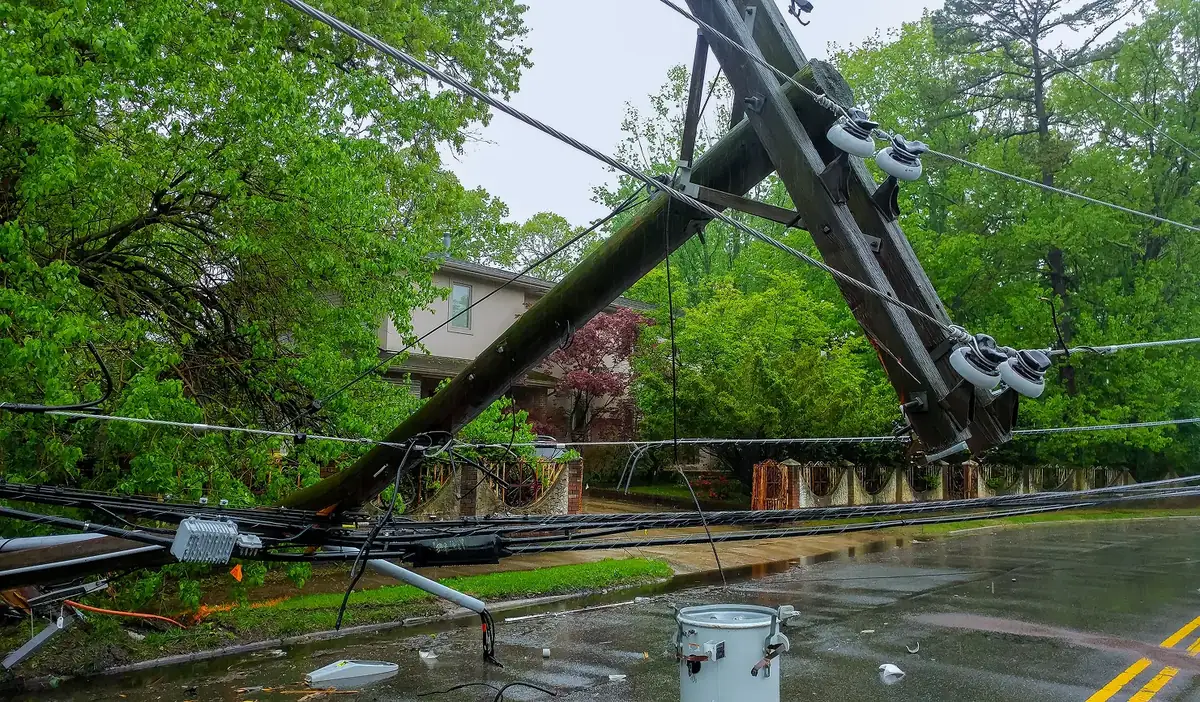
ETR is not a customer service problem. It is a field data problem. Every inaccurate estimated time to restoration issued during a major outage event traces back to the same root cause: the utility did not have a verified picture of damage scope, crew location, and circuit status when it issued the estimate. What the customer received was not an ETR. It was a guess dressed up as one.
After Hurricane Beryl, regulators in Texas stopped treating that distinction as a matter of good practice. They started treating it as a compliance failure.
Estimated Time to Restoration is the projected date and time by which a specific customer or circuit will have power restored following an outage. On the surface, it looks like a customer service metric. A figure to post on the outage tracker. A number to give callers. In practice, it is something considerably more significant.
ETR accuracy touches four separate areas of utility operations simultaneously: customer trust, regulatory compliance, storm cost recovery, and legal exposure. Get it right and it is invisible. But if you get it wrong, it becomes the organizing document for an investigation.
After major outages, regulators do not just examine how long restoration took. They examine what was communicated to customers and when. They examine whether those communications were grounded in actual field data or were generated by a model running on incomplete inputs. They examine whether ETR updates were issued as conditions changed. And they examine whether the utility had the operational systems in place to produce accurate ETR in the first place.
That last question is the one most utilities are unprepared to answer. Because producing accurate ETR requires real-time field data, and most utilities still collect damage information in ways that introduce hours of lag between what is happening on the ground and what the outage management system knows about it.
The core problem in plain terms: A damage assessor on the ground sees a downed transmission line feeding four distribution feeders. That information needs to reach OMS, get translated into affected customers and circuits, be matched against crew availability and travel time, and flow into a customer-facing ETR.
In paper-based or radio-based field capture systems, that chain takes hours. In digital real-time systems, like the one that KYRO AI has, it takes just a few minutes. The ETR accuracy gap is mostly a data latency problem.
Utilities that publish ETR without all four of the following inputs are publishing estimates that will fail under any serious scrutiny, regulatory or otherwise.
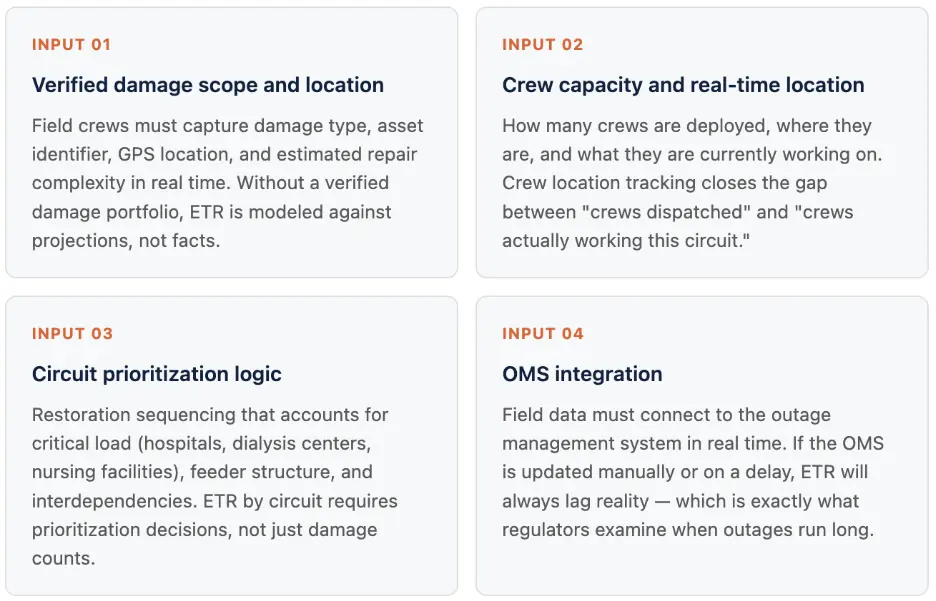
Most utilities have the OMS. Many have the circuit prioritization logic. The gap that consistently produces ETR failures is the damage data input: how long it takes for verified field damage information to reach the systems that calculate restoration time. The connection between field data accuracy and operational outcomes is direct, and ETR is one of the clearest examples of it.

Hurricane Beryl made landfall near Houston on July 8, 2024. It was a Category 1 storm at landfall, having weakened from a peak of Category 5 in the Caribbean. For most utilities, a Category 1 event is a manageable restoration scenario. What Beryl revealed at CenterPoint was not a Category 1 restoration problem. It was an operational readiness problem that had been building before the storm arrived.
A major derecho knocks out CenterPoint's outage tracker. The system is not restored before Beryl strikes six weeks later.
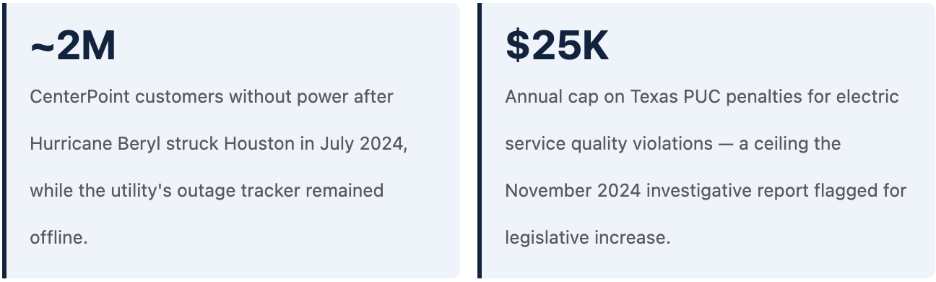
Beryl makes landfall. Approximately 2 million CenterPoint customers lose power. With the outage tracker still offline, customers have no way to check ETR status or confirm whether their outage has been logged.
As restoration stretches into its second week, public and political pressure intensifies. The Texas PUC launches a formal investigation. The Texas Attorney General opens a separate probe. Governor Abbott threatens to reduce CenterPoint's service territory.
The PUC publishes its investigative report. It identifies ETR communication failures as a major focus, recommends a consumer right to speak with a human representative who can provide accurate restoration estimates, and flags the $25,000 annual penalty cap for legislative increase.
The CenterPoint case matters because it made explicit what regulators had been moving toward for years: ETR is not an aspiration. It is an operational obligation. CenterPoint repeatedly acknowledged the communication failures in its meetings with the PUC and with customers, pledging to do better. That pledge came after the fact. The time to build accurate ETR capability is before the storm, not during the investigation that follows it.
Regulatory requirements around ETR vary significantly by state, but the post-Beryl trajectory points clearly toward increased specificity and enforcement across all major hurricane-exposure jurisdictions.
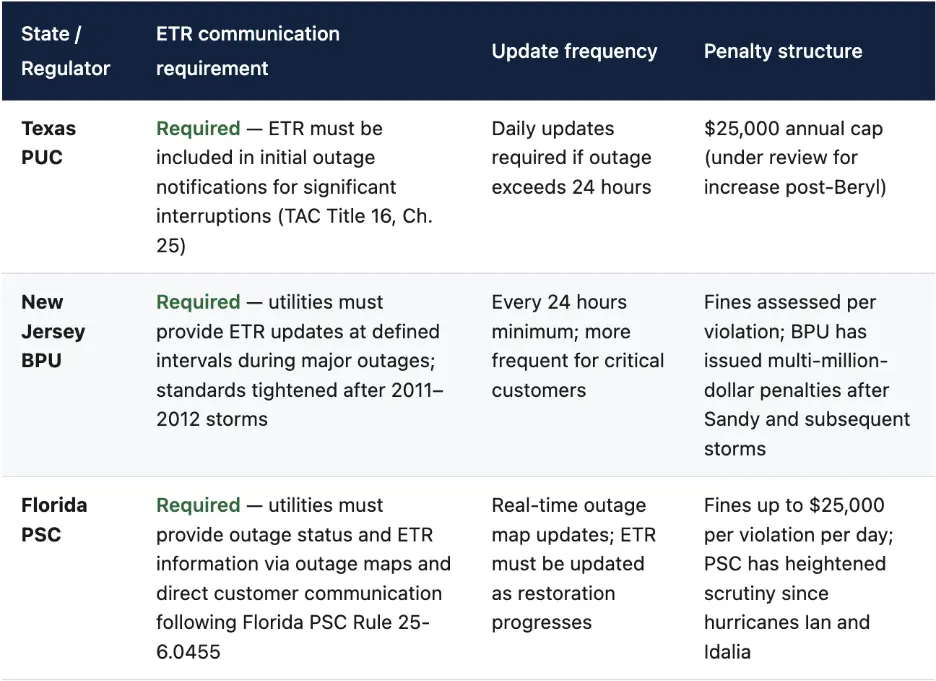
The common thread across all three states is that regulators no longer treat ETR as a customer satisfaction metric. They treat it as a service reliability obligation with enforcement teeth. And in all three states, the standard is not just that ETR be provided — it is that ETR be accurate and updated as field conditions change.
That requirement is impossible to meet without real-time field data flowing into the OMS.
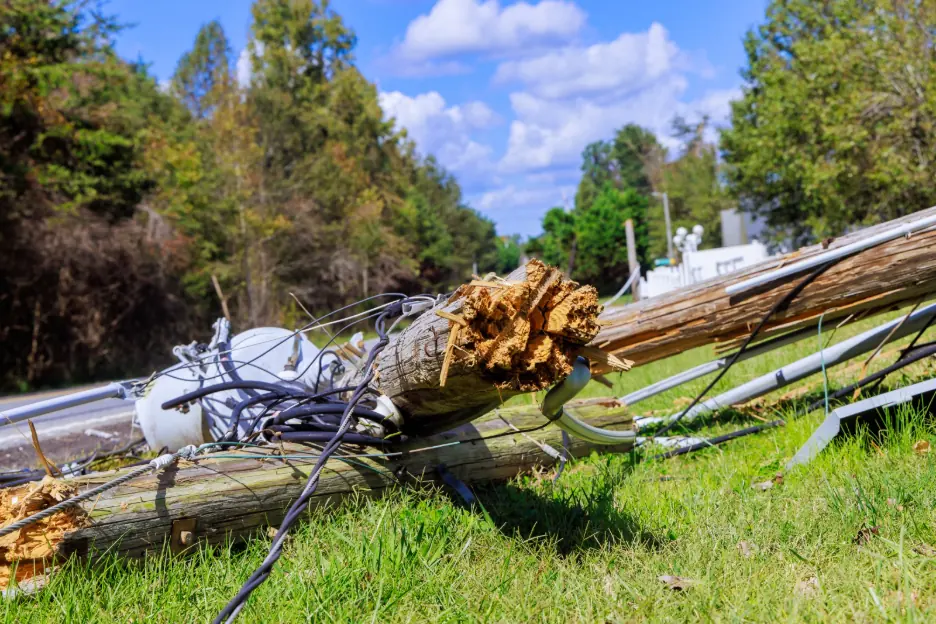
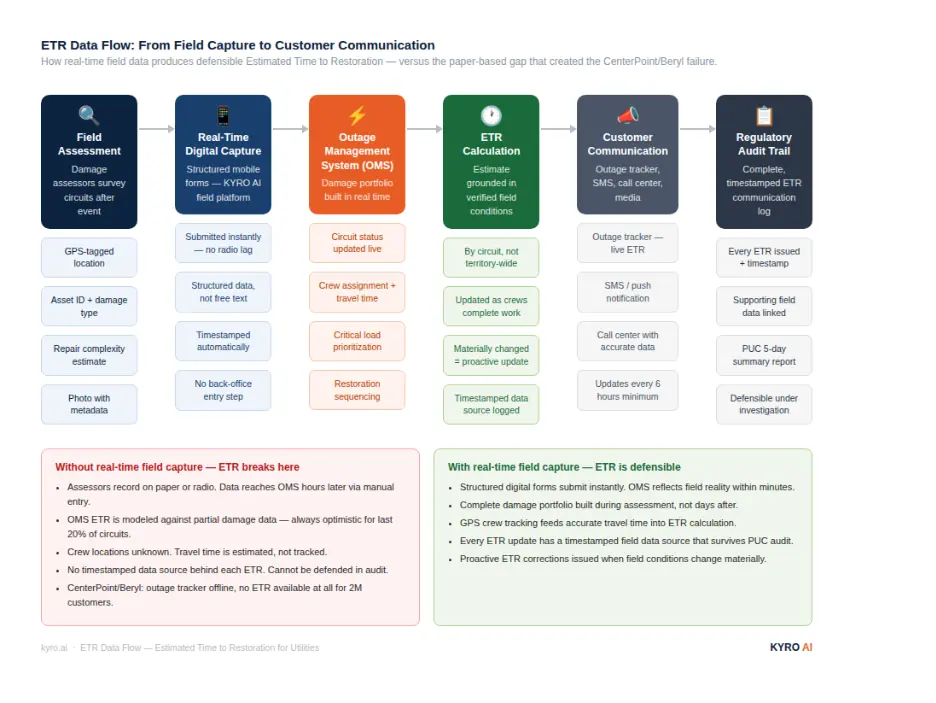
Here is what the ETR data chain looks like when field capture is real-time versus when it is not.
Without real-time field capture
A damage assessor surveys a three-mile stretch of downed wire and damaged poles. They record findings on paper or call them in via radio. Hours later, those findings are entered into OMS by a back-office operator who is simultaneously processing calls from six other assessors. The ETR that OMS generates is based on incomplete data, weighted toward the damage already logged rather than the total damage portfolio. Customers in the last 20% of affected circuits receive ETR estimates that are consistently too optimistic, because their damage has not reached the system yet.
With real-time field capture
The same assessor submits a digital damage form from a mobile device. GPS coordinates are embedded automatically. The damage type, asset identifier, and estimated repair time are captured in a structured format that feeds directly into OMS without a manual entry step. The ETR OMS produces reflects actual field conditions within minutes of assessment, not hours. As new assessments come in, the ETR updates. As crews complete repairs, their status updates in real time and the ETR for remaining customers adjusts accordingly.
This is the operational difference KYRO AI's real-time field capture creates. When every damage assessor and field crew is capturing structured data in real time through a mobile platform, the ETR your OMS generates is grounded in verified field conditions.
When crew hours are tracked and visible from the first hours of an event, restoration progress is measurable rather than estimated. The ETR becomes a calculation, not a guess.
After Beryl, several state regulators began requesting ETR communication logs as part of post-event reporting. The question they ask is not just whether ETR was provided, but whether ETR was accurate, and whether it was updated when the field picture changed.
A defensible ETR communication protocol needs to answer all three questions with documented evidence.
See how FEMA documentation requirements follow the same logic in our FEMA reimbursement guide for utilities.
The common mistake that makes all five steps fail: Building the ETR communication protocol without first fixing the field data pipeline. A perfect communication protocol backed by incomplete or delayed field data still produces inaccurate ETR. The protocol and the data infrastructure have to be built together. Neither alone is sufficient.
KYRO AI's field capture platform gives damage assessors structured mobile forms with GPS verification, feeds assessment data directly into OMS, and generates the timestamped documentation trail that backs up every ETR for your utility issues.
From first assessment to final restoration record, the data chain is complete and defensible.
See how KYRO AI supports ETR accuracy →
Frequently Asked Questions
What is Estimated Time to Restoration (ETR) for utilities?
ETR is the projected date and time by which power will be restored to a specific customer or circuit following an outage. Accurate ETR requires real-time damage data, crew capacity and location, circuit prioritization logic, and OMS integration. Without verified field data, ETR is an estimate in name only.
What does accurate ETR calculation require?
Four inputs working together in real time: verified damage scope and location from field crews, available crew capacity matched against the damage portfolio, circuit prioritization logic accounting for critical load, and OMS integration that translates field data into customer-facing time estimates. Remove any one of these and ETR accuracy degrades significantly.
What happened with CenterPoint and ETR during Hurricane Beryl?
Beryl struck Houston in July 2024 while CenterPoint's outage tracker remained offline after a May derecho. With roughly 2 million customers without power and no way to check ETR, customer outrage prompted a Texas PUC investigation, a Texas AG probe, and a November 2024 PUC report recommending legislative fixes to ETR communication requirements. The $25,000 annual penalty cap was flagged for increase.
How does real-time field data improve ETR accuracy?
ETR accuracy is fundamentally a field data latency problem. When damage assessors capture structured, GPS-verified data in real time via mobile platforms, that data reaches OMS within minutes rather than hours. The ETR OMS generates reflects actual field conditions, updates as crews complete work, and can be documented with timestamped evidence if regulators ask how it was calculated.
What are Texas PUC's ETR requirements for utilities?
Under TAC Title 16, Chapter 25, Texas utilities must include an estimated time of full restoration in initial outage notifications for significant interruptions. Outages lasting more than 24 hours require daily ETR updates. Within five working days of restoration, utilities must submit a summary report including cause, affected facilities, customer counts, and the full restoration timeline. Post-Beryl recommendations may expand these requirements legislatively.

ETR is not a customer service problem. It is a field data problem. Every inaccurate estimated time to restoration issued during a major outage event traces back to the same root cause: the utility did not have a verified picture of damage scope, crew location, and circuit status when it issued the estimate. What the customer received was not an ETR. It was a guess dressed up as one.
After Hurricane Beryl, regulators in Texas stopped treating that distinction as a matter of good practice. They started treating it as a compliance failure.

Estimated Time to Restoration is the projected date and time by which a specific customer or circuit will have power restored following an outage. On the surface, it looks like a customer service metric. A figure to post on the outage tracker. A number to give callers. In practice, it is something considerably more significant.
ETR accuracy touches four separate areas of utility operations simultaneously: customer trust, regulatory compliance, storm cost recovery, and legal exposure. Get it right and it is invisible. But if you get it wrong, it becomes the organizing document for an investigation.
After major outages, regulators do not just examine how long restoration took. They examine what was communicated to customers and when. They examine whether those communications were grounded in actual field data or were generated by a model running on incomplete inputs. They examine whether ETR updates were issued as conditions changed. And they examine whether the utility had the operational systems in place to produce accurate ETR in the first place.
That last question is the one most utilities are unprepared to answer. Because producing accurate ETR requires real-time field data, and most utilities still collect damage information in ways that introduce hours of lag between what is happening on the ground and what the outage management system knows about it.
The core problem in plain terms: A damage assessor on the ground sees a downed transmission line feeding four distribution feeders. That information needs to reach OMS, get translated into affected customers and circuits, be matched against crew availability and travel time, and flow into a customer-facing ETR.
In paper-based or radio-based field capture systems, that chain takes hours. In digital real-time systems, like the one that KYRO AI has, it takes just a few minutes. The ETR accuracy gap is mostly a data latency problem.

Utilities that publish ETR without all four of the following inputs are publishing estimates that will fail under any serious scrutiny, regulatory or otherwise.

Most utilities have the OMS. Many have the circuit prioritization logic. The gap that consistently produces ETR failures is the damage data input: how long it takes for verified field damage information to reach the systems that calculate restoration time. The connection between field data accuracy and operational outcomes is direct, and ETR is one of the clearest examples of it.

Hurricane Beryl made landfall near Houston on July 8, 2024. It was a Category 1 storm at landfall, having weakened from a peak of Category 5 in the Caribbean. For most utilities, a Category 1 event is a manageable restoration scenario. What Beryl revealed at CenterPoint was not a Category 1 restoration problem. It was an operational readiness problem that had been building before the storm arrived.
A major derecho knocks out CenterPoint's outage tracker. The system is not restored before Beryl strikes six weeks later.
Beryl makes landfall. Approximately 2 million CenterPoint customers lose power. With the outage tracker still offline, customers have no way to check ETR status or confirm whether their outage has been logged.
As restoration stretches into its second week, public and political pressure intensifies. The Texas PUC launches a formal investigation. The Texas Attorney General opens a separate probe. Governor Abbott threatens to reduce CenterPoint's service territory.
The PUC publishes its investigative report. It identifies ETR communication failures as a major focus, recommends a consumer right to speak with a human representative who can provide accurate restoration estimates, and flags the $25,000 annual penalty cap for legislative increase.
The CenterPoint case matters because it made explicit what regulators had been moving toward for years: ETR is not an aspiration. It is an operational obligation. CenterPoint repeatedly acknowledged the communication failures in its meetings with the PUC and with customers, pledging to do better. That pledge came after the fact. The time to build accurate ETR capability is before the storm, not during the investigation that follows it.
Regulatory requirements around ETR vary significantly by state, but the post-Beryl trajectory points clearly toward increased specificity and enforcement across all major hurricane-exposure jurisdictions.

The common thread across all three states is that regulators no longer treat ETR as a customer satisfaction metric. They treat it as a service reliability obligation with enforcement teeth. And in all three states, the standard is not just that ETR be provided — it is that ETR be accurate and updated as field conditions change.
That requirement is impossible to meet without real-time field data flowing into the OMS.

Here is what the ETR data chain looks like when field capture is real-time versus when it is not.
Without real-time field capture
A damage assessor surveys a three-mile stretch of downed wire and damaged poles. They record findings on paper or call them in via radio. Hours later, those findings are entered into OMS by a back-office operator who is simultaneously processing calls from six other assessors. The ETR that OMS generates is based on incomplete data, weighted toward the damage already logged rather than the total damage portfolio. Customers in the last 20% of affected circuits receive ETR estimates that are consistently too optimistic, because their damage has not reached the system yet.
With real-time field capture
The same assessor submits a digital damage form from a mobile device. GPS coordinates are embedded automatically. The damage type, asset identifier, and estimated repair time are captured in a structured format that feeds directly into OMS without a manual entry step. The ETR OMS produces reflects actual field conditions within minutes of assessment, not hours. As new assessments come in, the ETR updates. As crews complete repairs, their status updates in real time and the ETR for remaining customers adjusts accordingly.
This is the operational difference KYRO AI's real-time field capture creates. When every damage assessor and field crew is capturing structured data in real time through a mobile platform, the ETR your OMS generates is grounded in verified field conditions.
When crew hours are tracked and visible from the first hours of an event, restoration progress is measurable rather than estimated. The ETR becomes a calculation, not a guess.

After Beryl, several state regulators began requesting ETR communication logs as part of post-event reporting. The question they ask is not just whether ETR was provided, but whether ETR was accurate, and whether it was updated when the field picture changed.
A defensible ETR communication protocol needs to answer all three questions with documented evidence.
See how FEMA documentation requirements follow the same logic in our FEMA reimbursement guide for utilities.
The common mistake that makes all five steps fail: Building the ETR communication protocol without first fixing the field data pipeline. A perfect communication protocol backed by incomplete or delayed field data still produces inaccurate ETR. The protocol and the data infrastructure have to be built together. Neither alone is sufficient.
KYRO AI's field capture platform gives damage assessors structured mobile forms with GPS verification, feeds assessment data directly into OMS, and generates the timestamped documentation trail that backs up every ETR for your utility issues.
From first assessment to final restoration record, the data chain is complete and defensible.
See how KYRO AI supports ETR accuracy →
Frequently Asked Questions
What is Estimated Time to Restoration (ETR) for utilities?
ETR is the projected date and time by which power will be restored to a specific customer or circuit following an outage. Accurate ETR requires real-time damage data, crew capacity and location, circuit prioritization logic, and OMS integration. Without verified field data, ETR is an estimate in name only.
What does accurate ETR calculation require?
Four inputs working together in real time: verified damage scope and location from field crews, available crew capacity matched against the damage portfolio, circuit prioritization logic accounting for critical load, and OMS integration that translates field data into customer-facing time estimates. Remove any one of these and ETR accuracy degrades significantly.
What happened with CenterPoint and ETR during Hurricane Beryl?
Beryl struck Houston in July 2024 while CenterPoint's outage tracker remained offline after a May derecho. With roughly 2 million customers without power and no way to check ETR, customer outrage prompted a Texas PUC investigation, a Texas AG probe, and a November 2024 PUC report recommending legislative fixes to ETR communication requirements. The $25,000 annual penalty cap was flagged for increase.
How does real-time field data improve ETR accuracy?
ETR accuracy is fundamentally a field data latency problem. When damage assessors capture structured, GPS-verified data in real time via mobile platforms, that data reaches OMS within minutes rather than hours. The ETR OMS generates reflects actual field conditions, updates as crews complete work, and can be documented with timestamped evidence if regulators ask how it was calculated.
What are Texas PUC's ETR requirements for utilities?
Under TAC Title 16, Chapter 25, Texas utilities must include an estimated time of full restoration in initial outage notifications for significant interruptions. Outages lasting more than 24 hours require daily ETR updates. Within five working days of restoration, utilities must submit a summary report including cause, affected facilities, customer counts, and the full restoration timeline. Post-Beryl recommendations may expand these requirements legislatively.

Rabiya Farheen is a content strategist and a writer who loves turning complex ideas into clear, meaningful stories, especially in the world of utility, tech, AI, and B2B SaaS. She works closely with growing teams to create content that doesn’t just check SEO boxes, but actually helps people understand what a product does and why it matters. With a knack for research and a curiosity that never quits, Rabiya dives deep into industry trends, customer pain points, and data to craft content that feels super helpful and informative. When she’s not writing, she’s probably reading, painting, and exploring her creative side— or you'll find her hustling around for social causes, especially those that empower girls and women.