

Features
Industries
Who we serve
Resources
Sign in
Get Started - $500/month
No commitment. No implementation fee. Unlimited users. Cancel anytime
When a major weather event hits, utility communication demands escalate faster than any other business scenario. Within the first few hours of a storm call, a contractor may need to reach thousands of linemen simultaneously, confirm responses across multiple contractor tiers, reassign crews as conditions shift, and maintain a live count of who is confirmed, who is en route, and who hasn't responded. All of this happens under pressure, often with degraded cell networks, and with a utility client watching the clock. Every message in that flow is going to a real person who has family at home, gear in a truck, and hours of hard work ahead of them.
The instinct to reach for a familiar SMS messaging platform is understandable. Text blasting services like EZ Texting and Sinch MessageMedia are legitimate, widely used, and genuinely capable of sending bulk messages to large audiences. But understanding where they were built to perform, and where they weren't, can save a contractor from finding out the hard way in the middle of a Category 4 event.
Storm callouts are not a broadcast problem in the way a marketing campaign or a community weather alert is. They are a coordination problem that starts with an SMS text message. The specific requirements for any utility communication solution used in storm response are:
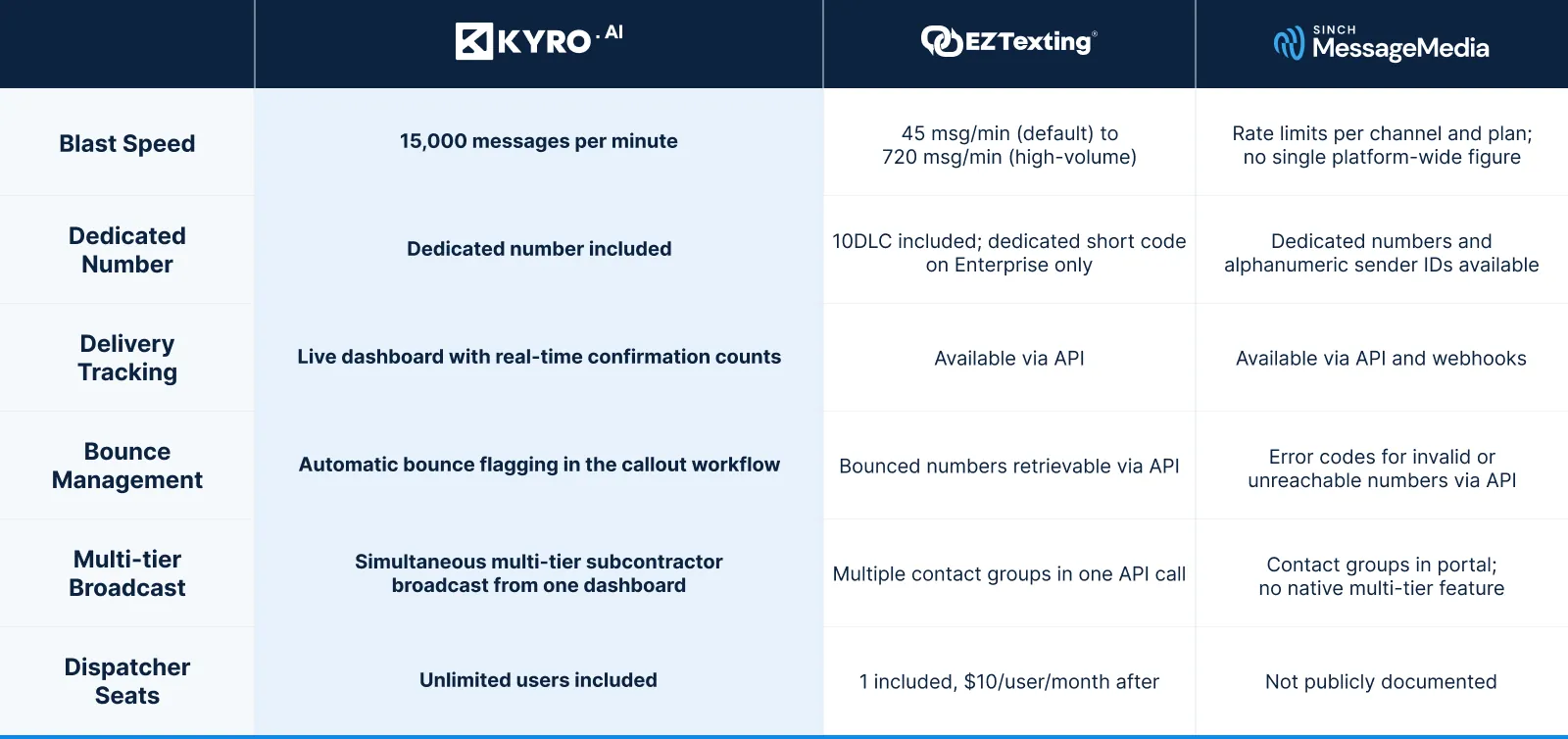
A storm roster can run into the thousands. When a callout goes out, every mobile text message on that list needs to land within minutes, not over the course of an hour. If your platform sends 45 messages per minute on its default number, a 2,000-person roster takes over 44 minutes to reach. In a storm, that is not fast enough.
Storm contractors work through layers of subcontractors. A mass group text needs to hit every tier simultaneously, not one group at a time through manual coordination or sequential API batches.
Storm supervisors need to know who confirmed and who didn't, in a live count that updates as responses come in. That information needs to be in front of them without running API queries or building custom reporting.
Every platform handles bounces differently. The question is whether your utilities communications system surfaces that information automatically inside the callout workflow or requires you to pull it through an API after the fact.
Crews are more likely to respond to a number they recognize. A dedicated line that belongs to your operation builds that trust over time. A shared short code or a default 10DLC number that looks like every other business text does not.
EZ Texting is a business SMS messaging platform built for community and organizational broadcast messaging. Local governments, HOAs, and municipalities use it as a text blast app to push storm warnings, evacuation notices, and safety updates to residents. For that job, it works well. It is easy to set up, straightforward to use, and reliable for single-tier list sends.
Where it runs into trouble for storm contractors is speed. According to EZ Texting's Textable Numbers Guide, the default low-volume 10DLC number included with plans sends up to 45 messages per minute. A high-volume number, associated with the Premium plan, pushes that to 720 messages per minute with 94%+ deliverability.
Consider a realistic scenario: a contractor gets a storm call at 11 PM and needs to reach a 2,000-person roster. On the default number, that callout takes over 44 minutes to deliver. Even on the high-volume number, it takes nearly three minutes. For a platform like KYRO that delivers 15,000 messages per minute, that same roster is reached in under eight seconds.
To EZ Texting's credit, the platform does offer meaningful delivery tracking through its API. A Detailed Delivery Reports endpoint lets you pull the specific phone numbers for each status, including bounced numbers. That data is real and useful. The catch is that it lives behind API endpoints. A storm supervisor managing a live callout is not querying an API at 2 AM. They need that information in front of them, in real time, without a developer in the loop.
Multi-tier broadcasting is technically possible. The API supports sending group SMS blasts to multiple contact groups in a single call, which means you can model contractor tiers as groups and fire one blast across all of them. That is a workable solution, but it requires setup, API integration, and group management that a storm-specific platform handles natively.
EZ Texting does understand that the sender number matters. The platform offers a range of options including low-volume and high-volume 10DLC, toll-free textable numbers, text-enabled landlines, and dedicated short codes, so businesses can pick a consistent sender that recipients learn to recognize.
Most standard EZ Texting plans include one user seat, with additional dispatchers billed on a per‑user monthly basis that recent pricing analyses put at around $10 per user. Dedicated short codes, which offer the highest throughput and a recognizable sender number, are generally bundled into Enterprise‑level agreements that start at roughly $3,000 per month according to current third‑party pricing comparisons and reviews.
Sinch MessageMedia, now part of Sinch Engage, is a carrier-grade SMS platform built for utility communications at scale. Sinch operates as a Tier 1 aggregator with direct carrier connections, which gives it a delivery reliability advantage over text messaging for utilities platforms that route through third-party infrastructure. Energy companies use it for outage notifications, service updates, and emergency broadcasts to large customer bases.
The most notable gap for storm contractors is transparency around speed.
MessageMedia does not publish a single, platform‑wide messages‑per‑minute or messages‑per‑second limit for all traffic. The API allows up to 100 messages per request, and broader Sinch documentation notes that short codes can support hundreds of messages per second, while 10DLC campaigns typically fall in the 25–50 messages‑per‑second range depending on carrier and registration. MessageMedia‑specific throughput expectations are described at the channel and plan level rather than as one universal rate, which makes it harder for a contractor to plan around a single concrete number for how fast a bulk callout will reach the full roster.
Delivery tracking is solid. The API provides detailed status reporting including queued, delivered, expired, rejected, and failed statuses, with granular error codes that distinguish between conditions like invalid destination address, destination unreachable, and SMS service unavailable. Like EZ Texting, this data is available, but it lives in API responses and webhook payloads rather than a live operational dashboard designed for storm callout management.
Multi-tier broadcast is achievable through contact groups in the web portal and by batching destination numbers in API requests, but there is no native multi-tier feature. The platform supports sub-accounts for organizational separation, but there is no documented mechanism to trigger simultaneous blasts across sub-accounts in a single action.
On the sender number side, MessageMedia offers dedicated virtual numbers and alphanumeric sender IDs, sometimes called alpha tags. A dedicated number keeps all messages from a business in one thread so recipients can save it and know exactly who is texting them. Alpha tags replace the phone number with a branded name for instant recognition. Both options do the job of making messages recognizable.
Seat limits and per-user pricing are not publicly documented. The platform supports multiple concurrent users through its Hub portal and sub-account structure, but how many seats are included and what additional seats cost is only available through sales conversations. For a contractor trying to evaluate whether their five-person command center can operate without surprise costs, that lack of transparency makes planning difficult.
KYRO AI StormShield was built specifically as a storm restoration and storm response software for utilities, prime contractors, and linemen. Its messaging infrastructure reflects that from the ground up, and every capability described below exists inside the storm callout workflow rather than behind an API that requires custom development to use. See how SMS and field messaging for utilities works in KYRO.
Speed is the most immediate differentiator. KYRO AI delivers 15,000 messages per minute. For a contractor with a 5,000-person roster across multiple subcontractor tiers, the entire network receives the callout in under 20 seconds. There is no batching, no queuing, and no daily send cap. When a follow-up message needs to go out twenty minutes later because conditions changed, KYRO sends it at the same speed. That kind of throughput is not a feature that general-purpose text blasting services are built to deliver because they were never designed for a use case that requires it.
Every KYRO AI account includes a dedicated dedicated number for outreach. This is a number that belongs to the contractor's operation, that crews see consistently every time a callout goes out, and that builds the recognition and trust that drives faster response rates. When a lineman sees an unfamiliar number at 2 AM, they hesitate. When they see a number they know, they pick up.
Multi-tier broadcasting in KYRO is not a workaround involving contact groups or API batching. A storm callout goes out simultaneously to every tier of the contractor network from a single dashboard. Each tier's responses are tracked separately so supervisors can see where confirmation gaps are developing in real time. This is mass group text capability built for storm coordination, not adapted from a marketing broadcast tool.
Response tracking goes well beyond delivery confirmation. Where EZ Texting and MessageMedia surface delivery and bounce data through API endpoints and webhook payloads, KYRO puts that information directly in front of supervisors as a live dashboard. As responses come in, the dashboard shows exactly how many crew members received the message, how many confirmed, how many have not responded, and how those counts are changing by the minute. The confirmation picture builds itself in real time as the callout runs.
Bounce management works the same way. When a mobile text message cannot be delivered because a number is inactive, incorrect, or out of service, KYRO flags it automatically inside the callout workflow and surfaces it for roster update. Contractors see in real time which numbers failed and can act on that information before the next callout goes out. Over time, this keeps the roster clean and ensures future callouts reach their full intended audience. Both EZ Texting and MessageMedia offer bounce data through their APIs, but the difference is that KYRO builds this into the operational flow rather than leaving it as a data point for a developer to retrieve and act on separately.
Pricing is $500 per month flat with unlimited users. The first 1,000 SMS are included, and anything beyond that is pre-billed at $100 per 2,000 SMS. That is a fixed rate with no variable surcharges, no per-seat fees, and no tier upgrades required to unlock speed or user access.
Inside KYRO AI, linemen are not just numbers on a contact list. Each lineman has a full profile that includes contact information, certifications, IBEW classification, past deployments, and other details that put a face to a number and humanize the workforce. When a supervisor pulls up a roster during a storm, he is looking at people he knows, not anonymous entries on a broadcast list.
This adds real operational value on top of the messaging capabilities. When the platform knows the qualifications, history, and role of every person on the roster, callouts get targeted more precisely, crews get built with the right mix of skills, and response counts carry more context than a raw number.
KYRO was built to reach people, and the workforce data model is part of what makes the storm callout workflow feel like it belongs to the contractor's operation rather than a generic broadcast tool.
When evaluating the best text blast service for storm restoration, the question is not whether a platform can send messages. EZ Texting and Sinch MessageMedia are capable platforms. They both offer delivery tracking, bounce reporting, and the ability to reach large audiences.
The question is whether those capabilities are built for the specific demands of storm callouts: the speed to reach thousands of linemen in seconds, the multi-tier broadcasting to hit every subcontractor level at once, the live response visibility that tells supervisors who confirmed without pulling an API report, and the automatic bounce flagging that keeps a roster clean between callouts. On every one of those points, the gap between general-purpose text blasting services and a utilities communication solution built specifically for storm restoration is significant.
KYRO AI was built on the other side of that gap.
See it in action. Attend a live KYRO webinar.

.webp)