

Features
Industries
Who we serve
Resources
Sign in
Get Started - $500/month
No commitment. No implementation fee. Unlimited users. Cancel anytime
.webp)
Getting the power back on after a big storm is a huge coordination job. Then the crews head home, the outage map goes quiet, and everyone moves on.
But utilities must pause to check, how well the storm response was performed, and what could have gone better?
That’s what a post-storm review is. You look back at how crews were deployed, where restoration slowed down, what happened on the safety side, and what the whole thing cost. Then you fix what you can before the next storm shows up. Because it will.
A post-storm review evaluates how a utility handled a storm. That covers prep, crew deployment, restoration, safety, communication and closeout.
The point is to get the right people in a room (operations, dispatch, field supervisors, safety, finance, and your contractors) and compare what you expected to happen with what actually did.
Where did the response fall short? Why? And what will you do differently next time?
FEMA’s after-action guidance mentions the same. It asks to record the storm response performance, then use them to improve how you run the next emergency.
A post-storm review looks backward at the storm you just had. A storm readiness assessment looks forward and asks whether you’re prepared for the next one.
Your utility must conduct a post-storm review because when a storm is restored, it doesn’t necessarily mean every step in the process went smoothly.
Maybe crews sat around for two hours waiting on assignments. Maybe a contractor showed up a day late. Or a stack of missing timesheets held up invoice approvals for weeks. None of that shows up on the outage map, but all of it costs you time and money.
A post-storm review helps utilities:
There’s no single right format to run a storm evaluation or post-storm review. But most of these reviews follow roughly the same path as follows:
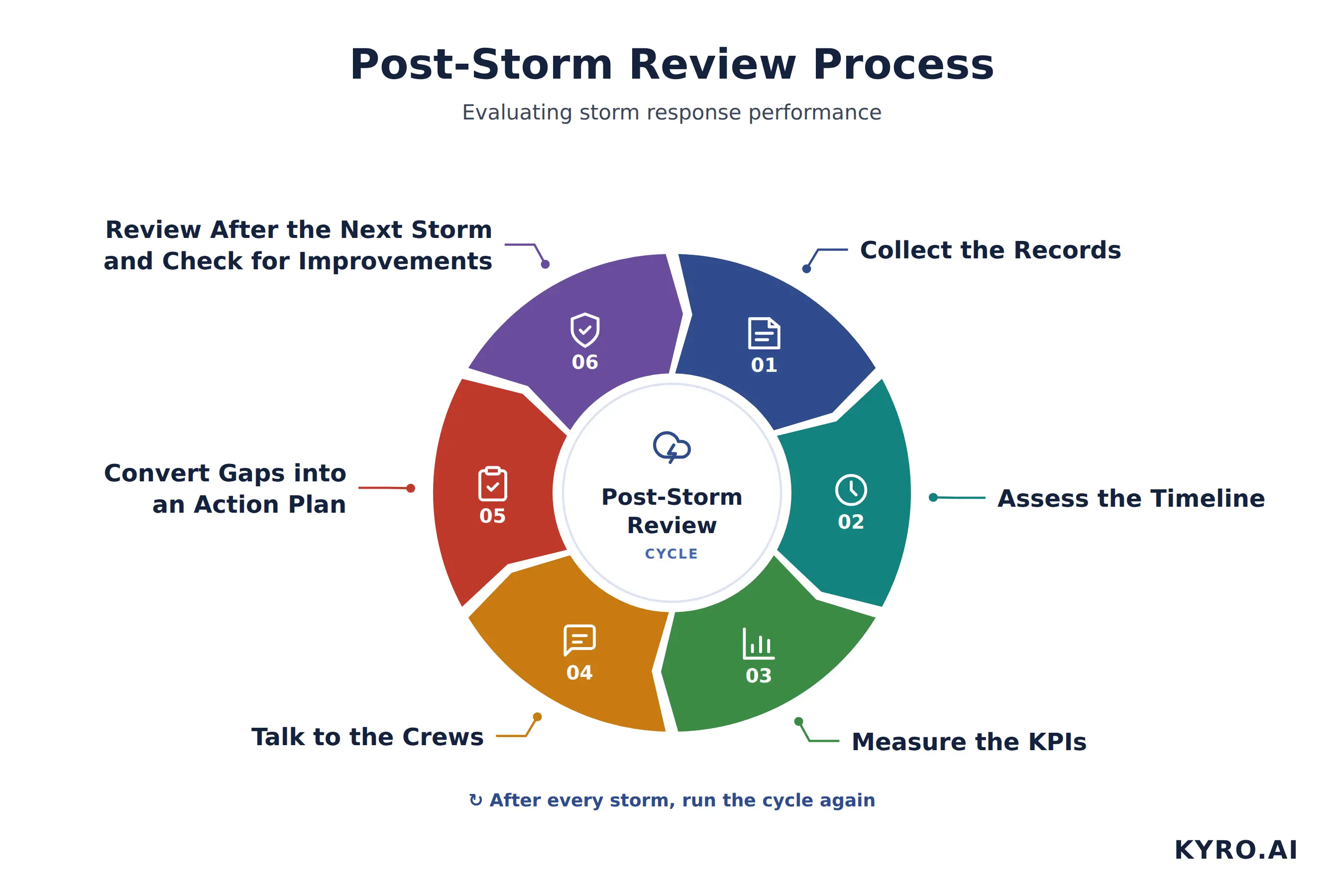
Start with all storm response records: dispatch logs, crew updates, outage records, work orders, safety reports, customer complaints, timesheets, contractor invoices.
Go from the first crew callout all the way to final closeout. When did crews arrive? When did repairs start? When did you hit each restoration milestone? How long did each stage take, and where did things stall?
If crews were ready to go but spent hours waiting for assignments, the problem probably wasn’t the crews. It was your callout or dispatch process.
A few metrics tell you a lot about where the response fell short:
The real value comes from comparing these against previous storms. If the same number looks bad every time, that’s your recurring problem.
SAIDI and SAIFI are worth a look too. SAIDI measures the average duration of power outages per customer, while SAIFI measures how often the average customer experiences an outage. Just keep in mind that severe weather can skew these values a lot.
Numbers only get you so far. Connect with the involved dispatchers, field supervisors, linemen, contractors and customer service staff once or twice a year.
Ask them where they lost time. Did they have the information they needed? What made the job harder than it had to be?
Write up the main findings and turn them into actions. That might be updating crew contact lists, getting better at material planning, tightening contractor reporting requirements, or fixing how field updates reach customer service.
Every action needs an owner and a deadline. Skip that and you’ll be facing the same issues after the next storm.
Check progress on outstanding actions before storm season starts. Update storm response plans where needed and make sure teams understand any new procedures. After the next storm, review the same metrics to see whether the changes helped.
By the end of all this, your team should have a clear picture of what happened, why it happened, and what you’re doing about it.
Post-storm reviews can be difficult when records are missing or teams don't have the full picture. A few common challenges can make the process harder.
An end-to-end storm response software like KYRO AI helps utilities bring crew updates, contractor activity, work records, and restoration progress into one place. With better visibility into storm operations, teams can conduct more informed post-storm reviews and address gaps before the next event.
It’s easy to lose track of something when you’re pulling together weeks of records. Here is a post-storm review checklist (or storm response evaluation checklist). Run through this list to make sure nothing slips:
☐ Lay out the storm timeline and the key decisions made along the way
☐ Look at crew callouts: who confirmed, who didn’t, and where mobilization dragged
☐ Check restoration milestones and note any delays that keep showing up
☐ Go over safety incidents, near misses and whether contractors followed the rules
☐ See how well outage updates and customer messages kept pace with the field
☐ Write down any equipment, material or logistics shortages
☐ Review how contractor coordination went, and what the storm cost
☐ Make sure timesheets, work orders and closeout records are complete
☐ Compare your response numbers with past storms
☐ Dig into root causes and capture the lessons learned
☐ Give every corrective action an owner and a deadline
☐ Update your storm plans based on what you found
A review that doesn’t change anything is just a meeting.
So, follow each problem back to where it started. Callouts took too long? Find the steps where things slow down. Ran short on materials? Your inventory plan probably needs another look.
If customer updates kept lagging behind what crews were doing in the field, trace where that information got stuck. And if contractor's invoices took weeks to reconcile, the trouble likely started with how timesheets and work records were handled.
It also helps a lot to keep crew details, callout responses, assignments, status updates, and timesheets in one place. That makes the storm restoration easier to run, and it makes the review much easier afterward.
KYRO AI helps utilities and contractors coordinate storm crews, track deployment, and manage timesheets,and invoicing in one workflow. With better visibility during restoration and more complete records afterward, teams can spend less time chasing information and more time improving their response for the next storm.
The goal is to understand how your storm response really went. You find the delays and safety gaps, then decide what to fix before the next event.
Earlier than you’d think. Start collecting records while the response is still going. Hold a quick debrief as things wind down. Then do the full review once restoration data, safety reports and cost records are in.
Operations leaders, dispatchers, field supervisors, safety, customer service, logistics and finance. Bring in the contractors and mutual aid partners who worked the storm too. They often see problems your own team misses.
The storm timeline, your response metrics, what worked, what didn’t, the root causes, lessons learned, and a list of corrective actions with owners and deadlines.
KYRO AI helps utilities keep storm response information organized, from crew callouts and availability to mobilization and crew status updates. Having this information in one place makes it easier to review what happened, identify delays and coordination gaps, and plan improvements before the next storm.



.webp)