.jpg)
Storm restoration planning often determines whether a major weather event becomes a three-day recovery or a ten-day restoration effort. Long before the first crew repairs a damaged pole, storm managers make critical decisions about emergency activation, crew staging, mutual aid, damage assessment, safety, documentation, and resource allocation.
Every major storm creates a race against time. Customers expect power to be restored quickly, regulators require accurate documentation, executives need real-time updates, and field crews depend on clear direction. The decisions made before restoration begins directly affect restoration speed, worker safety, regulatory compliance, and cost recovery.
According to the U.S. Department of Energy, extreme weather is now the leading cause of large-scale power outages in the United States. As storms become more frequent and infrastructure ages, utilities face increasing pressure to restore service faster while maintaining safety and meeting compliance requirements.
In this article, we'll explore the 10 critical decisions every storm manager makes before storm damage restoration begins and how making the right choices early can lead to faster, safer, and more efficient recovery.
Every storm restoration begins with one question: do we activate full storm operations? Activating too early results in unnecessary labor costs, equipment staging expenses, and contractor mobilization fees. Activating too late creates restoration delays that become harder to recover from as the event unfolds.
Storm managers evaluate National Weather Service forecasts, wind speed projections, flood risk, vegetation threat levels, historical outage models, critical infrastructure exposure, and geographic impact forecasts before making this call.
Modern utilities increasingly combine weather intelligence with GIS data and historical outage analytics to estimate likely damage before the storm arrives.
Best practice: Build activation thresholds around predefined weather triggers instead of subjective judgment calls made under pressure.
One of the costliest mistakes in storm response is positioning crews after outages begin. Experienced storm managers pre-stage resources based on predicted impact zones instead.
Outage management during the first 24 hours after a major storm
That means answering which substations are most vulnerable, which transmission corridors historically see vegetation damage, which service territories flood, which hospitals need priority restoration, and where contractor crews should report. Utilities often use historical outage heat maps combined with weather forecasting models to determine optimal staging locations.
The goal isn't deploying more crews. It's deploying the right crews to the right locations before they're needed.
Before storm restoration begins, storm managers evaluate workforce readiness for crew staging: how many line crews are available, which supervisors are on shift, whether damage assessors are assigned, how many vegetation teams are ready, which equipment operators are certified, and whether logistics personnel are fully staffed.
Resource visibility gets harder for utilities operating across multiple districts. Without centralized workforce tracking, managers often burn hours on phone calls just to understand available capacity.
A centralized operations platform like KYRO AI gives real-time visibility into personnel, certifications, equipment assignments, and crew availability instead.
Requesting mutual aid too late is one of the most expensive mistakes in storm damage restoration management. By the time outages become widespread, neighboring utilities may have already committed their available resources elsewhere.
Storm managers weigh predicted outage scale, internal restoration capacity, crew availability, contractor commitments, weather duration, and estimated restoration timeline. Mutual aid planning also means preparing lodging, fuel, staging areas, safety briefings, credential verification, and work assignments in advance.
For guidance on mutual assistance programs, utilities often reference the Edison Electric Institute's Mutual Assistance Program, which has supported large-scale restoration efforts across North America.
Storm restoration priorities depend entirely on damage visibility. Without accurate assessments, utilities risk dispatching crews inefficiently or missing critical infrastructure failures.
Storm managers choose the mix: ground assessments, drone inspections, helicopter patrols, GIS mapping, customer outage validation, and AI-assisted image analysis. Increasingly, utilities capture geotagged photos, videos, and inspection forms directly from mobile devices, letting operations centers prioritize repairs based on verified field conditions rather than secondhand reports.
Faster assessments lead directly to faster restoration.
See how field data collection accelerates utility storm restoration for a closer look at how this works in practice.
Not every outage is equal. Storm managers establish storm damage restoration priorities before crews receive work assignments: public safety hazards first, then hospitals, emergency services, transmission infrastructure, substations, distribution feeders, critical customers, large customer groups, and individual service restorations.
These priorities balance public safety, operational efficiency, and customer impact, factoring in estimated customers restored per repair, equipment availability, accessibility, flood conditions, and active hazards. A structured prioritization framework keeps crews from reactive decision-making as conditions change hour to hour.
Storm restoration remains one of the most dangerous jobs in the utility industry. Crews face downed energized conductors, flooded work areas, traffic hazards, falling trees, equipment failures, crew fatigue, and extreme weather, often all in the same shift.
Before storm damage restoration begins, storm managers lock in daily tailboard briefing procedures, PPE verification, hazard reporting processes, near-miss documentation, fatigue management schedules, and emergency communication channels. OSHA guidance calls for utilities to continuously identify, communicate, and mitigate workplace hazards throughout emergency response operations.
Digital safety forms keep hazard documentation consistent across internal and mutual aid crews. Learn more about near miss reporting vs. incident reporting and why utilities need both.
Documentation often becomes an afterthought during major storm restoration events. It shouldn't. Every decision made during storm response may later support FEMA reimbursement, insurance claims, regulatory reporting, OSHA investigations, executive reviews, and after-action reports.
Storm managers decide in advance which forms will be used, who approves field reports, how GPS verification is captured, what photo documentation standards apply, and how equipment and labor usage are tracked. Incomplete documentation routinely delays reimbursements and creates compliance exposure. Digital documentation closes those gaps while the event is still underway.
Storm restoration involves hundreds, sometimes thousands, of people working simultaneously. Communication breakdowns quickly create duplicate work, missed hazards, and delayed restoration.
Storm managers establish incident command structure, situation report schedules, crew communication protocols, executive dashboards, contractor updates, and customer messaging workflows. Many utilities now rely on centralized operational dashboards that consolidate crew locations, active work orders, damage assessments, restoration progress, safety incidents, and equipment availability into one view.
A single source of operational truth cuts confusion at every level of the response organization.
Perhaps the biggest decision happens before the storm even forms: will operations run on paper forms, phone calls, whiteboards, spreadsheets, and disconnected systems, or from a centralized storm management platform?
Modern storm operations need offline mobile access, GIS mapping, GPS crew tracking, AI-powered reporting, digital inspections, forms management, equipment tracking, real-time dashboards, photo documentation, and executive reporting in one place.
Read more: The 7 Biggest Disaster Recovery Mistakes Utilities Make After Severe Weather
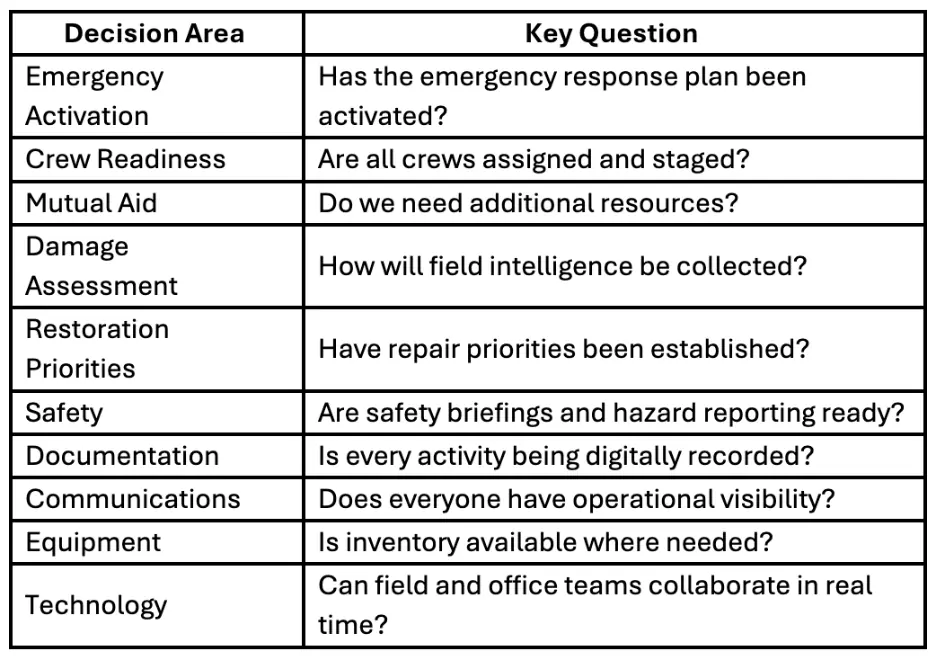
Storm restoration depends on visibility, not guesswork. KYRO AI's StormShield platform gives utilities a centralized operational view before, during, and after severe weather events.
With KYRO AI, storm managers can
Instead of coordinating across disconnected spreadsheets, emails, and radio calls, utilities get one operational picture that supports faster, safer, more accountable restoration.
Read more: The First 24 Hours After a Major Storm: An Outage Management Guide
Storm restoration doesn't begin when the first line crew reaches a damaged pole. It begins with the decisions made hours, or even days, before restoration starts.
The utilities that consistently restore power faster aren't simply those with the largest workforce. They're the ones that enter every storm with clear activation criteria, accurate situational awareness, coordinated resources, standardized documentation, and technology that keeps every team aligned.
As storms grow more frequent and severe, success will increasingly depend on preparation rather than reaction. By getting these ten decisions right before restoration begins, storm managers can improve safety, accelerate restoration timelines, strengthen regulatory compliance, and build a more resilient response for every future event.
What is storm restoration planning?
Storm restoration planning is the set of decisions utilities make before a storm hits, covering emergency activation, crew staging, mutual aid, damage assessment, safety protocols, and documentation. These decisions, made in advance, determine how fast and safely restoration happens once the storm passes.
When should a utility request mutual aid?
Mutual aid should be requested as soon as predicted outage scale exceeds internal restoration capacity, not after outages become widespread. Neighboring utilities often commit their available crews early, so late requests risk longer wait times for outside resources.
What's the biggest mistake utilities make in storm response?
Positioning crews and requesting mutual aid reactively, after outages begin, instead of proactively based on forecasted impact zones. Both mistakes add hours or days to restoration timelines and increase overtime and mobilization costs.
How does technology improve storm restoration outcomes?
Centralized platforms give storm managers real-time visibility into crew locations, damage assessments, safety incidents, and equipment availability. This replaces fragmented spreadsheets and phone-tree coordination with a single operational picture, which speeds decision-making and improves documentation for FEMA reimbursement.

Storm restoration planning often determines whether a major weather event becomes a three-day recovery or a ten-day restoration effort. Long before the first crew repairs a damaged pole, storm managers make critical decisions about emergency activation, crew staging, mutual aid, damage assessment, safety, documentation, and resource allocation.
Every major storm creates a race against time. Customers expect power to be restored quickly, regulators require accurate documentation, executives need real-time updates, and field crews depend on clear direction. The decisions made before restoration begins directly affect restoration speed, worker safety, regulatory compliance, and cost recovery.
According to the U.S. Department of Energy, extreme weather is now the leading cause of large-scale power outages in the United States. As storms become more frequent and infrastructure ages, utilities face increasing pressure to restore service faster while maintaining safety and meeting compliance requirements.
In this article, we'll explore the 10 critical decisions every storm manager makes before storm damage restoration begins and how making the right choices early can lead to faster, safer, and more efficient recovery.
Every storm restoration begins with one question: do we activate full storm operations? Activating too early results in unnecessary labor costs, equipment staging expenses, and contractor mobilization fees. Activating too late creates restoration delays that become harder to recover from as the event unfolds.
Storm managers evaluate National Weather Service forecasts, wind speed projections, flood risk, vegetation threat levels, historical outage models, critical infrastructure exposure, and geographic impact forecasts before making this call.
Modern utilities increasingly combine weather intelligence with GIS data and historical outage analytics to estimate likely damage before the storm arrives.
Best practice: Build activation thresholds around predefined weather triggers instead of subjective judgment calls made under pressure.
One of the costliest mistakes in storm response is positioning crews after outages begin. Experienced storm managers pre-stage resources based on predicted impact zones instead.
Outage management during the first 24 hours after a major storm
That means answering which substations are most vulnerable, which transmission corridors historically see vegetation damage, which service territories flood, which hospitals need priority restoration, and where contractor crews should report. Utilities often use historical outage heat maps combined with weather forecasting models to determine optimal staging locations.
The goal isn't deploying more crews. It's deploying the right crews to the right locations before they're needed.
Before storm restoration begins, storm managers evaluate workforce readiness for crew staging: how many line crews are available, which supervisors are on shift, whether damage assessors are assigned, how many vegetation teams are ready, which equipment operators are certified, and whether logistics personnel are fully staffed.
Resource visibility gets harder for utilities operating across multiple districts. Without centralized workforce tracking, managers often burn hours on phone calls just to understand available capacity.
A centralized operations platform like KYRO AI gives real-time visibility into personnel, certifications, equipment assignments, and crew availability instead.
Requesting mutual aid too late is one of the most expensive mistakes in storm damage restoration management. By the time outages become widespread, neighboring utilities may have already committed their available resources elsewhere.
Storm managers weigh predicted outage scale, internal restoration capacity, crew availability, contractor commitments, weather duration, and estimated restoration timeline. Mutual aid planning also means preparing lodging, fuel, staging areas, safety briefings, credential verification, and work assignments in advance.
For guidance on mutual assistance programs, utilities often reference the Edison Electric Institute's Mutual Assistance Program, which has supported large-scale restoration efforts across North America.
Storm restoration priorities depend entirely on damage visibility. Without accurate assessments, utilities risk dispatching crews inefficiently or missing critical infrastructure failures.
Storm managers choose the mix: ground assessments, drone inspections, helicopter patrols, GIS mapping, customer outage validation, and AI-assisted image analysis. Increasingly, utilities capture geotagged photos, videos, and inspection forms directly from mobile devices, letting operations centers prioritize repairs based on verified field conditions rather than secondhand reports.
Faster assessments lead directly to faster restoration.
See how field data collection accelerates utility storm restoration for a closer look at how this works in practice.
Not every outage is equal. Storm managers establish storm damage restoration priorities before crews receive work assignments: public safety hazards first, then hospitals, emergency services, transmission infrastructure, substations, distribution feeders, critical customers, large customer groups, and individual service restorations.
These priorities balance public safety, operational efficiency, and customer impact, factoring in estimated customers restored per repair, equipment availability, accessibility, flood conditions, and active hazards. A structured prioritization framework keeps crews from reactive decision-making as conditions change hour to hour.
Storm restoration remains one of the most dangerous jobs in the utility industry. Crews face downed energized conductors, flooded work areas, traffic hazards, falling trees, equipment failures, crew fatigue, and extreme weather, often all in the same shift.
Before storm damage restoration begins, storm managers lock in daily tailboard briefing procedures, PPE verification, hazard reporting processes, near-miss documentation, fatigue management schedules, and emergency communication channels. OSHA guidance calls for utilities to continuously identify, communicate, and mitigate workplace hazards throughout emergency response operations.
Digital safety forms keep hazard documentation consistent across internal and mutual aid crews. Learn more about near miss reporting vs. incident reporting and why utilities need both.
Documentation often becomes an afterthought during major storm restoration events. It shouldn't. Every decision made during storm response may later support FEMA reimbursement, insurance claims, regulatory reporting, OSHA investigations, executive reviews, and after-action reports.
Storm managers decide in advance which forms will be used, who approves field reports, how GPS verification is captured, what photo documentation standards apply, and how equipment and labor usage are tracked. Incomplete documentation routinely delays reimbursements and creates compliance exposure. Digital documentation closes those gaps while the event is still underway.
Storm restoration involves hundreds, sometimes thousands, of people working simultaneously. Communication breakdowns quickly create duplicate work, missed hazards, and delayed restoration.
Storm managers establish incident command structure, situation report schedules, crew communication protocols, executive dashboards, contractor updates, and customer messaging workflows. Many utilities now rely on centralized operational dashboards that consolidate crew locations, active work orders, damage assessments, restoration progress, safety incidents, and equipment availability into one view.
A single source of operational truth cuts confusion at every level of the response organization.
Perhaps the biggest decision happens before the storm even forms: will operations run on paper forms, phone calls, whiteboards, spreadsheets, and disconnected systems, or from a centralized storm management platform?
Modern storm operations need offline mobile access, GIS mapping, GPS crew tracking, AI-powered reporting, digital inspections, forms management, equipment tracking, real-time dashboards, photo documentation, and executive reporting in one place.
Read more: The 7 Biggest Disaster Recovery Mistakes Utilities Make After Severe Weather

Storm restoration depends on visibility, not guesswork. KYRO AI's StormShield platform gives utilities a centralized operational view before, during, and after severe weather events.
With KYRO AI, storm managers can
Instead of coordinating across disconnected spreadsheets, emails, and radio calls, utilities get one operational picture that supports faster, safer, more accountable restoration.
Read more: The First 24 Hours After a Major Storm: An Outage Management Guide
Storm restoration doesn't begin when the first line crew reaches a damaged pole. It begins with the decisions made hours, or even days, before restoration starts.
The utilities that consistently restore power faster aren't simply those with the largest workforce. They're the ones that enter every storm with clear activation criteria, accurate situational awareness, coordinated resources, standardized documentation, and technology that keeps every team aligned.
As storms grow more frequent and severe, success will increasingly depend on preparation rather than reaction. By getting these ten decisions right before restoration begins, storm managers can improve safety, accelerate restoration timelines, strengthen regulatory compliance, and build a more resilient response for every future event.
What is storm restoration planning?
Storm restoration planning is the set of decisions utilities make before a storm hits, covering emergency activation, crew staging, mutual aid, damage assessment, safety protocols, and documentation. These decisions, made in advance, determine how fast and safely restoration happens once the storm passes.
When should a utility request mutual aid?
Mutual aid should be requested as soon as predicted outage scale exceeds internal restoration capacity, not after outages become widespread. Neighboring utilities often commit their available crews early, so late requests risk longer wait times for outside resources.
What's the biggest mistake utilities make in storm response?
Positioning crews and requesting mutual aid reactively, after outages begin, instead of proactively based on forecasted impact zones. Both mistakes add hours or days to restoration timelines and increase overtime and mobilization costs.
How does technology improve storm restoration outcomes?
Centralized platforms give storm managers real-time visibility into crew locations, damage assessments, safety incidents, and equipment availability. This replaces fragmented spreadsheets and phone-tree coordination with a single operational picture, which speeds decision-making and improves documentation for FEMA reimbursement.

Rabiya Farheen is a content strategist and a writer who loves turning complex ideas into clear, meaningful stories, especially in the world of utility, tech, AI, and B2B SaaS. She works closely with growing teams to create content that doesn’t just check SEO boxes, but actually helps people understand what a product does and why it matters. With a knack for research and a curiosity that never quits, Rabiya dives deep into industry trends, customer pain points, and data to craft content that feels super helpful and informative. When she’s not writing, she’s probably reading, painting, and exploring her creative side— or you'll find her hustling around for social causes, especially those that empower girls and women.