.png)
Every major storm puts utilities under intense pressure. Crews race to restore power, customers demand updates, regulators require documentation, and the clock never stops. Despite detailed plans, many restoration efforts lose critical time due to preventable operational mistakes rather than a lack of resources or manpower.
The need for better disaster recovery has never been greater. The stakes continue to rise. NOAA data shows a clear increase in billion-dollar weather disasters over the past decade, with hurricanes, wildfires, floods, derechos, and winter storms becoming more frequent.
The U.S. Department of Energy reports that severe weather causes nearly 80% of major power outages nationwide. Utilities that recover fastest succeed through superior visibility, coordination, and standardized processes.
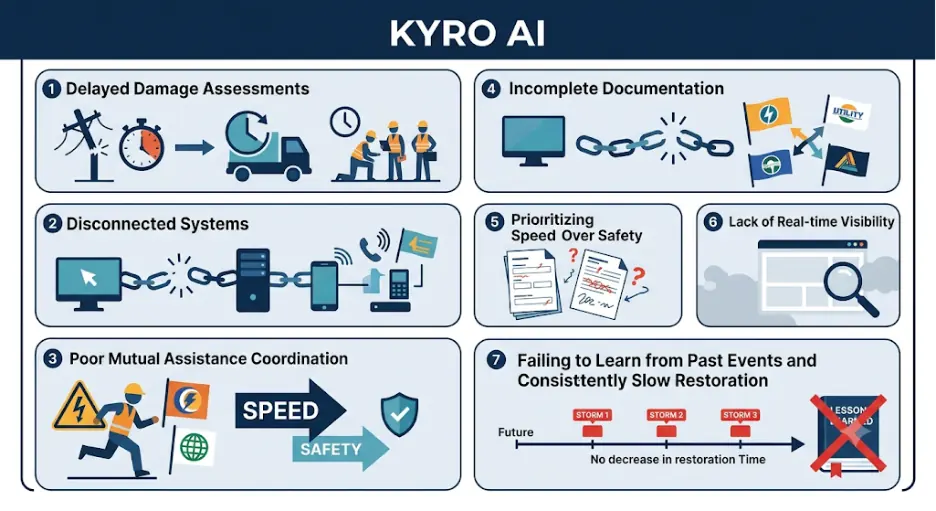
Addressing them delivers faster power restoration, better safety outcomes, stronger compliance, and greater resilience.
Here’s a closer look at each mistake and the practical strategies leading utilities use to avoid them.
The first hours after a storm determine the pace of the entire response. Without a clear, accurate picture of damage locations and priorities, crews are often sent to the wrong areas while critical outages linger.
Many utilities still depend on phone calls, emails, spreadsheets, and paper forms. The result is slow, inconsistent reporting that creates unreliable restoration estimates and poor customer communication.
Forward-thinking utilities replace manual processes with mobile inspection tools. Field teams capture GPS-tagged photos, equipment details, and notes directly from the site, even offline. Real-time dashboards then give command teams an immediate system-wide view, enabling data-driven prioritization instead of guesswork. Preparing these tools and workflows before storm season is essential.
A single storm generates thousands of data points: damage reports, crew assignments, work orders, safety checks, equipment logs, and customer updates. When this information lives across separate platforms, spreadsheets, emails, and calls, chaos follows.
Common problems include duplicate assignments, delayed dispatching, miscommunication, limited progress tracking, and excessive administrative work. These fragmented workflows make it difficult to adapt as conditions evolve.
High-performing utilities adopt integrated field operations platforms that unify inspections, work orders, crew management, documentation, and reporting in one system. A single source of truth reduces confusion and accelerates decision-making across field and office teams.
Mutual assistance programs bring thousands of additional line workers and contractors during major events leading to an invaluable resource. However, onboarding, credentialing, work zone assignments, safety briefings, and progress tracking for external crews often create new bottlenecks.
Without digital processes, crews arrive at wrong locations, assignments overlap, and supervisors lose visibility over an expanded workforce. The Edison Electric Institute (EEI) notes that efficient mutual assistance coordination has become critical for large-scale restorations.
Successful utilities prepare digital onboarding, standardized workflows, and real-time crew tracking in advance. When external crews can start productive work immediately upon arrival, overall restoration speed improves dramatically.
In the heat of restoration, documentation often falls to the bottom of the priority list. Yet incomplete records create major problems later. Delayed insurance claims, failed regulatory audits, and rejected FEMA Public Assistance reimbursements.
Missing photos, incomplete labor logs, handwritten notes, and inaccurate material records are common issues. Leading utilities treat documentation as a real-time activity rather than a post-event chore.
Key elements captured during work include time-stamped reports, before-and-after photos, GPS-verified locations, labor/equipment usage, material consumption, and hazard/safety data. Digital tools create a complete, audit-ready trail while reducing administrative burden and supporting better future planning.
Restoration is urgent, but never at the expense of safety. Crews often work extended 16-hour shifts in dangerous conditions—flooded roads, downed lines, damaged infrastructure, and fatigue. OSHA highlights how fatigue severely impairs awareness and reaction times.
Effective utilities embed safety into every step: digital tailboard briefings, lockout/tagout verification, hazard reporting, equipment checks, and near-miss tracking. Real-time visibility into crew hours and workloads helps prevent fatigue while sustaining productivity.
Safety and speed are not opposites. Integrated digital safety processes help crews work both faster and safer.
Storm environments change rapidly. New outages appear, roads become impassable, and priorities shift. Yet many utilities still rely on periodic phone updates or manual reports, meaning command centers often operate with outdated information.
This leads to duplicate inspections, inefficient crew reassignments, underused resources, inaccurate ETRs (estimated time of restoration), and slower decisions.
Modern approaches use GPS crew tracking, mobile digital work orders, and centralized dashboards for live visibility. Offline-capable solutions ensure data is captured even when networks fail and sync automatically when connectivity returns. Better visibility improves not only internal efficiency but also the accuracy of public and regulatory communications.
The final major mistake occurs after the lights come back on. Many utilities rush back to business-as-usual without a structured after-action review.
Every storm produces valuable data. High-performing teams analyze what caused delays, where communication broke down, how efficiently crews were deployed, whether documentation supported reimbursement, and which manual processes need automation.
By treating each event as a learning opportunity, utilities refine plans, eliminate recurring bottlenecks, and build stronger response capabilities for the next storm. In an era of more intense climate-driven weather, continuous improvement is essential for long-term resilience.

Utilities that invest in connected field operations restore power faster, protect workers better, reduce paperwork, and strengthen compliance.
Severe weather events are increasing in frequency and intensity. Utilities cannot control the storms, but they can control their preparedness.
Avoiding these seven mistakes requires proactive planning, integrated field technology, standardized processes, and real-time visibility. Organizations that modernize these areas significantly reduce outage durations, improve safety, simplify reimbursement processes, and meet rising customer expectations.
At KYRO AI, our platform is purpose-built for utility storm response. Features like offline field reporting, GPS-verified tracking, digital safety workflows, AI-assisted assessments, and audit-ready documentation help utilities move from assessment to full restoration with greater speed and confidence.
After severe weather, success isn’t just about how hard crews work. It’s about how effectively systems and processes support them.
Want to know more? Connect with us today!

Every major storm puts utilities under intense pressure. Crews race to restore power, customers demand updates, regulators require documentation, and the clock never stops. Despite detailed plans, many restoration efforts lose critical time due to preventable operational mistakes rather than a lack of resources or manpower.
The need for better disaster recovery has never been greater. The stakes continue to rise. NOAA data shows a clear increase in billion-dollar weather disasters over the past decade, with hurricanes, wildfires, floods, derechos, and winter storms becoming more frequent.
The U.S. Department of Energy reports that severe weather causes nearly 80% of major power outages nationwide. Utilities that recover fastest succeed through superior visibility, coordination, and standardized processes.

Addressing them delivers faster power restoration, better safety outcomes, stronger compliance, and greater resilience.
Here’s a closer look at each mistake and the practical strategies leading utilities use to avoid them.
The first hours after a storm determine the pace of the entire response. Without a clear, accurate picture of damage locations and priorities, crews are often sent to the wrong areas while critical outages linger.
Many utilities still depend on phone calls, emails, spreadsheets, and paper forms. The result is slow, inconsistent reporting that creates unreliable restoration estimates and poor customer communication.
Forward-thinking utilities replace manual processes with mobile inspection tools. Field teams capture GPS-tagged photos, equipment details, and notes directly from the site, even offline. Real-time dashboards then give command teams an immediate system-wide view, enabling data-driven prioritization instead of guesswork. Preparing these tools and workflows before storm season is essential.
A single storm generates thousands of data points: damage reports, crew assignments, work orders, safety checks, equipment logs, and customer updates. When this information lives across separate platforms, spreadsheets, emails, and calls, chaos follows.
Common problems include duplicate assignments, delayed dispatching, miscommunication, limited progress tracking, and excessive administrative work. These fragmented workflows make it difficult to adapt as conditions evolve.
High-performing utilities adopt integrated field operations platforms that unify inspections, work orders, crew management, documentation, and reporting in one system. A single source of truth reduces confusion and accelerates decision-making across field and office teams.
Mutual assistance programs bring thousands of additional line workers and contractors during major events leading to an invaluable resource. However, onboarding, credentialing, work zone assignments, safety briefings, and progress tracking for external crews often create new bottlenecks.
Without digital processes, crews arrive at wrong locations, assignments overlap, and supervisors lose visibility over an expanded workforce. The Edison Electric Institute (EEI) notes that efficient mutual assistance coordination has become critical for large-scale restorations.
Successful utilities prepare digital onboarding, standardized workflows, and real-time crew tracking in advance. When external crews can start productive work immediately upon arrival, overall restoration speed improves dramatically.
In the heat of restoration, documentation often falls to the bottom of the priority list. Yet incomplete records create major problems later. Delayed insurance claims, failed regulatory audits, and rejected FEMA Public Assistance reimbursements.
Missing photos, incomplete labor logs, handwritten notes, and inaccurate material records are common issues. Leading utilities treat documentation as a real-time activity rather than a post-event chore.
Key elements captured during work include time-stamped reports, before-and-after photos, GPS-verified locations, labor/equipment usage, material consumption, and hazard/safety data. Digital tools create a complete, audit-ready trail while reducing administrative burden and supporting better future planning.
Restoration is urgent, but never at the expense of safety. Crews often work extended 16-hour shifts in dangerous conditions—flooded roads, downed lines, damaged infrastructure, and fatigue. OSHA highlights how fatigue severely impairs awareness and reaction times.
Effective utilities embed safety into every step: digital tailboard briefings, lockout/tagout verification, hazard reporting, equipment checks, and near-miss tracking. Real-time visibility into crew hours and workloads helps prevent fatigue while sustaining productivity.
Safety and speed are not opposites. Integrated digital safety processes help crews work both faster and safer.
Storm environments change rapidly. New outages appear, roads become impassable, and priorities shift. Yet many utilities still rely on periodic phone updates or manual reports, meaning command centers often operate with outdated information.
This leads to duplicate inspections, inefficient crew reassignments, underused resources, inaccurate ETRs (estimated time of restoration), and slower decisions.
Modern approaches use GPS crew tracking, mobile digital work orders, and centralized dashboards for live visibility. Offline-capable solutions ensure data is captured even when networks fail and sync automatically when connectivity returns. Better visibility improves not only internal efficiency but also the accuracy of public and regulatory communications.
The final major mistake occurs after the lights come back on. Many utilities rush back to business-as-usual without a structured after-action review.
Every storm produces valuable data. High-performing teams analyze what caused delays, where communication broke down, how efficiently crews were deployed, whether documentation supported reimbursement, and which manual processes need automation.
By treating each event as a learning opportunity, utilities refine plans, eliminate recurring bottlenecks, and build stronger response capabilities for the next storm. In an era of more intense climate-driven weather, continuous improvement is essential for long-term resilience.

Utilities that invest in connected field operations restore power faster, protect workers better, reduce paperwork, and strengthen compliance.
Severe weather events are increasing in frequency and intensity. Utilities cannot control the storms, but they can control their preparedness.
Avoiding these seven mistakes requires proactive planning, integrated field technology, standardized processes, and real-time visibility. Organizations that modernize these areas significantly reduce outage durations, improve safety, simplify reimbursement processes, and meet rising customer expectations.
At KYRO AI, our platform is purpose-built for utility storm response. Features like offline field reporting, GPS-verified tracking, digital safety workflows, AI-assisted assessments, and audit-ready documentation help utilities move from assessment to full restoration with greater speed and confidence.
After severe weather, success isn’t just about how hard crews work. It’s about how effectively systems and processes support them.
Want to know more? Connect with us today!

Rabiya Farheen is a content strategist and a writer who loves turning complex ideas into clear, meaningful stories, especially in the world of utility, tech, AI, and B2B SaaS. She works closely with growing teams to create content that doesn’t just check SEO boxes, but actually helps people understand what a product does and why it matters. With a knack for research and a curiosity that never quits, Rabiya dives deep into industry trends, customer pain points, and data to craft content that feels super helpful and informative. When she’s not writing, she’s probably reading, painting, and exploring her creative side— or you'll find her hustling around for social causes, especially those that empower girls and women.