
Near Miss Reporting vs Incident Reporting for Utilities: Why Both Drive Real Safety Gains

July 17, 2026
4 min read

Every close call in utility work is a warning. A lineworker steps back as a branch crashes near the bucket. A crew spots an unmarked energized line. A vehicle narrowly misses a roadside team. No injury. No damage. Work continues.  

Yet these near misses contain some of the most valuable safety data utilities can collect. When paired with strong incident reporting, they form the backbone of a proactive safety program that prevents harm instead of just responding to it.

Near miss reporting captures events that could have caused injury or damage. Incident reporting documents events that did.  

Utilities that use both achieve better hazard visibility, stronger compliance, and fewer serious incidents.

What Is Near Miss Reporting in Utilities?

Near miss reporting documents unplanned events that had the potential for injury, property damage, equipment failure, environmental harm, or service interruption, but did not result in any.  

In utility operations, these events occur daily due to energized infrastructure, heavy machinery, traffic, severe weather, and dynamic job sites.  

Real-world utility examples include:

  • A tree falling within inches of an energized conductor during vegetation management
  • A dig crew discovering an unmarked underground utility just before excavation
  • A worker slipping on a bucket truck platform but regaining balance
  • Spotting an approaching vehicle before it enters an unprotected work zone
  • Equipment assigned to the wrong circuit during switching
  • Drone inspections revealing pole damage missed in prior manual checks

Safety experts, emphasize that near misses are “free lessons” that provide the same root insights as accidents, without the human or financial cost.

What Is Incident Reporting?

Incident reporting records events that have already produced measurable consequences, such as:

  • Employee injuries or fatalities
  • Vehicle collisions
  • Equipment damage
  • Electrical contacts
  • Service outages
  • Environmental releases
  • Regulatory violations

These reports support OSHA compliance, root cause analysis, insurance claims, audits, and corrective actions. They turn costly events into organizational learning.
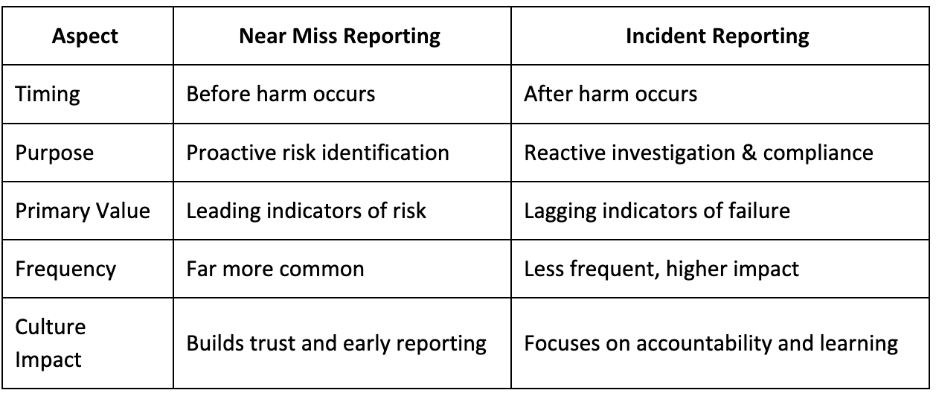
Near Miss vs Incident Reporting: Side-by-Side Comparison

Why Utilities Need Both: The Data Is Clear

According to established safety research, serious incidents are rarely isolated. Frank Bird’s landmark studies showed that for every serious injury, there are often hundreds of near misses and thousands of unsafe conditions.  

Modern studies reinforce this:

In electric utilities, where BLS data consistently ranks line workers among the highest-risk occupations, this multiplier effect is especially dangerous. Ignoring near misses means missing early signals of systemic problems like inadequate traffic control, poor switching documentation, outdated GIS data, or communication breakdowns during storm restoration.

The iceberg analogy holds true: Visible incidents are only the tip. Below the surface lie far more near misses and unsafe conditions. Addressing only incidents leaves most risks hidden.

Benefits of combining both systems:

  • Identify recurring hazards before injuries occur
  • Improve training by revealing knowledge gaps
  • Strengthen job planning and asset management
  • Foster a blame-free safety culture
  • Reduce financial losses from injuries, downtime, and claims

Common Barriers and Best Practices

Many utilities still rely on paper forms or disconnected spreadsheets, leading to delayed reporting, low participation, and poor trend analysis. Field crews in remote or storm-damaged areas often face connectivity challenges.

Proven best practices include:

  • Mobile-first digital forms with offline capability, photo/GPS integration, and voice input
  • Blame-free reporting culture reinforced by leadership
  • Standardized templates for consistent data
  • Trend analysis dashboards to spot geographic hotspots and systemic issues
  • Rapid feedback loops. share outcomes with crews so they see the impact of their reports

How KYRO AI Makes Safety Reporting Simple and Powerful

KYRO AI delivers purpose-built digital safety tools for utility teams operating in demanding conditions.

With KYRO AI, field crews can:

  • Submit near miss and incident reports quickly via mobile devices
  • Work offline with automatic sync when connectivity returns
  • Attach rich evidence (photos, GPS, timestamps)
  • Enable real-time visibility for safety managers through centralized dashboards

The result? Faster investigations, clearer trend analysis, proactive risk mitigation, and stronger compliance, all without slowing down critical field work.

Learn from Close Calls to Prevent the Next Incident

The safest utilities don’t just investigate what went wrong. They systematically learn from what almost went wrong.  

By integrating near miss reporting with robust incident reporting, utilities gain complete visibility into operational risks, protect their workforce, maintain service reliability, and reduce costs.

In an industry where every decision affects safety, compliance, and public trust, treating near misses as seriously as incidents is no longer optional, it’s essential.

Ready to modernize your utility safety program?  

Explore KYRO AI’s digital reporting and safety management solutions.

FAQ

What is the difference between near miss and incident reporting?

Near miss reporting captures events that could have caused harm but didn’t, while incident reporting documents events that did cause injury, damage, or disruption.

Why is near miss reporting important for utilities?

It provides leading indicators that help identify and fix hazards before they result in serious injuries or outages.

How can utilities improve their safety reporting?

Implement mobile digital tools like KYRO.AI that support offline use, standardize data collection, and enable real-time trend analysis.

Near Miss Reporting vs Incident Reporting for Utilities: Why Both Drive Real Safety Gains

July 17, 2026
4 min read
July 17, 2026
Rabiya Farheen
Content Strategist
Author
Rabiya Farheen
Content Strategist

Every close call in utility work is a warning. A lineworker steps back as a branch crashes near the bucket. A crew spots an unmarked energized line. A vehicle narrowly misses a roadside team. No injury. No damage. Work continues.  

Yet these near misses contain some of the most valuable safety data utilities can collect. When paired with strong incident reporting, they form the backbone of a proactive safety program that prevents harm instead of just responding to it.

Near miss reporting captures events that could have caused injury or damage. Incident reporting documents events that did.  

Utilities that use both achieve better hazard visibility, stronger compliance, and fewer serious incidents.

What Is Near Miss Reporting in Utilities?

Near miss reporting documents unplanned events that had the potential for injury, property damage, equipment failure, environmental harm, or service interruption, but did not result in any.  

In utility operations, these events occur daily due to energized infrastructure, heavy machinery, traffic, severe weather, and dynamic job sites.  

Real-world utility examples include:

  • A tree falling within inches of an energized conductor during vegetation management
  • A dig crew discovering an unmarked underground utility just before excavation
  • A worker slipping on a bucket truck platform but regaining balance
  • Spotting an approaching vehicle before it enters an unprotected work zone
  • Equipment assigned to the wrong circuit during switching
  • Drone inspections revealing pole damage missed in prior manual checks

Safety experts, emphasize that near misses are “free lessons” that provide the same root insights as accidents, without the human or financial cost.

What Is Incident Reporting?

Incident reporting records events that have already produced measurable consequences, such as:

  • Employee injuries or fatalities
  • Vehicle collisions
  • Equipment damage
  • Electrical contacts
  • Service outages
  • Environmental releases
  • Regulatory violations

These reports support OSHA compliance, root cause analysis, insurance claims, audits, and corrective actions. They turn costly events into organizational learning.

Near Miss vs Incident Reporting: Side-by-Side Comparison

Why Utilities Need Both: The Data Is Clear

According to established safety research, serious incidents are rarely isolated. Frank Bird’s landmark studies showed that for every serious injury, there are often hundreds of near misses and thousands of unsafe conditions.  

Modern studies reinforce this:

In electric utilities, where BLS data consistently ranks line workers among the highest-risk occupations, this multiplier effect is especially dangerous. Ignoring near misses means missing early signals of systemic problems like inadequate traffic control, poor switching documentation, outdated GIS data, or communication breakdowns during storm restoration.

The iceberg analogy holds true: Visible incidents are only the tip. Below the surface lie far more near misses and unsafe conditions. Addressing only incidents leaves most risks hidden.

Benefits of combining both systems:

  • Identify recurring hazards before injuries occur
  • Improve training by revealing knowledge gaps
  • Strengthen job planning and asset management
  • Foster a blame-free safety culture
  • Reduce financial losses from injuries, downtime, and claims

Common Barriers and Best Practices

Many utilities still rely on paper forms or disconnected spreadsheets, leading to delayed reporting, low participation, and poor trend analysis. Field crews in remote or storm-damaged areas often face connectivity challenges.

Proven best practices include:

  • Mobile-first digital forms with offline capability, photo/GPS integration, and voice input
  • Blame-free reporting culture reinforced by leadership
  • Standardized templates for consistent data
  • Trend analysis dashboards to spot geographic hotspots and systemic issues
  • Rapid feedback loops. share outcomes with crews so they see the impact of their reports

How KYRO AI Makes Safety Reporting Simple and Powerful

KYRO AI delivers purpose-built digital safety tools for utility teams operating in demanding conditions.

With KYRO AI, field crews can:

  • Submit near miss and incident reports quickly via mobile devices
  • Work offline with automatic sync when connectivity returns
  • Attach rich evidence (photos, GPS, timestamps)
  • Enable real-time visibility for safety managers through centralized dashboards

The result? Faster investigations, clearer trend analysis, proactive risk mitigation, and stronger compliance, all without slowing down critical field work.

Learn from Close Calls to Prevent the Next Incident

The safest utilities don’t just investigate what went wrong. They systematically learn from what almost went wrong.  

By integrating near miss reporting with robust incident reporting, utilities gain complete visibility into operational risks, protect their workforce, maintain service reliability, and reduce costs.

In an industry where every decision affects safety, compliance, and public trust, treating near misses as seriously as incidents is no longer optional, it’s essential.

Ready to modernize your utility safety program?  

Explore KYRO AI’s digital reporting and safety management solutions.

FAQ

What is the difference between near miss and incident reporting?

Near miss reporting captures events that could have caused harm but didn’t, while incident reporting documents events that did cause injury, damage, or disruption.

Why is near miss reporting important for utilities?

It provides leading indicators that help identify and fix hazards before they result in serious injuries or outages.

How can utilities improve their safety reporting?

Implement mobile digital tools like KYRO.AI that support offline use, standardize data collection, and enable real-time trend analysis.

Rabiya Farheen
Content Strategist

Rabiya Farheen is a content strategist and a writer who loves turning complex ideas into clear, meaningful stories, especially in the world of utility, tech, AI, and B2B SaaS. She works closely with growing teams to create content that doesn’t just check SEO boxes, but actually helps people understand what a product does and why it matters. With a knack for research and a curiosity that never quits, Rabiya dives deep into industry trends, customer pain points, and data to craft content that feels super helpful and informative. When she’s not writing, she’s probably reading, painting, and exploring her creative side— or you'll find her hustling around for social causes, especially those that empower girls and women.

Discover more related blogs.