
Who Is a Storm Manager? Roles, Tools & AI in Storm Response

April 22, 2026
3 min read

A storm manager is an operations lead who coordinates the rapid deployment of 50-500+ IBEW linemen during power restoration emergencies. They manage hiring, onboarding, compliance, crew deployment, timekeeping, invoicing, and payment collection, all under extreme time pressure.

Storm broker markups reach 20–30% of total storm recovery costs—on a $1B event, that's $200–300M passed to ratepayers. Integrated platforms cut broker dependency and protect ratepayers.

What Is a Storm Manager?

A storm manager is an operations lead at a contractor managing mobilization and crew deployment during power restoration emergencies. They own all operational coordination: hiring, compliance, invoicing, and payment management.

In prime contractors, storm managers manage rosters that grow from zero to hundreds of workers in just a few hours.

Both roles operate under identical constraints: speed, accuracy, compliance, and cash flow.

Core Responsibilities: What Storm Managers Actually Own

A storm manager doesn’t handle a single function. They run the entire operation, from building the crew to getting the final invoice paid. Every step is time-bound, compliance-driven, and financially exposed. There is no buffer. What gets missed early shows up later as delays, rework, or lost revenue.

1. Roster Building and Worker Hiring (Hours 0–24)

When a storm call comes in, the timeline compresses immediately. A storm manager typically has less than a few hours to build a complete, deployable roster.

This isn’t just about filling headcount. It’s about assembling a workforce that can clear compliance, mobilize on time, and match the job requirements. Workers are filtered in real time based on IBEW and other union membership, CDL status, medical card validity, availability, and classification, whether they are journeymen, apprentices, or groundmen.

The volume is high and the margin for error is low. One wrong approval or missed check doesn’t stay isolated. It affects deployment, compliance, and eventually billing.

2. Onboarding and Compliance Documentation

Before any crew is cleared to deploy, documentation has to be complete. There are no shortcuts here.

Each worker must submit and verify W-4 forms, I-9 employment eligibility verification (USCIS), policy acknowledgments, direct deposit details, drug and alcohol testing through DISA, and ClearingHouse verification for CDL compliance (FMCSA). Union workers must meet IBEW credentialing standards

At scale, this becomes operationally heavy. A 100-person crew means 100 complete sets of documents. And the rules are strict. Miss a single I-9, and that worker cannot be deployed.

This is where many operations slow down. Compliance is often treated as paperwork, but in reality, it’s a hard operational gate. If it’s not complete, nothing moves forward.

3. Crew Deployment and Field Operations

Once crews are approved, the focus shifts to execution. This is where planning meets reality.

Storm managers assign teams to specific locations, issue notice-to-proceed confirmations, and deploy crews into active storm zones. Conditions change quickly. Roads' flood, access points close, and new outages are reported, so crews are constantly rerouted based on real-time updates.

At the same time, field operations generate a steady stream of data. Supervisors submit timesheets; approvals are tracked daily, and work locations are validated to ensure crews are operating within scope.

This is also where small errors begin to compound. Incorrect hourly rates, missing approvals, or hours logged for workers not on the roster don’t just create admin issues. They delay invoicing later. What looks like a minor field error often turns into a financial bottleneck.

4. Invoice Generation and Customer Approval

Once restoration work is complete, the operational focus shifts to billing. This is not a simple handoff. It’s a detailed reconstruction of everything that happened in the field.

Storm managers compile invoices by calculating labor across classifications, pulling data from approved timesheets, adding equipment charges, and including all supporting expenses like fuel, lodging, and meals. Everything must align with the utility’s format and requirements.

The scale is significant. A single storm invoice can range from $400,000 to $2,000,000, with labor accounting for 60 to 75 percent of the total.

At this level, precision matters. A misapplied rate, a missed overtime entry, or a duplicate line item can cost thousands or trigger a rejection that sends the invoice back for rework. Every correction adds time, and every delay push payment further out.

5. Payment and Cash Flow Management

This is where financial pressure becomes real.

Utilities typically operate on Net 30, Net 60, or even Net 90 payment terms. But contractors don’t have that luxury. They have different workflows. Crews need to be paid weekly or biweekly, and operational costs like tolls, fuel, equipment, and lodging are immediate.

That creates a gap that needs to be managed.

For example, a $1 million invoice on Net 60 terms means the contractor carries that cost for two full months. Without a strategy, that kind of delay can strain payroll and limit the ability to take on additional work.
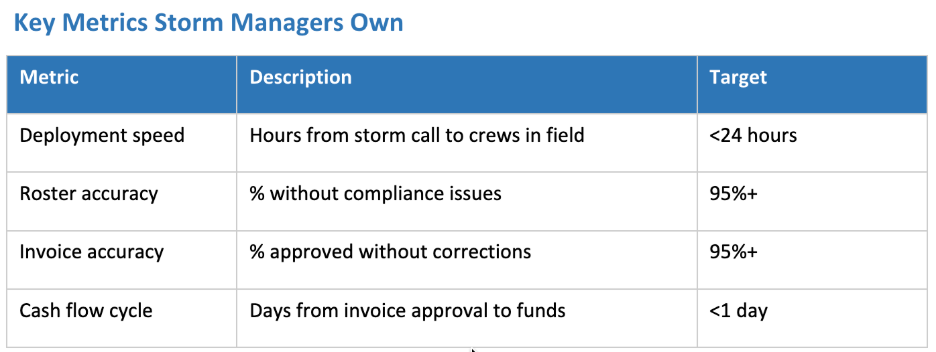
Key metrics storm managers own

Major Challenges Storm Managers Face

  • Challenge 1: Manual Onboarding

Linemen fill out the same W-4, I-9 forms for every event. 30 min/worker × 100 = 50 hours admin per event. 6 storms/year = 300 hours lost productivity.

Solution: Automated onboarding retains profiles and auto-populates documents. Workers complete in minutes.

  • Challenge 2: Timesheet Errors

100+ workers × multiple days = 300-500+ entries. Manual entry creates transcription errors, missing approvals, and duplicates.

Solution: Mobile timekeeping apps with pre-loaded rosters and auto-rates helps catch errors immediately.

  • Challenge 3: Invoice Compilation

$500K invoice = extract hours from 100+ timesheets, lookup rates, apply multipliers, add charges. All manuals in spreadsheets.

Solution: Auto-generation. System calculates totals, applies rates, and formats. Review + submit in 15 minutes.

  • Challenge 4: Cash Flow Delays

Waiting 60-90 days while payroll due in 7-14 days. Contractors delay payments or take out expensive loans.

Solution: Invoice factoring with 24-hour funding. Submit from platform, receive 85%+ next business day.
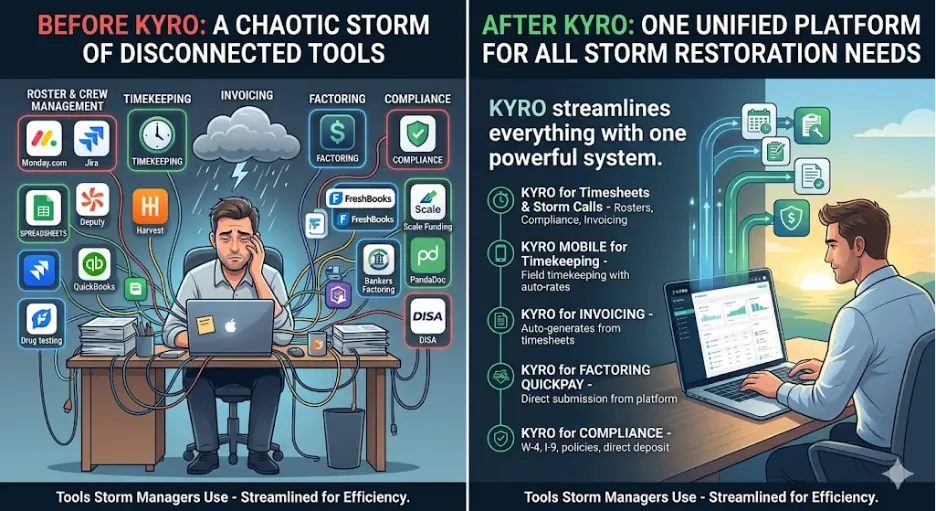
The Modern Storm Manager's Advantage

Modern Storm Manager Advantage - KYRO AI
Modern Storm Manager Advantage

Most storm contractors don’t have a centralized digital system. They usually have a stack of tools, legacy systems, and siloed platforms. Tools like Monday.com or Jira for tracking, Deputy for timekeeping, QuickBooks for invoicing, PandaDoc for documents, plus spreadsheets and texts to hold it all together. None of them connect. Data gets re-entered, errors slip through, and managers spend 40–50% of their time chasing updates instead of running operations.  

That fragmentation slows deployment, increases invoice errors, and stretches payment cycles.  

KYRO AI replaces the stack with a single operational system – a modern storm response software. Rosters, compliance, time, invoicing, and payments all connected, so nothing falls through, and nothing needs to be rebuilt twice. They deploy faster, maintain higher accuracy, and solve cash flow in 24 hours vs. 60 days.

The role remains operationally intense, but modern systems like KYRO AI free managers to focus on strategy, relationships, and execution rather than data entry.

How KYRO AI Changes Storm Operations

KYRO AI connects every step of storm response, so planning, hiring, execution, and payments move as one system, not separate tasks.

  • Predict failures before they happen using ArcGIS-powered mapping data, identifying high-risk assets and likely outage zones so crews are staged where they’re actually needed  
  • Automatically validate crew credentials with KYRO Verified (CDL, medical, compliance) in seconds, eliminating onboarding delays and ensuring only deployment-ready workers make it to the roster  
  • Flag compliance gaps early like missing documents, expired certifications before they block deployment  
  • Surface deployment-ready crews instantly with KYRO Verified badges, helping storm managers finalize rosters faster and with confidence  
  • Build full rosters in 2 minutes, not hours, with bulk storm calls sent via SMS, email, and push notifications, so linemen can accept and get storm-ready in just 2 clicks  
  • Track exactly who was deployed, where, and what was delivered, giving full visibility without chasing updates across tools  
  • KORY, KYRO’s AI agent, handles your repetitive tasks instantly, from data entry and document checks to invoice preparation—cutting hours of manual work down to seconds  
  • KYRO Capital bridges the cash flow gap by connecting contractors to funding partners and enabling fast invoice factoring, so payroll and operations don’t stall waiting on Net 30/60/90 cycles  

KYRO AI doesn’t change the responsibility. It gives storm managers the speed, accuracy, and control to run the entire operation without friction.  

Final Take

Storm managers don’t just run crews. They run the entire operation, from first call to final payment, under constant pressure. The teams that win are the ones that execute fast, clean, and without friction.

See how the KYRO AI storm restoration platform works in real scenarios. Register for the live webinar now.


FAQ

What's the difference between a storm manager and a dispatcher?

A dispatcher sends crews and manages routing. A storm manager owns all infrastructure: hiring, compliance, invoicing, and payment. A dispatcher may report to a storm manager.

How long does a typical storm restoration take?

Deployment: within 24 hours. Active restoration: 3-7 days. Invoicing/payment: 1-90 days depending on utility terms and factoring.

What qualifications do storm managers need?

No single certification is required. Success requires 3+ years in operations/construction, strong spreadsheet/PM skills, compliance experience, and high-pressure management ability. PMP/CMAA credentials are valuable but optional.

Do storm managers work year-round?

Seasonal: hurricane (June-Nov) and winter storms (Nov-Mar). Larger contractors may have year-round positions. Off-season involves hiring, setup, and vendor management.

What is the salary range?

$55,000-$95,000 annually depending on the region, company size, and experience. Seasonal roles may be $30-50/hour + bonuses.

How do compliance systems work?

Platforms like KYRO AI StormShield store worker documents, centrally. During registration, the system flags expired certifications, missing docs, or failed checks. Real-time validation prevents non-compliant deployments.


Who Is a Storm Manager? Roles, Tools & AI in Storm Response

April 22, 2026
3 min read
April 27, 2026
David Garcia
Product Manager
Author
David Garcia
Product Manager
Contributor
Srinivas N G
Product Manager

A storm manager is an operations lead who coordinates the rapid deployment of 50-500+ IBEW linemen during power restoration emergencies. They manage hiring, onboarding, compliance, crew deployment, timekeeping, invoicing, and payment collection, all under extreme time pressure.

Storm broker markups reach 20–30% of total storm recovery costs—on a $1B event, that's $200–300M passed to ratepayers. Integrated platforms cut broker dependency and protect ratepayers.

What Is a Storm Manager?

A storm manager is an operations lead at a contractor managing mobilization and crew deployment during power restoration emergencies. They own all operational coordination: hiring, compliance, invoicing, and payment management.

In prime contractors, storm managers manage rosters that grow from zero to hundreds of workers in just a few hours.

Both roles operate under identical constraints: speed, accuracy, compliance, and cash flow.

Core Responsibilities: What Storm Managers Actually Own

A storm manager doesn’t handle a single function. They run the entire operation, from building the crew to getting the final invoice paid. Every step is time-bound, compliance-driven, and financially exposed. There is no buffer. What gets missed early shows up later as delays, rework, or lost revenue.

1. Roster Building and Worker Hiring (Hours 0–24)

When a storm call comes in, the timeline compresses immediately. A storm manager typically has less than a few hours to build a complete, deployable roster.

This isn’t just about filling headcount. It’s about assembling a workforce that can clear compliance, mobilize on time, and match the job requirements. Workers are filtered in real time based on IBEW and other union membership, CDL status, medical card validity, availability, and classification, whether they are journeymen, apprentices, or groundmen.

The volume is high and the margin for error is low. One wrong approval or missed check doesn’t stay isolated. It affects deployment, compliance, and eventually billing.

2. Onboarding and Compliance Documentation

Before any crew is cleared to deploy, documentation has to be complete. There are no shortcuts here.

Each worker must submit and verify W-4 forms, I-9 employment eligibility verification (USCIS), policy acknowledgments, direct deposit details, drug and alcohol testing through DISA, and ClearingHouse verification for CDL compliance (FMCSA). Union workers must meet IBEW credentialing standards

At scale, this becomes operationally heavy. A 100-person crew means 100 complete sets of documents. And the rules are strict. Miss a single I-9, and that worker cannot be deployed.

This is where many operations slow down. Compliance is often treated as paperwork, but in reality, it’s a hard operational gate. If it’s not complete, nothing moves forward.

3. Crew Deployment and Field Operations

Once crews are approved, the focus shifts to execution. This is where planning meets reality.

Storm managers assign teams to specific locations, issue notice-to-proceed confirmations, and deploy crews into active storm zones. Conditions change quickly. Roads' flood, access points close, and new outages are reported, so crews are constantly rerouted based on real-time updates.

At the same time, field operations generate a steady stream of data. Supervisors submit timesheets; approvals are tracked daily, and work locations are validated to ensure crews are operating within scope.

This is also where small errors begin to compound. Incorrect hourly rates, missing approvals, or hours logged for workers not on the roster don’t just create admin issues. They delay invoicing later. What looks like a minor field error often turns into a financial bottleneck.

4. Invoice Generation and Customer Approval

Once restoration work is complete, the operational focus shifts to billing. This is not a simple handoff. It’s a detailed reconstruction of everything that happened in the field.

Storm managers compile invoices by calculating labor across classifications, pulling data from approved timesheets, adding equipment charges, and including all supporting expenses like fuel, lodging, and meals. Everything must align with the utility’s format and requirements.

The scale is significant. A single storm invoice can range from $400,000 to $2,000,000, with labor accounting for 60 to 75 percent of the total.

At this level, precision matters. A misapplied rate, a missed overtime entry, or a duplicate line item can cost thousands or trigger a rejection that sends the invoice back for rework. Every correction adds time, and every delay push payment further out.

5. Payment and Cash Flow Management

This is where financial pressure becomes real.

Utilities typically operate on Net 30, Net 60, or even Net 90 payment terms. But contractors don’t have that luxury. They have different workflows. Crews need to be paid weekly or biweekly, and operational costs like tolls, fuel, equipment, and lodging are immediate.

That creates a gap that needs to be managed.

For example, a $1 million invoice on Net 60 terms means the contractor carries that cost for two full months. Without a strategy, that kind of delay can strain payroll and limit the ability to take on additional work.

Key metrics storm managers own

Major Challenges Storm Managers Face

  • Challenge 1: Manual Onboarding

Linemen fill out the same W-4, I-9 forms for every event. 30 min/worker × 100 = 50 hours admin per event. 6 storms/year = 300 hours lost productivity.

Solution: Automated onboarding retains profiles and auto-populates documents. Workers complete in minutes.

  • Challenge 2: Timesheet Errors

100+ workers × multiple days = 300-500+ entries. Manual entry creates transcription errors, missing approvals, and duplicates.

Solution: Mobile timekeeping apps with pre-loaded rosters and auto-rates helps catch errors immediately.

  • Challenge 3: Invoice Compilation

$500K invoice = extract hours from 100+ timesheets, lookup rates, apply multipliers, add charges. All manuals in spreadsheets.

Solution: Auto-generation. System calculates totals, applies rates, and formats. Review + submit in 15 minutes.

  • Challenge 4: Cash Flow Delays

Waiting 60-90 days while payroll due in 7-14 days. Contractors delay payments or take out expensive loans.

Solution: Invoice factoring with 24-hour funding. Submit from platform, receive 85%+ next business day.

The Modern Storm Manager's Advantage

Modern Storm Manager Advantage - KYRO AI
Modern Storm Manager Advantage

Most storm contractors don’t have a centralized digital system. They usually have a stack of tools, legacy systems, and siloed platforms. Tools like Monday.com or Jira for tracking, Deputy for timekeeping, QuickBooks for invoicing, PandaDoc for documents, plus spreadsheets and texts to hold it all together. None of them connect. Data gets re-entered, errors slip through, and managers spend 40–50% of their time chasing updates instead of running operations.  

That fragmentation slows deployment, increases invoice errors, and stretches payment cycles.  

KYRO AI replaces the stack with a single operational system – a modern storm response software. Rosters, compliance, time, invoicing, and payments all connected, so nothing falls through, and nothing needs to be rebuilt twice. They deploy faster, maintain higher accuracy, and solve cash flow in 24 hours vs. 60 days.

The role remains operationally intense, but modern systems like KYRO AI free managers to focus on strategy, relationships, and execution rather than data entry.

How KYRO AI Changes Storm Operations

KYRO AI connects every step of storm response, so planning, hiring, execution, and payments move as one system, not separate tasks.

  • Predict failures before they happen using ArcGIS-powered mapping data, identifying high-risk assets and likely outage zones so crews are staged where they’re actually needed  
  • Automatically validate crew credentials with KYRO Verified (CDL, medical, compliance) in seconds, eliminating onboarding delays and ensuring only deployment-ready workers make it to the roster  
  • Flag compliance gaps early like missing documents, expired certifications before they block deployment  
  • Surface deployment-ready crews instantly with KYRO Verified badges, helping storm managers finalize rosters faster and with confidence  
  • Build full rosters in 2 minutes, not hours, with bulk storm calls sent via SMS, email, and push notifications, so linemen can accept and get storm-ready in just 2 clicks  
  • Track exactly who was deployed, where, and what was delivered, giving full visibility without chasing updates across tools  
  • KORY, KYRO’s AI agent, handles your repetitive tasks instantly, from data entry and document checks to invoice preparation—cutting hours of manual work down to seconds  
  • KYRO Capital bridges the cash flow gap by connecting contractors to funding partners and enabling fast invoice factoring, so payroll and operations don’t stall waiting on Net 30/60/90 cycles  

KYRO AI doesn’t change the responsibility. It gives storm managers the speed, accuracy, and control to run the entire operation without friction.  

Final Take

Storm managers don’t just run crews. They run the entire operation, from first call to final payment, under constant pressure. The teams that win are the ones that execute fast, clean, and without friction.

See how the KYRO AI storm restoration platform works in real scenarios. Register for the live webinar now.


FAQ

What's the difference between a storm manager and a dispatcher?

A dispatcher sends crews and manages routing. A storm manager owns all infrastructure: hiring, compliance, invoicing, and payment. A dispatcher may report to a storm manager.

How long does a typical storm restoration take?

Deployment: within 24 hours. Active restoration: 3-7 days. Invoicing/payment: 1-90 days depending on utility terms and factoring.

What qualifications do storm managers need?

No single certification is required. Success requires 3+ years in operations/construction, strong spreadsheet/PM skills, compliance experience, and high-pressure management ability. PMP/CMAA credentials are valuable but optional.

Do storm managers work year-round?

Seasonal: hurricane (June-Nov) and winter storms (Nov-Mar). Larger contractors may have year-round positions. Off-season involves hiring, setup, and vendor management.

What is the salary range?

$55,000-$95,000 annually depending on the region, company size, and experience. Seasonal roles may be $30-50/hour + bonuses.

How do compliance systems work?

Platforms like KYRO AI StormShield store worker documents, centrally. During registration, the system flags expired certifications, missing docs, or failed checks. Real-time validation prevents non-compliant deployments.

David Garcia
Product Manager

David Garcia is a Product Manager at KYRO AI, where he leads the platform’s roadmap across Storm Restoration, Vegetation Management, and Construction Management. With a background in Customer Success, he brings a field-first perspective shaped by close work with crews and operators, focusing on building AI-driven technology—like StormShield and KORY—that works in real-world conditions.

Discover more related blogs.