
.jpg)
At KYRO AI, we work with utility contractors managing some of the largest storm restoration events in the country. One pattern shows up consistently: the crews that end up in incident reports aren't the least skilled. They're the most exhausted.
When a major storm hits, utility crews work around the clock to restore power. Sixteen- and twenty-hour shifts become routine. Crews sleep in trailers, skip meals, and push through conditions that would shut down most workplaces.
That operational reality carries a serious problem most utilities still underestimate: fatigue in high-voltage environments isn't just a wellness concern. It's a safety failure, a compliance gap, and an increasingly expensive liability.
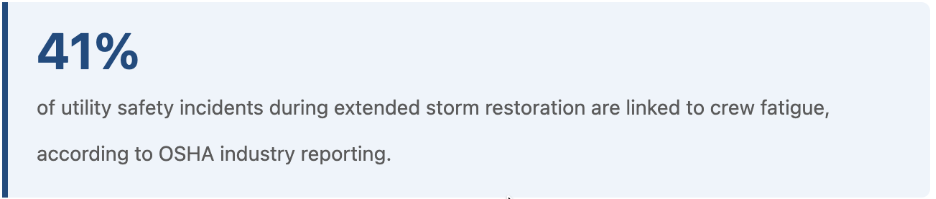
For utilities and contractors managing storm response today, crew fatigue sits at the intersection of regulatory compliance, workforce management, and legal risk.
This guide breaks down exactly what the rules require, where liability exposure is growing, and what proactive fatigue management actually looks like in practice.
Regular overtime fatigue and storm restoration fatigue are not the same thing. In normal utility operations, crews follow structured schedules with predictable recovery periods. During a major storm event, that structure disappears entirely.
Crews may travel across multiple states under mutual assistance agreements. They sleep in temporary accommodations or vehicles. Assignments change hourly. And they perform all of this in environments with live electrical infrastructure, debris fields, flood zones, and extreme weather conditions that demand sharp judgment at every step.
Research across transportation, emergency response, and industrial operations consistently shows that fatigue impairs cognitive performance at a level comparable to alcohol intoxication. In electric utility work, that level of impairment creates the conditions for arc flash incidents, falls from height, electrocution, and equipment failures.
Each factor alone is manageable. Combined over 72 or more hours, they push crews into dangerous performance territory, and the workers themselves are often the last to recognize it.
One of the most persistent myths in storm restoration is that OSHA doesn't regulate crew fatigue because there's no published maximum-hours rule for utility lineworkers. That framing is incomplete and in post-incident investigations, it consistently creates problems for utilities and contractors that relied on it.
OSHA's standard for electric power generation, transmission, and distribution work — 29 CFR 1910.269 — requires employers to ensure that employees can perform their assigned tasks safely under hazardous electrical conditions. It establishes employer responsibility for maintaining qualified worker performance and safe working environments.
The standard does not specify "a lineman cannot work more than X hours." But that absence does not mean an employer is protected when fatigue contributes to an incident.
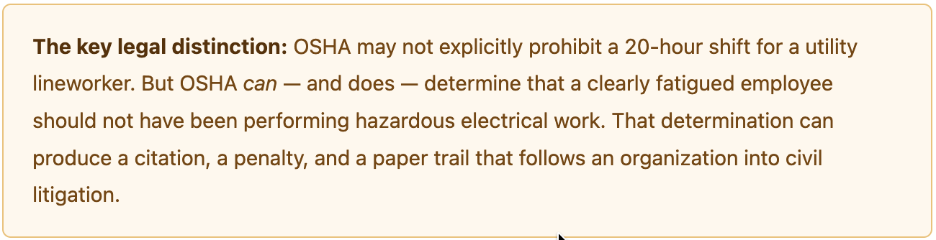
In post-incident reviews, OSHA investigators examine whether the employer knowingly allowed unsafe conditions to persist. Fatigue-related decision failures become evidence that the employer failed its duty under 1910.269, regardless of whether any specific hour limit was exceeded.
NFPA 70E addresses electrical safety from a broader human performance perspective. The standard recognizes that workers under physical or cognitive impairment are significantly more likely to make errors around energized systems and expects safety programs to account for that reality.
In practice, leading utilities now embed fatigue assessment directly into operational workflows:
When NFPA 70E's human performance principles are treated as a compliance standard rather than guidance, fatigue management becomes a documented practice rather than an informal judgment call.
Beyond OSHA and NFPA 70E, International Brotherhood of Electrical Workers agreements add another compliance layer during large restoration events. Many utility mutual assistance agreements contain provisions governing maximum work hours, mandatory rest windows, crew rotation expectations, and stop-work authority for fatigue conditions.
Contractors and utilities that override those provisions, even informally, even with good intentions about restoration speed, expose themselves to grievances, contractual disputes, and additional regulatory scrutiny on top of their existing OSHA exposure.
A common assumption in utility operations is that contractors absorb most of the liability when their crew members have incidents. During storm restoration, that assumption is increasingly difficult to sustain.
Post-incident investigators examine organizational structure and operational control, not just the immediate cause of an incident. When a utility assigns work, controls scheduling, approves continued operations under visible fatigue conditions, and maintains operational command over restoration zones, they take on a share of the risk that doesn't disappear because a contractor was the direct employer.
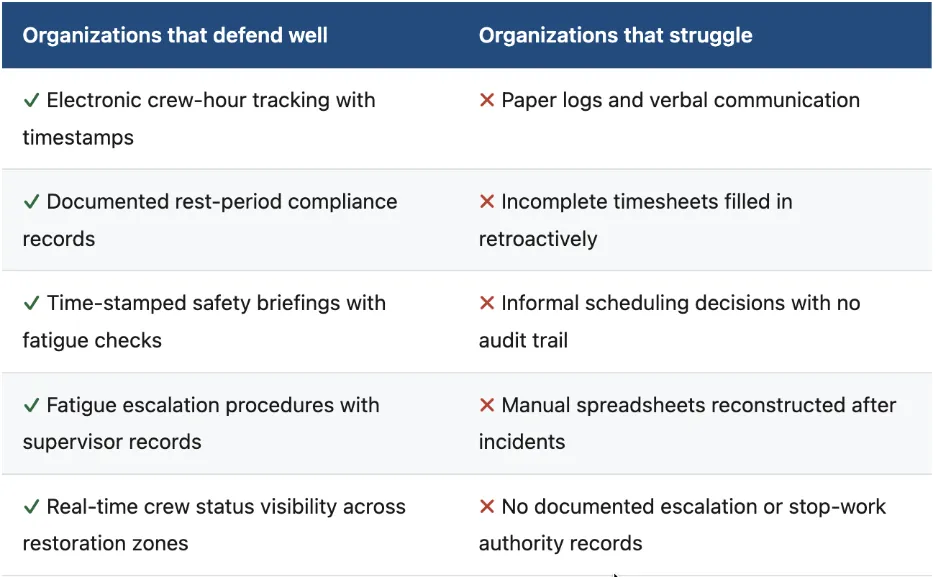
Legal teams in post-storm litigation routinely request GPS movement records, digital timesheets, dispatch logs, supervisor communications, and electronic audit trails. Reconstructed documentation, even accurate documentation, rarely performs well under that scrutiny.
The question investigators ask isn't just whether crews were fatigued. It's whether management had visibility, acted responsibly, and created the records to prove it.
Effective fatigue management during storm response isn't about slowing restoration. It's about sustaining safe restoration performance across multi-day events. Exhausted crews eventually create exactly the operational delays utilities are trying to avoid, through incidents, equipment damage, errors, and rework.
There's no single universal standard, but the thresholds leading utilities operate within look similar across the industry:
These aren't regulatory mandates, but they're operationally validated standards that reduce incident risk while maintaining restoration momentum. Utilities that document adherence to these thresholds are also the ones that tend to fare better when regulators review their storm operations afterward.
Manual fatigue tracking falls apart in large-scale storm response. Supervisors rotate. Crews move across multiple zones. Work assignments change faster than paper systems can capture.
Electronic crew tracking platforms now allow utilities and contractors to monitor cumulative work hours automatically, flag approaching threshold violations in real time, verify crew location histories, track mandatory rest periods, and maintain the kind of defensible audit trail that holds up under investigation.
For utilities managing contractor crews under mutual assistance agreements, real-time visibility into partner crew fatigue exposure is increasingly treated as an operational risk requirement rather than a convenience feature.
Pre-shift safety briefings that function as routine rituals create genuine risk. When investigators ask whether supervisors recognized fatigue indicators and whether fatigue concerns were documented, a 30-second verbal check-in provides no defensible answer.
Leading storm operations treat pre-shift briefings as timestamped operational records that capture hazard reviews, crew readiness assessments, fatigue observations, stop-work authority reinforcement, and work condition evaluations.
That transformation from ritual to record is one of the lowest-effort, highest-value improvements available in storm fatigue management.
Sustainable multi-day restoration requires structured rotation planning from the start of a major event, not as a reaction to visible exhaustion. Effective rotation programs include staggered deployment cycles, relief crew scheduling integrated with restoration progress, geographic workload balancing to reduce transit fatigue, and controlled demobilization planning that prevents late-event depletion.
Many contractors still rely on informal fatigue expectations rather than written operational policies. After a serious incident, that informality is expensive.
A defensible written fatigue management policy should clearly define five things:
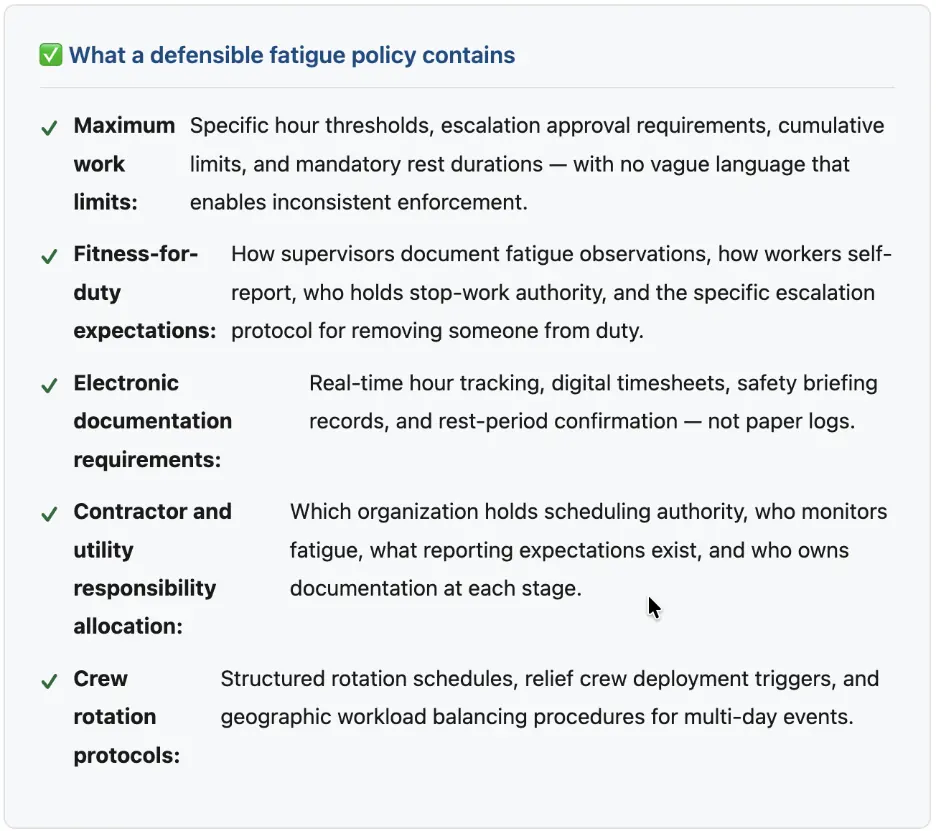
Vague policy language is routinely used against organizations after incidents. Specific, documented standards even if they set high thresholds, demonstrate proactive operational management in a way that informal expectations simply cannot.
Storm restoration procurement is evolving. Utilities now face increasing regulatory scrutiny, rising insurance premiums, and growing litigation exposure after major events. As a result, contractor selection is increasingly moving toward organizations with documented operational discipline and not just restoration speed.
Contractors who demonstrate real-time fatigue visibility, documented compliance records, electronic audit trails, and structured crew management programs are becoming preferred partners for the simple reason that they represent lower risk.
The cost of building those capabilities is measurable. The cost of not having them shows up in investigations, settlements, and contract losses that are harder to quantify in advance.
Crew fatigue in storm restoration is no longer treated as an unavoidable operational side effect. Regulators, insurers, and utilities increasingly expect organizations to demonstrate that fatigued crews were identified, monitored, and managed responsibly, with clear documentation to back it up.
OSHA may not publish a specific storm restoration hour limit. But the organizations that perform best during and after major events aren't the ones that push crews the hardest. They're the ones with real-time visibility, documented compliance, and the operational discipline to manage fatigue before it becomes an incident report.
For more details on storm restoration, check out our blogs.
How many hours can a utility lineman legally work during storm restoration?
OSHA does not publish a universal maximum-hours rule for utility lineworkers. However, OSHA 29 CFR 1910.269 requires employers to ensure workers can safely perform hazardous electrical work. Most leading utilities voluntarily cap emergency shifts at 16 hours with mandatory 8-hour rest minimums. Even without a hard statutory limit, regulators can still issue a violation if a fatigued crew caused or contributed to an incident.
Does OSHA have specific fatigue rules for electric utility workers?
OSHA 29 CFR 1910.269 governs electric power generation, transmission, and distribution work. While it doesn't prescribe exact shift-hour limits, it requires employers to maintain safe conditions and qualified worker performance. OSHA investigators can determine that allowing a fatigued employee to perform hazardous electrical work violated the general duty standard — making fatigue a compliance issue even without a specific hour cap in the rule text.
Who is liable if a fatigued contractor crew has an accident during storm restoration?
Liability can extend beyond the contractor to the utility if investigators find the utility assigned work, controlled schedules, or had visibility into fatigue risk and failed to act. Post-incident investigations examine who monitored crew hours, whether rest periods were documented, and whether the utility maintained real-time crew status visibility. Utilities with operational control over restoration assignments while ignoring fatigue indicators face significant shared liability exposure.
What does NFPA 70E say about crew fatigue?
NFPA 70E addresses human performance factors in electrical safety, recognizing that workers under physical or cognitive impairment are more likely to commit errors around energized systems. Many utilities now incorporate fatigue assessments into pre-shift tailboard meetings, job briefings, and incident investigations as a direct result of these human performance principles.
What fatigue records does a utility need to maintain during storm response?
A defensible record should include: electronic crew-hour tracking with timestamps, time-stamped safety briefing records, documented rest-period compliance, supervisor fatigue observation logs, fatigue escalation procedure records, and crew location verification via GPS or dispatch logs. Paper logs and reconstructed spreadsheets rarely survive regulatory or legal scrutiny after a serious incident.
What is a reasonable shift limit for utility crews during storm restoration?
There is no single universal standard. Leading utilities commonly operate within thresholds of 16-hour maximum active work periods, 8-hour mandatory rest minimums, and 72–84-hour cumulative ceilings before a mandatory rest review. Extensions beyond these thresholds typically require documented supervisor escalation approval.
How does crew fatigue affect safety in electrical utility work?
Research consistently shows that fatigue impairs performance comparably to alcohol intoxication. In electric utility work, this elevates the risk of arc flash incidents, falls, electrocutions, and equipment failures. Industry reporting links fatigue to up to 41% of utility safety incidents during extended restoration. Fatigue degrades hazard recognition, slows reaction time, and impairs the judgment required to safely work around energized systems.

At KYRO AI, we work with utility contractors managing some of the largest storm restoration events in the country. One pattern shows up consistently: the crews that end up in incident reports aren't the least skilled. They're the most exhausted.
When a major storm hits, utility crews work around the clock to restore power. Sixteen- and twenty-hour shifts become routine. Crews sleep in trailers, skip meals, and push through conditions that would shut down most workplaces.
That operational reality carries a serious problem most utilities still underestimate: fatigue in high-voltage environments isn't just a wellness concern. It's a safety failure, a compliance gap, and an increasingly expensive liability.

For utilities and contractors managing storm response today, crew fatigue sits at the intersection of regulatory compliance, workforce management, and legal risk.
This guide breaks down exactly what the rules require, where liability exposure is growing, and what proactive fatigue management actually looks like in practice.
Regular overtime fatigue and storm restoration fatigue are not the same thing. In normal utility operations, crews follow structured schedules with predictable recovery periods. During a major storm event, that structure disappears entirely.
Crews may travel across multiple states under mutual assistance agreements. They sleep in temporary accommodations or vehicles. Assignments change hourly. And they perform all of this in environments with live electrical infrastructure, debris fields, flood zones, and extreme weather conditions that demand sharp judgment at every step.
Research across transportation, emergency response, and industrial operations consistently shows that fatigue impairs cognitive performance at a level comparable to alcohol intoxication. In electric utility work, that level of impairment creates the conditions for arc flash incidents, falls from height, electrocution, and equipment failures.
Each factor alone is manageable. Combined over 72 or more hours, they push crews into dangerous performance territory, and the workers themselves are often the last to recognize it.
One of the most persistent myths in storm restoration is that OSHA doesn't regulate crew fatigue because there's no published maximum-hours rule for utility lineworkers. That framing is incomplete and in post-incident investigations, it consistently creates problems for utilities and contractors that relied on it.
OSHA's standard for electric power generation, transmission, and distribution work — 29 CFR 1910.269 — requires employers to ensure that employees can perform their assigned tasks safely under hazardous electrical conditions. It establishes employer responsibility for maintaining qualified worker performance and safe working environments.
The standard does not specify "a lineman cannot work more than X hours." But that absence does not mean an employer is protected when fatigue contributes to an incident.

In post-incident reviews, OSHA investigators examine whether the employer knowingly allowed unsafe conditions to persist. Fatigue-related decision failures become evidence that the employer failed its duty under 1910.269, regardless of whether any specific hour limit was exceeded.
NFPA 70E addresses electrical safety from a broader human performance perspective. The standard recognizes that workers under physical or cognitive impairment are significantly more likely to make errors around energized systems and expects safety programs to account for that reality.
In practice, leading utilities now embed fatigue assessment directly into operational workflows:
When NFPA 70E's human performance principles are treated as a compliance standard rather than guidance, fatigue management becomes a documented practice rather than an informal judgment call.
Beyond OSHA and NFPA 70E, International Brotherhood of Electrical Workers agreements add another compliance layer during large restoration events. Many utility mutual assistance agreements contain provisions governing maximum work hours, mandatory rest windows, crew rotation expectations, and stop-work authority for fatigue conditions.
Contractors and utilities that override those provisions, even informally, even with good intentions about restoration speed, expose themselves to grievances, contractual disputes, and additional regulatory scrutiny on top of their existing OSHA exposure.
A common assumption in utility operations is that contractors absorb most of the liability when their crew members have incidents. During storm restoration, that assumption is increasingly difficult to sustain.
Post-incident investigators examine organizational structure and operational control, not just the immediate cause of an incident. When a utility assigns work, controls scheduling, approves continued operations under visible fatigue conditions, and maintains operational command over restoration zones, they take on a share of the risk that doesn't disappear because a contractor was the direct employer.

Legal teams in post-storm litigation routinely request GPS movement records, digital timesheets, dispatch logs, supervisor communications, and electronic audit trails. Reconstructed documentation, even accurate documentation, rarely performs well under that scrutiny.
The question investigators ask isn't just whether crews were fatigued. It's whether management had visibility, acted responsibly, and created the records to prove it.
Effective fatigue management during storm response isn't about slowing restoration. It's about sustaining safe restoration performance across multi-day events. Exhausted crews eventually create exactly the operational delays utilities are trying to avoid, through incidents, equipment damage, errors, and rework.
There's no single universal standard, but the thresholds leading utilities operate within look similar across the industry:
These aren't regulatory mandates, but they're operationally validated standards that reduce incident risk while maintaining restoration momentum. Utilities that document adherence to these thresholds are also the ones that tend to fare better when regulators review their storm operations afterward.
Manual fatigue tracking falls apart in large-scale storm response. Supervisors rotate. Crews move across multiple zones. Work assignments change faster than paper systems can capture.
Electronic crew tracking platforms now allow utilities and contractors to monitor cumulative work hours automatically, flag approaching threshold violations in real time, verify crew location histories, track mandatory rest periods, and maintain the kind of defensible audit trail that holds up under investigation.
For utilities managing contractor crews under mutual assistance agreements, real-time visibility into partner crew fatigue exposure is increasingly treated as an operational risk requirement rather than a convenience feature.
Pre-shift safety briefings that function as routine rituals create genuine risk. When investigators ask whether supervisors recognized fatigue indicators and whether fatigue concerns were documented, a 30-second verbal check-in provides no defensible answer.
Leading storm operations treat pre-shift briefings as timestamped operational records that capture hazard reviews, crew readiness assessments, fatigue observations, stop-work authority reinforcement, and work condition evaluations.
That transformation from ritual to record is one of the lowest-effort, highest-value improvements available in storm fatigue management.
Sustainable multi-day restoration requires structured rotation planning from the start of a major event, not as a reaction to visible exhaustion. Effective rotation programs include staggered deployment cycles, relief crew scheduling integrated with restoration progress, geographic workload balancing to reduce transit fatigue, and controlled demobilization planning that prevents late-event depletion.
Many contractors still rely on informal fatigue expectations rather than written operational policies. After a serious incident, that informality is expensive.
A defensible written fatigue management policy should clearly define five things:

Vague policy language is routinely used against organizations after incidents. Specific, documented standards even if they set high thresholds, demonstrate proactive operational management in a way that informal expectations simply cannot.
Storm restoration procurement is evolving. Utilities now face increasing regulatory scrutiny, rising insurance premiums, and growing litigation exposure after major events. As a result, contractor selection is increasingly moving toward organizations with documented operational discipline and not just restoration speed.
Contractors who demonstrate real-time fatigue visibility, documented compliance records, electronic audit trails, and structured crew management programs are becoming preferred partners for the simple reason that they represent lower risk.
The cost of building those capabilities is measurable. The cost of not having them shows up in investigations, settlements, and contract losses that are harder to quantify in advance.
Crew fatigue in storm restoration is no longer treated as an unavoidable operational side effect. Regulators, insurers, and utilities increasingly expect organizations to demonstrate that fatigued crews were identified, monitored, and managed responsibly, with clear documentation to back it up.
OSHA may not publish a specific storm restoration hour limit. But the organizations that perform best during and after major events aren't the ones that push crews the hardest. They're the ones with real-time visibility, documented compliance, and the operational discipline to manage fatigue before it becomes an incident report.

For more details on storm restoration, check out our blogs.
How many hours can a utility lineman legally work during storm restoration?
OSHA does not publish a universal maximum-hours rule for utility lineworkers. However, OSHA 29 CFR 1910.269 requires employers to ensure workers can safely perform hazardous electrical work. Most leading utilities voluntarily cap emergency shifts at 16 hours with mandatory 8-hour rest minimums. Even without a hard statutory limit, regulators can still issue a violation if a fatigued crew caused or contributed to an incident.
Does OSHA have specific fatigue rules for electric utility workers?
OSHA 29 CFR 1910.269 governs electric power generation, transmission, and distribution work. While it doesn't prescribe exact shift-hour limits, it requires employers to maintain safe conditions and qualified worker performance. OSHA investigators can determine that allowing a fatigued employee to perform hazardous electrical work violated the general duty standard — making fatigue a compliance issue even without a specific hour cap in the rule text.
Who is liable if a fatigued contractor crew has an accident during storm restoration?
Liability can extend beyond the contractor to the utility if investigators find the utility assigned work, controlled schedules, or had visibility into fatigue risk and failed to act. Post-incident investigations examine who monitored crew hours, whether rest periods were documented, and whether the utility maintained real-time crew status visibility. Utilities with operational control over restoration assignments while ignoring fatigue indicators face significant shared liability exposure.
What does NFPA 70E say about crew fatigue?
NFPA 70E addresses human performance factors in electrical safety, recognizing that workers under physical or cognitive impairment are more likely to commit errors around energized systems. Many utilities now incorporate fatigue assessments into pre-shift tailboard meetings, job briefings, and incident investigations as a direct result of these human performance principles.
What fatigue records does a utility need to maintain during storm response?
A defensible record should include: electronic crew-hour tracking with timestamps, time-stamped safety briefing records, documented rest-period compliance, supervisor fatigue observation logs, fatigue escalation procedure records, and crew location verification via GPS or dispatch logs. Paper logs and reconstructed spreadsheets rarely survive regulatory or legal scrutiny after a serious incident.
What is a reasonable shift limit for utility crews during storm restoration?
There is no single universal standard. Leading utilities commonly operate within thresholds of 16-hour maximum active work periods, 8-hour mandatory rest minimums, and 72–84-hour cumulative ceilings before a mandatory rest review. Extensions beyond these thresholds typically require documented supervisor escalation approval.
How does crew fatigue affect safety in electrical utility work?
Research consistently shows that fatigue impairs performance comparably to alcohol intoxication. In electric utility work, this elevates the risk of arc flash incidents, falls, electrocutions, and equipment failures. Industry reporting links fatigue to up to 41% of utility safety incidents during extended restoration. Fatigue degrades hazard recognition, slows reaction time, and impairs the judgment required to safely work around energized systems.

Rabiya Farheen is a content strategist and a writer who loves turning complex ideas into clear, meaningful stories, especially in the world of utility, tech, AI, and B2B SaaS. She works closely with growing teams to create content that doesn’t just check SEO boxes, but actually helps people understand what a product does and why it matters. With a knack for research and a curiosity that never quits, Rabiya dives deep into industry trends, customer pain points, and data to craft content that feels super helpful and informative. When she’s not writing, she’s probably reading, painting, and exploring her creative side— or you'll find her hustling around for social causes, especially those that empower girls and women.