.jpg)
Outage management begins long before the skies clear. TThe storm passes at 3 AM, and inside a utility's Emergency Operations Center, the phones are already ringing. Outage management systems are lighting up with thousands of customer-reported faults. Field operations supervisors are waiting for word on when crews can safely enter damaged areas. Mutual aid partners are waiting to be activated. Regulators will expect an estimated restoration time (ETR) by morning. And somewhere out there, lineworkers who have already been awake for 18 hours are staged at a yard, waiting for the signal to drive into whatever the storm left behind.
Everything that happens in the next 24 hours will either compress the restoration timeline or extend it. In reality, most of that leverage lies in the first six hours, when every decision shapes how quickly, safely, and efficiently power can be restored.
Key Takeaways
The first 24 hours is where that preparation either pays off or fails publicly, in front of regulators, customers, and the media simultaneously.
A utility's storm declaration is not a bureaucratic label. It is the operational trigger that unlocks everything else including the processes and systems that support effective outage management throughout the restoration effort.
The moment a utility formally declares a storm event, several things happen in parallel:
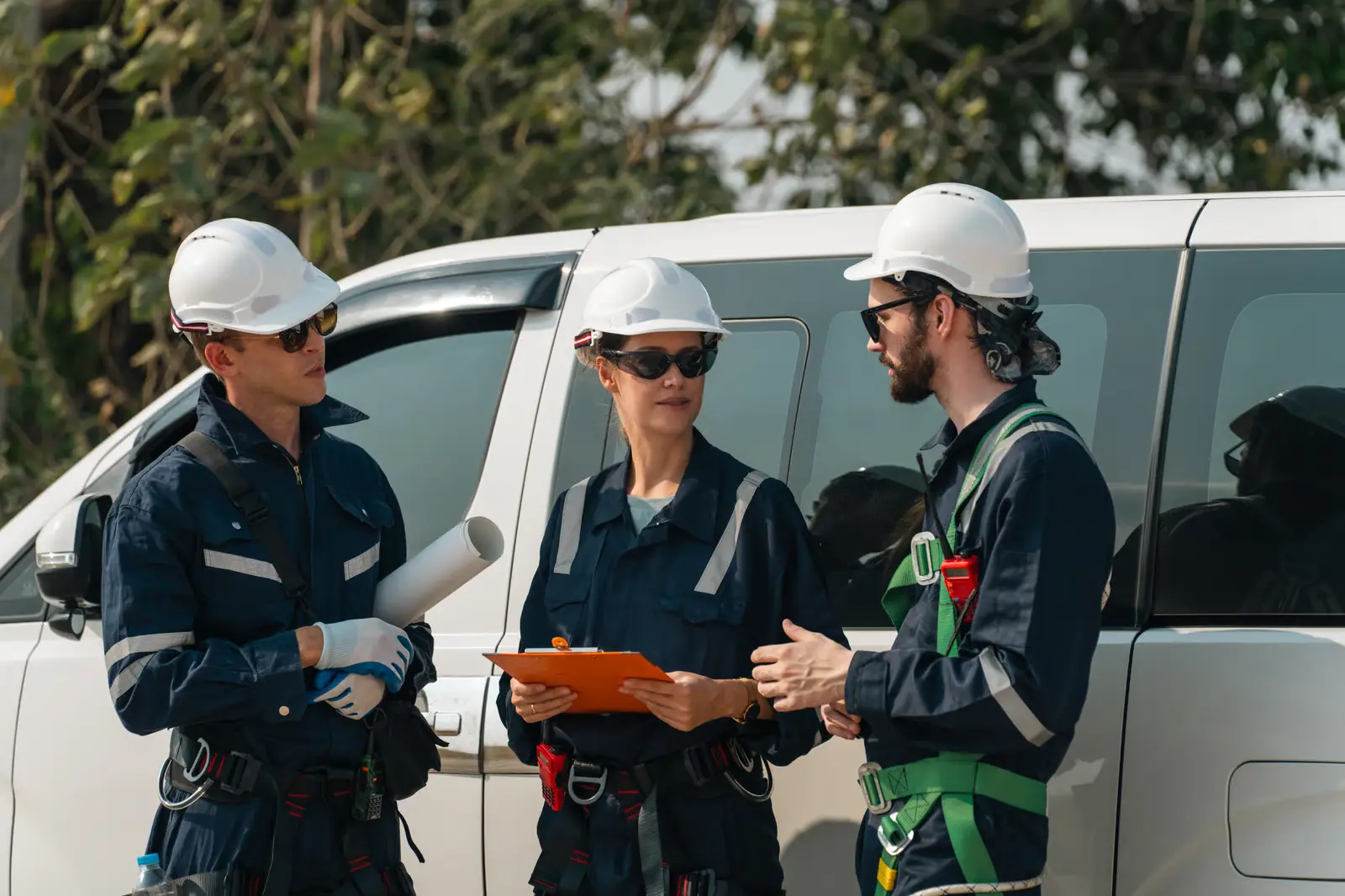
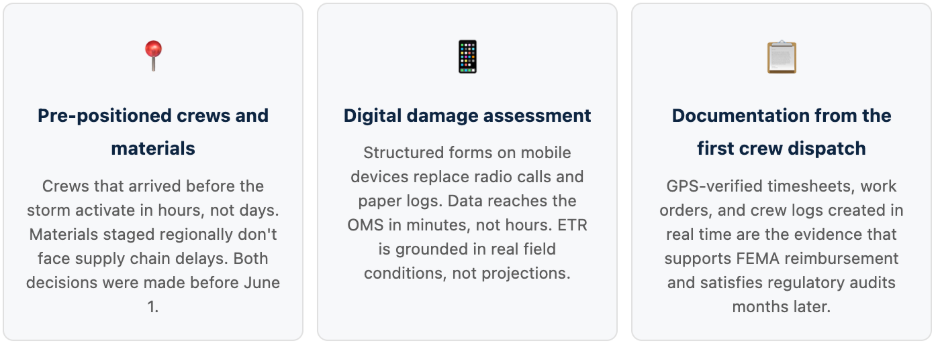
Utilities that made pre-season agreements with contractors to have qualified lineworkers staged in regional yards before the storm hit, get activated immediately at this point. There is no recruitment, no credential verification scramble, no onboarding delay. They are already in place, credentialed, briefed on the utility's systems, and waiting for the order.
Utilities without pre-positioned crews typically face a 3 to 5-day delay just assembling and onboarding crews after impact.
These are the days during which customers remain in the dark and regulators are asking for ETRs a utility cannot yet produce. Strong outage management depends on having the right people, resources, and decision-making structures in place before the first crew is dispatched.
The Incident Command System - ICS framework is not optional during major events. ICS assigns clear roles. Incident Commander, Operations Section Chief, Logistics, Finance, Planning and prevents the coordination failures that cost hours when hundreds of crews need clear direction simultaneously.
Effective outage management relies on this structure to ensure information, resources, and restoration activities remain aligned from the Emergency Operations Center to the field.
Effective outage management depends on accurate damage assessments. Utilities can't restore what they haven't assessed. But damage assessments can't begin until the storm has passed, roads are safe, and crews can reach affected areas. Every minute spent gathering information delays restoration.
For many utilities, the process still looks like this:
Only then can dispatchers determine which outages to tackle first and where available crews should be sent.
In reality, damaged roads, debris, and exhausted crews often stretch initial damage assessments to 12 to 24 hours. The quality of that first wave of information influences every restoration decision that follows.
The difference between restoring power in 12 hours versus 72 hours often comes down to one thing: operational visibility. Effective outage management depends on utilities having a real-time view of evolving field conditions, crew locations, and restoration priorities.
Utilities need real-time answers to questions like:
Without that visibility, storm restoration and outage management becomes a series of educated guesses.
Leading utilities are shrinking this assessment window by modernizing outage management with connected technologies.
Instead of relying solely on trucks and radio calls, they combine traditional inspections with:
This allows dispatch teams to see developing conditions almost immediately instead of waiting hours for updates. With faster, more accurate information flowing into the outage management process, utilities can prioritize repairs, deploy crews more efficiently, and restore power sooner.
Delayed information is one of the biggest obstacles to effective outage management. The challenge isn't just collecting damage information. It's moving that information quickly.
Paper forms, handwritten notes, and radio communications introduce delays, transcription errors, and missing details. Those gaps often lead to inaccurate restoration priorities and unreliable Estimated Time of Restoration (ETR) updates.
Digital field capture changes that equation. Damage assessments entered on a mobile device can flow directly into the Outage management systems (OMS) within minutes, giving operations teams a much clearer picture of the restoration effort.
Lakeland Electric experienced this during Hurricane Irma. Using a newly implemented OMS, four operators and two field dispatchers restored power to about 60,000 customers within 48 hours, with the remaining 30,000 customers restored within 12 days.
The utility credited much of that success to having real-time operational visibility across the restoration effort.
Every restoration effort follows a priority sequence that reflects both regulatory obligations and the principles of effective outage management. The sequence isn't arbitrary. It's designed to minimize life-safety risks first, restore the infrastructure that enables everything else, and then bring power back to the greatest number of customers as quickly as possible.
Restoring transmission restores power to multiple feeders simultaneously. No distribution restoration is possible until the transmission source is energized. This is always the first operational priority.
Hospitals, Emergency Operations Centers, water treatment plants, and dialysis centers come next. Regulatory requirements and the potential impact on public safety make these facilities a non-negotiable priority.
Nursing homes, gas stations, grocery stores, schools designated as evacuation shelters, and communications infrastructure follow. During Hurricane Irma, Florida Power & Light (FPL) restored 100% of hospital and Emergency Operations Center accounts before addressing general residential circuits.
Distribution feeders serving the largest number of customers are restored before individual laterals. A 10-minute repair on a main feeder may restore power to 2,000 customers, while the same crew might restore service to only one customer by repairing an individual service line.
These are addressed last. They are also the most time-consuming repairs per customer restored and are more likely to require full equipment replacement rather than repairs. Rural and remote customers often wait the longest for this reason.
This structured approach is why customers sometimes see their neighbors' lights come back on before theirs, even when crews appear to be working nearby. The configuration of the electrical distribution system, not geographic proximity, determines restoration order.
Clear communication of these outage management priorities in the first estimated restoration time (ETR) update helps set realistic expectations, reduce customer frustration, and build trust during the most critical hours after a major storm.
Major storm events exceed any single utility's internal restoration capacity. That's not a failure of planning. It's an expected characteristic of catastrophic events, which is why outage management strategies rely heavily on mutual aid. The electric industry's mutual assistance network allows utilities to rapidly expand their workforce when every hour counts.
The Eastern Interconnection has one of the strongest mutual aid networks in the world. It is built on the Edison Electric Institute's mutual assistance program and supported by IBEW agreements that allow crews to move across state lines quickly under standardized rules.
But mutual aid's effectiveness in the first 24 hours depends entirely on decisions made before the storm arrives. Pre-positioned crews don't need recruitment, onboarding, or crew assembly. They're in place, trained, briefed on the utility's protocols, and ready to work. A utility without pre-positioned crews faces 3 to 5 days of delay just assembling and onboarding crews after impact.
By hours 12 to 24, outage management shifts from initial response to restoration planning and customer communication. Every stakeholder who matters to a utility's long-term regulatory standing is asking the same question: When will power be restored?
The answer has to come from actual field data.
Best practice utilities determine global estimated restoration times and disseminate that information within 24 to 48 hours. Utilities that issue ETRs before they have the damage data to support them consistently find themselves revising those estimates publicly, which generates regulatory scrutiny, customer trust erosion, and media coverage that compounds the operational pressure.
The documentation failure that comes back to haunt utilities
In the first 24 hours of a major storm, field documentation quality is lowest. Crews are overwhelmed, paper logs get left in trucks, radio communications go unrecorded.
This is precisely the window that FEMA reimbursement auditors and NERC compliance reviewers focus on most closely, because the contemporaneous evidence from this period is the hardest to reconstruct later.
Paper-based processes frequently fail under these conditions. For effective outage management, utilities need digital field capture platforms that work offline, synchronize automatically, and provide accurate, time-stamped records to support restoration, regulatory compliance, and post-storm audits.
The first 24 hours of outage management is where the separation between a 10-day restoration and a 23-day restoration becomes visible. But the decisions that create that separation were made weeks or months earlier: in crew pre-qualification contracts, in OMS technology investments, in pre-staged material agreements, in digital field platform configurations.
By the time the storm passes, the operational infrastructure is either in place, or it isn't. The first day just reveals which.
See how KYRO AI helps utilities strengthen outage management during the most critical hours after a major storm.
Capture field data offline, track crews with GPS verification, generate audit-ready documentation, coordinate restoration activities, and manage storm operations from a single, connected platform.

Outage management begins long before the skies clear. TThe storm passes at 3 AM, and inside a utility's Emergency Operations Center, the phones are already ringing. Outage management systems are lighting up with thousands of customer-reported faults. Field operations supervisors are waiting for word on when crews can safely enter damaged areas. Mutual aid partners are waiting to be activated. Regulators will expect an estimated restoration time (ETR) by morning. And somewhere out there, lineworkers who have already been awake for 18 hours are staged at a yard, waiting for the signal to drive into whatever the storm left behind.
Everything that happens in the next 24 hours will either compress the restoration timeline or extend it. In reality, most of that leverage lies in the first six hours, when every decision shapes how quickly, safely, and efficiently power can be restored.
Key Takeaways
The first 24 hours is where that preparation either pays off or fails publicly, in front of regulators, customers, and the media simultaneously.
A utility's storm declaration is not a bureaucratic label. It is the operational trigger that unlocks everything else including the processes and systems that support effective outage management throughout the restoration effort.
The moment a utility formally declares a storm event, several things happen in parallel:
Utilities that made pre-season agreements with contractors to have qualified lineworkers staged in regional yards before the storm hit, get activated immediately at this point. There is no recruitment, no credential verification scramble, no onboarding delay. They are already in place, credentialed, briefed on the utility's systems, and waiting for the order.
Utilities without pre-positioned crews typically face a 3 to 5-day delay just assembling and onboarding crews after impact.
These are the days during which customers remain in the dark and regulators are asking for ETRs a utility cannot yet produce. Strong outage management depends on having the right people, resources, and decision-making structures in place before the first crew is dispatched.
The Incident Command System - ICS framework is not optional during major events. ICS assigns clear roles. Incident Commander, Operations Section Chief, Logistics, Finance, Planning and prevents the coordination failures that cost hours when hundreds of crews need clear direction simultaneously.
Effective outage management relies on this structure to ensure information, resources, and restoration activities remain aligned from the Emergency Operations Center to the field.
Effective outage management depends on accurate damage assessments. Utilities can't restore what they haven't assessed. But damage assessments can't begin until the storm has passed, roads are safe, and crews can reach affected areas. Every minute spent gathering information delays restoration.
For many utilities, the process still looks like this:
Only then can dispatchers determine which outages to tackle first and where available crews should be sent.
In reality, damaged roads, debris, and exhausted crews often stretch initial damage assessments to 12 to 24 hours. The quality of that first wave of information influences every restoration decision that follows.
The difference between restoring power in 12 hours versus 72 hours often comes down to one thing: operational visibility. Effective outage management depends on utilities having a real-time view of evolving field conditions, crew locations, and restoration priorities.
Utilities need real-time answers to questions like:
Without that visibility, storm restoration and outage management becomes a series of educated guesses.
Leading utilities are shrinking this assessment window by modernizing outage management with connected technologies.
Instead of relying solely on trucks and radio calls, they combine traditional inspections with:
This allows dispatch teams to see developing conditions almost immediately instead of waiting hours for updates. With faster, more accurate information flowing into the outage management process, utilities can prioritize repairs, deploy crews more efficiently, and restore power sooner.
Delayed information is one of the biggest obstacles to effective outage management. The challenge isn't just collecting damage information. It's moving that information quickly.
Paper forms, handwritten notes, and radio communications introduce delays, transcription errors, and missing details. Those gaps often lead to inaccurate restoration priorities and unreliable Estimated Time of Restoration (ETR) updates.
Digital field capture changes that equation. Damage assessments entered on a mobile device can flow directly into the Outage management systems (OMS) within minutes, giving operations teams a much clearer picture of the restoration effort.
Lakeland Electric experienced this during Hurricane Irma. Using a newly implemented OMS, four operators and two field dispatchers restored power to about 60,000 customers within 48 hours, with the remaining 30,000 customers restored within 12 days.
The utility credited much of that success to having real-time operational visibility across the restoration effort.
Every restoration effort follows a priority sequence that reflects both regulatory obligations and the principles of effective outage management. The sequence isn't arbitrary. It's designed to minimize life-safety risks first, restore the infrastructure that enables everything else, and then bring power back to the greatest number of customers as quickly as possible.
Restoring transmission restores power to multiple feeders simultaneously. No distribution restoration is possible until the transmission source is energized. This is always the first operational priority.
Hospitals, Emergency Operations Centers, water treatment plants, and dialysis centers come next. Regulatory requirements and the potential impact on public safety make these facilities a non-negotiable priority.
Nursing homes, gas stations, grocery stores, schools designated as evacuation shelters, and communications infrastructure follow. During Hurricane Irma, Florida Power & Light (FPL) restored 100% of hospital and Emergency Operations Center accounts before addressing general residential circuits.
Distribution feeders serving the largest number of customers are restored before individual laterals. A 10-minute repair on a main feeder may restore power to 2,000 customers, while the same crew might restore service to only one customer by repairing an individual service line.
These are addressed last. They are also the most time-consuming repairs per customer restored and are more likely to require full equipment replacement rather than repairs. Rural and remote customers often wait the longest for this reason.
This structured approach is why customers sometimes see their neighbors' lights come back on before theirs, even when crews appear to be working nearby. The configuration of the electrical distribution system, not geographic proximity, determines restoration order.
Clear communication of these outage management priorities in the first estimated restoration time (ETR) update helps set realistic expectations, reduce customer frustration, and build trust during the most critical hours after a major storm.
Major storm events exceed any single utility's internal restoration capacity. That's not a failure of planning. It's an expected characteristic of catastrophic events, which is why outage management strategies rely heavily on mutual aid. The electric industry's mutual assistance network allows utilities to rapidly expand their workforce when every hour counts.
The Eastern Interconnection has one of the strongest mutual aid networks in the world. It is built on the Edison Electric Institute's mutual assistance program and supported by IBEW agreements that allow crews to move across state lines quickly under standardized rules.
But mutual aid's effectiveness in the first 24 hours depends entirely on decisions made before the storm arrives. Pre-positioned crews don't need recruitment, onboarding, or crew assembly. They're in place, trained, briefed on the utility's protocols, and ready to work. A utility without pre-positioned crews faces 3 to 5 days of delay just assembling and onboarding crews after impact.
By hours 12 to 24, outage management shifts from initial response to restoration planning and customer communication. Every stakeholder who matters to a utility's long-term regulatory standing is asking the same question: When will power be restored?
The answer has to come from actual field data.
Best practice utilities determine global estimated restoration times and disseminate that information within 24 to 48 hours. Utilities that issue ETRs before they have the damage data to support them consistently find themselves revising those estimates publicly, which generates regulatory scrutiny, customer trust erosion, and media coverage that compounds the operational pressure.
The documentation failure that comes back to haunt utilities
In the first 24 hours of a major storm, field documentation quality is lowest. Crews are overwhelmed, paper logs get left in trucks, radio communications go unrecorded.
This is precisely the window that FEMA reimbursement auditors and NERC compliance reviewers focus on most closely, because the contemporaneous evidence from this period is the hardest to reconstruct later.
Paper-based processes frequently fail under these conditions. For effective outage management, utilities need digital field capture platforms that work offline, synchronize automatically, and provide accurate, time-stamped records to support restoration, regulatory compliance, and post-storm audits.

The first 24 hours of outage management is where the separation between a 10-day restoration and a 23-day restoration becomes visible. But the decisions that create that separation were made weeks or months earlier: in crew pre-qualification contracts, in OMS technology investments, in pre-staged material agreements, in digital field platform configurations.
By the time the storm passes, the operational infrastructure is either in place, or it isn't. The first day just reveals which.
See how KYRO AI helps utilities strengthen outage management during the most critical hours after a major storm.
Capture field data offline, track crews with GPS verification, generate audit-ready documentation, coordinate restoration activities, and manage storm operations from a single, connected platform.

Rabiya Farheen is a content strategist and a writer who loves turning complex ideas into clear, meaningful stories, especially in the world of utility, tech, AI, and B2B SaaS. She works closely with growing teams to create content that doesn’t just check SEO boxes, but actually helps people understand what a product does and why it matters. With a knack for research and a curiosity that never quits, Rabiya dives deep into industry trends, customer pain points, and data to craft content that feels super helpful and informative. When she’s not writing, she’s probably reading, painting, and exploring her creative side— or you'll find her hustling around for social causes, especially those that empower girls and women.