
.jpg)
Modern Grid Hardening Requires More Than Infrastructure Upgrades
Grid hardening makes infrastructure more resistant to storm damage. But it doesn't guarantee fast recovery.
Utilities that reduce outage duration combine physical upgrades like undergrounding and pole replacement with operational systems that give real-time crew visibility, connected contractor coordination, and offline-capable field documentation.
The gap between physical hardening and operational readiness is where resilience is actually won or lost.
The U.S. power grid is under more pressure than it has ever been.
Severe storms are intensifying. Electricity demand is climbing because of data centers, industrial growth, and accelerating electrification. Regulators and customers expect faster restoration. And utilities are being asked to document every dollar they spend doing it.
The capital is flowing. According to the Edison Electric Institute, U.S. investor-owned utilities are on pace to invest nearly $208 billion in 2025 alone, part of a projected $1.1 trillion in new grid investment over the next five years.
But here is the problem most utilities do not talk about openly: you can pour billions into stronger poles, upgraded substations, and hardened conductors and still watch outages drag on for days. Not because the infrastructure failed. Because the operations failed.
Modern grid hardening has become both an infrastructure challenge and an operational one. For utilities, transmission contractors, vegetation management teams, and storm response providers, the gap between physical hardening and operational readiness is where resilience is actually won or lost.
.png)
Utilities that cut outage durations and improve reliability metrics consistently are no longer treating resilience as a single-track problem. They are building across three connected layers:
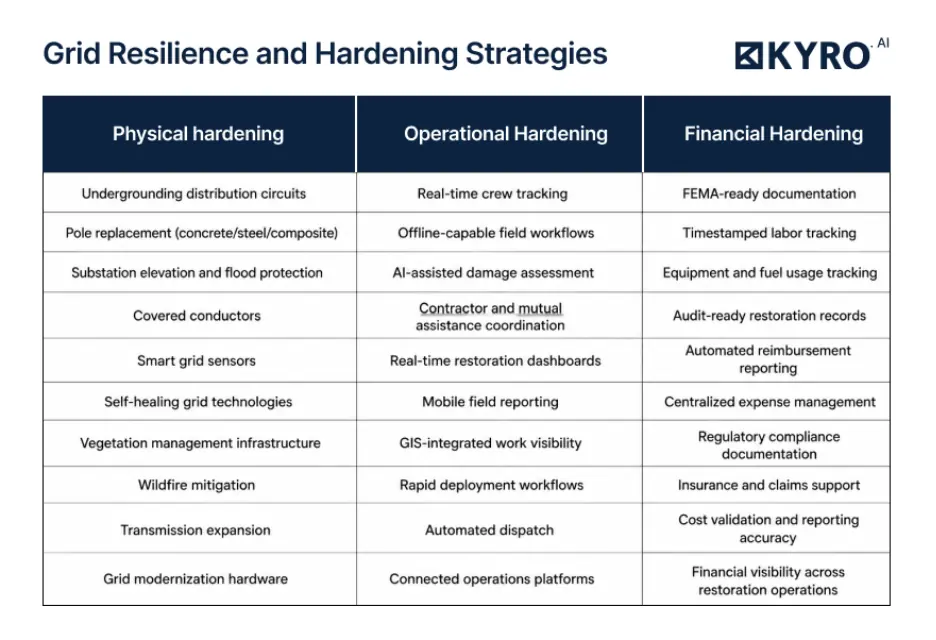
Physical hardening covers the infrastructure investments most people think of first. Undergrounding distribution circuits, replacing wooden poles with concrete or steel, elevating substations in flood zones, deploying smart grid sensors, and strengthening conductors. These reduce how much damage a storm can do.
Operational hardening covers the systems that determine how fast recovery happens once damage occurs. Real-time crew and contractor visibility, AI-assisted field reporting, offline restoration workflows, rapid damage assessment, and connected documentation.
Financial hardening covers the documentation infrastructure that protects reimbursement. Timestamped labor records, equipment usage tracking, audit-ready reporting, and FEMA-compliant workflows that are built continuously during an event rather than reconstructed afterward.
Utilities investing across all three layers recover faster, reduce outage durations, and protect more of the reimbursement dollars they legitimately earned. Most grid hardening investment today concentrates on layer one. Layers two and three are where significant performance gaps remain.
For decades, grid hardening focused almost entirely on what you could see and touch. Replacing aging poles, undergrounding distribution circuits, elevating flood-prone substations, deploying smart grid sensors, expanding vegetation management programs. Those investments remain essential.
Duke Energy's multi-year grid hardening and resilience program reduced average outage durations by roughly 27% between 2018 and 2024 in Florida, driven in part by concrete and steel pole replacements and the deployment of self-healing grid technology that can restore power in under a minute for a significant share of customers.
Yet severe weather keeps revealing the same blind spot: operational bottlenecks during restoration.
A utility can invest heavily in hardened infrastructure and still face prolonged outages because field crews cannot be tracked accurately, damage assessments are delayed, contractor coordination breaks down under scale, and leadership lacks real-time visibility into what is actually happening on the ground.
According to JD Power's 2025 U.S. Electric Utility Customer Satisfaction Study, the average length of the longest power outage increased from 8.1 hours to 12.8 hours between 2022 and mid-2025, even as physical grid investment accelerated. In the South, where utilities have spent heavily on hardening, customers who experienced extreme weather events faced average outages of 95 hours.
The result of operational failure is slower restoration, rising costs, reimbursement disputes, and eroded customer confidence, none of which stronger poles can fix. Grid resilience today depends just as much on operational coordination as it does on physical infrastructure.
.png)
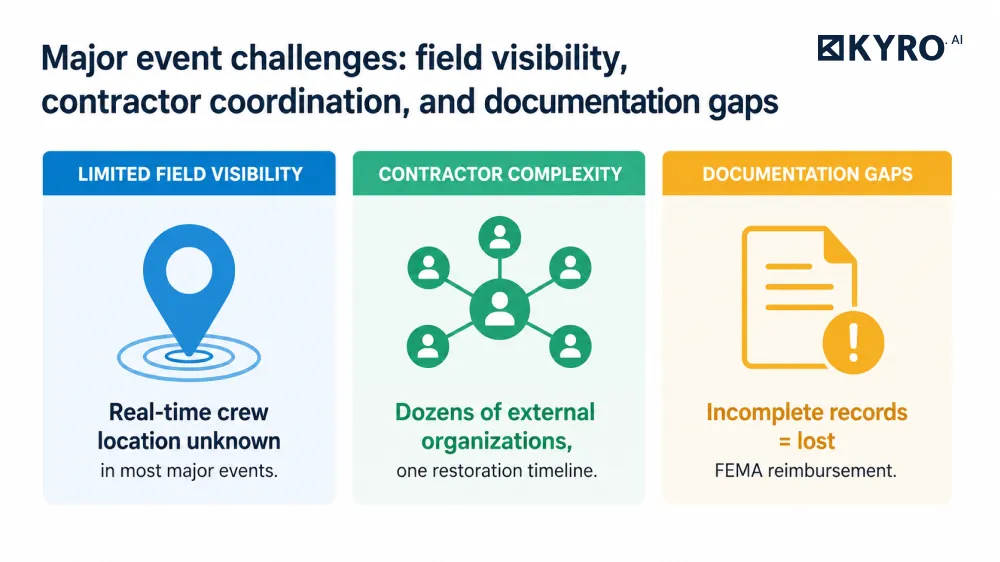
Most utility failures during major events today happen because restoration operations fragment at scale. When an event is large enough, you are simultaneously managing internal crews, subcontractors, mutual assistance teams from neighboring territories, vegetation contractors, damage assessors, and logistics providers across multiple service areas.
Limited field visibility is the most immediate problem. Utilities often cannot answer basic questions in real time:
When those answers live in text messages and spreadsheets, decision-making slows at exactly the moment it needs to be fastest. Crew mobilization delays alone can cost utilities an average of $50,000 per hour in overtime and staging expenses during large events.
Contractor and mutual assistance complexity compounds the problem. Managing labor tracking, compliance documentation, and reimbursement across dozens of external organizations becomes extremely difficult without centralized visibility, especially when crews cross multiple utility jurisdictions throughout a restoration.
For a closer look at how specialized scheduling software addresses this challenge, see KYRO AI's comparison of roster apps versus traditional scheduling for storm response teams.
Documentation gaps create financial risks long after the storm ends. Utilities must document labor hours, equipment usage, contractor activity, and restoration timelines for FEMA reimbursement, regulatory audits, and insurance claims. When that documentation is incomplete or scattered across systems, utilities risk losing reimbursements they legitimately earned, dollars that funded the response in the first place.
.png)
Artificial intelligence is being applied across the utility sector, but its most immediate operational impact is making restoration faster and documentation more reliable, not in theoretical prediction models, but in day-to-day field execution.
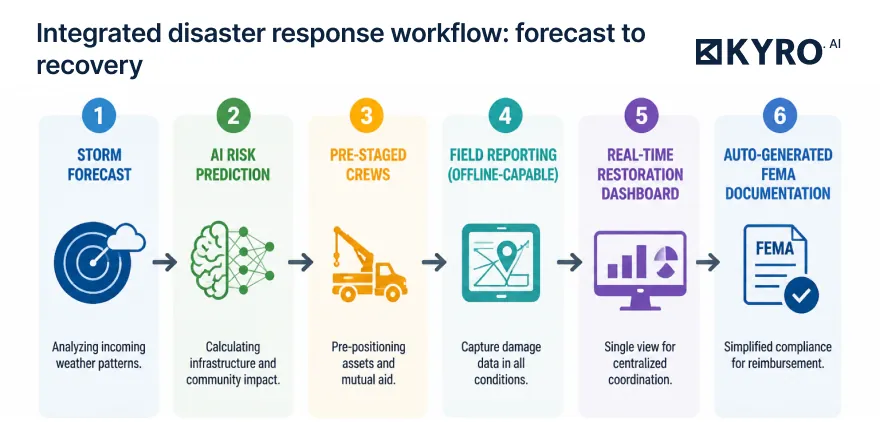
During restoration, AI helps triage incoming damage reports, track crew activity, identify stalled workflows, and flag documentation gaps in real time, instead of waiting hours for field reports to work back through layers of supervisors.
Utilities deploying AI-assisted field reporting have seen 20 to 40 percent faster restorations compared to manual workflows. For a detailed breakdown of what this looks like on the ground, see How AI Is Transforming Lineman Work During Storms.
Before storms hit, AI models analyze weather data, vegetation conditions, and asset health to identify high-risk circuits and vulnerable infrastructure allowing hardening investments to be targeted where they will have the greatest impact rather than distributed evenly across a territory. That proactive targeting capability is what separates utilities that are perpetually reactive from those that absorb storm impacts and recover quickly.
.png)
For a look at how KYRO AI's StormShield platform brings crew tracking, GIS mapping, and AI-assisted coordination into a single operational environment, 10 Storm Response Management System Features Crews Rely On is worth reading.
Vegetation-related outages remain one of the largest operational threats to distribution reliability in the U.S.
A hardened concrete pole can still fail if a tree falls on it. And vegetation encroachment is both preventable and measurable, which makes it one of the highest-return areas of grid resilience investment when managed with modern tools.
Modern vegetation management programs rely on mobile field reporting, GIS-integrated inspection workflows, digital records, and AI-assisted risk analysis to keep pace with encroachment rates and increasingly tight regulatory requirements. Static inspection schedules, paper forms, and disconnected mobile apps are no longer adequate for utilities operating under NERC FAC-003 compliance obligations and public scrutiny after wildfire and storm events.
For utilities building a combined grid hardening and vegetation management strategy, KYRO AI's Grid Hardening and Vegetation Management: A Practical Storm Resilience Strategy provides a practical starting point.
Utilities commonly operate across separate field apps, spreadsheet-based crew tracking, manual timekeeping tools, and siloed contractor management systems. That fragmentation is manageable during normal operations. During a major storm, it becomes a direct liability.
Connected operations platforms centralize field reporting, contractor coordination, crew tracking, expense management, timesheets, inspections, and restoration workflows into a single system of record. The impact is faster decision-making, stronger accountability, and FEMA documentation that is complete because it was captured continuously during the event not reconstructed afterward from memory and call logs.
KYRO AI's Storm Response Management Software 2026 Buyer's Guide evaluates the leading platforms across contractor management, offline capability, and financial workflows — a practical resource for utilities currently assessing their options.
One requirement that consistently gets underweighted in platform evaluations: offline capability. Field crews work in remote areas, disaster zones, and damaged communication environments where connectivity fails at the worst possible moment.
Operational systems that depend on continuous connectivity fail during exactly the moments utilities need them most. This is not a minor feature consideration, it is an architectural one. For a deeper look at why this matters technically, Why Storm Response Apps Fail in the Field explains the difference between an app that claims offline mode and one that is genuinely built offline-first.
For more on balancing traditional field operations with digital tools during high-pressure events, see Balancing Tradition and Technology in Storm Response.
Infrastructure investment will continue growing across transmission expansion, distribution automation, undergrounding, smart grid technologies, wildfire mitigation, and substation modernization. That capital is necessary, and the regulatory and market pressure behind it is not going away.
But the utilities that are actually cutting outage durations and improving reliability metrics are the ones building operational infrastructure alongside physical infrastructure. Real-time field visibility, connected contractor coordination, AI-assisted documentation, and offline-capable workflows are now core components of modern grid hardening strategy.
Physical hardening determines how much damage a storm can do. Operational hardening determines how fast you recover from it.
For a practical look at operational sequencing during the most critical phase of any storm event, KYRO AI's First 12 Hours of Storm Restoration Guide is a useful starting point.
KYRO AI helps utilities, contractors, and vegetation management teams modernize field operations across storm response, transmission and distribution projects, inspections, workforce coordination, and restoration workflows.
The platform delivers real-time operational visibility, digital field reporting, offline mobile workflows, contractor coordination, AI-powered documentation, timesheets, expense tracking, and centralized reporting, all within a single connected environment.
For more on storm restoration operations, vegetation management technology, and connected utility field operations, visit KYRO AI
What is grid hardening and why does it matter for storm resilience?
Grid hardening includes upgrades that make electrical infrastructure more resistant to storms and extreme weather. This includes undergrounding circuits, replacing aging poles, strengthening substations, and deploying advanced conductors. These improvements reduce outage frequency and infrastructure damage, but fast recovery also depends on operational readiness.
Why isn't physical infrastructure hardening enough to reduce outage times?
Stronger infrastructure alone does not guarantee faster restoration. Utilities still need real-time crew visibility, fast damage assessments, and connected contractor coordination. Without efficient operations, outages can last longer even on a hardened grid.
What role does AI play in utility storm restoration?
AI helps utilities prioritize damage reports, track crew activity, identify delays, and improve documentation during storm response. Before storms, AI models analyze weather and infrastructure risks to help utilities pre-stage crews and resources.
What should utilities look for in a storm response management platform?
Utilities should look for offline field functionality, real-time crew tracking, contractor coordination, digital inspections, timekeeping, and FEMA-ready documentation. Offline capability is critical because connectivity often fails during major storms.
How does vegetation management connect to grid hardening strategy?
Vegetation is one of the leading causes of power outages. Modern vegetation management programs use GIS workflows, mobile inspections, and AI-assisted risk analysis to reduce vegetation-related damage and improve storm resilience.
What is the difference between physical hardening and operational hardening?
Physical hardening strengthens infrastructure through upgrades like underground cables and concrete poles. Operational hardening improves restoration through crew tracking, contractor coordination, field reporting, and connected workflows. Both are necessary for grid resilience.

Modern Grid Hardening Requires More Than Infrastructure Upgrades
Grid hardening makes infrastructure more resistant to storm damage. But it doesn't guarantee fast recovery.
Utilities that reduce outage duration combine physical upgrades like undergrounding and pole replacement with operational systems that give real-time crew visibility, connected contractor coordination, and offline-capable field documentation.
The gap between physical hardening and operational readiness is where resilience is actually won or lost.
The U.S. power grid is under more pressure than it has ever been.
Severe storms are intensifying. Electricity demand is climbing because of data centers, industrial growth, and accelerating electrification. Regulators and customers expect faster restoration. And utilities are being asked to document every dollar they spend doing it.
The capital is flowing. According to the Edison Electric Institute, U.S. investor-owned utilities are on pace to invest nearly $208 billion in 2025 alone, part of a projected $1.1 trillion in new grid investment over the next five years.
But here is the problem most utilities do not talk about openly: you can pour billions into stronger poles, upgraded substations, and hardened conductors and still watch outages drag on for days. Not because the infrastructure failed. Because the operations failed.
Modern grid hardening has become both an infrastructure challenge and an operational one. For utilities, transmission contractors, vegetation management teams, and storm response providers, the gap between physical hardening and operational readiness is where resilience is actually won or lost.
.png)
Utilities that cut outage durations and improve reliability metrics consistently are no longer treating resilience as a single-track problem. They are building across three connected layers:

Physical hardening covers the infrastructure investments most people think of first. Undergrounding distribution circuits, replacing wooden poles with concrete or steel, elevating substations in flood zones, deploying smart grid sensors, and strengthening conductors. These reduce how much damage a storm can do.
Operational hardening covers the systems that determine how fast recovery happens once damage occurs. Real-time crew and contractor visibility, AI-assisted field reporting, offline restoration workflows, rapid damage assessment, and connected documentation.
Financial hardening covers the documentation infrastructure that protects reimbursement. Timestamped labor records, equipment usage tracking, audit-ready reporting, and FEMA-compliant workflows that are built continuously during an event rather than reconstructed afterward.
Utilities investing across all three layers recover faster, reduce outage durations, and protect more of the reimbursement dollars they legitimately earned. Most grid hardening investment today concentrates on layer one. Layers two and three are where significant performance gaps remain.
For decades, grid hardening focused almost entirely on what you could see and touch. Replacing aging poles, undergrounding distribution circuits, elevating flood-prone substations, deploying smart grid sensors, expanding vegetation management programs. Those investments remain essential.
Duke Energy's multi-year grid hardening and resilience program reduced average outage durations by roughly 27% between 2018 and 2024 in Florida, driven in part by concrete and steel pole replacements and the deployment of self-healing grid technology that can restore power in under a minute for a significant share of customers.
Yet severe weather keeps revealing the same blind spot: operational bottlenecks during restoration.
A utility can invest heavily in hardened infrastructure and still face prolonged outages because field crews cannot be tracked accurately, damage assessments are delayed, contractor coordination breaks down under scale, and leadership lacks real-time visibility into what is actually happening on the ground.
According to JD Power's 2025 U.S. Electric Utility Customer Satisfaction Study, the average length of the longest power outage increased from 8.1 hours to 12.8 hours between 2022 and mid-2025, even as physical grid investment accelerated. In the South, where utilities have spent heavily on hardening, customers who experienced extreme weather events faced average outages of 95 hours.
The result of operational failure is slower restoration, rising costs, reimbursement disputes, and eroded customer confidence, none of which stronger poles can fix. Grid resilience today depends just as much on operational coordination as it does on physical infrastructure.
.png)
Most utility failures during major events today happen because restoration operations fragment at scale. When an event is large enough, you are simultaneously managing internal crews, subcontractors, mutual assistance teams from neighboring territories, vegetation contractors, damage assessors, and logistics providers across multiple service areas.
Limited field visibility is the most immediate problem. Utilities often cannot answer basic questions in real time:
When those answers live in text messages and spreadsheets, decision-making slows at exactly the moment it needs to be fastest. Crew mobilization delays alone can cost utilities an average of $50,000 per hour in overtime and staging expenses during large events.
Contractor and mutual assistance complexity compounds the problem. Managing labor tracking, compliance documentation, and reimbursement across dozens of external organizations becomes extremely difficult without centralized visibility, especially when crews cross multiple utility jurisdictions throughout a restoration.
For a closer look at how specialized scheduling software addresses this challenge, see KYRO AI's comparison of roster apps versus traditional scheduling for storm response teams.
Documentation gaps create financial risks long after the storm ends. Utilities must document labor hours, equipment usage, contractor activity, and restoration timelines for FEMA reimbursement, regulatory audits, and insurance claims. When that documentation is incomplete or scattered across systems, utilities risk losing reimbursements they legitimately earned, dollars that funded the response in the first place.
.png)
Artificial intelligence is being applied across the utility sector, but its most immediate operational impact is making restoration faster and documentation more reliable, not in theoretical prediction models, but in day-to-day field execution.
During restoration, AI helps triage incoming damage reports, track crew activity, identify stalled workflows, and flag documentation gaps in real time, instead of waiting hours for field reports to work back through layers of supervisors.
Utilities deploying AI-assisted field reporting have seen 20 to 40 percent faster restorations compared to manual workflows. For a detailed breakdown of what this looks like on the ground, see How AI Is Transforming Lineman Work During Storms.
Before storms hit, AI models analyze weather data, vegetation conditions, and asset health to identify high-risk circuits and vulnerable infrastructure allowing hardening investments to be targeted where they will have the greatest impact rather than distributed evenly across a territory. That proactive targeting capability is what separates utilities that are perpetually reactive from those that absorb storm impacts and recover quickly.
.png)
For a look at how KYRO AI's StormShield platform brings crew tracking, GIS mapping, and AI-assisted coordination into a single operational environment, 10 Storm Response Management System Features Crews Rely On is worth reading.
Vegetation-related outages remain one of the largest operational threats to distribution reliability in the U.S.
A hardened concrete pole can still fail if a tree falls on it. And vegetation encroachment is both preventable and measurable, which makes it one of the highest-return areas of grid resilience investment when managed with modern tools.
Modern vegetation management programs rely on mobile field reporting, GIS-integrated inspection workflows, digital records, and AI-assisted risk analysis to keep pace with encroachment rates and increasingly tight regulatory requirements. Static inspection schedules, paper forms, and disconnected mobile apps are no longer adequate for utilities operating under NERC FAC-003 compliance obligations and public scrutiny after wildfire and storm events.
For utilities building a combined grid hardening and vegetation management strategy, KYRO AI's Grid Hardening and Vegetation Management: A Practical Storm Resilience Strategy provides a practical starting point.
Utilities commonly operate across separate field apps, spreadsheet-based crew tracking, manual timekeeping tools, and siloed contractor management systems. That fragmentation is manageable during normal operations. During a major storm, it becomes a direct liability.
Connected operations platforms centralize field reporting, contractor coordination, crew tracking, expense management, timesheets, inspections, and restoration workflows into a single system of record. The impact is faster decision-making, stronger accountability, and FEMA documentation that is complete because it was captured continuously during the event not reconstructed afterward from memory and call logs.
KYRO AI's Storm Response Management Software 2026 Buyer's Guide evaluates the leading platforms across contractor management, offline capability, and financial workflows — a practical resource for utilities currently assessing their options.
One requirement that consistently gets underweighted in platform evaluations: offline capability. Field crews work in remote areas, disaster zones, and damaged communication environments where connectivity fails at the worst possible moment.
Operational systems that depend on continuous connectivity fail during exactly the moments utilities need them most. This is not a minor feature consideration, it is an architectural one. For a deeper look at why this matters technically, Why Storm Response Apps Fail in the Field explains the difference between an app that claims offline mode and one that is genuinely built offline-first.
For more on balancing traditional field operations with digital tools during high-pressure events, see Balancing Tradition and Technology in Storm Response.
Infrastructure investment will continue growing across transmission expansion, distribution automation, undergrounding, smart grid technologies, wildfire mitigation, and substation modernization. That capital is necessary, and the regulatory and market pressure behind it is not going away.
But the utilities that are actually cutting outage durations and improving reliability metrics are the ones building operational infrastructure alongside physical infrastructure. Real-time field visibility, connected contractor coordination, AI-assisted documentation, and offline-capable workflows are now core components of modern grid hardening strategy.
Physical hardening determines how much damage a storm can do. Operational hardening determines how fast you recover from it.
For a practical look at operational sequencing during the most critical phase of any storm event, KYRO AI's First 12 Hours of Storm Restoration Guide is a useful starting point.
KYRO AI helps utilities, contractors, and vegetation management teams modernize field operations across storm response, transmission and distribution projects, inspections, workforce coordination, and restoration workflows.
The platform delivers real-time operational visibility, digital field reporting, offline mobile workflows, contractor coordination, AI-powered documentation, timesheets, expense tracking, and centralized reporting, all within a single connected environment.
For more on storm restoration operations, vegetation management technology, and connected utility field operations, visit KYRO AI
What is grid hardening and why does it matter for storm resilience?
Grid hardening includes upgrades that make electrical infrastructure more resistant to storms and extreme weather. This includes undergrounding circuits, replacing aging poles, strengthening substations, and deploying advanced conductors. These improvements reduce outage frequency and infrastructure damage, but fast recovery also depends on operational readiness.
Why isn't physical infrastructure hardening enough to reduce outage times?
Stronger infrastructure alone does not guarantee faster restoration. Utilities still need real-time crew visibility, fast damage assessments, and connected contractor coordination. Without efficient operations, outages can last longer even on a hardened grid.
What role does AI play in utility storm restoration?
AI helps utilities prioritize damage reports, track crew activity, identify delays, and improve documentation during storm response. Before storms, AI models analyze weather and infrastructure risks to help utilities pre-stage crews and resources.
What should utilities look for in a storm response management platform?
Utilities should look for offline field functionality, real-time crew tracking, contractor coordination, digital inspections, timekeeping, and FEMA-ready documentation. Offline capability is critical because connectivity often fails during major storms.
How does vegetation management connect to grid hardening strategy?
Vegetation is one of the leading causes of power outages. Modern vegetation management programs use GIS workflows, mobile inspections, and AI-assisted risk analysis to reduce vegetation-related damage and improve storm resilience.
What is the difference between physical hardening and operational hardening?
Physical hardening strengthens infrastructure through upgrades like underground cables and concrete poles. Operational hardening improves restoration through crew tracking, contractor coordination, field reporting, and connected workflows. Both are necessary for grid resilience.

Rabiya Farheen is a content strategist and a writer who loves turning complex ideas into clear, meaningful stories, especially in the world of utility, tech, AI, and B2B SaaS. She works closely with growing teams to create content that doesn’t just check SEO boxes, but actually helps people understand what a product does and why it matters. With a knack for research and a curiosity that never quits, Rabiya dives deep into industry trends, customer pain points, and data to craft content that feels super helpful and informative. When she’s not writing, she’s probably reading, painting, and exploring her creative side— or you'll find her hustling around for social causes, especially those that empower girls and women.