
OSHA Recordkeeping Requirements 2026: What Contractors Must Log, Report & Retain

June 19, 2026
4 min read

OSHA recordkeeping is one of the most consistently mishandled compliance areas in construction and utility contracting. Inspectors disagree. Inaccurate logs, late entries, and missed electronic submissions are among the most frequently cited recordkeeping failures, and they don't just produce standalone citations. They trigger broader inspections that find everything else.  

This guide covers what you actually need to know in 2026, in plain language, not regulatory boilerplate.

2026 OSHA penalty update:  

As of January 15, 2026, maximum penalties for Serious and Other-Than-Serious violations are $16,550 per violation. Willful or Repeated violations reach $165,514 per violation. Recordkeeping failures that reveal broader safety gaps can compound quickly.  

Who Must Keep OSHA Records: The 10-Employee Rule and Exempt Industries

Most employers with 10 or more employees must maintain OSHA injury and illness records under 29 CFR Part 1904, unless they qualify for a partial exemption based on their NAICS industry code.  

The exemptions apply to certain low-hazard industries such as retail, finance, real estate, and similar sectors with historically low injury rates.

Construction is not exempt. All construction contractors (NAICS 23) with 10 or more employees must maintain OSHA 300, 300A, and 301 records. Utility contractors, lineworkers, and vegetation management firms fall under the same requirement. There is no size-based exemption for high-hazard industries above the 10-employee threshold.

Two additional rules catch contractors off guard:
  • Multi-establishment rule: If your company has multiple locations each expected to operate for at least a year, you need a separate Form 300 log for each establishment, not one consolidated log at headquarters.
  • Supervised workers rule: If you supervise temporary or contract workers day-to-day, you record their injuries even if another company is their direct employer of record. Supervision, not just payroll, determines recording responsibility on multi-employer worksites.

OSHA Form 300 vs. 300A vs. 301: What Each Covers and When It's Required

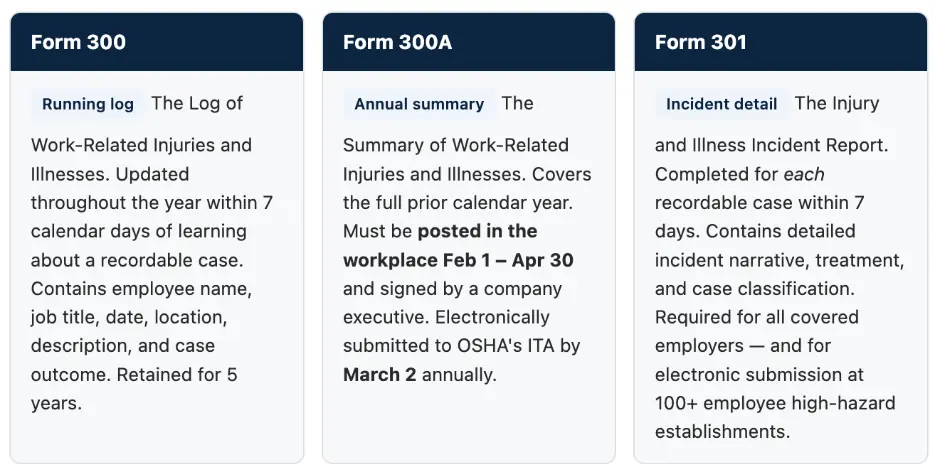
Form 300, Form 300A, Form 301

All three forms must be retained for 5 years following the end of the calendar year they cover and must be made available to employees, former employees, and authorized representatives on request.

OSHA's official recordkeeping page has the current versions of all three forms.

What Is a "Recordable Incident" — The Full OSHA Definition with Examples

The most common recordkeeping error in the field isn't a missed deadline or a forgotten signature. It's incorrect classification, logging something that shouldn't be recorded or failing to log something that should be.

Under 29 CFR 1904.7, a work-related injury or illness is recordable if it results in any of the following:

Recordable and Non-recordable incidents

The recordable vs. non-recordable line trips contractors most often on the medical treatment threshold. A worker visiting an urgent care clinic doesn't automatically produce a recordable case. The question is whether treatment went beyond the OSHA first-aid list. Prescription medication, physical therapy referrals, and sutures all push a case into recordable territory.  

Separately, three categories of serious incidents require immediate notification to OSHA by phone or online, these are reportable, not just recordable:

  • Fatality: Report within 8 hours
  • In-patient hospitalization, amputation, or loss of an eye: Report within 24 hours

OSHA E-Reporting: Which Employers Must Submit Electronically and By When

Electronic submission through OSHA's Injury Tracking Application (ITA) is mandatory for most construction and utility contractors, not optional.  

The 2026 thresholds are:
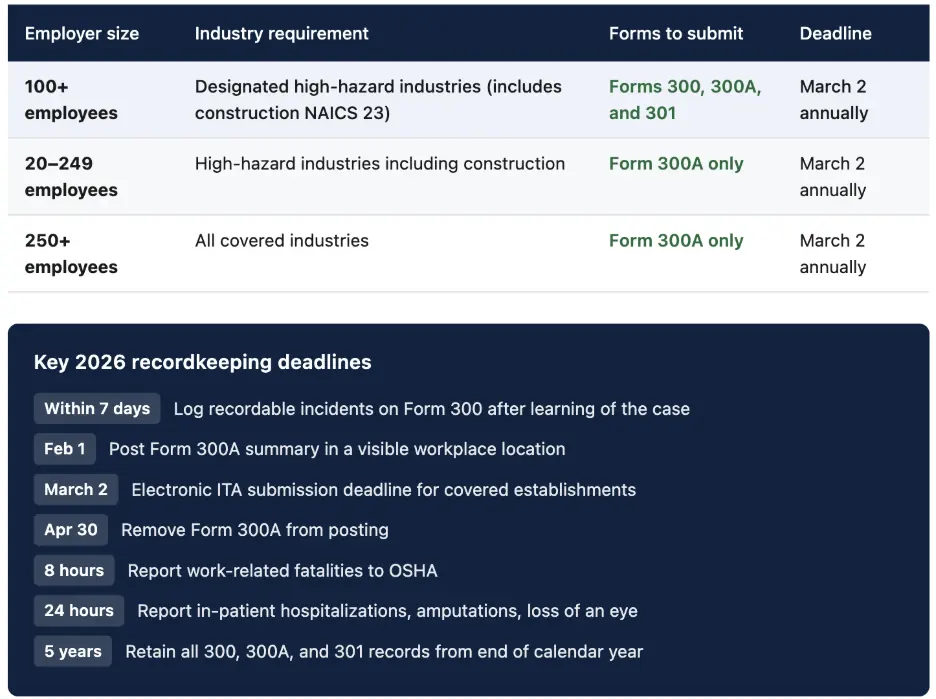
Recordkeeping deadlines you must know!

The 5 Most Common OSHA Recordkeeping Violations and How to Avoid Them

  1. Failing to log recordable incidents within 7 days  

The most common gap. Incident gets triaged, worker returns to duty, and the Form 300 entry gets forgotten until an audit surfaces the case months later.  

Fix: build a 7-day entry requirement into your incident response workflow, not as a separate step, but as part of the same process as injury reporting.  

  1. Incorrect recordable / non-recordable classification  

Misclassifying a recordable case as first-aid-only, usually because the supervisor didn't know the full treatment the worker received, produces inaccurate logs that inspectors treat as intentional under-recording. Requires a consistent case review process, not just supervisor judgment.  

  1. Missing or late Form 300A posting

Form 300A must be posted from February 1 through April 30 in a location where employees can see it. Contractors with multiple work sites often post at headquarters but miss individual project locations. Each establishment needs its own posting.  

  1. Missing electronic ITA submission deadline

The March 2 deadline applies regardless of whether your log shows zero cases. A zero-case year still requires submission. Missed submissions draw citations and, more importantly, flag your establishment for closer scrutiny in future inspection targeting. OSHA uses ITA submission data to prioritize audits in high-hazard industries.  

  1. Inadequate Form 301 case narratives

Form 301 must describe what the employee was doing, how the injury occurred, the object or substance involved, and the body part affected, in enough detail to reconstruct the incident. Generic entries like "employee injured back while working" fail this standard and produce citations on their own. More importantly, thin narratives prevent you from identifying the pattern before the next incident happens.  

How Digital Safety Forms Make Your 300 Log Audit-Ready Year-Round

The underlying problem with paper-based OSHA recordkeeping is its system design. When incident reports are filed on paper in the field, transmitted by text message to an office, entered manually into a spreadsheet, and reviewed quarterly, the 7-day window closes before anyone realizes the log needs updating.  

By the time an inspector asks for the current Form 300, it's reconstructed from memory, not contemporaneous records.

Digital field safety forms change this at the source. When a KYRO AI field form captures an incident, including the treatment details, location, and case classification, that data flows directly into a running incident log rather than sitting in a supervisor's truck.  

The 7-day clock becomes a notification, not a deadline you remember after the fact. Form 301 narratives are captured at the point of report, where detail is highest, rather than assembled weeks later.

For contractors managing large-scale utility restoration deployments or distributed construction crews, the multi-establishment recordkeeping requirement adds another layer of complexity that manual systems consistently fail. Digital platforms that assign each project or establishment its own log automatically and flag incidents for review before the 7-day window closes. That's exactly the difference between audit-ready records and reconstructed documentation that inspectors treat as a red flag.  

The same safety infrastructure that supports leading indicator tracking also produces the OSHA 300 log as a byproduct, rather than a separate administrative exercise.

OSHA 300 log compliance built into the same platform your crews already use

KYRO AI's safety module captures incident details at the point of report, generates audit-ready documentation, and keeps your Form 300 current year-round — without a separate recordkeeping workflow for field teams.

See KYRO AI's safety module →

Frequently Asked Questions

Who must keep OSHA records in 2026?

Most employers with 10 or more employees must maintain OSHA records under 29 CFR Part 1904, unless their NAICS industry code qualifies for a partial exemption. Construction (NAICS 23) is not exempt, all construction and utility contractors with 10 or more employees must maintain Form 300, 300A, and 301.

What is the difference between OSHA Form 300, 300A, and 301?

Form 300 is the running injury and illness log updated within 7 days of each recordable case. Form 301 is the detailed incident report for each individual case. Form 300A is the annual summary posted from Feb 1–Apr 30 and submitted electronically by March 2.

What makes an injury or illness OSHA recordable?

A work-related injury or illness is recordable under 29 CFR 1904.7 if it results in: days away from work, restricted work or transfer, medical treatment beyond first aid, loss of consciousness, or a significant diagnosis by a healthcare professional. First-aid-only treatment and commuting injuries are not recordable.

When must contractors submit OSHA records electronically in 2026?

The annual deadline is March 2. Construction employers with 20–249 employees submit Form 300A only. Those with 100+ employees in designated high-hazard industries must also submit Forms 300 and 301. Employers with 250+ employees in any covered industry submit Form 300A. All submissions go through OSHA's Injury Tracking Application (ITA).

OSHA Recordkeeping Requirements 2026: What Contractors Must Log, Report & Retain

June 19, 2026
4 min read
June 19, 2026
Rabiya Farheen
Content Strategist
Author
Rabiya Farheen
Content Strategist

OSHA recordkeeping is one of the most consistently mishandled compliance areas in construction and utility contracting. Inspectors disagree. Inaccurate logs, late entries, and missed electronic submissions are among the most frequently cited recordkeeping failures, and they don't just produce standalone citations. They trigger broader inspections that find everything else.  

This guide covers what you actually need to know in 2026, in plain language, not regulatory boilerplate.

2026 OSHA penalty update:  

As of January 15, 2026, maximum penalties for Serious and Other-Than-Serious violations are $16,550 per violation. Willful or Repeated violations reach $165,514 per violation. Recordkeeping failures that reveal broader safety gaps can compound quickly.  

Who Must Keep OSHA Records: The 10-Employee Rule and Exempt Industries

Most employers with 10 or more employees must maintain OSHA injury and illness records under 29 CFR Part 1904, unless they qualify for a partial exemption based on their NAICS industry code.  

The exemptions apply to certain low-hazard industries such as retail, finance, real estate, and similar sectors with historically low injury rates.

Construction is not exempt. All construction contractors (NAICS 23) with 10 or more employees must maintain OSHA 300, 300A, and 301 records. Utility contractors, lineworkers, and vegetation management firms fall under the same requirement. There is no size-based exemption for high-hazard industries above the 10-employee threshold.

Two additional rules catch contractors off guard:

  • Multi-establishment rule: If your company has multiple locations each expected to operate for at least a year, you need a separate Form 300 log for each establishment, not one consolidated log at headquarters.
  • Supervised workers rule: If you supervise temporary or contract workers day-to-day, you record their injuries even if another company is their direct employer of record. Supervision, not just payroll, determines recording responsibility on multi-employer worksites.

OSHA Form 300 vs. 300A vs. 301: What Each Covers and When It's Required

Form 300, Form 300A, Form 301

All three forms must be retained for 5 years following the end of the calendar year they cover and must be made available to employees, former employees, and authorized representatives on request.

OSHA's official recordkeeping page has the current versions of all three forms.

What Is a "Recordable Incident" — The Full OSHA Definition with Examples

The most common recordkeeping error in the field isn't a missed deadline or a forgotten signature. It's incorrect classification, logging something that shouldn't be recorded or failing to log something that should be.

Under 29 CFR 1904.7, a work-related injury or illness is recordable if it results in any of the following:

Recordable and Non-recordable incidents

The recordable vs. non-recordable line trips contractors most often on the medical treatment threshold. A worker visiting an urgent care clinic doesn't automatically produce a recordable case. The question is whether treatment went beyond the OSHA first-aid list. Prescription medication, physical therapy referrals, and sutures all push a case into recordable territory.  

Separately, three categories of serious incidents require immediate notification to OSHA by phone or online, these are reportable, not just recordable:

  • Fatality: Report within 8 hours
  • In-patient hospitalization, amputation, or loss of an eye: Report within 24 hours

OSHA E-Reporting: Which Employers Must Submit Electronically and By When

Electronic submission through OSHA's Injury Tracking Application (ITA) is mandatory for most construction and utility contractors, not optional.  

The 2026 thresholds are:

Recordkeeping deadlines you must know!

The 5 Most Common OSHA Recordkeeping Violations and How to Avoid Them

  1. Failing to log recordable incidents within 7 days  

The most common gap. Incident gets triaged, worker returns to duty, and the Form 300 entry gets forgotten until an audit surfaces the case months later.  

Fix: build a 7-day entry requirement into your incident response workflow, not as a separate step, but as part of the same process as injury reporting.  

  1. Incorrect recordable / non-recordable classification  

Misclassifying a recordable case as first-aid-only, usually because the supervisor didn't know the full treatment the worker received, produces inaccurate logs that inspectors treat as intentional under-recording. Requires a consistent case review process, not just supervisor judgment.  

  1. Missing or late Form 300A posting

Form 300A must be posted from February 1 through April 30 in a location where employees can see it. Contractors with multiple work sites often post at headquarters but miss individual project locations. Each establishment needs its own posting.  

  1. Missing electronic ITA submission deadline

The March 2 deadline applies regardless of whether your log shows zero cases. A zero-case year still requires submission. Missed submissions draw citations and, more importantly, flag your establishment for closer scrutiny in future inspection targeting. OSHA uses ITA submission data to prioritize audits in high-hazard industries.  

  1. Inadequate Form 301 case narratives

Form 301 must describe what the employee was doing, how the injury occurred, the object or substance involved, and the body part affected, in enough detail to reconstruct the incident. Generic entries like "employee injured back while working" fail this standard and produce citations on their own. More importantly, thin narratives prevent you from identifying the pattern before the next incident happens.  

How Digital Safety Forms Make Your 300 Log Audit-Ready Year-Round

The underlying problem with paper-based OSHA recordkeeping is its system design. When incident reports are filed on paper in the field, transmitted by text message to an office, entered manually into a spreadsheet, and reviewed quarterly, the 7-day window closes before anyone realizes the log needs updating.  

By the time an inspector asks for the current Form 300, it's reconstructed from memory, not contemporaneous records.

Digital field safety forms change this at the source. When a KYRO AI field form captures an incident, including the treatment details, location, and case classification, that data flows directly into a running incident log rather than sitting in a supervisor's truck.  

The 7-day clock becomes a notification, not a deadline you remember after the fact. Form 301 narratives are captured at the point of report, where detail is highest, rather than assembled weeks later.

For contractors managing large-scale utility restoration deployments or distributed construction crews, the multi-establishment recordkeeping requirement adds another layer of complexity that manual systems consistently fail. Digital platforms that assign each project or establishment its own log automatically and flag incidents for review before the 7-day window closes. That's exactly the difference between audit-ready records and reconstructed documentation that inspectors treat as a red flag.  

The same safety infrastructure that supports leading indicator tracking also produces the OSHA 300 log as a byproduct, rather than a separate administrative exercise.

OSHA 300 log compliance built into the same platform your crews already use

KYRO AI's safety module captures incident details at the point of report, generates audit-ready documentation, and keeps your Form 300 current year-round — without a separate recordkeeping workflow for field teams.

See KYRO AI's safety module →

Frequently Asked Questions

Who must keep OSHA records in 2026?

Most employers with 10 or more employees must maintain OSHA records under 29 CFR Part 1904, unless their NAICS industry code qualifies for a partial exemption. Construction (NAICS 23) is not exempt, all construction and utility contractors with 10 or more employees must maintain Form 300, 300A, and 301.

What is the difference between OSHA Form 300, 300A, and 301?

Form 300 is the running injury and illness log updated within 7 days of each recordable case. Form 301 is the detailed incident report for each individual case. Form 300A is the annual summary posted from Feb 1–Apr 30 and submitted electronically by March 2.

What makes an injury or illness OSHA recordable?

A work-related injury or illness is recordable under 29 CFR 1904.7 if it results in: days away from work, restricted work or transfer, medical treatment beyond first aid, loss of consciousness, or a significant diagnosis by a healthcare professional. First-aid-only treatment and commuting injuries are not recordable.

When must contractors submit OSHA records electronically in 2026?

The annual deadline is March 2. Construction employers with 20–249 employees submit Form 300A only. Those with 100+ employees in designated high-hazard industries must also submit Forms 300 and 301. Employers with 250+ employees in any covered industry submit Form 300A. All submissions go through OSHA's Injury Tracking Application (ITA).

Rabiya Farheen
Content Strategist

Rabiya Farheen is a content strategist and a writer who loves turning complex ideas into clear, meaningful stories, especially in the world of utility, tech, AI, and B2B SaaS. She works closely with growing teams to create content that doesn’t just check SEO boxes, but actually helps people understand what a product does and why it matters. With a knack for research and a curiosity that never quits, Rabiya dives deep into industry trends, customer pain points, and data to craft content that feels super helpful and informative. When she’s not writing, she’s probably reading, painting, and exploring her creative side— or you'll find her hustling around for social causes, especially those that empower girls and women.

Discover more related blogs.