Storm response , storm damage and restoration software

Storm Response Management Software: The 2026 Utility Buyer's Guide

April 8, 2026
11 min read

Storm response management software is a platform that helps electric utilities build rosters, coordinate and communicate with crews, map damage zones, validate contractor credentials, and document all restoration activity from a single command center. Modern platforms combine GIS mapping, offline field data capture, AI-powered crew routing, and automated FEMA compliance documentation to reduce outage duration and lower restoration costs, while supporting field decision-making under real conditions.

Here’s the uncomfortable truth: most storm response plans look solid on paper. But when a real storm hits, complexity takes over, and within hours, the plan starts to break down. The issue isn’t the plan. It’s the lack of infrastructure to support it under real conditions. As storms increase in scale and frequency, this has become a structural problem, not an occasional one.

That is why utilities are turning to storm response management software for storm damage repair and restoration, as core operational infrastructure. This guide is for the people making that call. Operations leaders, EOC managers, and field teams who need to know what actually works before they commit.

What Is Storm Response Management Software? (And What It Isn't)

Storm response management software is a purpose-built platform designed to manage the full lifecycle of a utility’s response to a major weather event.  

It spans:

  • Pre-storm preparation  
  • Crew mobilization and damage assessment  
  • Real-time coordination during restoration  
  • Post-event FEMA documentation and cost recovery

Storm response breaks down when disconnected systems like OMS, GIS, spreadsheets, and field reports fail to provide a clear, real-time view of operations.

Storm response management software is not:

  1. An Outage Management System (OMS).  

Your OMS tracks outages and customer impact on the grid. It is essential, but it is not built to manage storm logistics like crews, credentials, lodging, timesheets, and safety compliance. Storm response platforms handle this and integrate with your OMS rather than replace it.

  1. A General Field Service Management (FSM) tool.  

Platforms like ServiceNow FSM or Salesforce Field Service are strong for routine work and scheduled maintenance but not built for the complexity of a 48-hour mutual aid event with 1,000 workers from 30 different utilities.

  1. A weather prediction platform.  

Some tools exist specifically to forecast outage risk. Utility storm response software platforms incorporate predictive data, but prediction and operational response are different problems.

What the storm response management and restoration platforms actually do is sit between these systems, connecting OMS, GIS, and field data into a single operational view.

Why Legacy Storm Response Tools Fail Under Real Storm Conditions

If you've ever been in utility operations, you already know the pattern.

A storm is forecast, crews are pre-positioned, and mutual aid is set up. Then the storm hits and things get chaotic. Storm damage reports outpace assessors, outside crews need onboarding, timesheets get lost, payroll is disputed, and FEMA documentation is pieced together later from incomplete records.  

Most utilities have lived this.  

The difference between managing a storm and controlling one comes down to data flow. Legacy OMS and manual tools cannot handle the volume of real-time data from outages, crews, field reports, and assets. When data breaks down, decisions slow, crews are misassigned, duplicate work happens, and compliance risks increase.  

These are not edge cases, they are patterns repeated every storm season. The issue isn’t a lack of tools. It’s that most tools weren’t built to handle the scale, speed, and unpredictability of a major storm event in a single system.

What Features Utilities Actually Need (The Non-Negotiables)

Not all features carry equal weight. In storm response, a few capabilities are non-negotiable. Based on insights from utility operators and field teams, here are the features that matter in storm damage repair and restoration software, in short:

  1. Offline Field Data Capture
    If it does not work without internet, it will fail in a storm. True offline-first apps store data locally and sync later, preventing data loss and audit gaps.  
  1. Crew Tracking and Credential Validation
    It is not just about where crews are, but whether they are qualified. Automated validation reduces safety risks and prevents unqualified assignments.  
  1. GIS-Based Hazard Mapping
    Real-time maps matter. Conditions change fast, and dynamic hazard visibility helps dispatchers route crews safely and avoid outdated information.  
  1. Automated Timesheets and Invoicing
    Manual tracking leads to errors and disputes. Digital capture tied to work and location ensures accurate payroll, faster invoicing, and cleaner cost recovery.  
  1. Compliance Documentation
    FEMA, OSHA, and NERC requirements demand detailed records. Capturing documentation in real time avoids delays, errors, and cost disallowances.  
  1. System Integration
    A utility storm restoration platform must connect with your OMS, GIS, and other systems. Without integration, you are just adding another silo instead of solving the problem.

This is just a high-level view of what crews actually rely on when storms hit.  Explore a detailed breakdown of these capabilities in this article.  

Top Storm Response Management Software Platforms (2026)

The storm response management software market is relatively concentrated. A few platforms have significant utility customer bases; others are newer entrants with more modern architectures and AI-forward designs. Here's an honest look at the major players.

KYRO AI StormShield

KYRO AI StormShield is positioned specifically at the intersection of utility storm response, vegetation management, and construction, targeting utilities and their field service contractors as a unified operational platform. The storm response module combines GIS-powered hazard mapping (built on ArcGIS), offline-first field data capture, roster building in 2 minutes, AI-driven crew tracking, real-time credential validation, and automated timesheets and invoicing.

What distinguishes KYRO AI is the offline architecture, the breadth of the integrated workflow, and the accuracy of the data collected. Crews in the field can capture damage data, log time, complete safety forms, and update maps without connectivity, with everything syncing automatically when signal returns. The platform also covers the full event lifecycle, from pre-storm preparation through FEMA documentation, to getting paid, all within a single system.

A critical part of that workflow is invoice factoring, built directly into the platform to address one of the biggest pain points contractors face during storm work: delayed payments. Instead of waiting weeks or months for invoices to clear, contractors can access working capital in as little as 24 hours. This allows crews to keep operations running, cover payroll, mobilize additional resources, and take on more work without cash flow constraints slowing them down. By tying everything together, KYRO removes the friction between completing work and getting paid.

Contractors know how much of their earnings get eaten up by broker markups, often adding 20–30% to overall storm costs while limiting what reaches the crews on the ground.  

KYRO AI StormShield is built to change that by enabling direct contractor engagement, giving crews clearer visibility, faster payments, and a more transparent way to work without unnecessary layers in between.

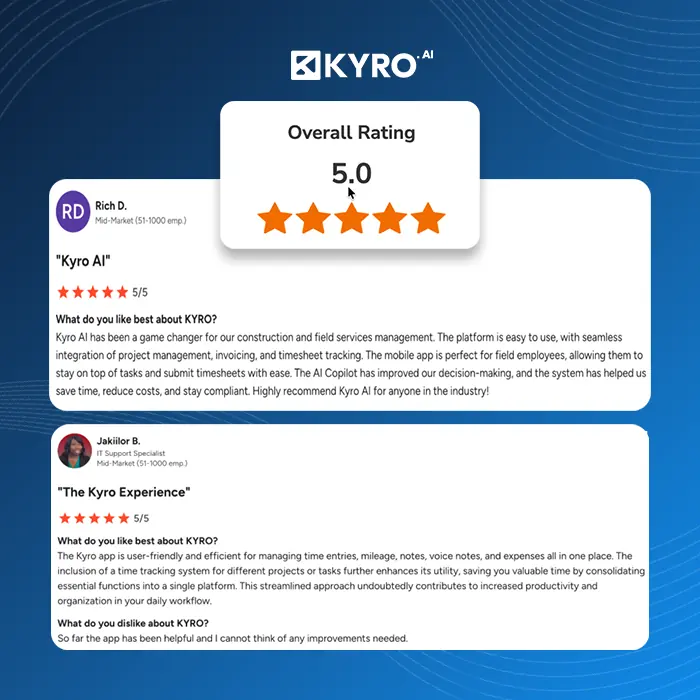
Customer testimonials highlight ease of field use, offline reliability, and integration with existing utility systems.  
Collage_1.png

Worth knowing:

KYRO AI serves utility contractors, not just utilities themselves. If your utility manages a mix of internal crews and contracted field teams, that's a relevant distinction. Many competing platforms are designed for one or the other; KYRO AI is built to span both.

KYRO AI is one of the few platforms that combines contractor management, offline-first architecture, and built-in financial workflows in a single system, something most platforms still handle across separate tools.

ARCOS Mobile Workbench and Roster Apps

ARCOS has been in the utility workforce management space for years. Their Mobile Workbench product specifically targets storm damage assessment, guiding field crews through patrol routes, capturing assessments digitally, and feeding data directly to OMS and live maps. Their stat of mobilizing field workers faster during damage assessment is cited across the industry.

Roster Apps scheduling product primarily built for airline crew management, has been extended into the utility space. It handles union rules, shift bidding, credential tracking, and timesheet automation. It's genuinely strong for scheduling compliance in complex labor environments.

Notable absence: ARCOS RosterApps has no public reviews on G2 or Capterra as of this writing. That makes independent evaluation harder than it should be, and it's worth asking for direct customer references, particularly from utilities that have used it across a major storm event.

Urbint Storm Manager

Urbint acquired WRM Software, expanding its AI-risk platform into storm response. Storm Manager connects the logistics lifecycle of a storm event. Crew mobilization, lodging, work management, financial reconciliation, in a single platform designed for utilities.

Urbint's strength is its depth of integration with existing utility risk management workflows, including its Storm Impact predictive module, which uses AI and industry forecasting to predict storm impact on the grid before events make landfall. For utilities that want their storm response platform to sit inside a broader operational risk ecosystem, Urbint has a compelling story.

Where it's less strong: Urbint's platform is enterprise-focused, and smaller utilities or utility contractors may find the implementation scope and pricing structure challenging. It's also newer to the integrated AI/mobile field operations space than some of its competitors.

Urbint has no public reviews on G2 or Capterra as of this writing.

AiDASH

AiDASH approaches storm response from a satellite and AI intelligence angle. Their strength is in pre-storm prediction: satellite imagery combined with machine learning to identify high-risk vegetation zones, predict outage locations, and recommend targeted mitigation before events make landfall. Their platform also covers post-storm damage assessments from aerial and satellite data.

AiDASH is less focused on the field-operations side, crew management, timesheets, compliance documentation, and more focused on the data intelligence layer. For utilities that have mature operational infrastructure and need better predictive and assessment intelligence layered on top, AiDASH is a strong candidate. For utilities that need an end-to-end operational platform, it's not a complete solution on its own.

Milsoft Outage Management / StormSyte

Milsoft has deep roots in cooperative utility OMS. Their StormSyte product is a web-based platform specifically for mutual aid coordination during large-scale outages. It's used by hundreds of utilities and has demonstrated ROI, with utility customers reporting that the investment pays back within just a few storm events.

Milsoft's strength is its OMS integration and its established position in the cooperative utility market. It's not the most AI-forward platform on this list, but it's proven and well-supported.
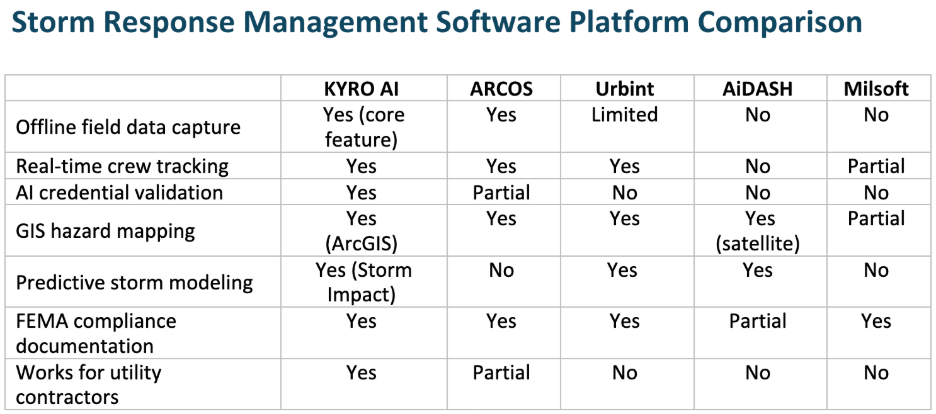
Storm Response Management Software Platform Comparison

Feature comparison for Storm Response Management Software

This comparison is based on publicly available product information and research as of April 2026. As of this analysis, KYRO AI is the only platform among those listed, having publicly available reviews on G2 and Capterra. Other vendors have no presence on these platforms.

This limits independent validation, making it important to ask for direct customer references, particularly from utilities with real storm event experience.

How to Actually Evaluate Storm Response Software

Most platforms perform well in demos. The real test is how they perform in field conditions. Here's how to evaluate beyond the demo:

  1. Ask about their last major storm deployment (Category 3 or severe ice storm). What broke, what slowed them down, and what they wish they knew beforehand.

  1. Test offline mode during your pilot. Run a full shift in airplane mode—log timesheets, damage assessments, safety forms, and photos. Reconnect and confirm everything syncs correctly, in order, to the right work orders. This is a basic requirement, not a stress test.

  1. Ask how many non-native crews it can handle at once. There’s a real difference between managing hundreds vs. Thousands. Get actual numbers from reference customers.

  1. Walk through the FEMA documentation process end-to-end. Who generates what, in what format, and has it been accepted for actual cost recovery? “FEMA-ready” isn’t the same as FEMA-approved.

  1. Clarify integration depth, not just existence. Ask which systems have live APIs, how data flows both ways, and what happens to OMS data during high-volume storm events.

  1. Pressure the implementation timeline. If storm season is in six months and rollout takes nine, it won’t help. Get real timelines.  

How AI Improves Storm Response Software Performance in the Field

AI in storm response is often overused in marketing. Its real value is operational speed and decision support. Here's what AI actually adds when it's implemented well:

  • Predictive outage modeling.  

The most useful form of AI in storm response isn't reactive, it's predictive. Platforms that combine historical outage data, vegetation proximity data, weather forecast data, and asset condition data can predict where outages are likely to occur before the storm makes landfall.  

Some U.S. utilities using these tools are predicting fuse failures during storms due to vegetation issues with more than 80% accuracy. That's not a marginal improvement. That lets you pre-position crews, pre-stage materials, and potentially perform last-minute vegetation management in high-risk areas, turning a reactive restoration into something more controlled.

  • Crew routing optimization.  

During a major event, getting crews to the right place involves dozens of competing variables: travel time, road conditions, crew qualifications, remaining fatigue hours, the impact value of different restoration circuits on overall SAIDI. Humans can't hold all of that simultaneously. AI can, and it can update routing recommendations in real time as conditions change.

  • Roster validation at scale.  

Manually verifying the credentials of 500 mutual aid workers takes time you don't have. AI-powered validation that cross-references submissions against credential databases in real time, and flags anomalies automatically, turning a days-long administrative burden into a real-time automated check.

  • After-action learning.  

Every storm is an operational data set. Platforms that analyze where response lagged, where crews were underutilized, where documentation gaps occurred, and where policy failed in practice give utility operations leaders something genuinely valuable: the ability to improve measurably from event to event rather than starting fresh each time.

One useful mental model for understanding what AI should do in storm response: think of it as a very fast, very attentive operations coordinator who never sleeps, never loses track of a data point, and never forgets to check if that credential expired last month.  

AI doesn't replace the field judgment of an experienced lineman. It replaces the administrative burden that slows that lineman down.

The Metrics That Should Drive Your Buying Decision

Storm response software is infrastructure, which means it needs to justify its cost in operational terms. Three reliability metrics matter most here.

SAIDI (System Average Interruption Duration Index) measures the average total duration of interruptions per customer. Every hour you shave off restoration time on a large-scale event moves SAIDI meaningfully.

SAIFI (System Average Interruption Frequency Index) measures how often customers experience interruptions. Pre-storm vegetation management driven by AI prediction reduces SAIFI by preventing outages before they happen.

CAIDI (Customer Average Interruption Duration Index) measures the average duration of interruptions for customers who experience them. Faster damage assessment, better crew routing, and pre-staged materials all compress CAIDI.

Read more: 8 Metrics that define a utility storm readiness score

Regulatory pressure on these metrics has increased significantly. Rate disallowance for storm recovery costs is rising, from 10-20% in the decade before 2018, to 35-40% between 2019 and 2023 per KPMG analysis. Utilities can no longer treat storm recovery as an unscrutinized expense line. Software that improves these metrics and provides the documentation to prove it isn't just operational infrastructure; it's regulatory insurance.

When evaluating platforms, ask vendors directly:  

  • What SAIDI/SAIFI/CAIDI improvements have your customers documented?  
  • Ask for pre- and post-deployment data from utilities of similar size and geography.  

The best vendors have this data. The ones who don't are worth questioning.

What Hurricane Helene and Milton Revealed

In 2024, two major storms hit the southeastern United States within weeks of each other: Hurricane Helene, a Category 4 that caused $78.7 billion in damage, and Hurricane Milton, a Category 3 that caused $34.3 billion. Together, they became a real-world stress test for utility storm response.

What they exposed was a widening gap between utilities with modern operational platforms and those still relying on legacy systems. Utilities using predictive outage modeling pre-positioned crews more effectively and restored high-priority circuits faster. During Helene, drone-based damage assessment helped map impacted areas and relay data to command centers within hours.

Milton saw over 50,000 mutual aid workers mobilized within 72 hours. Managing that scale required systems capable of coordinating thousands of external crews. Utilities that restored fastest were those already built for that level of complexity.

This isn’t about software replacing people. Linemen working long hours under extreme conditions made restoration possible. But the systems supporting them, the data, routing, and work orders, played a critical role.  

Better systems led to better decisions, and ultimately, faster restoration.

The Bottom Line

The storm response management software market is mature enough to have proven players and young enough that the technology gap between the best and worst options is still very wide.

What separates platforms that actually improve storm outcomes from platforms that look good in a procurement process is mostly about three things: how they perform offline, how they handle scale during a major mutual aid event, and how well they integrate with the systems your utility already depends on.

All platforms have genuine strengths. None of them is the right choice for every utility. The right choice depends on your size, your existing tech stack, the composition of your workforce (internal versus contracted), your storm profile (hurricane coast versus ice storm interior versus year-round fire weather), and how much operational lift you have for implementation.

What isn't a reasonable option anymore is doing nothing. Not with storm frequency and cost at current levels.  The next storm won't give you a warning. Your storm response software should.

KYRO AI provides AI-powered storm response management software for electric utilities and utility contractors. This article was researched and written independently, drawing on industry data, NOAA statistics, G2 and Capterra user research, and publicly available platform information as of April 2026.

Frequently Asked Questions

What is storm response management software?

Storm response management software is a purpose-built platform that helps electric utilities manage the full lifecycle of a major weather event – from pre-storm crew mobilization and damage assessment through FEMA cost-recovery documentation. It combines GIS mapping, offline field data capture, AI-powered crew routing, and automated compliance documentation in a single system.

How is it different from an OMS?

An Outage Management System tracks outages and customer impact on the grid. Storm response management software manages the operational side — crews, credentials, timesheets, lodging, and FEMA documentation. The two systems are complementary, not competing. Storm response platforms typically integrate with your OMS rather than replace it.

Does it work without internet?

Offline-first storm response platforms store data locally on field devices and sync automatically when connectivity returns. This is a non-negotiable requirement for utility storm work, where field crews routinely operate in areas with no cellular signal. Platforms that require constant connectivity will fail during the events they are designed to support.

How much does storm response software cost?

Pricing varies by utility size, workforce scale, and deployment scope. Most platforms use subscription-based pricing. ROI typically exceeds cost after a single major storm event through improved FEMA reimbursement, reduced broker costs, and faster restoration. Request pre- and post-deployment SAIDI/SAIFI data from vendors to quantify the operational return.

How long does implementation take?

Typically 2–6 months for basic setup, and up to 12 months for full enterprise deployment. Storm seasons do not wait for implementations — confirm the realistic timeline from reference customers, not from sales, before committing to a platform.

What integrations are required?

Storm response software typically requires integration with your Outage Management System (OMS), GIS platform such as ArcGIS, SCADA, and payroll or HR systems. Advanced deployments also integrate with ERP and NERC compliance tools. Ask vendors which integrations are live API connections versus manual exports the difference matters significantly during high-volume storm events.  

Can it reduce storm broker costs?

Yes. Platforms that enable direct contractor management remove broker intermediaries from the crew mobilization process, reducing markups that typically add 20 to 30 percent to overall storm labor costs. Direct engagement also improves crew visibility, faster payments, and cleaner documentation — all of which improve FEMA reimbursement rates.

How does invoice factoring help during storms?

Invoice factoring gives utility contractors access to working capital within 24 hours of submitting verified invoices, rather than waiting 30 to 90 days for utility payment. During storms, this allows contractors to cover crew payroll, mobilize additional resources, and take on more work without cash flow constraints stalling operations at the worst possible moment.


Storm Response Management Software: The 2026 Utility Buyer's Guide

April 8, 2026
11 min read
April 9, 2026
David Garcia
Head of Product
Author
David Garcia
Head of Product
Contributor
Srinivas N G
Product Manager

Storm response management software is a platform that helps electric utilities build rosters, coordinate and communicate with crews, map damage zones, validate contractor credentials, and document all restoration activity from a single command center. Modern platforms combine GIS mapping, offline field data capture, AI-powered crew routing, and automated FEMA compliance documentation to reduce outage duration and lower restoration costs, while supporting field decision-making under real conditions.

Here’s the uncomfortable truth: most storm response plans look solid on paper. But when a real storm hits, complexity takes over, and within hours, the plan starts to break down. The issue isn’t the plan. It’s the lack of infrastructure to support it under real conditions. As storms increase in scale and frequency, this has become a structural problem, not an occasional one.

That is why utilities are turning to storm response management software for storm damage repair and restoration, as core operational infrastructure. This guide is for the people making that call. Operations leaders, EOC managers, and field teams who need to know what actually works before they commit.

What Is Storm Response Management Software? (And What It Isn't)

Storm response management software is a purpose-built platform designed to manage the full lifecycle of a utility’s response to a major weather event.  

It spans:

  • Pre-storm preparation  
  • Crew mobilization and damage assessment  
  • Real-time coordination during restoration  
  • Post-event FEMA documentation and cost recovery

Storm response breaks down when disconnected systems like OMS, GIS, spreadsheets, and field reports fail to provide a clear, real-time view of operations.

Storm response management software is not:

  1. An Outage Management System (OMS).  

Your OMS tracks outages and customer impact on the grid. It is essential, but it is not built to manage storm logistics like crews, credentials, lodging, timesheets, and safety compliance. Storm response platforms handle this and integrate with your OMS rather than replace it.

  1. A General Field Service Management (FSM) tool.  

Platforms like ServiceNow FSM or Salesforce Field Service are strong for routine work and scheduled maintenance but not built for the complexity of a 48-hour mutual aid event with 1,000 workers from 30 different utilities.

  1. A weather prediction platform.  

Some tools exist specifically to forecast outage risk. Utility storm response software platforms incorporate predictive data, but prediction and operational response are different problems.

What the storm response management and restoration platforms actually do is sit between these systems, connecting OMS, GIS, and field data into a single operational view.

Why Legacy Storm Response Tools Fail Under Real Storm Conditions

If you've ever been in utility operations, you already know the pattern.

A storm is forecast, crews are pre-positioned, and mutual aid is set up. Then the storm hits and things get chaotic. Storm damage reports outpace assessors, outside crews need onboarding, timesheets get lost, payroll is disputed, and FEMA documentation is pieced together later from incomplete records.  

Most utilities have lived this.  

The difference between managing a storm and controlling one comes down to data flow. Legacy OMS and manual tools cannot handle the volume of real-time data from outages, crews, field reports, and assets. When data breaks down, decisions slow, crews are misassigned, duplicate work happens, and compliance risks increase.  

These are not edge cases, they are patterns repeated every storm season. The issue isn’t a lack of tools. It’s that most tools weren’t built to handle the scale, speed, and unpredictability of a major storm event in a single system.

What Features Utilities Actually Need (The Non-Negotiables)

Not all features carry equal weight. In storm response, a few capabilities are non-negotiable. Based on insights from utility operators and field teams, here are the features that matter in storm damage repair and restoration software, in short:

  1. Offline Field Data Capture
    If it does not work without internet, it will fail in a storm. True offline-first apps store data locally and sync later, preventing data loss and audit gaps.  
  1. Crew Tracking and Credential Validation
    It is not just about where crews are, but whether they are qualified. Automated validation reduces safety risks and prevents unqualified assignments.  
  1. GIS-Based Hazard Mapping
    Real-time maps matter. Conditions change fast, and dynamic hazard visibility helps dispatchers route crews safely and avoid outdated information.  
  1. Automated Timesheets and Invoicing
    Manual tracking leads to errors and disputes. Digital capture tied to work and location ensures accurate payroll, faster invoicing, and cleaner cost recovery.  
  1. Compliance Documentation
    FEMA, OSHA, and NERC requirements demand detailed records. Capturing documentation in real time avoids delays, errors, and cost disallowances.  
  1. System Integration
    A utility storm restoration platform must connect with your OMS, GIS, and other systems. Without integration, you are just adding another silo instead of solving the problem.

This is just a high-level view of what crews actually rely on when storms hit.  Explore a detailed breakdown of these capabilities in this article.  

Top Storm Response Management Software Platforms (2026)

The storm response management software market is relatively concentrated. A few platforms have significant utility customer bases; others are newer entrants with more modern architectures and AI-forward designs. Here's an honest look at the major players.

KYRO AI StormShield

KYRO AI StormShield is positioned specifically at the intersection of utility storm response, vegetation management, and construction, targeting utilities and their field service contractors as a unified operational platform. The storm response module combines GIS-powered hazard mapping (built on ArcGIS), offline-first field data capture, roster building in 2 minutes, AI-driven crew tracking, real-time credential validation, and automated timesheets and invoicing.

What distinguishes KYRO AI is the offline architecture, the breadth of the integrated workflow, and the accuracy of the data collected. Crews in the field can capture damage data, log time, complete safety forms, and update maps without connectivity, with everything syncing automatically when signal returns. The platform also covers the full event lifecycle, from pre-storm preparation through FEMA documentation, to getting paid, all within a single system.

A critical part of that workflow is invoice factoring, built directly into the platform to address one of the biggest pain points contractors face during storm work: delayed payments. Instead of waiting weeks or months for invoices to clear, contractors can access working capital in as little as 24 hours. This allows crews to keep operations running, cover payroll, mobilize additional resources, and take on more work without cash flow constraints slowing them down. By tying everything together, KYRO removes the friction between completing work and getting paid.

Contractors know how much of their earnings get eaten up by broker markups, often adding 20–30% to overall storm costs while limiting what reaches the crews on the ground.  

KYRO AI StormShield is built to change that by enabling direct contractor engagement, giving crews clearer visibility, faster payments, and a more transparent way to work without unnecessary layers in between.

Customer testimonials highlight ease of field use, offline reliability, and integration with existing utility systems.  

Collage_1.png

Worth knowing:

KYRO AI serves utility contractors, not just utilities themselves. If your utility manages a mix of internal crews and contracted field teams, that's a relevant distinction. Many competing platforms are designed for one or the other; KYRO AI is built to span both.

KYRO AI is one of the few platforms that combines contractor management, offline-first architecture, and built-in financial workflows in a single system, something most platforms still handle across separate tools.

ARCOS Mobile Workbench and Roster Apps

ARCOS has been in the utility workforce management space for years. Their Mobile Workbench product specifically targets storm damage assessment, guiding field crews through patrol routes, capturing assessments digitally, and feeding data directly to OMS and live maps. Their stat of mobilizing field workers faster during damage assessment is cited across the industry.

Roster Apps scheduling product primarily built for airline crew management, has been extended into the utility space. It handles union rules, shift bidding, credential tracking, and timesheet automation. It's genuinely strong for scheduling compliance in complex labor environments.

Notable absence: ARCOS RosterApps has no public reviews on G2 or Capterra as of this writing. That makes independent evaluation harder than it should be, and it's worth asking for direct customer references, particularly from utilities that have used it across a major storm event.

Urbint Storm Manager

Urbint acquired WRM Software, expanding its AI-risk platform into storm response. Storm Manager connects the logistics lifecycle of a storm event. Crew mobilization, lodging, work management, financial reconciliation, in a single platform designed for utilities.

Urbint's strength is its depth of integration with existing utility risk management workflows, including its Storm Impact predictive module, which uses AI and industry forecasting to predict storm impact on the grid before events make landfall. For utilities that want their storm response platform to sit inside a broader operational risk ecosystem, Urbint has a compelling story.

Where it's less strong: Urbint's platform is enterprise-focused, and smaller utilities or utility contractors may find the implementation scope and pricing structure challenging. It's also newer to the integrated AI/mobile field operations space than some of its competitors.

Urbint has no public reviews on G2 or Capterra as of this writing.

AiDASH

AiDASH approaches storm response from a satellite and AI intelligence angle. Their strength is in pre-storm prediction: satellite imagery combined with machine learning to identify high-risk vegetation zones, predict outage locations, and recommend targeted mitigation before events make landfall. Their platform also covers post-storm damage assessments from aerial and satellite data.

AiDASH is less focused on the field-operations side, crew management, timesheets, compliance documentation, and more focused on the data intelligence layer. For utilities that have mature operational infrastructure and need better predictive and assessment intelligence layered on top, AiDASH is a strong candidate. For utilities that need an end-to-end operational platform, it's not a complete solution on its own.

Milsoft Outage Management / StormSyte

Milsoft has deep roots in cooperative utility OMS. Their StormSyte product is a web-based platform specifically for mutual aid coordination during large-scale outages. It's used by hundreds of utilities and has demonstrated ROI, with utility customers reporting that the investment pays back within just a few storm events.

Milsoft's strength is its OMS integration and its established position in the cooperative utility market. It's not the most AI-forward platform on this list, but it's proven and well-supported.

Storm Response Management Software Platform Comparison

Feature comparison for Storm Response Management Software

This comparison is based on publicly available product information and research as of April 2026. As of this analysis, KYRO AI is the only platform among those listed, having publicly available reviews on G2 and Capterra. Other vendors have no presence on these platforms.

This limits independent validation, making it important to ask for direct customer references, particularly from utilities with real storm event experience.

How to Actually Evaluate Storm Response Software

Most platforms perform well in demos. The real test is how they perform in field conditions. Here's how to evaluate beyond the demo:

  1. Ask about their last major storm deployment (Category 3 or severe ice storm). What broke, what slowed them down, and what they wish they knew beforehand.

  1. Test offline mode during your pilot. Run a full shift in airplane mode—log timesheets, damage assessments, safety forms, and photos. Reconnect and confirm everything syncs correctly, in order, to the right work orders. This is a basic requirement, not a stress test.

  1. Ask how many non-native crews it can handle at once. There’s a real difference between managing hundreds vs. Thousands. Get actual numbers from reference customers.

  1. Walk through the FEMA documentation process end-to-end. Who generates what, in what format, and has it been accepted for actual cost recovery? “FEMA-ready” isn’t the same as FEMA-approved.

  1. Clarify integration depth, not just existence. Ask which systems have live APIs, how data flows both ways, and what happens to OMS data during high-volume storm events.

  1. Pressure the implementation timeline. If storm season is in six months and rollout takes nine, it won’t help. Get real timelines.  

How AI Improves Storm Response Software Performance in the Field

AI in storm response is often overused in marketing. Its real value is operational speed and decision support. Here's what AI actually adds when it's implemented well:

  • Predictive outage modeling.  

The most useful form of AI in storm response isn't reactive, it's predictive. Platforms that combine historical outage data, vegetation proximity data, weather forecast data, and asset condition data can predict where outages are likely to occur before the storm makes landfall.  

Some U.S. utilities using these tools are predicting fuse failures during storms due to vegetation issues with more than 80% accuracy. That's not a marginal improvement. That lets you pre-position crews, pre-stage materials, and potentially perform last-minute vegetation management in high-risk areas, turning a reactive restoration into something more controlled.

  • Crew routing optimization.  

During a major event, getting crews to the right place involves dozens of competing variables: travel time, road conditions, crew qualifications, remaining fatigue hours, the impact value of different restoration circuits on overall SAIDI. Humans can't hold all of that simultaneously. AI can, and it can update routing recommendations in real time as conditions change.

  • Roster validation at scale.  

Manually verifying the credentials of 500 mutual aid workers takes time you don't have. AI-powered validation that cross-references submissions against credential databases in real time, and flags anomalies automatically, turning a days-long administrative burden into a real-time automated check.

  • After-action learning.  

Every storm is an operational data set. Platforms that analyze where response lagged, where crews were underutilized, where documentation gaps occurred, and where policy failed in practice give utility operations leaders something genuinely valuable: the ability to improve measurably from event to event rather than starting fresh each time.

One useful mental model for understanding what AI should do in storm response: think of it as a very fast, very attentive operations coordinator who never sleeps, never loses track of a data point, and never forgets to check if that credential expired last month.  

AI doesn't replace the field judgment of an experienced lineman. It replaces the administrative burden that slows that lineman down.

The Metrics That Should Drive Your Buying Decision

Storm response software is infrastructure, which means it needs to justify its cost in operational terms. Three reliability metrics matter most here.

SAIDI (System Average Interruption Duration Index) measures the average total duration of interruptions per customer. Every hour you shave off restoration time on a large-scale event moves SAIDI meaningfully.

SAIFI (System Average Interruption Frequency Index) measures how often customers experience interruptions. Pre-storm vegetation management driven by AI prediction reduces SAIFI by preventing outages before they happen.

CAIDI (Customer Average Interruption Duration Index) measures the average duration of interruptions for customers who experience them. Faster damage assessment, better crew routing, and pre-staged materials all compress CAIDI.

Read more: 8 Metrics that define a utility storm readiness score

Regulatory pressure on these metrics has increased significantly. Rate disallowance for storm recovery costs is rising, from 10-20% in the decade before 2018, to 35-40% between 2019 and 2023 per KPMG analysis. Utilities can no longer treat storm recovery as an unscrutinized expense line. Software that improves these metrics and provides the documentation to prove it isn't just operational infrastructure; it's regulatory insurance.

When evaluating platforms, ask vendors directly:  

  • What SAIDI/SAIFI/CAIDI improvements have your customers documented?  
  • Ask for pre- and post-deployment data from utilities of similar size and geography.  

The best vendors have this data. The ones who don't are worth questioning.

What Hurricane Helene and Milton Revealed

In 2024, two major storms hit the southeastern United States within weeks of each other: Hurricane Helene, a Category 4 that caused $78.7 billion in damage, and Hurricane Milton, a Category 3 that caused $34.3 billion. Together, they became a real-world stress test for utility storm response.

What they exposed was a widening gap between utilities with modern operational platforms and those still relying on legacy systems. Utilities using predictive outage modeling pre-positioned crews more effectively and restored high-priority circuits faster. During Helene, drone-based damage assessment helped map impacted areas and relay data to command centers within hours.

Milton saw over 50,000 mutual aid workers mobilized within 72 hours. Managing that scale required systems capable of coordinating thousands of external crews. Utilities that restored fastest were those already built for that level of complexity.

This isn’t about software replacing people. Linemen working long hours under extreme conditions made restoration possible. But the systems supporting them, the data, routing, and work orders, played a critical role.  

Better systems led to better decisions, and ultimately, faster restoration.

The Bottom Line

The storm response management software market is mature enough to have proven players and young enough that the technology gap between the best and worst options is still very wide.

What separates platforms that actually improve storm outcomes from platforms that look good in a procurement process is mostly about three things: how they perform offline, how they handle scale during a major mutual aid event, and how well they integrate with the systems your utility already depends on.

All platforms have genuine strengths. None of them is the right choice for every utility. The right choice depends on your size, your existing tech stack, the composition of your workforce (internal versus contracted), your storm profile (hurricane coast versus ice storm interior versus year-round fire weather), and how much operational lift you have for implementation.

What isn't a reasonable option anymore is doing nothing. Not with storm frequency and cost at current levels.  The next storm won't give you a warning. Your storm response software should.

KYRO AI provides AI-powered storm response management software for electric utilities and utility contractors. This article was researched and written independently, drawing on industry data, NOAA statistics, G2 and Capterra user research, and publicly available platform information as of April 2026.

Frequently Asked Questions

What is storm response management software?

Storm response management software is a purpose-built platform that helps electric utilities manage the full lifecycle of a major weather event – from pre-storm crew mobilization and damage assessment through FEMA cost-recovery documentation. It combines GIS mapping, offline field data capture, AI-powered crew routing, and automated compliance documentation in a single system.

How is it different from an OMS?

An Outage Management System tracks outages and customer impact on the grid. Storm response management software manages the operational side — crews, credentials, timesheets, lodging, and FEMA documentation. The two systems are complementary, not competing. Storm response platforms typically integrate with your OMS rather than replace it.

Does it work without internet?

Offline-first storm response platforms store data locally on field devices and sync automatically when connectivity returns. This is a non-negotiable requirement for utility storm work, where field crews routinely operate in areas with no cellular signal. Platforms that require constant connectivity will fail during the events they are designed to support.

How much does storm response software cost?

Pricing varies by utility size, workforce scale, and deployment scope. Most platforms use subscription-based pricing. ROI typically exceeds cost after a single major storm event through improved FEMA reimbursement, reduced broker costs, and faster restoration. Request pre- and post-deployment SAIDI/SAIFI data from vendors to quantify the operational return.

How long does implementation take?

Typically 2–6 months for basic setup, and up to 12 months for full enterprise deployment. Storm seasons do not wait for implementations — confirm the realistic timeline from reference customers, not from sales, before committing to a platform.

What integrations are required?

Storm response software typically requires integration with your Outage Management System (OMS), GIS platform such as ArcGIS, SCADA, and payroll or HR systems. Advanced deployments also integrate with ERP and NERC compliance tools. Ask vendors which integrations are live API connections versus manual exports the difference matters significantly during high-volume storm events.  

Can it reduce storm broker costs?

Yes. Platforms that enable direct contractor management remove broker intermediaries from the crew mobilization process, reducing markups that typically add 20 to 30 percent to overall storm labor costs. Direct engagement also improves crew visibility, faster payments, and cleaner documentation — all of which improve FEMA reimbursement rates.

How does invoice factoring help during storms?

Invoice factoring gives utility contractors access to working capital within 24 hours of submitting verified invoices, rather than waiting 30 to 90 days for utility payment. During storms, this allows contractors to cover crew payroll, mobilize additional resources, and take on more work without cash flow constraints stalling operations at the worst possible moment.

David Garcia
Head of Product

David Garcia is Head of Product at KYRO AI, where he leads the platform’s roadmap across Storm Restoration, Vegetation Management, and Construction Management. With a background in Customer Success, he brings a field-first perspective shaped by close work with crews and operators, focusing on building AI-driven technology—like StormShield and KORY—that works in real-world conditions.

Discover more related blogs.