

Features
Industries
Who we serve
Resources
Sign in
Get Started - $500/month
No commitment. No implementation fee. Unlimited users

When a utility needs to call in additional crews, the first challenge is figuring out who to contact. It could be an unexpected outage, a major storm, an emergency repair, or an increase in workload that requires more people on the ground.
But calling workers isn't as simple as opening an employee directory and dialing numbers one after another.
Who gets contacted, and in what order, is usually set by the utility’s Collective Bargaining Agreement (CBA), Union Labor Laws, and callout policy.
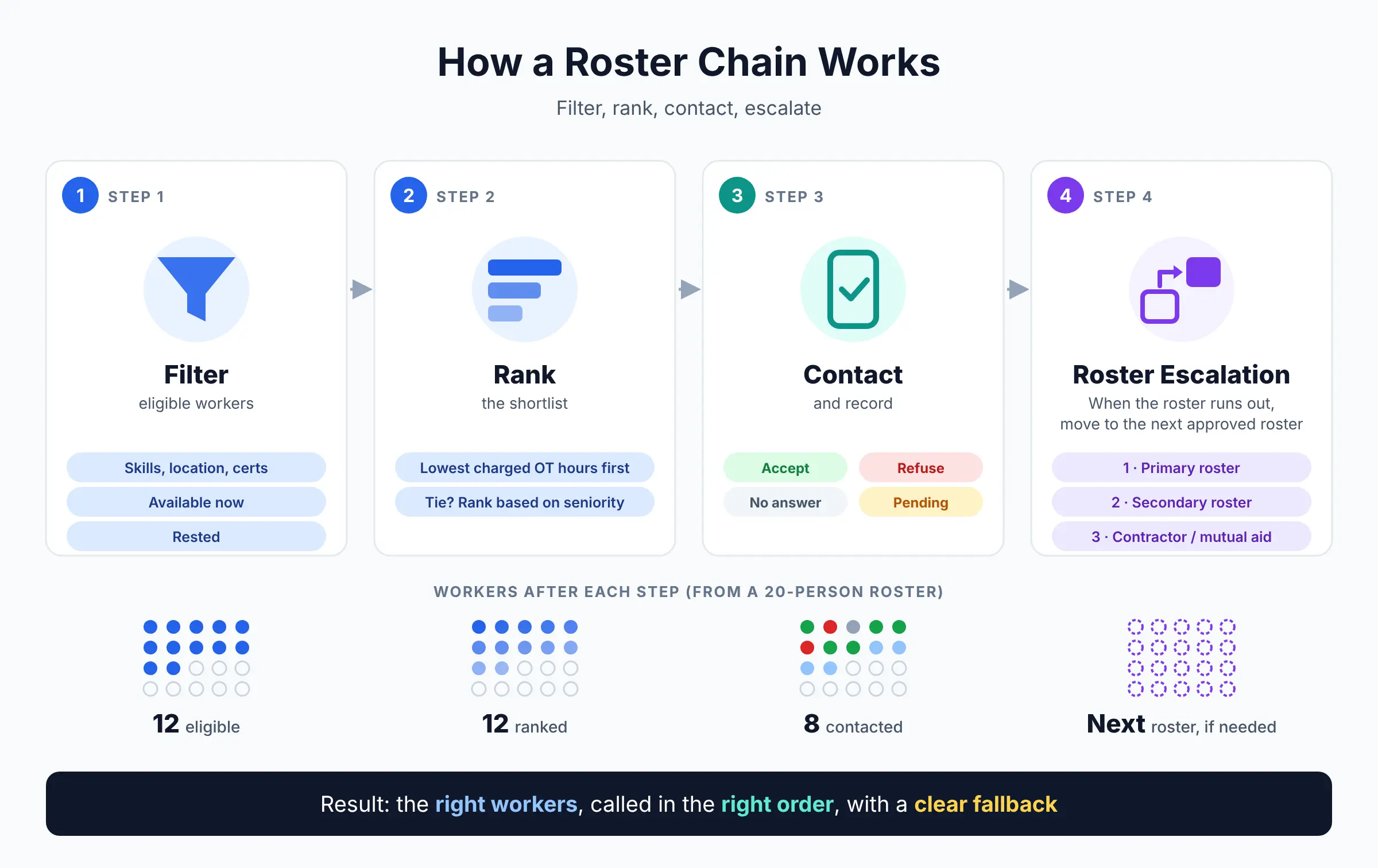
A roster chain turns these rules into a structured callout list of eligible workers. Workers are then filtered by those who are available and close enough to respond and ranked by overtime equalization and seniority. It also defines what happens when the roster runs out: whether the callout moves to a nearby yard’s roster, which roster comes next and which rules apply.
This article explains how roster chains work, how utilities build them, and where automation can make the process easier.
Utilities build roster chains based on filter conditions like union rules, skills, location, overtime hours, rest limits, etc. A roster chain helps supervisors understand whom to contact next and keeps the callout process organized.
For example, suppose a utility needs five lineworkers for an emergency repair and it has an existing roster of 20 eligible employees.
A roster chain building process looks like this:
A static employee list is essentially a directory. It contains names, job titles, phone numbers, and perhaps other employee details.
A roster chain is more dynamic. It uses employee information and callout rules to determine who is eligible and where they fall in the contact sequence.
The biggest disadvantage of using a static employee list for a callout is that it goes out of date as soon as a worker’s status changes. Whenever someone goes on leave, enters a mandatory rest period, lets a certification lapse or picks up overtime hours, the static list doesn’t change.
Supervisors then waste time calling people who can’t take the job, risk sending workers who are fatigued or not qualified, and may skip the person who should have been offered the overtime. It can lead to union grievances when safety is compromised.
Utilities use roster chains to make crew callouts faster, more organized, and easier to track. Key reasons include:
Building a roster chain takes more than putting employees in seniority order. The utility first needs to identify who can perform the work, who is available, and which callout rules apply.
The exact process varies by utility, labor agreement, and type of assignment. Here are some of the important steps in buildiong a roster chain:
The first step is identifying employees who can actually perform the required work.
These filters help narrow the roster before the utility applies its contact-order rules.
Employee availability can change at any time. Utilities should keep the roster updated with statuses such as:
Real-time updates help prevent duplicate calls and ensure supervisors contact available employees.
An employee may be available but too fatigued to take another shift. Utilities should check:
This is especially important during storm restoration, when crews often work extended shifts. OSHA warns that long work hours can increase fatigue, reduce concentration, and raise the risk of injuries.
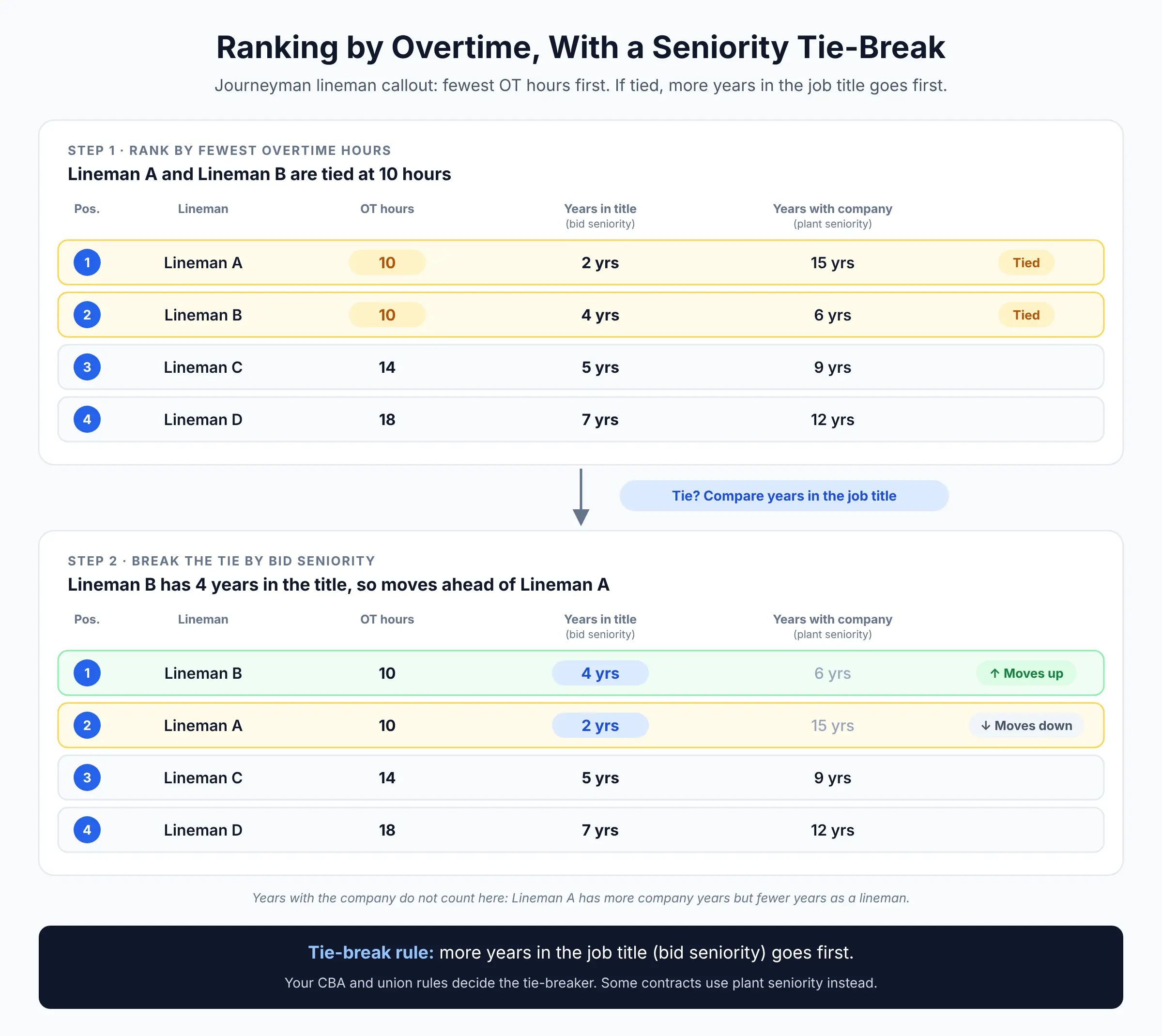
Once eligible employees are identified, the utility ranks the list based on who has the least overtime (OT) worked hours. This is called overtime equalization that intends to give overtime opportunities to everyone fairly. (refer: source on overtime clause examples)
But what happens when 2 workers are in a tiebreaker with the same number of accumulated OT hours?
In this case, the worker with the higher bid seniority (the one with most time spent working under that specific job title) is ranked higher in the list compared to the other worker with same OT hours.
Example:
Assume, a utility callout is looking for a Journeyman Lineman and two linemen are tied with the exact same OT hours.
Lineman ‘A’ has held the job title for 2 years and the other lineman ‘B’ has held the title for 4 years. So, the lineman with higher bid seniority, i.e, lineman B will be ranked higher than Lineman A.
Once the roster chain is set, the utility starts contacting employees. Each response is recorded to track the callout progress.
Common response statuses include:
These statuses help determine what happens next.
Sometimes every eligible worker on the primary roster has been contacted and the crew still isn’t filled. A roster chain needs a plan for this before the callout begins, so supervisors aren’t left deciding under pressure.
This is called roster escalation or callout escalation: the callout moves from one roster to the next in a set order. For example:
Utilities should define these rules for cascading:
A charged refusal occurs when a worker declines a callout and the declined hours are added to their charged overtime hours, as if they had worked them. This moves them down the roster chain, and other workers with fewer charged hours are contacted first for future callouts.
Note that, not every refusal is charged. Depending on the labor agreement or company policy, these may be treated differently:
Utilities need to record every response accurately and apply the rules in their own overtime policy or labor agreement. Charged refusals are a common source of grievances, so a clear, time-stamped record of each contact and response is essential.
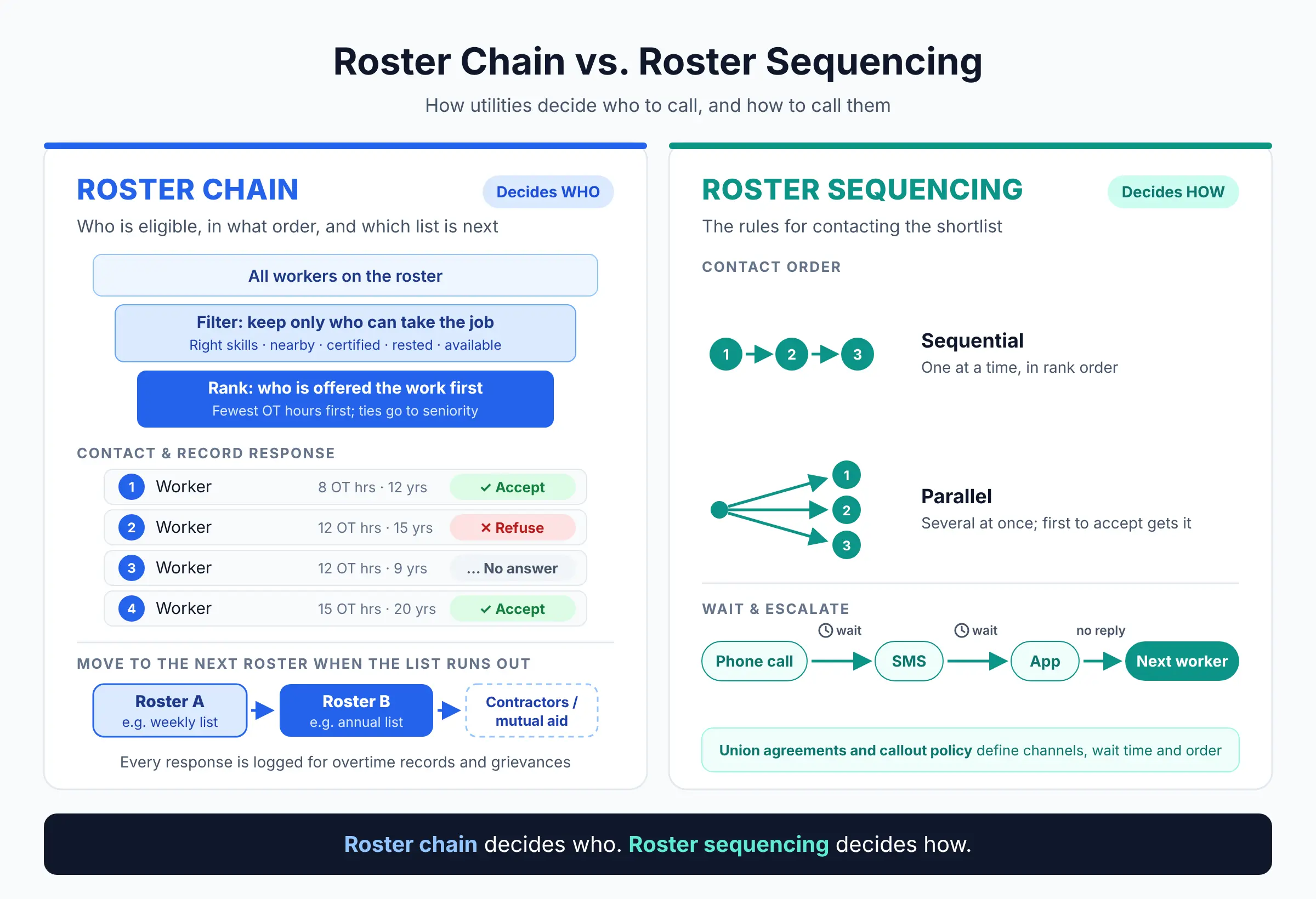
The terms roster chain and roster sequence are closely related, but they describe different parts of the callout process.
A roster chain is a list of qualified and shortlisted workers who can be contacted during a utility callout based on certain filters and rules. It documents the response from each person on the roster based on which you progress to the next eligible person.
Roster sequencing sets how eligible workers are contacted: one at a time (sequentially) or several at once (in parallel). If a worker doesn’t respond to phone calls, the system tries other channels such as an app notification, SMS, or email. It waits for a predefined wait time before moving to the next channel. If there’s still no reply for all modes of contact, it marks the worker as unreachable and moves to the next person.
NOTE: The union rules, CBA, or callout policy define how long to wait before moving to the next contact channel.
Roster chain depth refers to how far the utility has to move through a roster to fill the required positions. In simple terms, it tells you how many employees the utility had to reach or attempt to reach before securing enough workers.
Consider a utility that needs three additional lineworkers.
Its callout progresses as follows:
The utility reached position six to fill three available positions.
In this example, the chain depth is six positions.
In larger callout events, utilities can also track how many sequences, sub-callouts and backup rosters were involved along with measuring the number of people contacted.
Roster Chain Depth helps identify issues in the callout process. If a utility repeatedly has to reach deep into its roster to fill a few positions, it may indicate limited resource availability, outdated contact details, or an issue with the existing callout rotation.
Chain depth thereby helps in improved workforce planning in future.
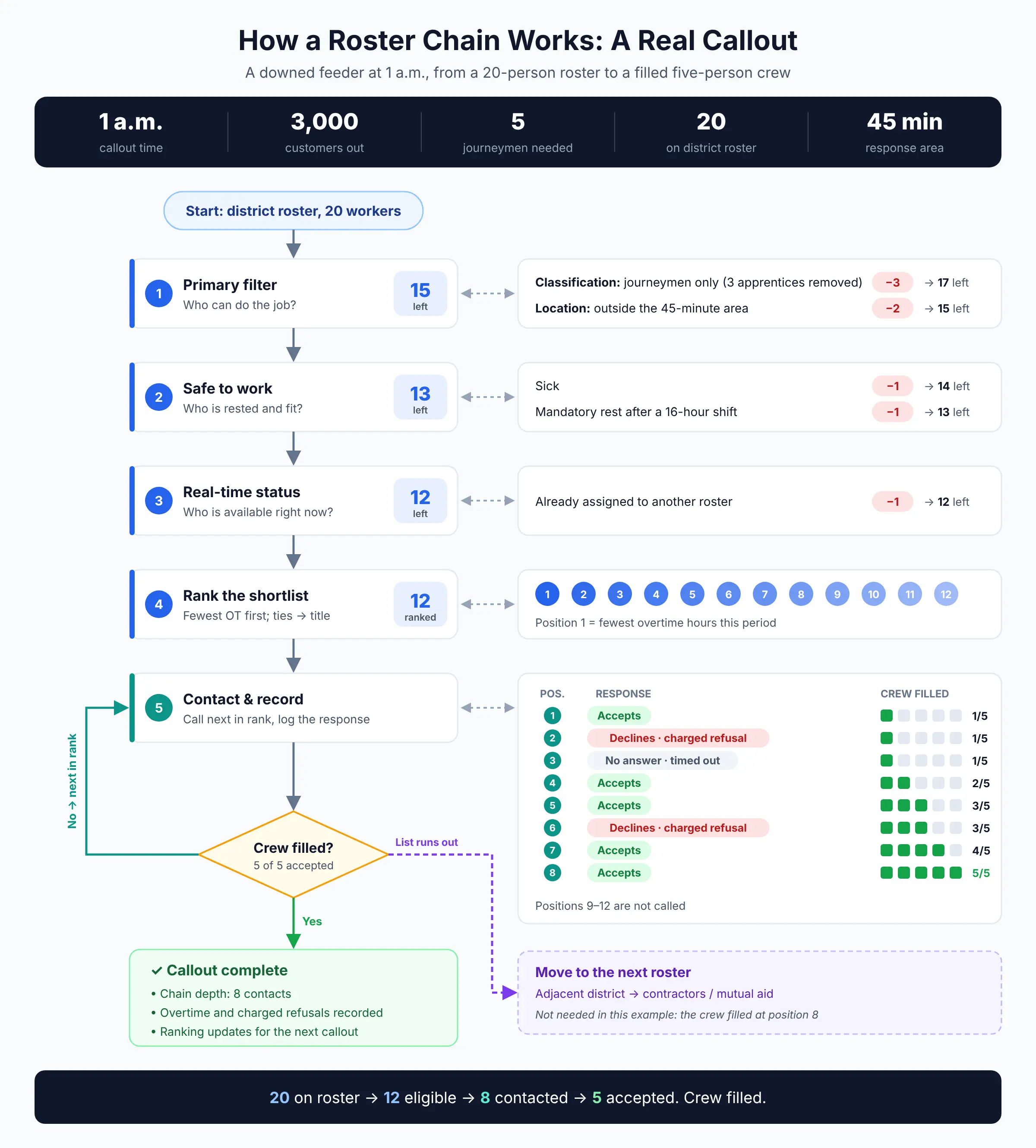
Here is an example scenario, that shows how a roster chain works in real-time:
At 1 a.m., a downed feeder leaves 3,000 customers without power. The utility needs five journeyman lineworkers. Its district roster lists 20.
Step 1: Apply Primary Filter (Filter for eligibility)
Step 2: Who is safe to work (rested worker)
Step 3: Real-time status: who is available right now
Step 4: Who gets offered the work first (overtime equalization rules + hierarchy)
The utility ranks the remaining 12 workers by fewest overtime (OT) hours this period. When two workers have the same OT hours, the worker with higher bid seniority is ranked before the other worker.
Step 5: Record each of their responses
The crew is filled after eight contacts, so the chain depth is 8.
Positions 9 to 12 aren't called. The overtime and refusals are recorded, and the ranking updates for the next callout.
An automated Crew Callout Software replaces spreadsheets, phone lists and manual dialing for a callout process. It builds the roster chain, contacts workers, and records every response in real time.
During storm restoration, supervisors may be filling several crews across different territories at once. Centralized callout software prevents duplicate calls, keeps chain depth low and shows at a glance who is ready to report.
A roster chain gives utilities a structured way to contact employees when additional workers are needed. It brings together employee qualifications, availability, overtime rules, contact order, and response tracking.
But maintaining the roster is only part of the job. Utilities also need to know what happens when someone refuses, doesn't answer, or is no longer available. And when the initial roster doesn't provide enough workers, there needs to be a clear escalation path.
Manual processes can become difficult to manage when several crews need to be mobilized at once. A centralized, automated callout process makes it easier to follow the sequence, track responses, and see where additional resources are needed.
Ultimately, a well-managed roster chain helps utilities make crew callouts more consistent, transparent, and easier to coordinate.
A roster chain changes whenever a worker’s status changes: they accept a callout, refuse one, enter a mandatory rest period, call in sick or pick up overtime hours. That’s why it needs to be kept in a central system that updates in real time.
The callout cascades to the next roster, such as an adjacent district, contractors or mutual aid crews. The cascade order and limits are usually set in advance by the utility’s callout policy or labor agreement.
A call list only shows who works for the utility. A roster chain shows who is qualified, available and next in line for a specific callout, based on overtime and labor-agreement rules. That makes crews faster to fill and keeps overtime fair and easy to audit.
When a supervisor calls workers one by one, filling a crew can take close to an hour, especially at night when many calls go unanswered. Automated callout software fills the same crew in a fraction of that time. Supervisors can watch the crew fill up live instead of keeping track on paper.
