

Features
Industries
Who we serve
Resources
Sign in
Get Started - $500/month
No commitment. No implementation fee. Unlimited users
When a storm knocks out power for thousands of customers, utilities need to mobilize qualified crews as quickly as possible. But before workers can head into the field, dispatchers must answer a few questions: Who gets contacted first? Which channels should be used? How long should they wait for a response? And when should they try another channel or move to the next worker?
Roster sequencing determines how this contact process works, helping utilities follow their callout rules while mobilizing crews efficiently.
This article explains what a roster sequence in utility callout is and which method to choose (sequential or parallel) and when. It also explains when a callout moves on to the next worker.
Roster sequencing sets out how eligible workers are contacted during a utility callout: one at a time (sequentially) or several at once (in parallel). It turns the callout rules in a labor agreement into steps that run the same way every time for a utility.
A roster sequence handles both these:
Worker contact sequencing decides whether workers on that ranked list are contacted one at a time (sequentially) or several at once (in parallel).
The callout moves to the next worker when that worker declines, or doesn’t respond on any permitted channel.
The two settings are independent. A sequential callout might use one phone number only, while a parallel callout might alert every channel at once.
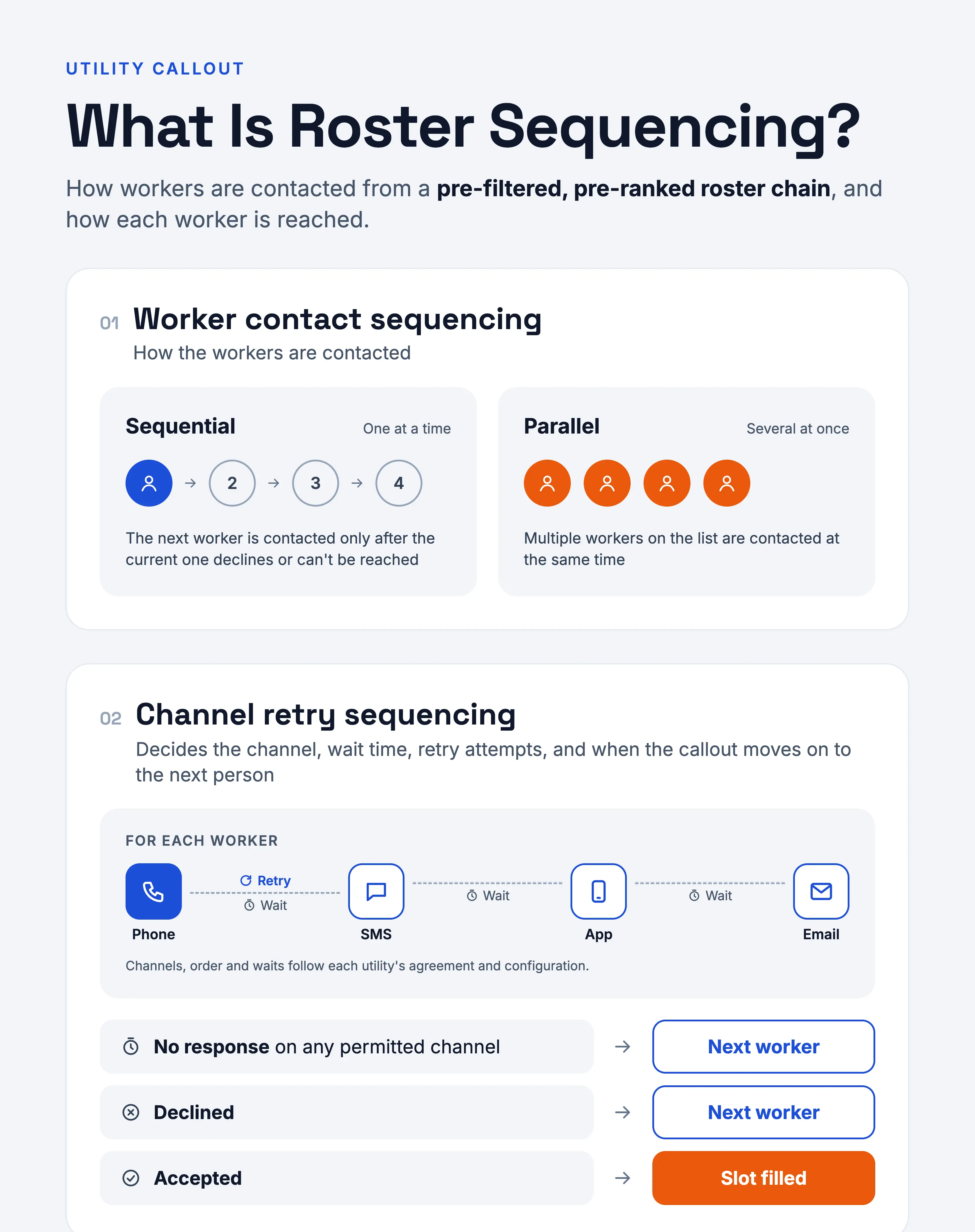
In the sequential method, you contact the workers one by one from a pre-filtered and ranked list (also called as roster chain). Most utility labor agreements follow this method of callout.
How each worker is reached: The callout starts with a phone call. If there's no answer after a predefined wait, the system moves to other channels such as an app notification, SMS, or email. It waits a set time between each attempt before moving to the next channel.
These conditions are based on the callout policy and can vary from one utility to another.
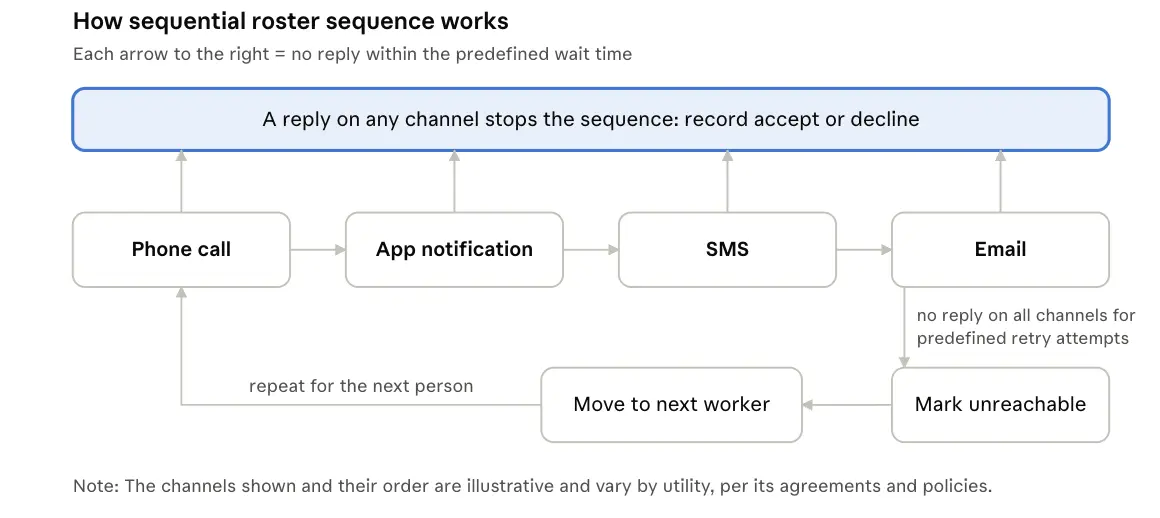
The rule: If the worker does not respond in any of the channels after a predefined number of retries and wait time, then the sequence marks him ‘unreachable’. If the worker explicitly declines it, then record the response as ‘declined’. Whether marking the worker as temporarily unavailability, or to apply refusal credit or retry criteria are applicable according to the governing rules.
Pros:
Cons:
Notifications go to several or all eligible workers at once through an automated callout system.
How it works:
In a parallel callout roster sequence method, a utility may contact multiple workers at once while preserving priority order, or use an expressly authorized first-come-first-served system.
Parallel callout method may be authorized by an existing agreement, letter agreement, MOU, applicable operating policy, or grievance settlement with the union.
Pros:
Cons:
Utilities use different callout methods to contact workers during emergencies. The two common roster sequencing approaches are sequential and parallel callouts, each with a different way of reaching workers and filling assignments.
Here is a table of difference between them:
In general, utilities use sequential callout for routine work, where strict list order matters and parallel callout for emergency situations like storms, gas leaks and major outages where time to mobilize crews matters a lot.
In both cases, the Collective Bargaining Agreement (CBA), utility policies and legal requirements set the limits and restrictions. The choice of callout method depends on the applicable procedures, staffing requirement, and permitted contact and award methods.
The roster sequence also decides when the callout stops trying one worker and moves to the next name on the list. That happens in one of two ways:
When the list runs out and the callout escalates to the next list, such as a neighboring yard. Some utilities have additional roster categories, alternate classifications or approval steps before expanding geographically.
Accepting is the worker’s response. Getting the work is a separate award decision, and the two can differ.
In a simple sequential callout, only one worker receives the offer at a time. The first worker who accepts gets the position, as long as they meet eligibility and award requirements. The system checks if a position is still open, marks it as filled, and stops further offers for that slot.
However, there are other methods of work being awarded to a worker like:
Many agreements were written for phone trees(It is a manual calling system where a supervisor calls workers one at a time from a printed list).
If your utility agreement with the local union, legal requirements, or CBA mentions it as one call at a time, sign a memorandum of understanding (MOU) with the union before switching to parallel.
Also check the following before proceeding with either of the roster sequence callout methods:
Log every attempt, channel, response and award with a timestamp to avoid disputes.
Sequential callout enforces one-at-a-time priority enforcement; parallel callout protects time. Both are applied in different use case scenarios.
Automated callout software should treat roster sequencing as a flexible and not a fixed process. The platform should allow each workgroup to have its own approved contact methods, communication channels, and response time limits to match each union agreement. Any changes to these settings must be authorized and recorded.
It should also be able to verify the workers’ current qualifications, location, availability and required rest periods. Every call, response and work assignment should be timestamped for future reference. The system should also follow the utility’s agreed overtime callout rules.
KYRO AI helps utilities and storm contractors build storm rosters in minutes and reach crews by call, SMS, push notification, and email, with an audit trail on every message.