

What Roster Chain Depth Reveals About Utility Callout Performance
A heavy storm impacts power across three distribution circuits, and dispatch needs six linemen on the road. The utility has 48 qualified employees on its callout roster, ranked in a predefined order.
The first few employees don't respond or decline the callout. Others are unavailable. The dispatcher keeps moving down the list. Forty minutes later the callout reached position 41 on the ordered roster before all six positions were filled.
In this example, the roster chain depth is 41. This value may be lower if some positions were skipped without contacting the worker.
But why does this metric matter when the utility has already filled all six positions?
Fill rate tells you whether the required positions were filled. Time-to-fill metric tells you how long it took. Roster chain depth shows how far down the callout list the dispatcher had to go. It offers another way to spot workforce availability gaps, low acceptance rates, and inefficiencies that can delay crew mobilization.
What is Roster Chain Depth?
When a callout progresses between separate rosters, the number of rosters traversed is measured separately.
Before a callout starts, the roster chain has already done two jobs. It has filtered and ranked workers based on applicable rules like overtime equalization, seniority, rotation, or any other metric applicable to the utility policies.
Roster Chain Depth is the position of the last person you had to reach in the roster chain to fill all the required slots.
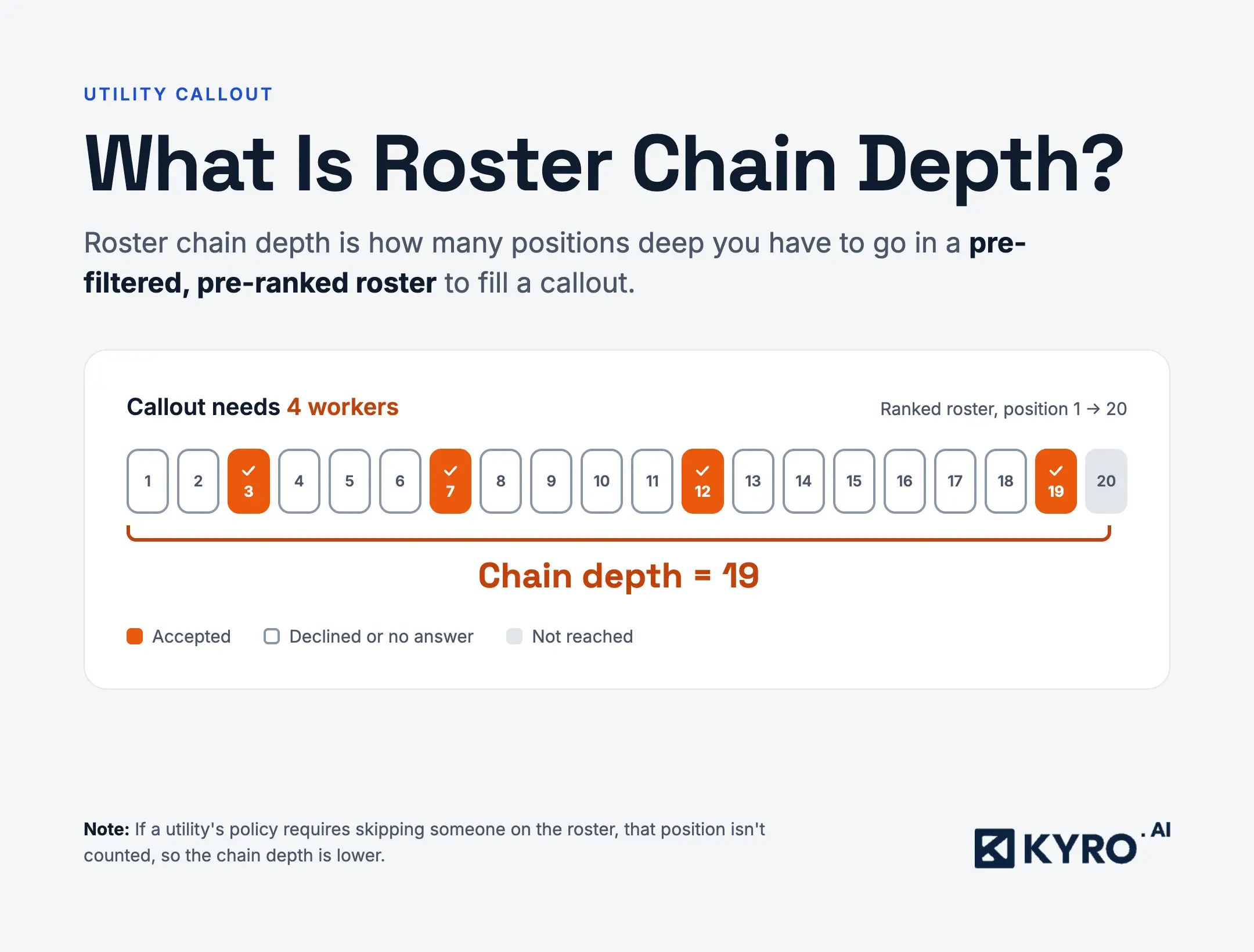
Here's a simple example. You need 4 workers. Acceptances come from positions 3, 7, 12 and 19 in the roster chain. For this example, assume all four accepting employees meet the applicable eligibility requirements and are awarded the requested positions.
The chain depth for this callout is 19. You needed 4 people and contacted 19 to get them.
How it differs from ‘fill rate’ and ‘time-to-fill'
Fill rate tells you whether the required positions were filled. Time-to-fill measures how long it took. Roster chain depth shows how far into the ordered workforce the callout progressed.
For example, two callouts may both achieve a 100% fill rate, but one reaches all required workers at roster depth 5, while the other goes as far as position 40. Both were successful, but the second required significantly more contact attempts.
When time-to-fill increases, reviewing roster-position depth alongside contact attempts, response times and callout outcomes can help identify whether the delay is related to workforce reach or another part of the process.
Why Roster Chain Depth Matters in a Utility Callout?
A deep chain is never just a dispatcher's problem. It impacts restoration time, roster quality, crew wellbeing, labor relations, and planning. Here are the specific reasons why Roster Chain Depth matters for a Utility Crew Callout:
1. Every extra position in the roster, costs time
In a crew callout process, each contact takes time to respond, whether it's a call, a text or a wait for a reply window to expire. Callouts that run one at a time (sequential callout method) feel this most.
In a hypothetical strictly sequential callout, 30 consecutive contact windows of 60–90 seconds each would total 30–45 minutes. Actual duration depends on the permitted contact methods, retries, response periods and whether contacts can overlap.
These delays can hold up crew mobilization and, in turn, restoration work. Longer outages can affect reliability metrics such as SAIDI and CAIDI, which track how long customers are without power. The extent of the impact depends on the outage, crew availability, and restoration conditions
2. Chain depth exposes an imperfect roster with fragmented data
A roster can be filtered and ranked correctly on paper but still fail in practice. This often happens because employee information is scattered across different systems, and fragmented data makes it difficult to keep records updated with the latest details. Phone numbers may be outdated, and availability records may not reflect when workers are on vacation, sick, or otherwise unavailable.
As a result, workers near the top of the roster may decline a callout, fail to respond, or never receive the notification. Chain depth helps expose these gaps. Under these circumstances, the utility repeatedly has to move further down the roster to fill the required positions increasing the roster chain depth value.
Repeatedly high roster depth may prompt a review of employee contact details, availability records and eligibility information. Contact-failure reasons and roster-data quality should be examined alongside depth to identify the underlying cause.
3. More contacts, more compliance risk
Deeper callouts may involve more contact and response events requiring accurate rule enforcement and documentation.
Also, when workers at the top don't respond, the same few employees may end up taking most assignments, creating overtime imbalances and increasing fatigue.
Reviewing ordering decisions, bypasses, refusals and exceptions can help identify potential compliance issues
4. A rise in chain depth is an early warning
If the average chain depth increases from 8 to 15 over a quarter, it may indicate declining workforce availability, more callout refusals, or outdated roster information. Tracking this trend helps utilities identify and address staffing gaps before a major storm puts additional pressure on their crews.
Compare similar crew sizes, workgroups, roster configurations and event conditions before drawing conclusions.
What Results in a High Roster Chain Depth Value?
A handful of factors account for a high roster chain depth value:
- Time of day and week. Overnight, weekend and holiday callouts mostly run deeper. People are either asleep or unavailable.
- Back-to-back events. After a long restoration, crews are tired and less willing to accept another callout. Depth on day three of a storm can be double that of day one.
- Low Callout Acceptance Rate: When employees frequently decline callout requests, fewer positions are filled near the top of the roster. Utilities must contact more workers further down the list to fill the required crew positions, increasing chain depth.
- Contact method and response windows. Short reply windows, or choice of contacting channel could be some of the reasons why there is "no response” to a callout and the chain depth increases.
- Outdated and fragmented roster data. Wrong phone numbers, outdated qualifications and availability data that are scattered across different systems
- Limited qualified personnel. Few workers only meet the required classification or skill criteria.
- Overlapping callouts. Multiple callouts may contact the same workers at the same time. A worker might accept one offer and decline another, causing the declined callout to move further down the roster chain.
High roster chain depth along with other factors like calling method, response behavior and applicable procedures impact time taken for crew confirmation and crew mobilization.
Roster Chain Depth Metrics to Measure in a Utility Callout
These are the important metrics associated with roster chain depth.
- Chain depth per callout: The number of employees contacted in a roster sequence before all required positions are filled. If the last employee contacted is at position 19, the chain depth is 19.
- Average and maximum depth: tracked weekly or monthly. The average shows the trend, and the maximum shows your worst cases.
- Depth ratio: chain depth divided by positions needed. This lets you compare a 2-person callout with a 20-person one. In the earlier example above, 19 (position) ÷ 4 (number of workers needed) gives a ratio of 4.75.
For multi-roster callouts, the calculation would need a separately defined methodology before a single aggregate ratio could be reported.
Then break those numbers down by yard or service center, crew type, shift, day of week and event type (routine vs. storm). An average that looks fine company-wide often hides one yard or one overnight shift that is consistently deep.
When multiple rosters are involved, identify which roster's position is being reported rather than treating positions from separate rosters as one continuous ranking.
How to Reduce Roster Chain Depth Vaue
Here are some ways how roster chain depth value could be reduced.
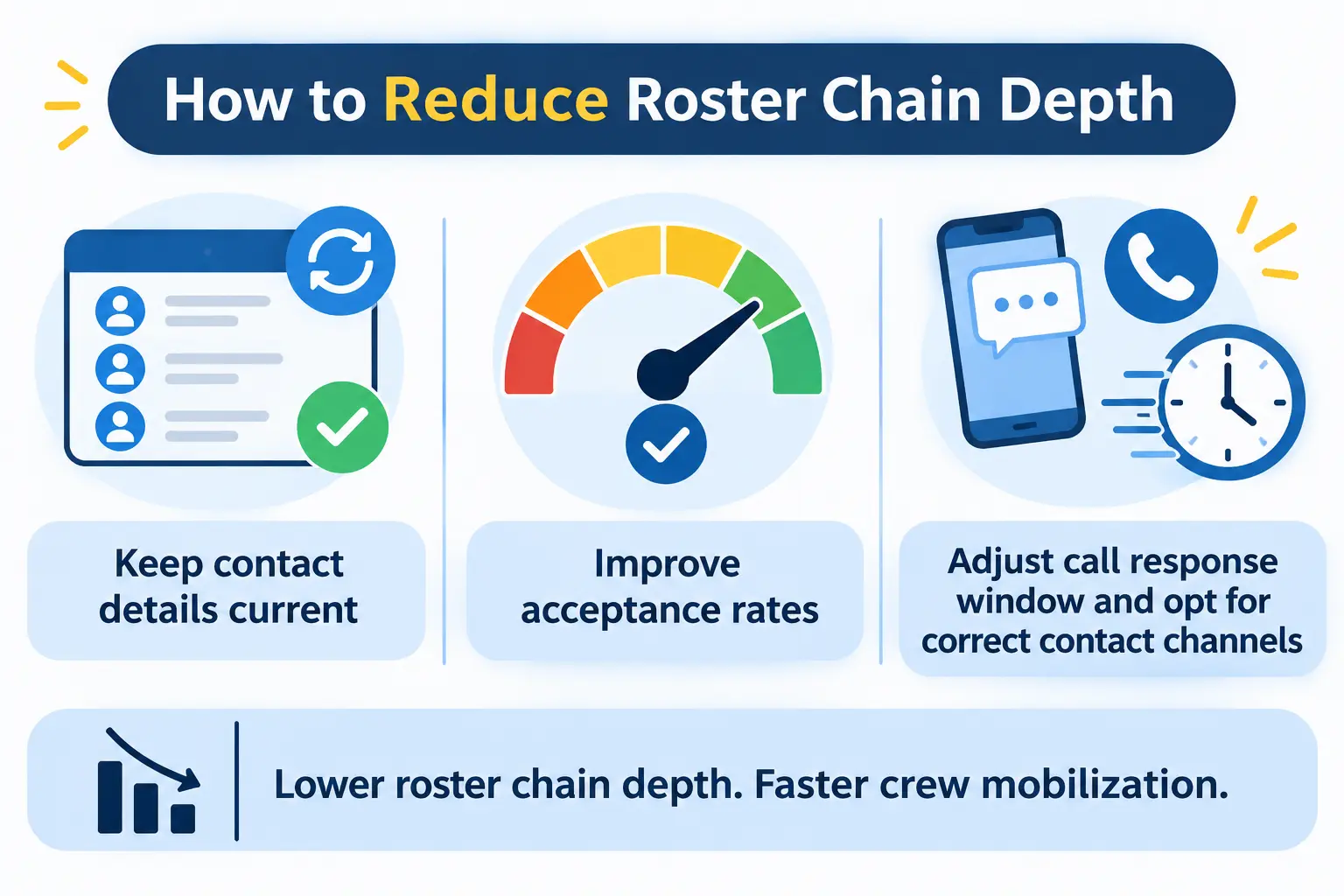
- Keep contact details current and centralized. Keep employee phone numbers, email addresses, and availability records updated in one centralized system. This helps supervisors reach the right crew members quickly and avoid delays caused by outdated or scattered contact information. It avoids the need to move further deep into the roster if contacts are not reachable.
- Monitor and Improve Callout Acceptance Rates: Higher acceptance among eligible workers contacted earlier in the roster may reduce the depth needed to fill a callout. Acceptance rate and roster-position depth should be tracked as separate, complementary measures.
Track how often employees accept valid callout requests. Identify patterns of frequent refusals and non-responses, and review what contributes to low acceptance.
Give clear notifications with assignment details, estimated duration to qualified, rested, and available workers to help improve callout acceptance rates.
Consistently monitor those workers with low callout acceptance rates and understand the reason behind it and see if it can be fixed.
Refer to this article on how callout acceptance rate differs from response rate and how the minimum threshold for callout acceptance rate has evolved over the years.
- Adjust the call response windows and communication channels. Where permitted by the applicable utility procedures and labor agreements, support multiple communication channels and configure approved response windows, contact attempts, retries and escalation conditions.
Conclusion
Roster chain depth gives utilities a clearer picture of how their crew callout process performs in real-world situations. It goes beyond tracking whether an employee accepted or declined a callout.
By tracking roster-position depth alongside unique employees contacted, contact attempts, roster transitions, staffing outcomes and time-to-fill, utilities can better understand workforce availability and identify opportunities to improve the callout process
Automated callout software can make this process easier by managing employee rosters, tracking responses, and maintaining callout records. With better visibility into callout activity, utilities can refine roster rules, improve acceptance rates, and reach qualified crews faster when storm response demands increase.