
Lockout Tagout for Storm Restoration Crews: Steps, Kits, and Why Tailboard Briefings Are Your Last Line of Defense

June 24, 2026
4 min read

  • 2,177 lockout/tagout violations were cited by OSHA in fiscal year 2025, making it the agency's fourth most-cited standard.
  • 120 worker fatalities are prevented each year through proper lockout/tagout compliance, according to OSHA estimates.
  • 50,000 serious workplace injuries are avoided annually using lockout/tagout procedures.

And these statistics come from normal operating conditions. Storm restoration adds fatigue, damaged infrastructure, changing work zones, and compressed timelines to the equation. When crews are racing to restore power, a missed isolation point or incomplete lockout/tagout procedure can turn a routine task into a life-threatening incident.  

What Is Lockout Tagout?

Lockout tagout (LOTO) is the procedure for isolating every hazardous energy source connected to a piece of equipment before anyone services or maintains it, and verifying that those sources cannot be accidentally re-energized while workers are present.

The name describes the two primary control methods.  

A lockout means physically applying a padlock to an energy isolating device, a circuit breaker, a disconnect switch, and a valve so that it cannot be operated. The key stays with the worker who applied the lock. Nobody else can remove it.  

A tagout is used where a device cannot be physically locked: a warning tag is attached indicating that the equipment must not be operated and must not be re-energized until the tag is removed by the person who placed it.

The governing OSHA standard for general industry is 29 CFR 1910.147.  

For utility crews doing electric power generation, transmission, and distribution work, which is most storm restoration linework, the governing standard is 29 CFR 1910.269. The requirements under both are nearly identical in substance, but the distinction matters for compliance purposes, and it matters for how your written procedures need to be drafted.

The storm restoration context that changes everything:  

During normal operations, the energy sources on equipment are known and documented. During storm restoration, crews are working on systems that may have been partially energized by other restoration crews, on circuits with unclear switching history, in conditions where the normal single-source isolation assumption may not hold.  

This is why Logout tagout in storm restoration is not a routine procedure. It is a life-critical one that requires more discipline, not less, when pressure and fatigue are highest.  

Which OSHA Standard Applies: 1910.147 vs 1910.269

This is where utility and contractor crews most commonly get confused and where compliance failures start.
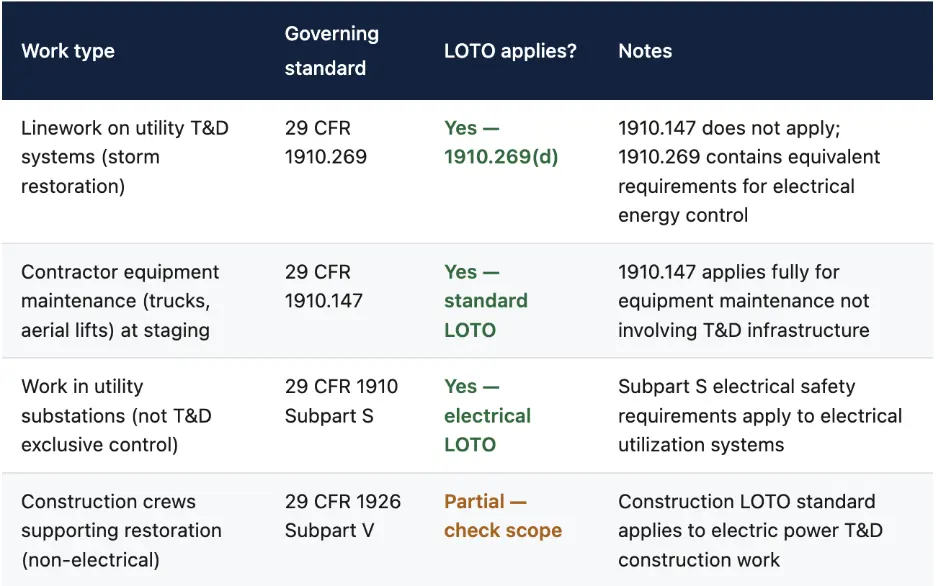
The practical implication: most storm restoration contractors will have crews under multiple standards simultaneously.  

Lineworkers on distribution circuits are under 1910.269. The mechanic servicing bucket trucks back at the staging yard is under 1910.147. Your written energy control program needs to address both, and your supervisors need to know which standard governs which crew on which task.

The 8 Lockout Tagout Steps — What Each One Actually Requires

These steps come directly from OSHA 1910.147(d) and are mirrored in 1910.269(d). Every step is required. The verification step is the most commonly skipped and the most commonly cited.

  1. Prepare for shutdown  

Identify all energy sources connected to the equipment: electrical, hydraulic, pneumatic, mechanical, thermal, chemical. On storm restoration sites, this means accounting for potential backfeed from partially restored adjacent circuits and not just the obvious primary source. Review the equipment-specific written Logout/tagout procedure before touching anything.  

Failure mode in storm restoration is that crews assume they know the energy sources from previous similar jobs. Partially restored circuits mean that assumption is dangerous.  

  1. Notify affected employees  

Every employee whose work area will be affected by the shutdown must be notified before Lockout/tagout begins. In a large restoration deployment, that means coordinating with other crews working the same circuit segment, not just the immediate crew.  

Failure mode: one crew applies lockout without notifying a second crew working 200 meters down the same line.  

  1. Shut down the equipment  

Use the normal stopping procedure for the equipment. Do not bypass interlocks or use emergency stops as a substitute for the proper shutdown sequence.  

  1. Isolate all energy sources  

Operate every energy isolating device to the safe (de-energized) position. For electrical lockout tagout specifically, this means opening disconnects and circuit breakers, all of them, for every energy source identified in step one, not just the primary feed.  

Failure mode in electrical Lockout/tagout: isolating the primary feed but missing a secondary or backfeed source on a partially restored circuit.  

  1. Apply lockout/tagout devices  

Each authorized employee applies their own personal padlock to each energy isolating device. No sharing locks. If multiple workers need to work on the same equipment, a group lockout hasp allows each worker to apply their own lock to a single isolation point. Tagout devices are used only when a device cannot be physically locked and the standard is clear that tagout provides less protection than lockout.  

  1. Release or restrain stored energy  

De-energization is not complete after applying locks. Stored energy, charged capacitors, pressurized lines, suspended components under gravity load, residual electrical charge — must be released, bled, discharged, or blocked before work begins. On energized system work, this step includes grounding procedures under 1910.269.  

  1. Verify isolation — the step crews most often skip  

After applying all lockout devices, the authorized employee must verify that the equipment is actually in a zero energy state. For electrical systems, this means testing with an approved voltage detector to confirm the circuit is de-energized. For mechanical equipment, it means attempting to start the machine while standing clear. If the equipment can still be started or energized, lockout has not been completed.  

This is the single most-cited Lockout/tagout violation in OSHA inspections. The verification step is not optional and is not implied by completing steps 1 through 6.  

  1. Perform the work  

Only after all seven preceding steps are complete and verified does work begin. If the scope of work changes and new energy sources may be involved, the lockout tagout procedure starts over from step one for those sources.  

Removing locks requires its own documented procedure.  

Before any lockout device is removed: inspect the work area to confirm all tools and components are clear, verify all employees are safely positioned away from the equipment, and notify affected employees that lockout is ending. Only the employee who applied a lock may remove it. If that employee is not present in shift change, demobilization, injury, there is a specific documented process required before any supervisor can remove someone else's lock.  

What a Lockout Tagout Kit Must Contain for Electrical Field Work

A well-stocked electrical lockout tagout kit is a compliance requirement. Under 1910.147 and 1910.269, authorized employees must have access to appropriate lockout devices. Arriving at a work site without proper lockout tagout hardware is arriving without the ability to work safely or legally.

Here’s what your lockout tagout kit must contain:  

  • Individually keyed padlocks - One per authorized employee. Keyed differently from all other locks on the job. No master keys that could allow someone else to remove your lock.  
  • Group lockout hasps - Allows multiple workers to apply individual locks to a single isolation point. Essential for storm restoration work where multiple crew members may be working on the same circuit.  
  • Circuit breaker lockout devices - Designed to clamp over breaker handles in both the on and off positions. Match device size to breaker type like single pole, double pole, and multi-pole breakers require different clamp sizes.  
  • OSHA-compliant tagout tags - Must withstand the environmental conditions of the work site. Rated to prevent accidental detachment. Must carry a clear "Do Not Operate" or "Do Not Energize" warning. Filled out with employee name, date, and reason.  
  • Plug lockout devices - Prevents a cord-and-plug equipment from being re-energized by covering the plug with a locked device. Required for cord-connected equipment where a physical disconnect is not available.  
  • Equipment-specific procedure cards - OSHA requires written procedures for each piece of equipment. The procedure card should be in the kit and go with the crew to the equipment. Generic procedures do not satisfy this requirement.  
  • Voltage detector / proximity tester - Required for the verification step (step 7). Approved voltage detectors confirm zero energy state before work begins on electrical systems. This is not an optional equipment.  
  • Lockout station or kit bag - Keeps all components organized and accessible. Pre-staged on each work vehicle before deployment begins. A missing component discovered at the work site is a job stoppage.  

The Safety Tailboard: What Good lockout tagout Briefings Include and Why Most Crews Rush Them

What is a tailboard?  

A safety tailboard also called a tailgate meeting, or pre-job briefing is the daily or pre-task safety meeting held before crews begin work.  

For lockout tagout, it is the last planned opportunity to make sure every person on the crew understands the specific energy sources at today's site, who is authorized to apply and remove locks, and what to do if something does not match the procedure.

Here is the reality of storm restoration tailboard briefings: they are 90 seconds long when they should be five minutes, held while crews are climbing out of trucks and checking their phones, and treated as a compliance ritual rather than an operational safety step.  

The pressure to restore power is real and constant. The tailboard is where that pressure most directly conflicts with the discipline Lockout tagout requires.

A complete lockout tagout tailboard for storm restoration should cover these six points, and it should take at least five minutes every single time:

  1. Identify every energy source at today's specific site. Not "the circuit" in general. This pole, this transformer, this disconnect, this backfeed possibility from this adjacent feeder that was partially restored by another crew yesterday.  
  1. Confirm who is authorized to apply and remove lockout devices today. Crew rotation during storm restoration means the authorized employee from the last shift may not be present. Today's authorized employee must be identified by name before work starts.  
  1. Review the equipment-specific lockout tagout procedure, not a generic one. The procedure card for the specific equipment being worked on should be read aloud or reviewed by every crew member, not assumed from memory.  
  1. Cover the verification step explicitly. Confirm that after locks are applied, the verification test will be performed and who will perform it. Naming a responsible person for verification closes the gap that produces most skip-step violations.  
  1. Address what happens if someone finds a lock they did not apply. Stop work. Find the employee who applied it before proceeding. This is not optional and the answer cannot be "pull it and find out." Every crew member should know this protocol before work starts.  
  1. Document it with a timestamp and crew sign-off. A verbal tailboard briefing that was rushed and undocumented becomes "no tailboard was held" in a post-incident investigation. Digital sign-off takes 30 seconds and creates a timestamped record that protects both the crew and the employer.  

The 7 essential storm response safety checklists we've built for utility crews treat the tailboard as a documented operational record rather than a verbal ritual. That shift, from memory to record, is what makes a safety briefing defensible when it matters.  

See also our guide on the safety leading indicators that predict incidents before they happen, where tailboard completion rate is one of the eight highest-predictive metrics.

Digital Tailboards: Making lockout tagout Documentation Automatic

The practical barrier to consistent lockout tagout tailboard documentation during storm restoration is not willingness. Crews know lockout tagout matters. The barrier is friction: paper forms that blow away, clipboards that get left in trucks, sign-off sheets that end up in someone's bag and never make it back to the office.

Digital safety tailboards solve this by moving the briefing record to the same mobile device crews already carry for time tracking and work orders. A KYRO AI safety form takes 30 seconds to complete at the end of a tailboard, crew members sign off on a mobile screen, the record is timestamped automatically, and it syncs to the central safety log without a manual step.  

This also feeds directly into the leading indicator tracking that predicts incident risk before it becomes an incident report. A crew whose tailboard completion rate drops below 85% is statistically at higher risk of a lockout tagout -related incident. You can see that trend in real time when briefings are captured digitally. You cannot see it at all when they are done verbally and undocumented.

Digital Logout/Tagout tailboards that take 30 seconds, not 30 minutes of paperwork

With KYRO AI, crews can quickly access and complete OSHA-aligned safety forms from the field, including pre-job briefings, JHAs, tailgate meetings or tailboards, and incident reports. Every submission is timestamped, GPS-tagged, and instantly visible to supervisors, making it easier to track compliance and monitor safety activity across all deployed crews.

See KYRO AI's safety module →  

Lockout Tagout for Storm Restoration Crews: Steps, Kits, and Why Tailboard Briefings Are Your Last Line of Defense

June 24, 2026
4 min read
June 29, 2026
Rabiya Farheen
Content Strategist
Author
Rabiya Farheen
Content Strategist

  • 2,177 lockout/tagout violations were cited by OSHA in fiscal year 2025, making it the agency's fourth most-cited standard.
  • 120 worker fatalities are prevented each year through proper lockout/tagout compliance, according to OSHA estimates.
  • 50,000 serious workplace injuries are avoided annually using lockout/tagout procedures.

And these statistics come from normal operating conditions. Storm restoration adds fatigue, damaged infrastructure, changing work zones, and compressed timelines to the equation. When crews are racing to restore power, a missed isolation point or incomplete lockout/tagout procedure can turn a routine task into a life-threatening incident.  

What Is Lockout Tagout?

Lockout tagout (LOTO) is the procedure for isolating every hazardous energy source connected to a piece of equipment before anyone services or maintains it, and verifying that those sources cannot be accidentally re-energized while workers are present.

The name describes the two primary control methods.  

A lockout means physically applying a padlock to an energy isolating device, a circuit breaker, a disconnect switch, and a valve so that it cannot be operated. The key stays with the worker who applied the lock. Nobody else can remove it.  

A tagout is used where a device cannot be physically locked: a warning tag is attached indicating that the equipment must not be operated and must not be re-energized until the tag is removed by the person who placed it.

The governing OSHA standard for general industry is 29 CFR 1910.147.  

For utility crews doing electric power generation, transmission, and distribution work, which is most storm restoration linework, the governing standard is 29 CFR 1910.269. The requirements under both are nearly identical in substance, but the distinction matters for compliance purposes, and it matters for how your written procedures need to be drafted.

The storm restoration context that changes everything:  

During normal operations, the energy sources on equipment are known and documented. During storm restoration, crews are working on systems that may have been partially energized by other restoration crews, on circuits with unclear switching history, in conditions where the normal single-source isolation assumption may not hold.  

This is why Logout tagout in storm restoration is not a routine procedure. It is a life-critical one that requires more discipline, not less, when pressure and fatigue are highest.  

Which OSHA Standard Applies: 1910.147 vs 1910.269

This is where utility and contractor crews most commonly get confused and where compliance failures start.

The practical implication: most storm restoration contractors will have crews under multiple standards simultaneously.  

Lineworkers on distribution circuits are under 1910.269. The mechanic servicing bucket trucks back at the staging yard is under 1910.147. Your written energy control program needs to address both, and your supervisors need to know which standard governs which crew on which task.

The 8 Lockout Tagout Steps — What Each One Actually Requires

These steps come directly from OSHA 1910.147(d) and are mirrored in 1910.269(d). Every step is required. The verification step is the most commonly skipped and the most commonly cited.

  1. Prepare for shutdown  

Identify all energy sources connected to the equipment: electrical, hydraulic, pneumatic, mechanical, thermal, chemical. On storm restoration sites, this means accounting for potential backfeed from partially restored adjacent circuits and not just the obvious primary source. Review the equipment-specific written Logout/tagout procedure before touching anything.  

Failure mode in storm restoration is that crews assume they know the energy sources from previous similar jobs. Partially restored circuits mean that assumption is dangerous.  

  1. Notify affected employees  

Every employee whose work area will be affected by the shutdown must be notified before Lockout/tagout begins. In a large restoration deployment, that means coordinating with other crews working the same circuit segment, not just the immediate crew.  

Failure mode: one crew applies lockout without notifying a second crew working 200 meters down the same line.  

  1. Shut down the equipment  

Use the normal stopping procedure for the equipment. Do not bypass interlocks or use emergency stops as a substitute for the proper shutdown sequence.  

  1. Isolate all energy sources  

Operate every energy isolating device to the safe (de-energized) position. For electrical lockout tagout specifically, this means opening disconnects and circuit breakers, all of them, for every energy source identified in step one, not just the primary feed.  

Failure mode in electrical Lockout/tagout: isolating the primary feed but missing a secondary or backfeed source on a partially restored circuit.  

  1. Apply lockout/tagout devices  

Each authorized employee applies their own personal padlock to each energy isolating device. No sharing locks. If multiple workers need to work on the same equipment, a group lockout hasp allows each worker to apply their own lock to a single isolation point. Tagout devices are used only when a device cannot be physically locked and the standard is clear that tagout provides less protection than lockout.  

  1. Release or restrain stored energy  

De-energization is not complete after applying locks. Stored energy, charged capacitors, pressurized lines, suspended components under gravity load, residual electrical charge — must be released, bled, discharged, or blocked before work begins. On energized system work, this step includes grounding procedures under 1910.269.  

  1. Verify isolation — the step crews most often skip  

After applying all lockout devices, the authorized employee must verify that the equipment is actually in a zero energy state. For electrical systems, this means testing with an approved voltage detector to confirm the circuit is de-energized. For mechanical equipment, it means attempting to start the machine while standing clear. If the equipment can still be started or energized, lockout has not been completed.  

This is the single most-cited Lockout/tagout violation in OSHA inspections. The verification step is not optional and is not implied by completing steps 1 through 6.  

  1. Perform the work  

Only after all seven preceding steps are complete and verified does work begin. If the scope of work changes and new energy sources may be involved, the lockout tagout procedure starts over from step one for those sources.  

Removing locks requires its own documented procedure.  

Before any lockout device is removed: inspect the work area to confirm all tools and components are clear, verify all employees are safely positioned away from the equipment, and notify affected employees that lockout is ending. Only the employee who applied a lock may remove it. If that employee is not present in shift change, demobilization, injury, there is a specific documented process required before any supervisor can remove someone else's lock.  

What a Lockout Tagout Kit Must Contain for Electrical Field Work

A well-stocked electrical lockout tagout kit is a compliance requirement. Under 1910.147 and 1910.269, authorized employees must have access to appropriate lockout devices. Arriving at a work site without proper lockout tagout hardware is arriving without the ability to work safely or legally.

Here’s what your lockout tagout kit must contain:  

  • Individually keyed padlocks - One per authorized employee. Keyed differently from all other locks on the job. No master keys that could allow someone else to remove your lock.  
  • Group lockout hasps - Allows multiple workers to apply individual locks to a single isolation point. Essential for storm restoration work where multiple crew members may be working on the same circuit.  
  • Circuit breaker lockout devices - Designed to clamp over breaker handles in both the on and off positions. Match device size to breaker type like single pole, double pole, and multi-pole breakers require different clamp sizes.  
  • OSHA-compliant tagout tags - Must withstand the environmental conditions of the work site. Rated to prevent accidental detachment. Must carry a clear "Do Not Operate" or "Do Not Energize" warning. Filled out with employee name, date, and reason.  
  • Plug lockout devices - Prevents a cord-and-plug equipment from being re-energized by covering the plug with a locked device. Required for cord-connected equipment where a physical disconnect is not available.  
  • Equipment-specific procedure cards - OSHA requires written procedures for each piece of equipment. The procedure card should be in the kit and go with the crew to the equipment. Generic procedures do not satisfy this requirement.  
  • Voltage detector / proximity tester - Required for the verification step (step 7). Approved voltage detectors confirm zero energy state before work begins on electrical systems. This is not an optional equipment.  
  • Lockout station or kit bag - Keeps all components organized and accessible. Pre-staged on each work vehicle before deployment begins. A missing component discovered at the work site is a job stoppage.  

The Safety Tailboard: What Good lockout tagout Briefings Include and Why Most Crews Rush Them

What is a tailboard?  

A safety tailboard also called a tailgate meeting, or pre-job briefing is the daily or pre-task safety meeting held before crews begin work.  

For lockout tagout, it is the last planned opportunity to make sure every person on the crew understands the specific energy sources at today's site, who is authorized to apply and remove locks, and what to do if something does not match the procedure.

Here is the reality of storm restoration tailboard briefings: they are 90 seconds long when they should be five minutes, held while crews are climbing out of trucks and checking their phones, and treated as a compliance ritual rather than an operational safety step.  

The pressure to restore power is real and constant. The tailboard is where that pressure most directly conflicts with the discipline Lockout tagout requires.

A complete lockout tagout tailboard for storm restoration should cover these six points, and it should take at least five minutes every single time:

  1. Identify every energy source at today's specific site. Not "the circuit" in general. This pole, this transformer, this disconnect, this backfeed possibility from this adjacent feeder that was partially restored by another crew yesterday.  
  1. Confirm who is authorized to apply and remove lockout devices today. Crew rotation during storm restoration means the authorized employee from the last shift may not be present. Today's authorized employee must be identified by name before work starts.  
  1. Review the equipment-specific lockout tagout procedure, not a generic one. The procedure card for the specific equipment being worked on should be read aloud or reviewed by every crew member, not assumed from memory.  
  1. Cover the verification step explicitly. Confirm that after locks are applied, the verification test will be performed and who will perform it. Naming a responsible person for verification closes the gap that produces most skip-step violations.  
  1. Address what happens if someone finds a lock they did not apply. Stop work. Find the employee who applied it before proceeding. This is not optional and the answer cannot be "pull it and find out." Every crew member should know this protocol before work starts.  
  1. Document it with a timestamp and crew sign-off. A verbal tailboard briefing that was rushed and undocumented becomes "no tailboard was held" in a post-incident investigation. Digital sign-off takes 30 seconds and creates a timestamped record that protects both the crew and the employer.  

The 7 essential storm response safety checklists we've built for utility crews treat the tailboard as a documented operational record rather than a verbal ritual. That shift, from memory to record, is what makes a safety briefing defensible when it matters.  

See also our guide on the safety leading indicators that predict incidents before they happen, where tailboard completion rate is one of the eight highest-predictive metrics.

Digital Tailboards: Making lockout tagout Documentation Automatic

The practical barrier to consistent lockout tagout tailboard documentation during storm restoration is not willingness. Crews know lockout tagout matters. The barrier is friction: paper forms that blow away, clipboards that get left in trucks, sign-off sheets that end up in someone's bag and never make it back to the office.

Digital safety tailboards solve this by moving the briefing record to the same mobile device crews already carry for time tracking and work orders. A KYRO AI safety form takes 30 seconds to complete at the end of a tailboard, crew members sign off on a mobile screen, the record is timestamped automatically, and it syncs to the central safety log without a manual step.  

This also feeds directly into the leading indicator tracking that predicts incident risk before it becomes an incident report. A crew whose tailboard completion rate drops below 85% is statistically at higher risk of a lockout tagout -related incident. You can see that trend in real time when briefings are captured digitally. You cannot see it at all when they are done verbally and undocumented.

Digital Logout/Tagout tailboards that take 30 seconds, not 30 minutes of paperwork

With KYRO AI, crews can quickly access and complete OSHA-aligned safety forms from the field, including pre-job briefings, JHAs, tailgate meetings or tailboards, and incident reports. Every submission is timestamped, GPS-tagged, and instantly visible to supervisors, making it easier to track compliance and monitor safety activity across all deployed crews.

See KYRO AI's safety module →  

Rabiya Farheen
Content Strategist

Rabiya Farheen is a content strategist and a writer who loves turning complex ideas into clear, meaningful stories, especially in the world of utility, tech, AI, and B2B SaaS. She works closely with growing teams to create content that doesn’t just check SEO boxes, but actually helps people understand what a product does and why it matters. With a knack for research and a curiosity that never quits, Rabiya dives deep into industry trends, customer pain points, and data to craft content that feels super helpful and informative. When she’s not writing, she’s probably reading, painting, and exploring her creative side— or you'll find her hustling around for social causes, especially those that empower girls and women.

Discover more related blogs.