
Near-miss reporting

Near-Miss Reporting: Why It Matters and How to Build the Habit

May 22, 2026
4 min read

A near miss is an unplanned workplace event that could have caused injury, illness, or property damage, but didn't. It is the closest signal you will ever get that a recordable incident is coming. And according to research on workplace safety ratios, for every fatality in a workplace, there are approximately 300 near misses involving the same type of hazard that went unreported or unresolved.

That ratio is why near-miss reporting is the highest-leverage leading indicator in any safety program. It doesn't show up in your TRIR or DART rate. But it predicts both.

What Counts as a Near Miss?

A near miss is any event where no injury or illness occurred, but the potential was real. OSHA defines it informally as a close call. An unplanned event that did not result in injury, illness, or damage, but had the potential to do so under slightly different circumstances.

Common near-miss examples by industry:

  • Construction: An unsecured tool falls from scaffolding and lands two feet from a worker. No injury. That's a Near miss.
  • Utilities: A storm restoration crew member nearly contacts an energized line while working on an adjacent circuit. No contact made. It's a Near miss.
  • Manufacturing: A forklift reverses without a spotter and stops inches from a pedestrian. No collision. Near miss.
  • Warehousing: A worker slips on a spill in an aisle but catches themselves on a shelf. No fall. Near miss.
  • Field operations: A vehicle reverses onto a worksite and narrowly misses a ground crew member who was outside the driver's sightline. Near miss.
  • General: A worker lifts an oversized load alone, feels a sharp back strain, and stops before injury occurs. Near miss.

In every case, the hazard was real. The outcome was lucky. And the conditions that created the near miss will still be present tomorrow unless someone reports and corrects them.

Why Near-Miss Reporting Is Your Most Important Leading Indicator

Safety metrics fall into two categories: lagging indicators, which measure outcomes after they occur (TRIR, DART, LTIR), and leading indicators, which measure conditions and behaviors before incidents happen.

Near-miss reports are leading indicators. They tell you where your systems are failing before a worker pays the price for that failure.

The data on this is clear:

  • Organizations that actively track leading indicators including near misses achieve 59% lower TRIR compared to those relying solely on lagging metrics
  • The National Safety Council estimates that workplace injuries cost U.S. employers over $167 billion annually, costs that near-miss programs directly help prevent
  • OSHA's Voluntary Protection Programs (VPP), which recognize the highest-performing safety sites in the country, consistently cite robust near-miss reporting as a defining characteristic of participating worksites

The logic here is straightforward: near misses outnumber recordable incidents by hundreds to one. If your company is only learning from recordable incidents, you are discarding the vast majority of the safety information your operations are generating every day.

Why Don't Workers Report Near Misses?

Most near-miss programs fail because of their culture. Workers consistently cite the same barriers:

  • Fear of blame. Even in organizations with non-punitive policies on paper, workers often assume that reporting will trigger scrutiny, discipline, or negative attention. If the last person who reported a near miss got interrogated rather than thanked, others noticed.
  • "Nothing happened" thinking. Workers instinctively discount near misses because the outcome was fine. The cognitive bias toward outcome-based judgment is powerful and requires active cultural counterwork.
  • No visible follow-through. If workers submit reports and nothing changes, reporting stops. This is the most common reason near-miss programs die after launch. Without visible corrective action, reporting feels pointless.
  • Friction in the process. If submitting a near-miss report requires a 20-minute form, a supervisor's signature, and a follow-up meeting, workers will not do it. Especially on busy sites. Every additional step reduces reporting volume.

The solution to all four is the same: make reporting fast, non-punitive, and visibly worth it.

How to Build a Near-Miss Reporting Culture That Actually Works

Strong near-miss programs share five characteristics:

1. A genuinely non-punitive policy — in writing and in practice. The policy must explicitly state that near-miss reports will never be used as the basis for discipline. More importantly, leadership must model this consistently. One punitive response to a near-miss report can collapse reporting culture for months.

2. Reporting in under 60 seconds. QR codes on site, mobile-first digital forms, or even a physical drop box lower the friction enough to make reporting habitual. Workers will report what's easy to report. Design for that reality.

3. Acknowledgement within 24 hours. Every near-miss report should receive a response, even a brief one, within 24 hours. This signals that the report was received and taken seriously.

4. Visible corrective action closure. Post the corrective actions taken as a result of near-miss reports in toolbox talks, on site boards, or in team communications. "You reported the slippery ramp. Here's what we changed." This is the single most powerful driver of continued reporting.

5. Volume targets, not zero targets. High-performing safety programs report more near misses than low-performing ones, not fewer. Set a monthly near-miss reporting volume target and celebrate increases. A rising near-miss report count is a sign of a healthy safety culture, not a dangerous one.

How to Write a Near-Miss Report

A near-miss report doesn't need to be long. It needs to be complete enough to enable a root-cause investigation. A strong near-miss report captures:
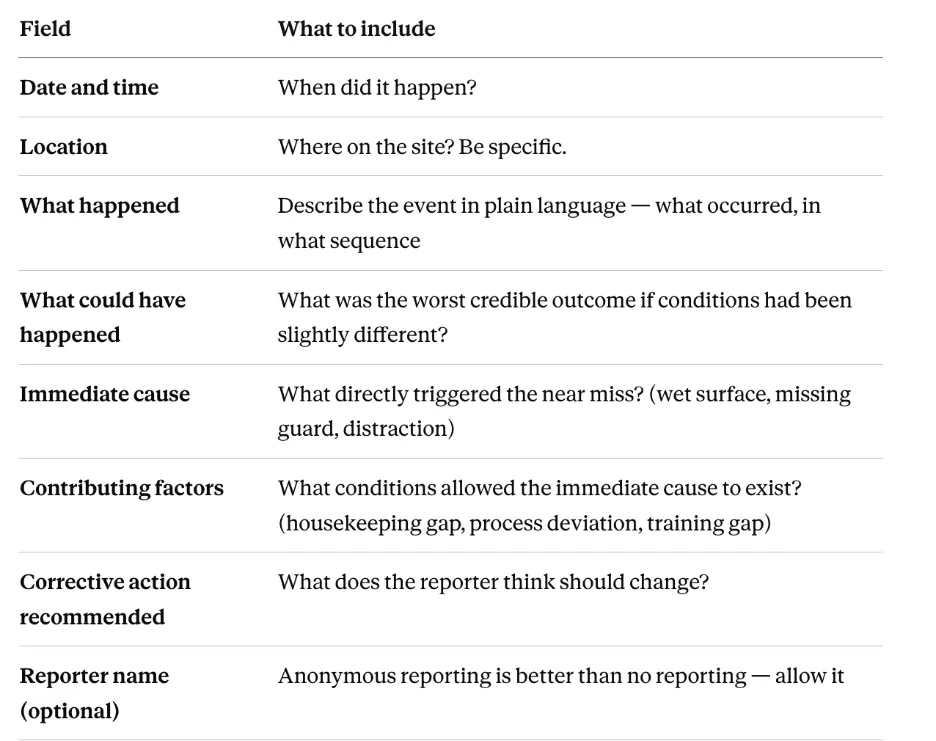
How to write a near-miss report and what to include

The goal is not a perfect investigation at the point of reporting. It's enough information to allow a supervisor or safety team to investigate the root cause and close the hazard. Simple, fast, and actionable.

What Should You Do After a Near Miss Is Reported?

Every near-miss report should trigger at minimum a supervisor review within 24 hours. For higher-severity near misses, those where the potential outcome is a serious injury or fatality, a full root-cause investigation using 5 Whys or fault tree analysis is appropriate.

The investigation should answer: why did this hazard exist, and what system change prevents it from recurring?

Retrained the worker? That addresses the immediate cause. It does not address why the hazardous condition existed in the first place. Root-cause investigations that result in engineering controls, process changes, or equipment modifications produce lasting safety improvements. Investigations that result only in retraining rarely do.

Track corrective actions in a shared system with assigned owners and due dates. Close them within 30 days. Report closure rates monthly. This is itself a leading indicator of safety program health.

How Near-Miss Reporting Connects to Your TRIR

Near misses do not appear in your TRIR. But they are the most direct upstream input to it. Every recordable incident on your TRIR was preceded by near misses and hazardous conditions that weren't identified, reported, or resolved.

A counterintuitive pattern to watch: if your TRIR is declining while your near-miss reporting volume is also declining, that is not necessarily good news. It may mean workers are reporting less and not that the workplace itself is safer.  

The hazards are still there, but they're just invisible now.

Conversely, a short-term increase in near-miss reports, after launching a new reporting program often reflects improved reporting culture. Treat rising near-miss volume as a positive signal and not an alarm.

For the full picture on TRIR, benchmarks, and how leading indicators connect to your incident rate: What Is a Good Total Recordable Incident Rate? →

The Bottom Line

Near-miss reporting is one of the clearest indicators of a mature safety culture and one of the most underused tools for reducing TRIR. Organizations that build fast, non-punitive reporting habits with visible follow-through, consistently outperform peers on every lagging metric that matters.

The incidents that will appear on next year's OSHA 300 log are being telegraphed right now by near misses happening on your sites today.  

The question is whether your program is capturing them.

Read more:

What Is a Good Total Recordable Incident Rate?  

Leading vs. Lagging Safety Indicators  

FAQs

Are near misses OSHA-recordable?  

No. Near misses are not recordable under OSHA's 29 CFR Part 1904 recordkeeping regulations because no injury or illness occurred. However, OSHA strongly encourages near-miss reporting as a best practice and references it in its Recommended Practices for Safety and Health Programs.

Why should we track near misses if they're not required?  

Because they reveal hazards before an incident becomes recordable. Near misses are the earliest available signal that your systems have a gap. Organizations that capture and resolve them consistently have significantly lower TRIR than those that don't.

What is the biggest barrier to near-miss reporting?  

Fear of blame and lack of visible follow-through. Workers stop reporting when they believe reports will be used against them or when they see no evidence that reports lead to change. A non-punitive policy and rapid, visible corrective action are the two most effective interventions.

What's the difference between a near miss and an incident?  

A near miss has no injury or illness outcome — only the potential for one. An incident results in actual harm. Both require investigation, but near misses are especially valuable because they allow you to fix the hazard before anyone is hurt.

How many near misses should we expect to receive per month?

There is no universal benchmark, but high-performing safety programs consistently report more near misses than industry peers — not fewer. As a starting point, aim for a ratio of at least 10 near-miss reports per recordable incident. If you're recording 2 incidents per month, a target of 20+ near-miss reports is a reasonable initial goal.

Near-Miss Reporting: Why It Matters and How to Build the Habit

May 22, 2026
4 min read
May 26, 2026
Rabiya Farheen
Content Strategist
Author
Rabiya Farheen
Content Strategist

A near miss is an unplanned workplace event that could have caused injury, illness, or property damage, but didn't. It is the closest signal you will ever get that a recordable incident is coming. And according to research on workplace safety ratios, for every fatality in a workplace, there are approximately 300 near misses involving the same type of hazard that went unreported or unresolved.

That ratio is why near-miss reporting is the highest-leverage leading indicator in any safety program. It doesn't show up in your TRIR or DART rate. But it predicts both.

What Counts as a Near Miss?

A near miss is any event where no injury or illness occurred, but the potential was real. OSHA defines it informally as a close call. An unplanned event that did not result in injury, illness, or damage, but had the potential to do so under slightly different circumstances.

Common near-miss examples by industry:

  • Construction: An unsecured tool falls from scaffolding and lands two feet from a worker. No injury. That's a Near miss.
  • Utilities: A storm restoration crew member nearly contacts an energized line while working on an adjacent circuit. No contact made. It's a Near miss.
  • Manufacturing: A forklift reverses without a spotter and stops inches from a pedestrian. No collision. Near miss.
  • Warehousing: A worker slips on a spill in an aisle but catches themselves on a shelf. No fall. Near miss.
  • Field operations: A vehicle reverses onto a worksite and narrowly misses a ground crew member who was outside the driver's sightline. Near miss.
  • General: A worker lifts an oversized load alone, feels a sharp back strain, and stops before injury occurs. Near miss.

In every case, the hazard was real. The outcome was lucky. And the conditions that created the near miss will still be present tomorrow unless someone reports and corrects them.

Why Near-Miss Reporting Is Your Most Important Leading Indicator

Safety metrics fall into two categories: lagging indicators, which measure outcomes after they occur (TRIR, DART, LTIR), and leading indicators, which measure conditions and behaviors before incidents happen.

Near-miss reports are leading indicators. They tell you where your systems are failing before a worker pays the price for that failure.

The data on this is clear:

  • Organizations that actively track leading indicators including near misses achieve 59% lower TRIR compared to those relying solely on lagging metrics
  • The National Safety Council estimates that workplace injuries cost U.S. employers over $167 billion annually, costs that near-miss programs directly help prevent
  • OSHA's Voluntary Protection Programs (VPP), which recognize the highest-performing safety sites in the country, consistently cite robust near-miss reporting as a defining characteristic of participating worksites

The logic here is straightforward: near misses outnumber recordable incidents by hundreds to one. If your company is only learning from recordable incidents, you are discarding the vast majority of the safety information your operations are generating every day.

Why Don't Workers Report Near Misses?

Most near-miss programs fail because of their culture. Workers consistently cite the same barriers:

  • Fear of blame. Even in organizations with non-punitive policies on paper, workers often assume that reporting will trigger scrutiny, discipline, or negative attention. If the last person who reported a near miss got interrogated rather than thanked, others noticed.
  • "Nothing happened" thinking. Workers instinctively discount near misses because the outcome was fine. The cognitive bias toward outcome-based judgment is powerful and requires active cultural counterwork.
  • No visible follow-through. If workers submit reports and nothing changes, reporting stops. This is the most common reason near-miss programs die after launch. Without visible corrective action, reporting feels pointless.
  • Friction in the process. If submitting a near-miss report requires a 20-minute form, a supervisor's signature, and a follow-up meeting, workers will not do it. Especially on busy sites. Every additional step reduces reporting volume.

The solution to all four is the same: make reporting fast, non-punitive, and visibly worth it.

How to Build a Near-Miss Reporting Culture That Actually Works

Strong near-miss programs share five characteristics:

1. A genuinely non-punitive policy — in writing and in practice. The policy must explicitly state that near-miss reports will never be used as the basis for discipline. More importantly, leadership must model this consistently. One punitive response to a near-miss report can collapse reporting culture for months.

2. Reporting in under 60 seconds. QR codes on site, mobile-first digital forms, or even a physical drop box lower the friction enough to make reporting habitual. Workers will report what's easy to report. Design for that reality.

3. Acknowledgement within 24 hours. Every near-miss report should receive a response, even a brief one, within 24 hours. This signals that the report was received and taken seriously.

4. Visible corrective action closure. Post the corrective actions taken as a result of near-miss reports in toolbox talks, on site boards, or in team communications. "You reported the slippery ramp. Here's what we changed." This is the single most powerful driver of continued reporting.

5. Volume targets, not zero targets. High-performing safety programs report more near misses than low-performing ones, not fewer. Set a monthly near-miss reporting volume target and celebrate increases. A rising near-miss report count is a sign of a healthy safety culture, not a dangerous one.

How to Write a Near-Miss Report

A near-miss report doesn't need to be long. It needs to be complete enough to enable a root-cause investigation. A strong near-miss report captures:

How to write a near-miss report and what to include

The goal is not a perfect investigation at the point of reporting. It's enough information to allow a supervisor or safety team to investigate the root cause and close the hazard. Simple, fast, and actionable.

What Should You Do After a Near Miss Is Reported?

Every near-miss report should trigger at minimum a supervisor review within 24 hours. For higher-severity near misses, those where the potential outcome is a serious injury or fatality, a full root-cause investigation using 5 Whys or fault tree analysis is appropriate.

The investigation should answer: why did this hazard exist, and what system change prevents it from recurring?

Retrained the worker? That addresses the immediate cause. It does not address why the hazardous condition existed in the first place. Root-cause investigations that result in engineering controls, process changes, or equipment modifications produce lasting safety improvements. Investigations that result only in retraining rarely do.

Track corrective actions in a shared system with assigned owners and due dates. Close them within 30 days. Report closure rates monthly. This is itself a leading indicator of safety program health.

How Near-Miss Reporting Connects to Your TRIR

Near misses do not appear in your TRIR. But they are the most direct upstream input to it. Every recordable incident on your TRIR was preceded by near misses and hazardous conditions that weren't identified, reported, or resolved.

A counterintuitive pattern to watch: if your TRIR is declining while your near-miss reporting volume is also declining, that is not necessarily good news. It may mean workers are reporting less and not that the workplace itself is safer.  

The hazards are still there, but they're just invisible now.

Conversely, a short-term increase in near-miss reports, after launching a new reporting program often reflects improved reporting culture. Treat rising near-miss volume as a positive signal and not an alarm.

For the full picture on TRIR, benchmarks, and how leading indicators connect to your incident rate: What Is a Good Total Recordable Incident Rate? →

The Bottom Line

Near-miss reporting is one of the clearest indicators of a mature safety culture and one of the most underused tools for reducing TRIR. Organizations that build fast, non-punitive reporting habits with visible follow-through, consistently outperform peers on every lagging metric that matters.

The incidents that will appear on next year's OSHA 300 log are being telegraphed right now by near misses happening on your sites today.  

The question is whether your program is capturing them.

Read more:

What Is a Good Total Recordable Incident Rate?  

Leading vs. Lagging Safety Indicators  

FAQs

Are near misses OSHA-recordable?  

No. Near misses are not recordable under OSHA's 29 CFR Part 1904 recordkeeping regulations because no injury or illness occurred. However, OSHA strongly encourages near-miss reporting as a best practice and references it in its Recommended Practices for Safety and Health Programs.

Why should we track near misses if they're not required?  

Because they reveal hazards before an incident becomes recordable. Near misses are the earliest available signal that your systems have a gap. Organizations that capture and resolve them consistently have significantly lower TRIR than those that don't.

What is the biggest barrier to near-miss reporting?  

Fear of blame and lack of visible follow-through. Workers stop reporting when they believe reports will be used against them or when they see no evidence that reports lead to change. A non-punitive policy and rapid, visible corrective action are the two most effective interventions.

What's the difference between a near miss and an incident?  

A near miss has no injury or illness outcome — only the potential for one. An incident results in actual harm. Both require investigation, but near misses are especially valuable because they allow you to fix the hazard before anyone is hurt.

How many near misses should we expect to receive per month?

There is no universal benchmark, but high-performing safety programs consistently report more near misses than industry peers — not fewer. As a starting point, aim for a ratio of at least 10 near-miss reports per recordable incident. If you're recording 2 incidents per month, a target of 20+ near-miss reports is a reasonable initial goal.

Rabiya Farheen
Content Strategist

Rabiya Farheen is a content strategist and a writer who loves turning complex ideas into clear, meaningful stories, especially in the world of utility, tech, AI, and B2B SaaS. She works closely with growing teams to create content that doesn’t just check SEO boxes, but actually helps people understand what a product does and why it matters. With a knack for research and a curiosity that never quits, Rabiya dives deep into industry trends, customer pain points, and data to craft content that feels super helpful and informative. When she’s not writing, she’s probably reading, painting, and exploring her creative side— or you'll find her hustling around for social causes, especially those that empower girls and women.

Discover more related blogs.