
.jpg)
Storm response and storm restoration are two fundamentally different operations. If you get the sequencing wrong, problems compound fast. This can lead to safety incidents on live hazards to documentation gaps that reduce FEMA reimbursement by tens of thousands of dollars per event.
This article draws on firsthand experience managing large-scale storm-recovery events and reflects FEMA PAPPG FY2025, NERC EOP-011-1, and DOE grid-resilience frameworks.
Storm response covers everything during and immediately after the storm. The goal is to make the situation safe and stop things getting worse. Speed is the primary metric and permanence is not.
This phase begins before the storm arrives. Experienced utilities pre-position crews, activate mutual-aid agreements, and run weather-track models against known grid vulnerabilities to identify which feeders and substations will fail first.
A temporary splice that restores 600 customers in 45 minutes is the right call, even if it gets replaced later. The job is to just neutralize the crisis.
Storm response ends when three conditions are met:
Starting restoration before all three are confirmed is the most expensive mistake in storm recovery.
Storm Restoration is the structured, project-managed work of permanently repairing storm damage and returning the grid to full, often improved condition. It cannot be improvised. It follows five auditable phases:
Engineers use drone imagery, LiDAR point clouds, and thermal scanning to find hidden failures, with stressed crossarms and saturated underground cable, that response teams couldn't reach. Skipping this step almost always generates more work downstream.
Assessment data becomes detailed work orders. Materials lists, crew assignments by certification, cost forecasts tied to FEMA cost codes, and logistics plans. Large events involve hundreds of mutual aid line workers across multiple states.
Storm damage repair for replacing poles, transformers, conductors, and substation equipment to pre-storm or improved standards. Work sequences from highest customer-impact circuits down to individual services. FEMA Hazard Mitigation funding often enables "build back better" upgrades at this stage.
Every repaired circuit are tested before re-energization. This step prevents secondary outages and protects crews. And it gets cut when response and restoration blur together.
Every labor hour, material unit, and inspection record must be dated and tied to a specific FEMA project worksheet. The FEMA compliance is explicit: incomplete or undated records are the primary basis for reduced or denied PA claims.
Know the difference:
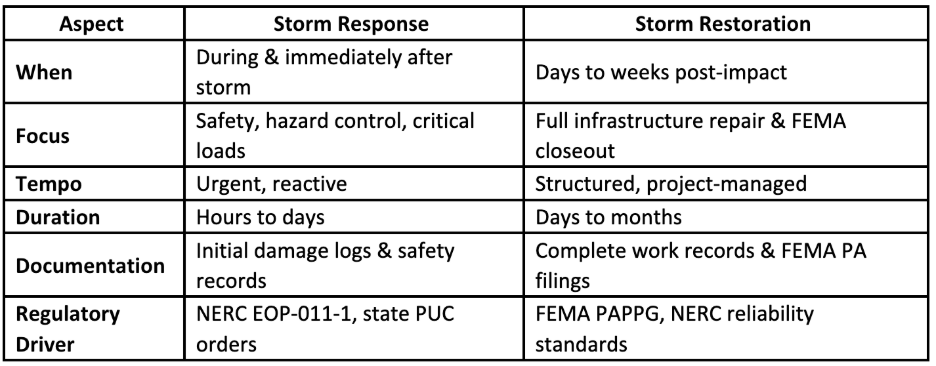
Storm response is the emergency phase during and immediately after a storm, focused on safety and temporary power restoration.
Storm restoration is the structured phase that follows, focused on permanent infrastructure repair and FEMA financial closeout. They require different resources, timelines, and documentation standards.
Storm response = emergency safety + temporary power.
Storm restoration = permanent repair + full FEMA financial closeout.
Utilities that conflate both phases hit the same three costly failures every time:
Clean separation with a verified data handoff prevents all three and consistently delivers faster restoration and higher FEMA reimbursement per event.
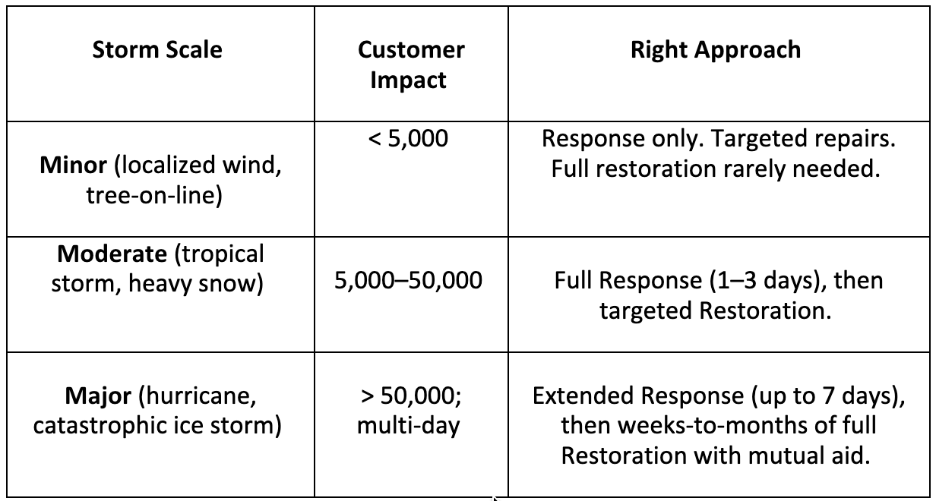
Rule of thumb:
Stay in Response until all hazards are cleared and damage scope is documented.
Switch too early = safety risk.
Stay too long = burned mutual-aid budget.
Both reduce FEMA reimbursement.
These are based on post-event reviews across Hurricane Ida and multiple tornado outbreaks:
Pitfall 1:
Rushing into storm damage restoration before storm response is complete. Crews work around live hazards. Storm damage assessments and repairs stay incomplete. FEMA reviewers flag documentation gaps during project worksheet audits.
Pitfall 2:
Staying in emergency mode too long. Day-rate mutual-aid costs accumulate without advancing permanent scope. After catastrophic events, mutual aid can represent 60–80% of total restoration labor spends.
Pitfall 3:
Data not transferring between phases. When GIS records, GPS-tagged photos, and crew logs don't move cleanly from response to restoration teams, the restoration team starts from scratch. This single failure accounts for the majority of reimbursement shortfalls we have reviewed.
The most resilient utilities aim to restore 90% of customers within 48 hours after moderate events, and those that come closest treat outage response and recovery as one connected workflow, not two separate efforts.
Field crews submit real-time damage data via mobile (offline-capable). Dispatchers view a live GIS map. Mutual-aid credentials verify automatically. Prioritization, customer impact, feeder criticality, crew proximity decisions runs on data and not radio calls.
Project managers track live progress against approved scope. Finance receives FEMA-coded timesheets automatically. Engineers review drone footage before ground crews enter hazardous areas. FEMA documentation builds continuously, not in a last-minute closeout scramble.
In Corsicana, Texas, Oncor used KYRO AI's platform for remote drone inspections during active storm recovery. Teams completed aerial damage surveys without entering hazardous terrain, enabling the response-to-restoration handoff two days earlier than the previous event baseline — with full field data immediately available to restoration planners, no manual transfer required.
KYRO AI was built by operators who lived through the sequencing breakdowns above.
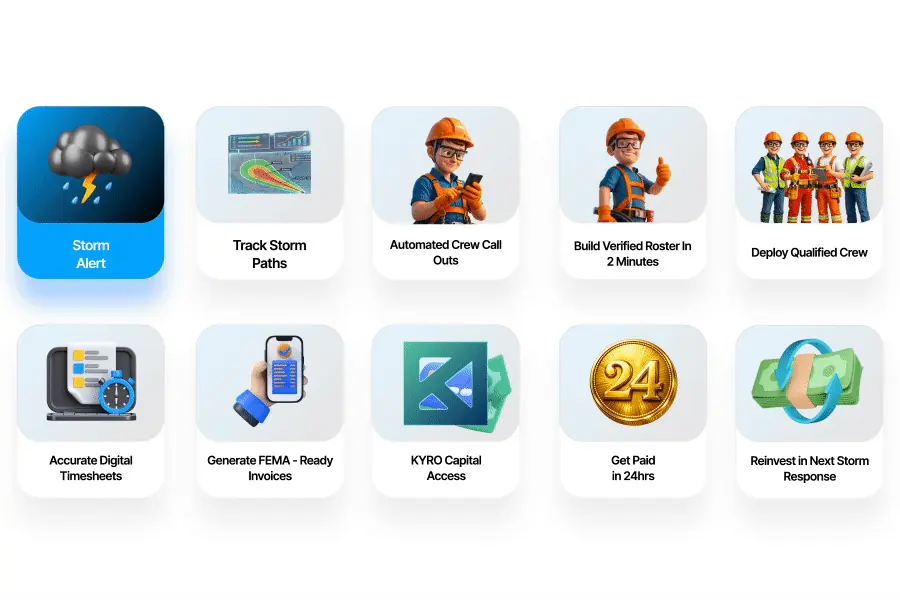
The platform connects pre-storm mobilization through final FEMA closeout, so field data travels with the project, not between disconnected systems.
Pre-storm: SMS alerts reach crews instantly. Acceptances, declines, and readiness confirmations are visible in real time. No phone trees.
Credentialing: Digital forms verify certifications and mutual-aid status automatically before crews reach staging. DISA integration does the background check, and the verification is completed.
Assignment: AI matching assigns crews by skill, equipment, proximity, and availability, accelerating the response-to-restoration handoff.
Dashboards: Mobilization status, restoration progress, mutual aid burn rates, and FEMA documentation completeness, all in one live view.
Payment: KYRO Pay converts field activity into structured, invoice-ready documentation automatically. Access to working capital helps contractors submit FEMA-ready billing packages and get paid in 24hrs.
See the companion guide: Top 8 Metrics That Define a Utility's Storm Readiness Score — covering SAIDI, SAIFI, CAIDI, and the indicators regulators watch most closely.
Utility storm response is about speed. Restoration is about completeness. Communities get power back fastest, and utilities recover the most FEMA reimbursement, when those two phases hand off cleanly, with real data flowing end-to-end.
See how KYRO AI connects both phases.
Frequently Asked Questions
Q: What is the difference between storm response and storm restoration?
Storm response is the emergency phase focused on safety, hazard control, and temporary power restoration during and immediately after a storm. Storm restoration is the structured phase that follows, covering permanent infrastructure repair and FEMA PA documentation closeout. The key differences are tempo (reactive vs. project-managed), duration (hours-to-days vs. days-to-months), and documentation standard.
Q: When does storm restoration begin?
Storm restoration begins only after storm response ends, when all active hazards are controlled, critical customers have power, and the full damage scope is verified with documented records. Starting restoration before these three conditions are met creates safety risk, incomplete scope, and FEMA documentation gaps.
Q: How does FEMA reimbursement connect to storm restoration?
FEMA's Public Assistance programm reimburses utilities for permanent repair work in storm restoration. Reimbursement depends on documentation quality: dated timesheets with FEMA cost codes, materials logs, GPS-tagged photos, and inspection records tied to project worksheets. Per FEMA PAPPG FY2024, incomplete or undated records are the primary reason claims are reduced or denied.
Q: How long does storm restoration take? Response phases last hours to days. Restoration ranges from several days for moderate events to several months for major hurricanes or ice storms. DOE grid-resilience data puts average restoration of 95% of customers at approximately 3.8 days after major storms. Utilities using integrated platforms consistently target under 48 hours for 90% restoration after moderate events.
Q: What is the biggest risk of poor coordination between storm response and restoration teams? The biggest risk is data loss at the phase handoff. When damage records, GPS-tagged photos, and crew logs don't transfer cleanly from response to restoration teams, the restoration team rebuilds scope from scratch, adding days to timelines, spiking costs, and creating FEMA documentation gaps that reduce reimbursement. Integrated platforms that carry field data across both phases eliminate this failure point.

Storm response and storm restoration are two fundamentally different operations. If you get the sequencing wrong, problems compound fast. This can lead to safety incidents on live hazards to documentation gaps that reduce FEMA reimbursement by tens of thousands of dollars per event.
This article draws on firsthand experience managing large-scale storm-recovery events and reflects FEMA PAPPG FY2025, NERC EOP-011-1, and DOE grid-resilience frameworks.
Storm response covers everything during and immediately after the storm. The goal is to make the situation safe and stop things getting worse. Speed is the primary metric and permanence is not.
This phase begins before the storm arrives. Experienced utilities pre-position crews, activate mutual-aid agreements, and run weather-track models against known grid vulnerabilities to identify which feeders and substations will fail first.
A temporary splice that restores 600 customers in 45 minutes is the right call, even if it gets replaced later. The job is to just neutralize the crisis.
Storm response ends when three conditions are met:
Starting restoration before all three are confirmed is the most expensive mistake in storm recovery.
Storm Restoration is the structured, project-managed work of permanently repairing storm damage and returning the grid to full, often improved condition. It cannot be improvised. It follows five auditable phases:
Engineers use drone imagery, LiDAR point clouds, and thermal scanning to find hidden failures, with stressed crossarms and saturated underground cable, that response teams couldn't reach. Skipping this step almost always generates more work downstream.
Assessment data becomes detailed work orders. Materials lists, crew assignments by certification, cost forecasts tied to FEMA cost codes, and logistics plans. Large events involve hundreds of mutual aid line workers across multiple states.
Storm damage repair for replacing poles, transformers, conductors, and substation equipment to pre-storm or improved standards. Work sequences from highest customer-impact circuits down to individual services. FEMA Hazard Mitigation funding often enables "build back better" upgrades at this stage.
Every repaired circuit are tested before re-energization. This step prevents secondary outages and protects crews. And it gets cut when response and restoration blur together.
Every labor hour, material unit, and inspection record must be dated and tied to a specific FEMA project worksheet. The FEMA compliance is explicit: incomplete or undated records are the primary basis for reduced or denied PA claims.
Know the difference:
Storm response is the emergency phase during and immediately after a storm, focused on safety and temporary power restoration.
Storm restoration is the structured phase that follows, focused on permanent infrastructure repair and FEMA financial closeout. They require different resources, timelines, and documentation standards.
Storm response = emergency safety + temporary power.
Storm restoration = permanent repair + full FEMA financial closeout.

Utilities that conflate both phases hit the same three costly failures every time:
Clean separation with a verified data handoff prevents all three and consistently delivers faster restoration and higher FEMA reimbursement per event.

Rule of thumb:
Stay in Response until all hazards are cleared and damage scope is documented.
Switch too early = safety risk.
Stay too long = burned mutual-aid budget.
Both reduce FEMA reimbursement.
These are based on post-event reviews across Hurricane Ida and multiple tornado outbreaks:
Pitfall 1:
Rushing into storm damage restoration before storm response is complete. Crews work around live hazards. Storm damage assessments and repairs stay incomplete. FEMA reviewers flag documentation gaps during project worksheet audits.
Pitfall 2:
Staying in emergency mode too long. Day-rate mutual-aid costs accumulate without advancing permanent scope. After catastrophic events, mutual aid can represent 60–80% of total restoration labor spends.
Pitfall 3:
Data not transferring between phases. When GIS records, GPS-tagged photos, and crew logs don't move cleanly from response to restoration teams, the restoration team starts from scratch. This single failure accounts for the majority of reimbursement shortfalls we have reviewed.
The most resilient utilities aim to restore 90% of customers within 48 hours after moderate events, and those that come closest treat outage response and recovery as one connected workflow, not two separate efforts.
Field crews submit real-time damage data via mobile (offline-capable). Dispatchers view a live GIS map. Mutual-aid credentials verify automatically. Prioritization, customer impact, feeder criticality, crew proximity decisions runs on data and not radio calls.
Project managers track live progress against approved scope. Finance receives FEMA-coded timesheets automatically. Engineers review drone footage before ground crews enter hazardous areas. FEMA documentation builds continuously, not in a last-minute closeout scramble.
In Corsicana, Texas, Oncor used KYRO AI's platform for remote drone inspections during active storm recovery. Teams completed aerial damage surveys without entering hazardous terrain, enabling the response-to-restoration handoff two days earlier than the previous event baseline — with full field data immediately available to restoration planners, no manual transfer required.
KYRO AI was built by operators who lived through the sequencing breakdowns above.

The platform connects pre-storm mobilization through final FEMA closeout, so field data travels with the project, not between disconnected systems.
Pre-storm: SMS alerts reach crews instantly. Acceptances, declines, and readiness confirmations are visible in real time. No phone trees.
Credentialing: Digital forms verify certifications and mutual-aid status automatically before crews reach staging. DISA integration does the background check, and the verification is completed.
Assignment: AI matching assigns crews by skill, equipment, proximity, and availability, accelerating the response-to-restoration handoff.
Dashboards: Mobilization status, restoration progress, mutual aid burn rates, and FEMA documentation completeness, all in one live view.
Payment: KYRO Pay converts field activity into structured, invoice-ready documentation automatically. Access to working capital helps contractors submit FEMA-ready billing packages and get paid in 24hrs.
See the companion guide: Top 8 Metrics That Define a Utility's Storm Readiness Score — covering SAIDI, SAIFI, CAIDI, and the indicators regulators watch most closely.
Utility storm response is about speed. Restoration is about completeness. Communities get power back fastest, and utilities recover the most FEMA reimbursement, when those two phases hand off cleanly, with real data flowing end-to-end.
See how KYRO AI connects both phases.
Frequently Asked Questions
Q: What is the difference between storm response and storm restoration?
Storm response is the emergency phase focused on safety, hazard control, and temporary power restoration during and immediately after a storm. Storm restoration is the structured phase that follows, covering permanent infrastructure repair and FEMA PA documentation closeout. The key differences are tempo (reactive vs. project-managed), duration (hours-to-days vs. days-to-months), and documentation standard.
Q: When does storm restoration begin?
Storm restoration begins only after storm response ends, when all active hazards are controlled, critical customers have power, and the full damage scope is verified with documented records. Starting restoration before these three conditions are met creates safety risk, incomplete scope, and FEMA documentation gaps.
Q: How does FEMA reimbursement connect to storm restoration?
FEMA's Public Assistance programm reimburses utilities for permanent repair work in storm restoration. Reimbursement depends on documentation quality: dated timesheets with FEMA cost codes, materials logs, GPS-tagged photos, and inspection records tied to project worksheets. Per FEMA PAPPG FY2024, incomplete or undated records are the primary reason claims are reduced or denied.
Q: How long does storm restoration take? Response phases last hours to days. Restoration ranges from several days for moderate events to several months for major hurricanes or ice storms. DOE grid-resilience data puts average restoration of 95% of customers at approximately 3.8 days after major storms. Utilities using integrated platforms consistently target under 48 hours for 90% restoration after moderate events.
Q: What is the biggest risk of poor coordination between storm response and restoration teams? The biggest risk is data loss at the phase handoff. When damage records, GPS-tagged photos, and crew logs don't transfer cleanly from response to restoration teams, the restoration team rebuilds scope from scratch, adding days to timelines, spiking costs, and creating FEMA documentation gaps that reduce reimbursement. Integrated platforms that carry field data across both phases eliminate this failure point.

Rabiya Farheen is a content strategist and a writer who loves turning complex ideas into clear, meaningful stories, especially in the world of construction tech, AI, and B2B SaaS. She works closely with growing teams to create content that doesn’t just check SEO boxes, but actually helps people understand what a product does and why it matters. With a knack for research and a curiosity that never quits, Rabiya dives deep into industry trends, customer pain points, and data to craft content that feels super helpful and informative. When she’s not writing, she’s probably reading, painting, and exploring her creative side— or you'll find her hustling around for social causes, especially those that empower girls and women.