.jpg)
After a major storm, utility safety teams and field managers tend to do the same thing: pull up the incident report, count the injuries, review what went wrong. It's a natural instinct. The data is right there, concrete and undeniable. Three recordable injuries. One lost-time incident. TRIR up from last quarter.
The problem is that by the time you're reading that report, the window to prevent those injuries has already closed. You're not looking at safety. You're looking at the evidence that safety failed.
That's the core tension between leading and lagging indicators. It becomes especially sharp for storm response teams, where compressed timelines, mutual aid crews arriving from out of state, and unpredictable field conditions mean you genuinely do not have the luxury of learning from last week's mistakes.
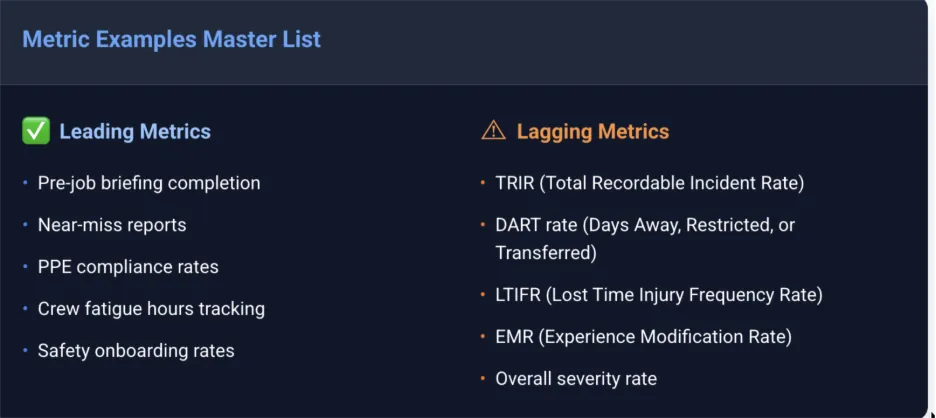
Lagging indicators measure safety outcomes after they occur, such as injuries, TRIR, and lost-time incidents.
Leading indicators measure the conditions and behaviors that predict those outcomes before they happen — training completion, near-miss reports, pre-job briefings, inspection close-out rates.
For storm response teams, leading indicators are the only metrics that can actually move fast enough to prevent incidents during active response operations.
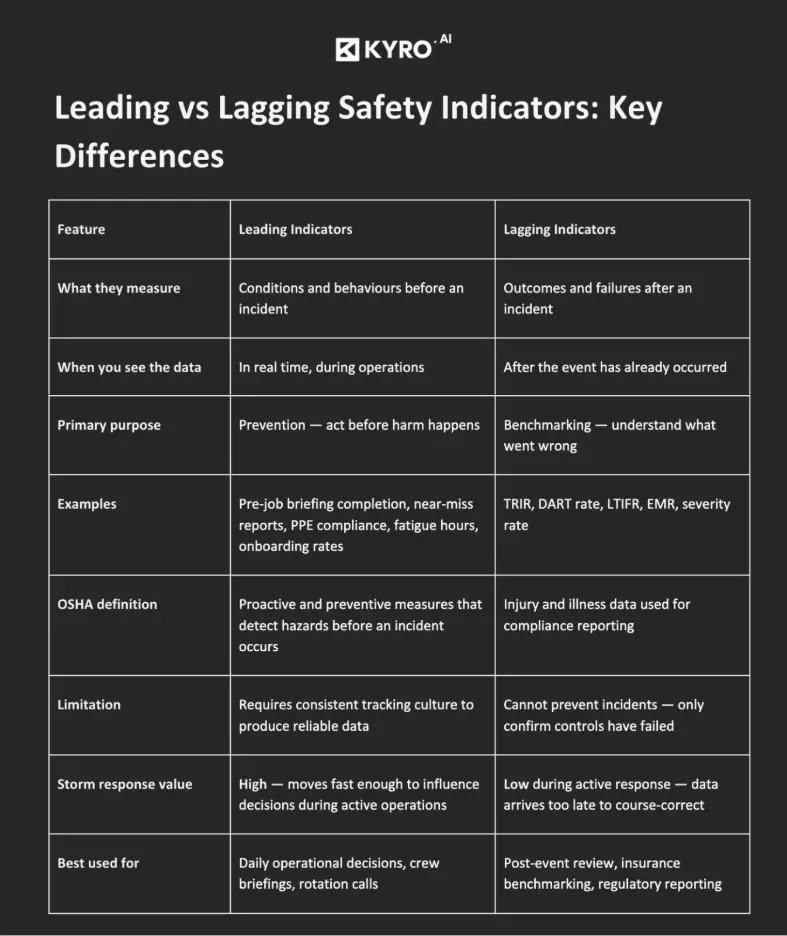
Lagging indicators are the traditional foundation of safety programs.
These are the numbers every safety manager knows, reports to leadership, and benchmarks against industry peers.
OSHA requires them. Insurers price against them. And a high TRIR is absolutely a signal that something is broken.
But the Campbell Institute, which studies EHS excellence across major industrial organizations, has called them "failure-focused", and that framing is precise. Lagging indicators can only confirm that your controls have already failed.
The Caterpillar example has become something of a reference point in EHS circles for good reason. In 2002, the company was recording over 20,000 injuries annually with 63,000 lost workdays. Their safety leadership made a pointed observation that has since been widely cited: traditional metrics tell you the score at the end of the game, but they don't tell you how to play better.
The company shifted its entire safety strategy toward leading indicators, and over a ten-year period reduced injuries by 85% while saving $450 million in direct and indirect injury-related costs.
The lesson isn't that lagging indicators should be abandoned. It's that relying on them exclusively is like driving by watching the rearview mirror.
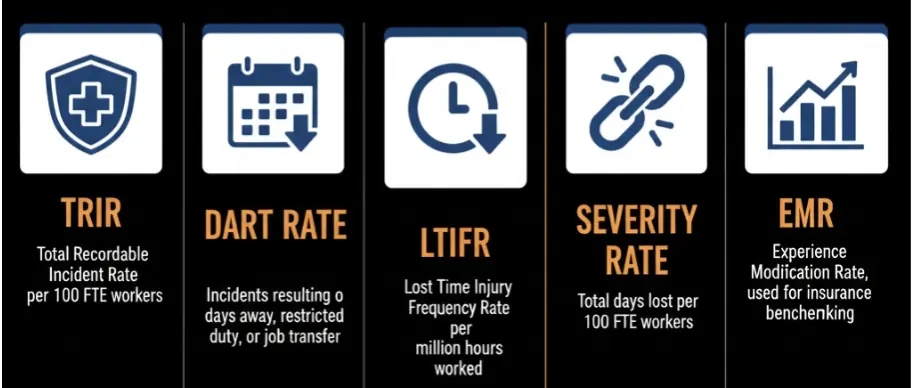
For storm response specifically, TRIR and DART have an additional limitation: they're built around a stable workforce over a defined period. When you're absorbing mutual aid crews from five different utilities for a ten-day event, the denominator in those calculations gets messy fast, and the incident rate numbers can be misleading in both directions.
A leading indicator is any measure that precedes and predicts a safety outcome. It tracks what people are doing, or failing to do before an incident occurs.
OSHA defines them as "proactive and preventive measures that help you detect and address hazards before an incident occurs."
A 2024 VelocityEHS State of the Market study of 478 organizations found that
The gap between tracking and actually using leading indicators effectively is where most programs fall short.
For storm response teams, the case for leading indicators is even stronger than in routine operations:
Not all leading indicators are created equal. Tracking the number of safety meetings held is technically a leading indicator. But it tells you almost nothing useful unless you also know whether the right information was covered, whether mutual aid crews were integrated, and whether the pre-job briefing accounted for the specific hazards at that site, that day, in those conditions.
The percentage of field crews conducting a full pre-job briefing before beginning work. During storm response, this is the single most actionable leading indicator because it's the primary mechanism for communicating real-time hazard information to crews working unfamiliar circuits.
The number of near-miss reports submitted per 100 workers per month. A high near-miss rate is not a sign that your operation is dangerous. It's a sign that your crew culture is healthy enough that people report close calls instead of absorbing them silently.
For storm response teams, near-miss reporting often collapses under pressure. Crews are exhausted, they don't want to slow the operation, and there's a cultural instinct to push through. Building that reporting culture before storm season is the only way to maintain it during active response.
The percentage of incoming mutual aid crews who have completed your utility's safety onboarding before beginning work.
Nashville Electric Service's post-storm guidance states it plainly: "Linemen must be qualified, trained on our system, insured, and integrated into our safety and operations protocols." That integration check is a leading indicator. Skipping it is how contractors end up working in conditions they don't fully understand.
Read more: Linemen safety guide – 2026
The percentage of safety inspection findings closed out within a defined timeframe.
A SafetyPedia case study found that areas with low hazard reporting rates had proportionally higher incident rates and that after driving up reporting and close-out rates, incidents dropped 25% within three months. Finding hazards matters. Closing them out matters more.
Shift length tracking, consecutive days worked, and overtime patterns during extended response. For storm response teams this is arguably the most critical leading indicator because fatigue specifically degrades hazard recognition, the cognitive function most essential in live-wire environments.
The percentage of field observations where required PPE is being worn correctly. For electrical restoration work, PPE compliance is the last line of defense.
Collecting leading indicator data and actually using it to make decisions are two different things. Leading indicators don't improve safety by existing in a spreadsheet but by giving supervisors something to act on before the incident log gets a new entry.
For storm response, the connection point has to be built into the operation itself.
During Hurricane Helene, Appalachian Power absorbed two to three times as many mutual aid crews as in previous storms without coordination bottlenecks, specifically because real-time digital workflows made circuit status, crew location, and work assignments visible to everyone simultaneously.
That kind of real-time visibility is exactly what platforms like KYRO AI StormShield are built to enable. Bringing together field data, crew activity, and operational updates into a single, continuously updated system that forms the foundation of a leading indicator system.
Leading indicators only work if you have baseline data to compare against. If you've never tracked near-miss reporting rates during normal operations, you have no way to know whether a drop in reports during storm response means things are going well or means crews have stopped reporting.
The most effective storm response safety programs build their leading indicator baselines in the 60–90 days before storm season:
There isn't one. The search for the single most important leading indicator is itself a lagging-indicator mindset applied to a proactive problem. You're looking for one number that will tell you safety has already succeeded or failed.
What actually moves the needle in storm response safety is a small set of high-fidelity leading indicators tracked with real-time visibility, connected to people who have authority to act on them before the next shift starts.
Lagging indicators tell you how last season went. Leading indicators tell you how today is going.
If you want to see how real-time leading indicator tracking works in active storm response operations, explore how KYRO AI StormShield brings field data, crew activity, and safety metrics into a single live view.
What is the difference between leading and lagging indicators?
Lagging indicators measure safety outcomes after they occur — injuries, TRIR, lost workdays. Leading indicators measure conditions and behaviours before an incident happens — pre-job briefings, near-miss reports, PPE compliance. Lagging indicators confirm that safety controls have already failed. Leading indicators give supervisors something to act on before the next task begins.
Why are leading indicators important in safety?
Leading indicators are important because most incidents build gradually — through skipped briefings, unreported hazards, and fatigued crews — before they become injuries. Leading indicators let supervisors spot those gaps in real time and act before harm occurs. In high-risk environments like storm response, lagging data arrives too late. Leading indicators move at the same speed as operations.
What are examples of leading indicators in construction?
The most impactful leading indicators in construction are: pre-job briefing completion rate, near-miss reporting frequency, safety inspection close-out rate, toolbox talk participation, PPE compliance during field observations, and fatigue tracking (hours worked and consecutive shifts). These work because they reflect actual crew behavior in the field — not just paperwork compliance — giving supervisors data they can act on immediately.

After a major storm, utility safety teams and field managers tend to do the same thing: pull up the incident report, count the injuries, review what went wrong. It's a natural instinct. The data is right there, concrete and undeniable. Three recordable injuries. One lost-time incident. TRIR up from last quarter.
The problem is that by the time you're reading that report, the window to prevent those injuries has already closed. You're not looking at safety. You're looking at the evidence that safety failed.
That's the core tension between leading and lagging indicators. It becomes especially sharp for storm response teams, where compressed timelines, mutual aid crews arriving from out of state, and unpredictable field conditions mean you genuinely do not have the luxury of learning from last week's mistakes.

Lagging indicators measure safety outcomes after they occur, such as injuries, TRIR, and lost-time incidents.
Leading indicators measure the conditions and behaviors that predict those outcomes before they happen — training completion, near-miss reports, pre-job briefings, inspection close-out rates.
For storm response teams, leading indicators are the only metrics that can actually move fast enough to prevent incidents during active response operations.

Lagging indicators are the traditional foundation of safety programs.
These are the numbers every safety manager knows, reports to leadership, and benchmarks against industry peers.
OSHA requires them. Insurers price against them. And a high TRIR is absolutely a signal that something is broken.
But the Campbell Institute, which studies EHS excellence across major industrial organizations, has called them "failure-focused", and that framing is precise. Lagging indicators can only confirm that your controls have already failed.
The Caterpillar example has become something of a reference point in EHS circles for good reason. In 2002, the company was recording over 20,000 injuries annually with 63,000 lost workdays. Their safety leadership made a pointed observation that has since been widely cited: traditional metrics tell you the score at the end of the game, but they don't tell you how to play better.
The company shifted its entire safety strategy toward leading indicators, and over a ten-year period reduced injuries by 85% while saving $450 million in direct and indirect injury-related costs.
The lesson isn't that lagging indicators should be abandoned. It's that relying on them exclusively is like driving by watching the rearview mirror.

For storm response specifically, TRIR and DART have an additional limitation: they're built around a stable workforce over a defined period. When you're absorbing mutual aid crews from five different utilities for a ten-day event, the denominator in those calculations gets messy fast, and the incident rate numbers can be misleading in both directions.
A leading indicator is any measure that precedes and predicts a safety outcome. It tracks what people are doing, or failing to do before an incident occurs.
OSHA defines them as "proactive and preventive measures that help you detect and address hazards before an incident occurs."
A 2024 VelocityEHS State of the Market study of 478 organizations found that
The gap between tracking and actually using leading indicators effectively is where most programs fall short.
For storm response teams, the case for leading indicators is even stronger than in routine operations:
Not all leading indicators are created equal. Tracking the number of safety meetings held is technically a leading indicator. But it tells you almost nothing useful unless you also know whether the right information was covered, whether mutual aid crews were integrated, and whether the pre-job briefing accounted for the specific hazards at that site, that day, in those conditions.
The percentage of field crews conducting a full pre-job briefing before beginning work. During storm response, this is the single most actionable leading indicator because it's the primary mechanism for communicating real-time hazard information to crews working unfamiliar circuits.
The number of near-miss reports submitted per 100 workers per month. A high near-miss rate is not a sign that your operation is dangerous. It's a sign that your crew culture is healthy enough that people report close calls instead of absorbing them silently.
For storm response teams, near-miss reporting often collapses under pressure. Crews are exhausted, they don't want to slow the operation, and there's a cultural instinct to push through. Building that reporting culture before storm season is the only way to maintain it during active response.
The percentage of incoming mutual aid crews who have completed your utility's safety onboarding before beginning work.
Nashville Electric Service's post-storm guidance states it plainly: "Linemen must be qualified, trained on our system, insured, and integrated into our safety and operations protocols." That integration check is a leading indicator. Skipping it is how contractors end up working in conditions they don't fully understand.
Read more: Linemen safety guide – 2026
The percentage of safety inspection findings closed out within a defined timeframe.
A SafetyPedia case study found that areas with low hazard reporting rates had proportionally higher incident rates and that after driving up reporting and close-out rates, incidents dropped 25% within three months. Finding hazards matters. Closing them out matters more.
Shift length tracking, consecutive days worked, and overtime patterns during extended response. For storm response teams this is arguably the most critical leading indicator because fatigue specifically degrades hazard recognition, the cognitive function most essential in live-wire environments.
The percentage of field observations where required PPE is being worn correctly. For electrical restoration work, PPE compliance is the last line of defense.
Collecting leading indicator data and actually using it to make decisions are two different things. Leading indicators don't improve safety by existing in a spreadsheet but by giving supervisors something to act on before the incident log gets a new entry.
For storm response, the connection point has to be built into the operation itself.
During Hurricane Helene, Appalachian Power absorbed two to three times as many mutual aid crews as in previous storms without coordination bottlenecks, specifically because real-time digital workflows made circuit status, crew location, and work assignments visible to everyone simultaneously.
That kind of real-time visibility is exactly what platforms like KYRO AI StormShield are built to enable. Bringing together field data, crew activity, and operational updates into a single, continuously updated system that forms the foundation of a leading indicator system.
Leading indicators only work if you have baseline data to compare against. If you've never tracked near-miss reporting rates during normal operations, you have no way to know whether a drop in reports during storm response means things are going well or means crews have stopped reporting.
The most effective storm response safety programs build their leading indicator baselines in the 60–90 days before storm season:
There isn't one. The search for the single most important leading indicator is itself a lagging-indicator mindset applied to a proactive problem. You're looking for one number that will tell you safety has already succeeded or failed.
What actually moves the needle in storm response safety is a small set of high-fidelity leading indicators tracked with real-time visibility, connected to people who have authority to act on them before the next shift starts.
Lagging indicators tell you how last season went. Leading indicators tell you how today is going.
If you want to see how real-time leading indicator tracking works in active storm response operations, explore how KYRO AI StormShield brings field data, crew activity, and safety metrics into a single live view.
What is the difference between leading and lagging indicators?
Lagging indicators measure safety outcomes after they occur — injuries, TRIR, lost workdays. Leading indicators measure conditions and behaviours before an incident happens — pre-job briefings, near-miss reports, PPE compliance. Lagging indicators confirm that safety controls have already failed. Leading indicators give supervisors something to act on before the next task begins.
Why are leading indicators important in safety?
Leading indicators are important because most incidents build gradually — through skipped briefings, unreported hazards, and fatigued crews — before they become injuries. Leading indicators let supervisors spot those gaps in real time and act before harm occurs. In high-risk environments like storm response, lagging data arrives too late. Leading indicators move at the same speed as operations.
What are examples of leading indicators in construction?
The most impactful leading indicators in construction are: pre-job briefing completion rate, near-miss reporting frequency, safety inspection close-out rate, toolbox talk participation, PPE compliance during field observations, and fatigue tracking (hours worked and consecutive shifts). These work because they reflect actual crew behavior in the field — not just paperwork compliance — giving supervisors data they can act on immediately.

Rabiya Farheen is a content strategist and a writer who loves turning complex ideas into clear, meaningful stories, especially in the world of construction tech, AI, and B2B SaaS. She works closely with growing teams to create content that doesn’t just check SEO boxes, but actually helps people understand what a product does and why it matters. With a knack for research and a curiosity that never quits, Rabiya dives deep into industry trends, customer pain points, and data to craft content that feels super helpful and informative. When she’s not writing, she’s probably reading, painting, and exploring her creative side— or you'll find her hustling around for social causes, especially those that empower girls and women.