
.jpg)
Every utility has two Operating Plans. One lives in a SharePoint folder. The other lives in the middle of a storm. NERC only cares about one of them. It cares about hour six of your worst storm of the year, when nobody's writing anything down because everybody's too busy keeping the lights on.
There is a version of your Operating Plan that exists on paper, reviewed and approved, sitting in a binder or a SharePoint folder, technically compliant with everything EOP-011 asks for.
And there is the version that actually happens during a real emergency, when switching orders get called over a radio, EEA escalations happen in the middle of a chaotic shift change, and nobody on the crew is thinking about whether this moment needs a timestamp.
NERC does not audit the binder. It audits the gap between the binder and the radio call. That gap is where almost every EOP-011 finding lives.
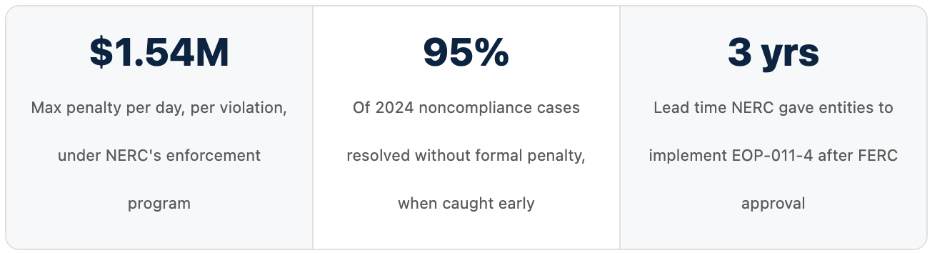
Strip away the regulatory language and EOP-011 is asking a simple question:
The standard applies to Transmission Operators and Balancing Authorities, and as of EOP-011-4, approved by FERC in February 2024, it now reaches Distribution Providers and UFLS-only entities too.
The expansion came directly out of the lessons from Winter Storm Uri, when the grid failures in Texas made it clear that emergency planning couldn't stop at the transmission level.
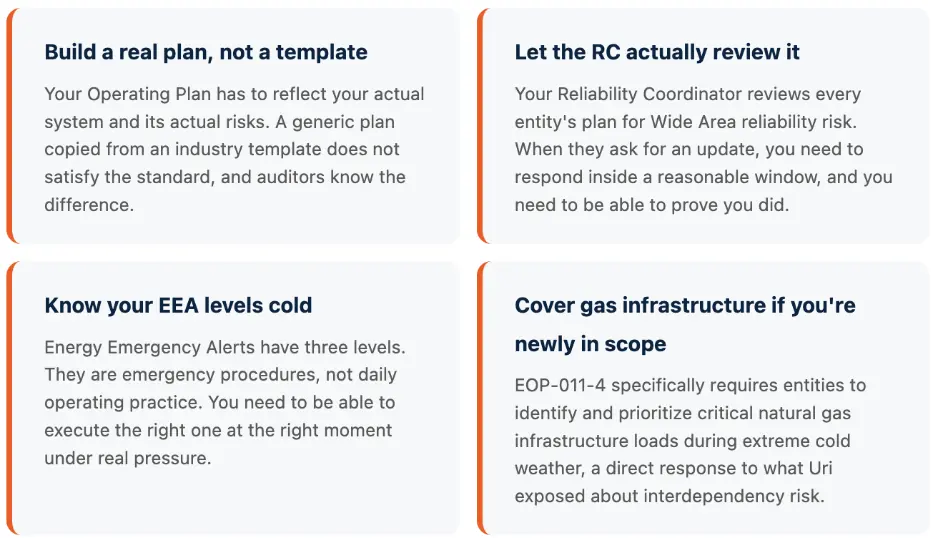
None of that is controversial. Most utilities already think this way operational. The standard doesn't fail utilities on intent. It fails them on proof.
Every utility produces documentation after a major event. Lessons-learned reports, after-action reviews, and summary timelines for leadership.
That documentation is real, it's useful, and it is consistently the weaker half of what NERC actually wants to see.
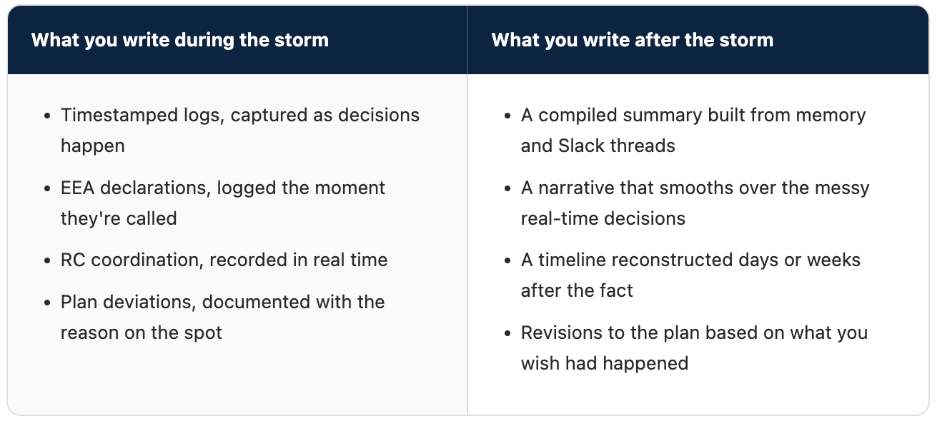
Auditors weigh the left column heavily and the right column lightly, and for good reason.
A record built in the moment is hard to fake and easy to trust. A record built three weeks later, after the adrenaline's gone and the story has already been told a few times internally, is the version everyone remembers wanting to be true.
NERC has seen enough of both to know the difference on sight. This is the same failure pattern showing up across every storm-related compliance obligation utilities carry.
FEMA reimbursement reviews reject paper logs reconstructed after a major event for the same reason NERC auditors flag reconstructed Operating Plan evidence.
See how this plays out in FEMA's documentation requirements for utilities.
NERC's audit worksheets give a non-exclusive list of acceptable evidence types, which is another way of saying there's no single template to fill out and pass. But the failure patterns across audits are remarkably consistent.
"Repeated violations often reflect not just documentation lapses, but operational patterns that stay invisible until an audit forces a retrospective review."
That line, drawn from broader NERC compliance research, applies to EOP-011 almost word for word. The gap rarely means the utility handled the emergency poorly. It means the systems used to capture what happened weren't built to produce real evidence in real time, and nobody noticed until an auditor went looking for it.
The instinct when you find a documentation gap is to write a better post-event report template. That doesn't fix anything. The actual fix is moving the evidence capture point earlier, to the moment the decision or the action actually happens.
When crew deployment, switching operations, EEA timing, and RC communications get logged through a digital field platform instead of a radio call and a notepad, three things change immediately.
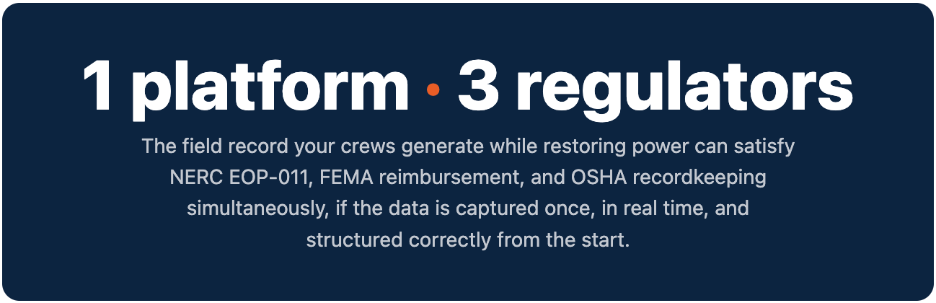
This is the same underlying infrastructure question behind every regulatory obligation a utility carries through a storm. The systems that capture accurate field data automatically are the systems that produce defensible records for FEMA, for OSHA, and now for NERC, without anyone having to build three separate documentation processes for three separate regulators asking variations of the same question.
Most platform investment conversations start with operational efficiency: faster mobilization, better damage visibility, quicker restoration. Those arguments work. But NERC compliance gives the case a second angle that often lands harder with the people who control the budget.
A penalty ceiling of $1.54 million per day per violation gets attention in any boardroom. But the more common cost isn't the penalty itself, since most violations resolve through corrective action rather than formal fines. The real cost is the weeks of internal disruption that follow a finding: legal review, mitigation plan development, follow-up reporting, and staff pulled off their normal jobs to manage a response that better documentation would have prevented from becoming a finding in the first place.
A field platform that produces timestamped, structured evidence as a natural byproduct of normal storm operations turns that risk into something closer to background noise. It's the same platform that helps crews mobilize faster in the critical first hours of a storm, and it happens to be the platform that produces a clean audit trail when NERC, FERC, or a Regional Entity comes asking. That's not two separate investments. It's one investment doing two jobs.
What not to do: build a separate, compliance-only documentation layer on top of operations that already run through a different system. That duplication is exactly what creates the reconciliation gaps that produce findings in the first place. The most resilient compliance posture comes from operations that generate compliance evidence as a side effect, not from a compliance team bolting paperwork onto operations after the storm has already passed.
KYRO AI captures timestamped, structured field data as your crews restore power, so the record they generate while doing the job is the same record that satisfies EOP-011 audits, FEMA reimbursement reviews, and OSHA recordkeeping requirements.
See KYRO AI for Storm Operations →
FAQ
What does NERC EOP-011 require?
EOP-011 requires Transmission Operators and Balancing Authorities to develop, maintain, and implement Operating Plans for identified operating Emergencies, with provisions for Energy Emergency Alerts and Reliability Coordinator review. Entities must retain evidence of plan review and revision history.
What documentation must utilities produce for EOP-011 compliance?
Two categories of evidence: contemporaneous records created during the event, such as timestamped operational logs and Reliability Coordinator communications, and a post-event evidence package summarizing implementation. Auditors weigh real-time, contemporaneous documentation far more heavily than reconstructed summaries written after the storm has passed.
What are common audit findings in EOP-011 reviews?
The most frequent findings are missing evidence of plan review history, no proof Reliability Coordinator review happened within required timeframes, a mismatch between the written plan and what field records show actually occurred, and reconstructed documentation that can't establish a credible timeline.
What penalties can NERC impose for EOP-011 non-compliance?
NERC can impose penalties up to 1.54 million dollars per day per violation, up from the original 1 million dollar daily cap set in 2007. FERC enforcement settlements across reliability standard violations totaled roughly 33 million dollars in 2024, with severity scaled to bulk power system risk and the entity's compliance history.
How do digital field platforms support NERC EOP-011 compliance?
Digital field platforms like KYRO AI that log crew activity, switching decisions, and coordination communications in real time create exactly the timestamped, contemporaneous evidence NERC auditors weigh most heavily. Utilities skip the manual reconciliation process that normally creates documentation gaps after major storm events.
Does NERC EOP-011 apply to Distribution Providers?
Yes. Under EOP-011-4, the standard was expanded to include certain Distribution Providers (DPs) and UFLS-only entities whose systems play a role in Bulk Electric System (BES) reliability. If your organization is identified as an applicable entity under the standard, you must develop, maintain, and implement Operating Plans, retain evidence of plan reviews, and demonstrate compliance during audits.
How long should utilities retain Operating Plan records for EOP-011 compliance?
Utilities should retain the current Operating Plan, all superseded versions issued since the last audit, and supporting evidence such as revision history, Reliability Coordinator review records, and implementation documentation. Maintaining a complete, timestamped record of plan updates and reviews helps demonstrate compliance and supports a successful NERC audit.

Every utility has two Operating Plans. One lives in a SharePoint folder. The other lives in the middle of a storm. NERC only cares about one of them. It cares about hour six of your worst storm of the year, when nobody's writing anything down because everybody's too busy keeping the lights on.
There is a version of your Operating Plan that exists on paper, reviewed and approved, sitting in a binder or a SharePoint folder, technically compliant with everything EOP-011 asks for.
And there is the version that actually happens during a real emergency, when switching orders get called over a radio, EEA escalations happen in the middle of a chaotic shift change, and nobody on the crew is thinking about whether this moment needs a timestamp.
NERC does not audit the binder. It audits the gap between the binder and the radio call. That gap is where almost every EOP-011 finding lives.

Strip away the regulatory language and EOP-011 is asking a simple question:
The standard applies to Transmission Operators and Balancing Authorities, and as of EOP-011-4, approved by FERC in February 2024, it now reaches Distribution Providers and UFLS-only entities too.
The expansion came directly out of the lessons from Winter Storm Uri, when the grid failures in Texas made it clear that emergency planning couldn't stop at the transmission level.

None of that is controversial. Most utilities already think this way operational. The standard doesn't fail utilities on intent. It fails them on proof.
Every utility produces documentation after a major event. Lessons-learned reports, after-action reviews, and summary timelines for leadership.
That documentation is real, it's useful, and it is consistently the weaker half of what NERC actually wants to see.

Auditors weigh the left column heavily and the right column lightly, and for good reason.
A record built in the moment is hard to fake and easy to trust. A record built three weeks later, after the adrenaline's gone and the story has already been told a few times internally, is the version everyone remembers wanting to be true.
NERC has seen enough of both to know the difference on sight. This is the same failure pattern showing up across every storm-related compliance obligation utilities carry.
FEMA reimbursement reviews reject paper logs reconstructed after a major event for the same reason NERC auditors flag reconstructed Operating Plan evidence.
See how this plays out in FEMA's documentation requirements for utilities.
NERC's audit worksheets give a non-exclusive list of acceptable evidence types, which is another way of saying there's no single template to fill out and pass. But the failure patterns across audits are remarkably consistent.
"Repeated violations often reflect not just documentation lapses, but operational patterns that stay invisible until an audit forces a retrospective review."
That line, drawn from broader NERC compliance research, applies to EOP-011 almost word for word. The gap rarely means the utility handled the emergency poorly. It means the systems used to capture what happened weren't built to produce real evidence in real time, and nobody noticed until an auditor went looking for it.
The instinct when you find a documentation gap is to write a better post-event report template. That doesn't fix anything. The actual fix is moving the evidence capture point earlier, to the moment the decision or the action actually happens.
When crew deployment, switching operations, EEA timing, and RC communications get logged through a digital field platform instead of a radio call and a notepad, three things change immediately.
This is the same underlying infrastructure question behind every regulatory obligation a utility carries through a storm. The systems that capture accurate field data automatically are the systems that produce defensible records for FEMA, for OSHA, and now for NERC, without anyone having to build three separate documentation processes for three separate regulators asking variations of the same question.

Most platform investment conversations start with operational efficiency: faster mobilization, better damage visibility, quicker restoration. Those arguments work. But NERC compliance gives the case a second angle that often lands harder with the people who control the budget.
A penalty ceiling of $1.54 million per day per violation gets attention in any boardroom. But the more common cost isn't the penalty itself, since most violations resolve through corrective action rather than formal fines. The real cost is the weeks of internal disruption that follow a finding: legal review, mitigation plan development, follow-up reporting, and staff pulled off their normal jobs to manage a response that better documentation would have prevented from becoming a finding in the first place.
A field platform that produces timestamped, structured evidence as a natural byproduct of normal storm operations turns that risk into something closer to background noise. It's the same platform that helps crews mobilize faster in the critical first hours of a storm, and it happens to be the platform that produces a clean audit trail when NERC, FERC, or a Regional Entity comes asking. That's not two separate investments. It's one investment doing two jobs.
What not to do: build a separate, compliance-only documentation layer on top of operations that already run through a different system. That duplication is exactly what creates the reconciliation gaps that produce findings in the first place. The most resilient compliance posture comes from operations that generate compliance evidence as a side effect, not from a compliance team bolting paperwork onto operations after the storm has already passed.
KYRO AI captures timestamped, structured field data as your crews restore power, so the record they generate while doing the job is the same record that satisfies EOP-011 audits, FEMA reimbursement reviews, and OSHA recordkeeping requirements.
See KYRO AI for Storm Operations →
FAQ
What does NERC EOP-011 require?
EOP-011 requires Transmission Operators and Balancing Authorities to develop, maintain, and implement Operating Plans for identified operating Emergencies, with provisions for Energy Emergency Alerts and Reliability Coordinator review. Entities must retain evidence of plan review and revision history.
What documentation must utilities produce for EOP-011 compliance?
Two categories of evidence: contemporaneous records created during the event, such as timestamped operational logs and Reliability Coordinator communications, and a post-event evidence package summarizing implementation. Auditors weigh real-time, contemporaneous documentation far more heavily than reconstructed summaries written after the storm has passed.
What are common audit findings in EOP-011 reviews?
The most frequent findings are missing evidence of plan review history, no proof Reliability Coordinator review happened within required timeframes, a mismatch between the written plan and what field records show actually occurred, and reconstructed documentation that can't establish a credible timeline.
What penalties can NERC impose for EOP-011 non-compliance?
NERC can impose penalties up to 1.54 million dollars per day per violation, up from the original 1 million dollar daily cap set in 2007. FERC enforcement settlements across reliability standard violations totaled roughly 33 million dollars in 2024, with severity scaled to bulk power system risk and the entity's compliance history.
How do digital field platforms support NERC EOP-011 compliance?
Digital field platforms like KYRO AI that log crew activity, switching decisions, and coordination communications in real time create exactly the timestamped, contemporaneous evidence NERC auditors weigh most heavily. Utilities skip the manual reconciliation process that normally creates documentation gaps after major storm events.
Does NERC EOP-011 apply to Distribution Providers?
Yes. Under EOP-011-4, the standard was expanded to include certain Distribution Providers (DPs) and UFLS-only entities whose systems play a role in Bulk Electric System (BES) reliability. If your organization is identified as an applicable entity under the standard, you must develop, maintain, and implement Operating Plans, retain evidence of plan reviews, and demonstrate compliance during audits.
How long should utilities retain Operating Plan records for EOP-011 compliance?
Utilities should retain the current Operating Plan, all superseded versions issued since the last audit, and supporting evidence such as revision history, Reliability Coordinator review records, and implementation documentation. Maintaining a complete, timestamped record of plan updates and reviews helps demonstrate compliance and supports a successful NERC audit.

Rabiya Farheen is a content strategist and a writer who loves turning complex ideas into clear, meaningful stories, especially in the world of utility, tech, AI, and B2B SaaS. She works closely with growing teams to create content that doesn’t just check SEO boxes, but actually helps people understand what a product does and why it matters. With a knack for research and a curiosity that never quits, Rabiya dives deep into industry trends, customer pain points, and data to craft content that feels super helpful and informative. When she’s not writing, she’s probably reading, painting, and exploring her creative side— or you'll find her hustling around for social causes, especially those that empower girls and women.