

What are RMAGs for Utilities? A Complete Guide
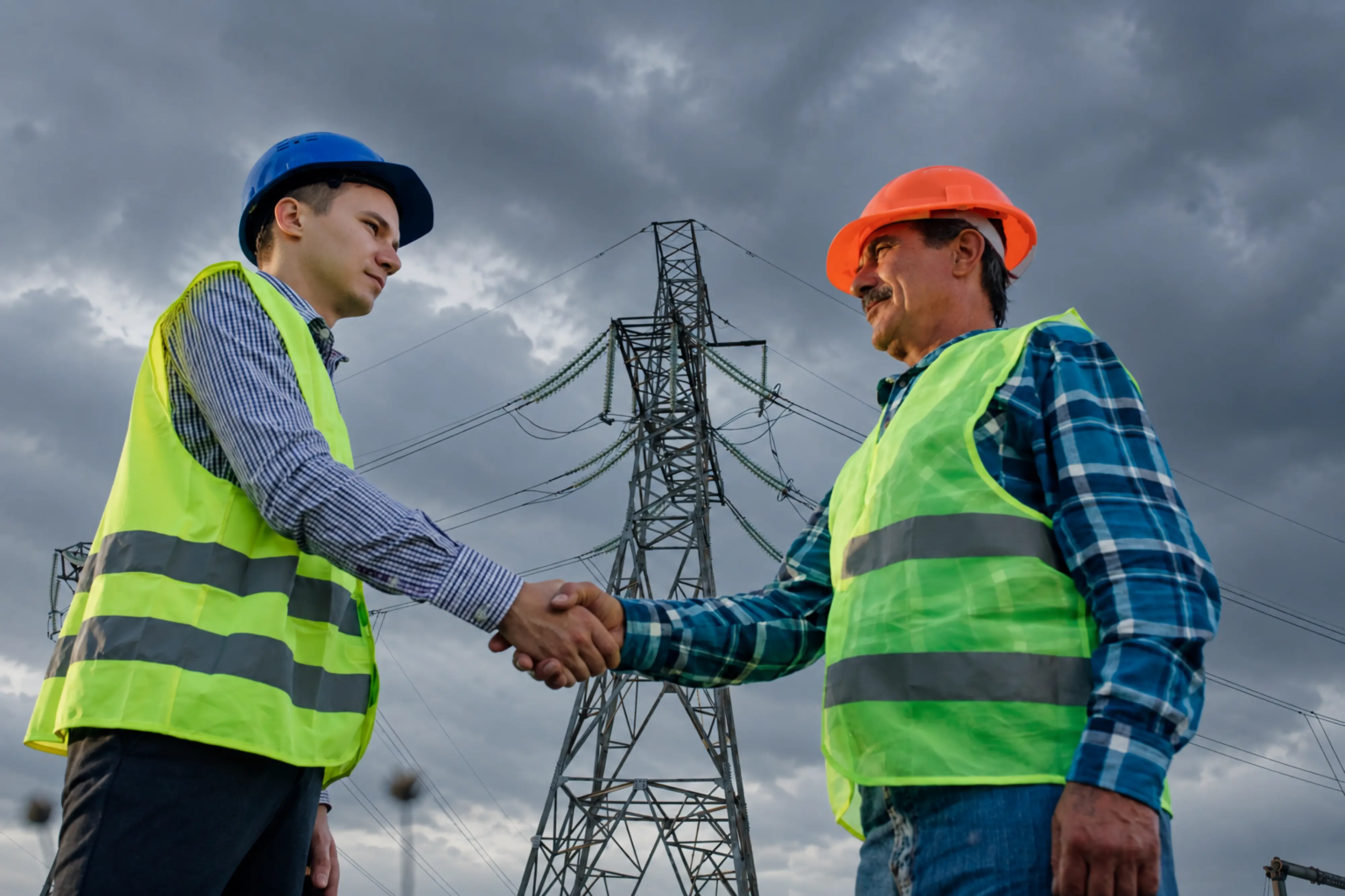
Mutual aid, also called mutual assistance, is a voluntary arrangement in which utilities lend each other line crews, equipment and materials to restore power after major outages. It exists because no utility keeps enough crews on payroll to rebuild its grid alone after a hurricane, or storm.
Coordination at that scale runs through Regional Mutual Assistance Groups (RMAGs).
This article explains what RMAGs are, the different types of mutual aid networks, and how the RMAG process works step by step. It also covers how requests escalate to a national response, real-world examples, the roadblocks utilities still face and how to overcome them.
What are RMAGs?
Regional Mutual Assistance Groups (RMAGs) are geographically organized networks of utilities that agree to help one another restore power after major outages. Most members are investor-owned utilities that follow the Edison Electric Institute's (EEI) mutual assistance guidelines, with regional rules layered on top.
Mutual assistance process itself is simple. Utilities lend each other line crews, contractors, equipment and materials when a disaster occurs in a local capacity. According to EEI's Mutual Assistance 101, RMAGs make this work at scale by:
- Receiving restoration requests from member utilities
- Identifying available workers, specialized skills, equipment and materials
- Coordinating logistics and personnel
- Planning ahead so that lending crews doesn't leave the home region exposed to a second event
- Calling on other regions when their own members can't cover the need
RMAG operates on three ground rules
Three important principles underpin many utility mutual-assistance arrangements according to EEI’s Governing Principles:
- Cost-based reimbursement: Under EEI's mutual-assistance principles, the requesting utility generally reimburses the responding utility for documented assistance costs, including applicable labor, travel and equipment expenses. Contractors engaged directly by the requesting utility may operate under separately negotiated commercial arrangements.
- Responding utility control: Each responding utility determines which resources it can provide and retains the authority to recall its personnel, contractors and equipment under the applicable mutual-assistance arrangements.
- Voluntary participation: Utilities contribute resources when they have the capacity to help without compromising their own operations.
The requesting utility coordinates restoration priorities, operating requirements and necessary support arrangements. Responding crews remain employees of their original utility and receive instructions through designated supervisors or crew leads. The RMAG helps coordinate resources between participating utilities.
Investor-Owned Utility Mutual Assistance Networks
Investor-Owned Utility (IOU) Mutual Assistance Networks are voluntary arrangements through which privately owned electric utilities share restoration crews, contractors, and equipment during major outages.
In the U.S., the Edison Electric Institute (EEI) supports this network. Its member utilities coordinate through Regional Mutual Assistance Groups (RMAGs), which provide a regional structure for requesting, offering, and coordinating restoration resources.
Different RMAGs Existing in the U.S
The IOU Mutual Assistance Networks cover seven regional groups (RMAGs) recognized by DOE (State Energy Security Plan Optional Drop-In: Mutual Assistance November 2023) and NARUC which are as follows:
- Western Region Mutual Assistance Group (WRMAG)
- Midwest Mutual Assistance Group (MMAG)
- Wisconsin Mutual Assistance Group
- Great Lakes Mutual Assistance Group (GLMAG)
- North Atlantic Mutual Assistance Group (NAMAG)
- Southeastern Electric Exchange (SEE)
- Texas Mutual Assistance Group (TXMAG)
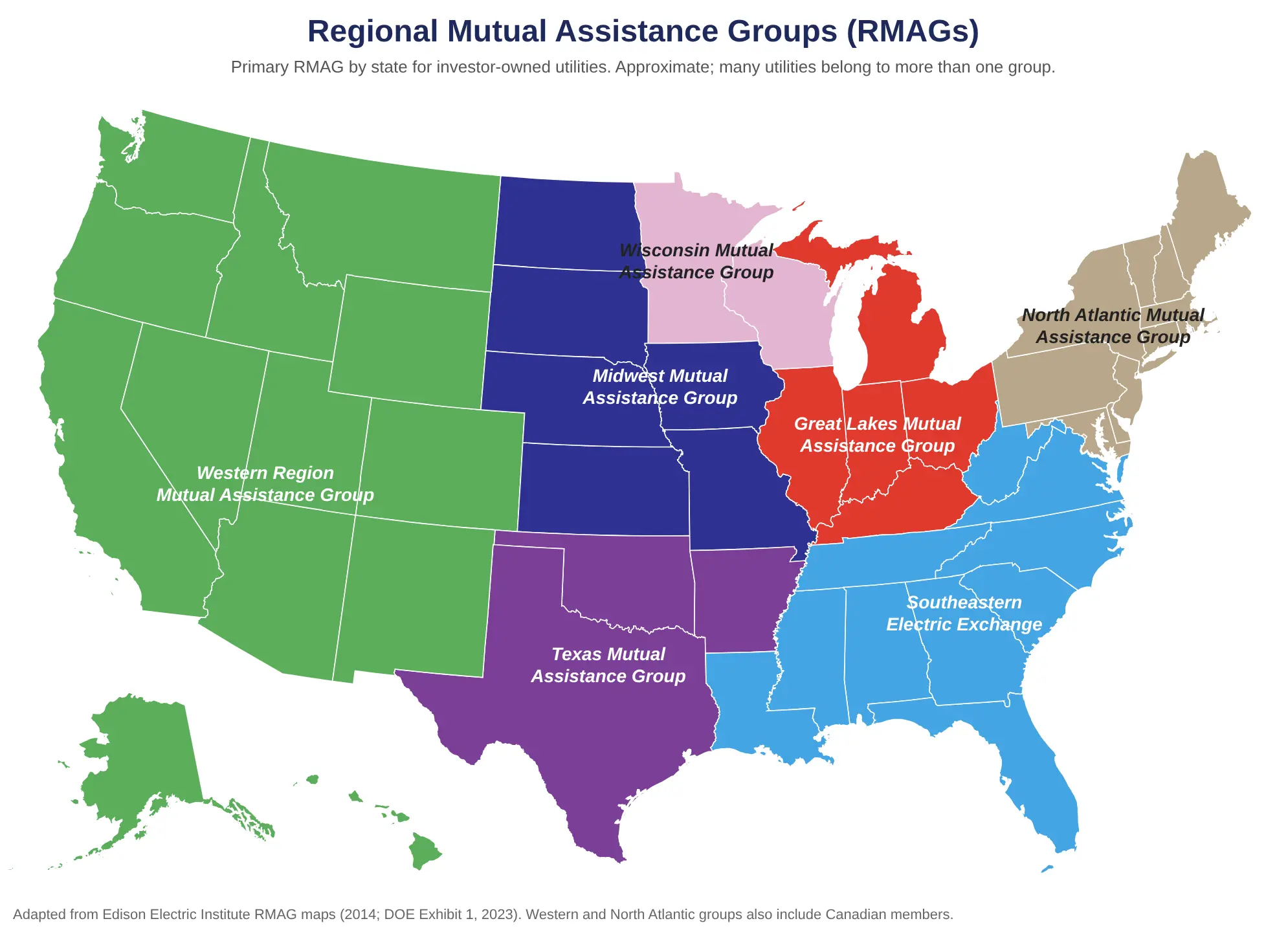
These groups help member utilities communicate resource requirements, identify available crews, and coordinate assistance during widespread outages. When a storm affects multiple regions, coordination can extend beyond an individual RMAG.
How do the various RMAGs differ in rules?
EEI sets the baseline, but each RMAG layers its own agreement and guidelines on top, and where a regional agreement exists, it governs (EEI Mutual Assistance Agreement). The differences show up in three places: payment, coordination, and crew release.
These are examples of agreement-specific terms. The applicable agreement between the requesting and responding utilities determines the actual billing, payment and release obligations for a given assistance arrangement.
How do RMAGs Work?
RMAGs are member-led mutual-assistance coordination networks. Their governance, administrative support, membership conditions and operating procedures vary by region.
For example, refer to the published guidelines of NAMAG and WRMAG describing their respective leadership structures and member responsibilities.
Membership
According to NAMAG's published 2013 guidelines, membership is open to utilities in the region, mainly investor-owned utilities, though NAMAG also admits co-ops and municipal utilities. A utility joins by contacting an officer, and NAMAG approves new members by majority vote. There are no fees. Members pay only for the assistance they receive and take turns hosting meetings.
Governance
Each RMAG has elected officers who typically serve one-year terms. Leadership roles may differ by region. For example, NAMAG rotates its Secretary into the Vice Chair role and then Chair, while WRMAG has two Co-Chairs, a Vice Chair, and a Secretary representing different parts of the region.
NAMAG generally makes decisions through consensus, with a three-quarters majority required to change its guidelines.
Member responsibilities
- Keep designated contacts current. NAMAG asks for three authorized contacts per company and updates its roster at least every three months.
- Join activation calls and attend the twice-yearly spring and fall meetings.
- Take part in exercises and share lessons learned (WRMAG).
- Help others in later events in proportion to the company's size (WRMAG).
How an RMAG activates
- Initiate regional coordination: The affected utility contacts the appropriate regional coordinator or chair under applicable procedures.
- Assess resource needs and availability: Requesting utilities communicate requirements, and responding utilities identify resources they may be able to provide.
- Evaluate allocation options: RAMP-UP's historically documented functions support requests, offers, matching and allocation calculations. Regional participants evaluate proposed allocations and practical constraints.
- Record the allocation decision: Document the agreed resource distribution, shortages and applicable conditions.
- Confirm commitments: Responding utilities authorize the resources they can actually release, including any reductions or conditions.
- Mobilize resources: The involved utilities coordinate authorized crew deployment, travel, rosters and receiving arrangements.
- Demobilize crews and settle costs: Resources are released under applicable arrangements, and the parties reconcile their financial obligations.
Responding utilities invoice the requesting utility under the applicable mutual-assistance agreement. The requesting utility may subsequently pursue eligible cost recovery through regulatory mechanisms, insurance or FEMA Public Assistance where applicable.
How Mutual Assistance Expands from Local to National Coordination
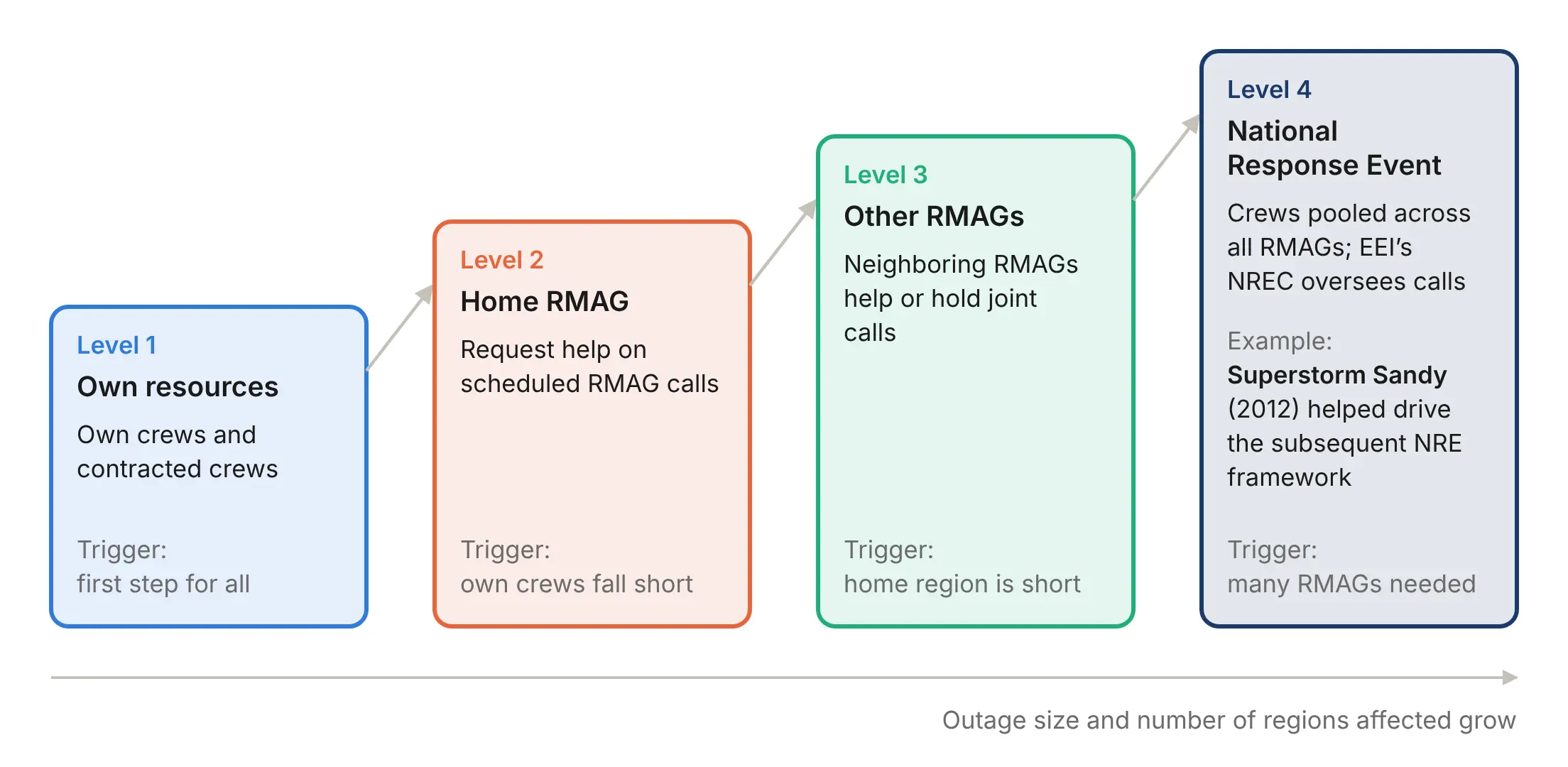
Depending on the scale and anticipated impact of an emergency, mutual-assistance coordination may expand from a utility's own resources to regional, cross-regional and national assistance. These are common coordination pathways rather than mandatory sequential levels.
- Own crews and contractors. Every response starts with internal and already-contracted resources.
- Home RMAG. The utility requests help through its own regional group, usually on scheduled calls.
- Cross-RMAG support. If the home region is short, other RMAGs help each other or hold joint calls.
- National Response Event (NRE). For the largest events, resources are coordinated nationally.
What happens in a Mutual Aid National Response Event
An NRE covers a natural or man-made event that causes, or is forecast to cause, widespread outages needing resources from multiple RMAGs. For example, during major hurricanes, earthquakes, or acts of war.
An affected EEI member company's authorized senior executive may request national response coordination.
During a National Response Event, participating utilities and RMAGs coordinate resource requests and available offers nationally. Allocation processes help distribute offered assistance among affected utilities, while responding companies retain authority over the resources they can provide or recall.
The National Response Executive Committee (NREC), a rotating group of senior utility executives, oversees the event. It activates the National Mutual Assistance Resource Team (NMART), which evaluates requests and assigns crews in coordination with the RMAGs. The industry also works alongside DOE, DHS, DOT, the Department of Defense and the Canadian Border Services Agency.
EEI's board approved the NRE framework in September 2013, a direct lesson from Superstorm Sandy (From Sandy to Today).
Examples of Mutual Aid Through RMAGs
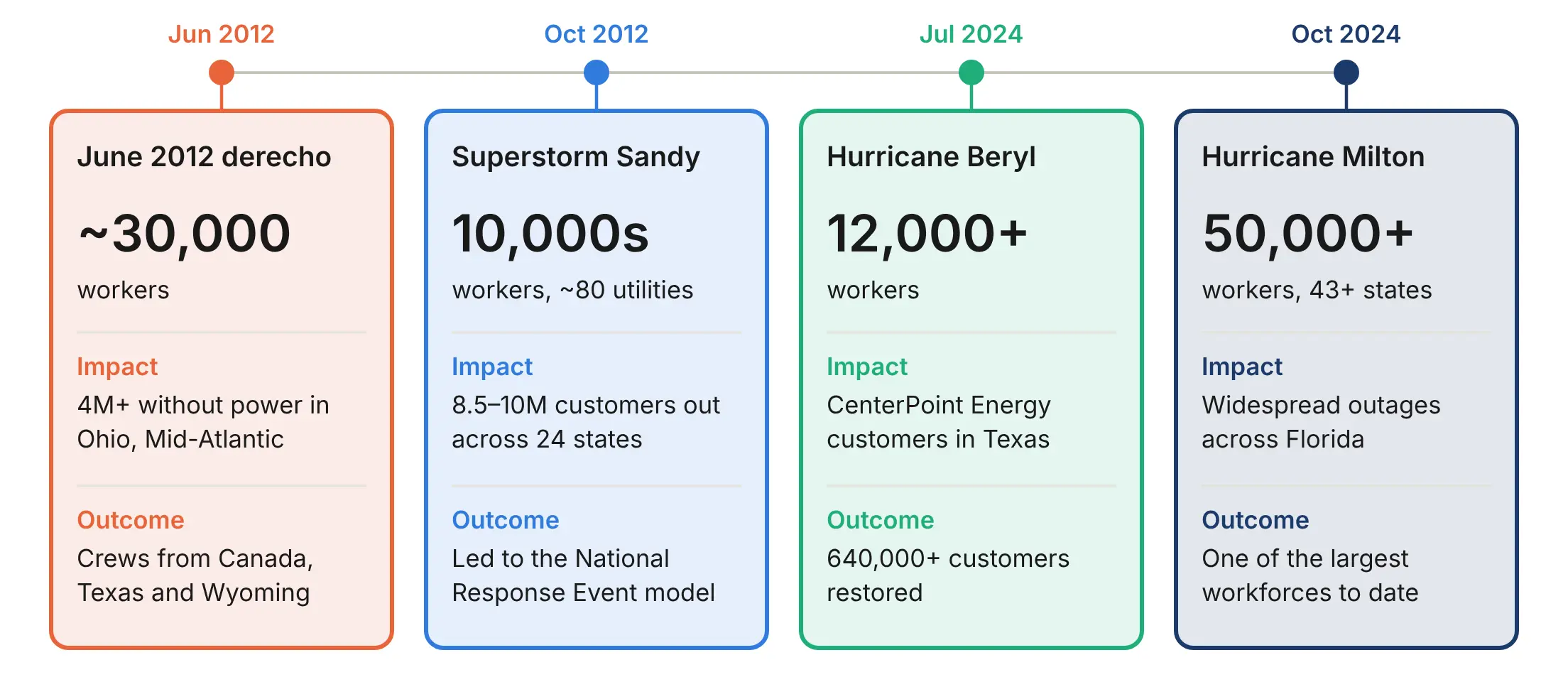
RMAGs have played a key role in coordinating utility crews across regions during major storms and widespread outages. The following examples show how this cooperation works in real-world events.
Examples of Mutual Aid for Utilities through RMAG
Superstorm Sandy (2012): the birth of the NRE
Superstorm Sandy (2012) cut power to roughly 10 million customers across 24 states. Tens of thousands of workers from around 80 utilities, including Canadian companies, responded. The storm exposed the lack of a national framework for events of that scale, which led directly to the NRE model.
The June 2012 Derecho
The June 29, 2012, derecho developed rapidly, leaving utilities with little time to prepare. It knocked out power to more than 4.2 million customers across 11 states and Washington, D.C. Around 30,000 utility workers joined restoration efforts, with crews arriving from as far away as Canada, Texas, and Wyoming.
Hurricane Beryl (2024)
During Hurricane Beryl, CenterPoint mobilized a large restoration workforce comprising internal and external resources. Its after-action report recorded 13,991 crew resources activated and 10,589 on site as of July 9, 2024.
Hurricane Milton (2024)
More than 50,000 workers from at least 43 states mobilized for Florida, one of the largest restoration workforces assembled to date.
Roadblocks in Today's RMAG Processes
RMAGs work, but the process around them still leaks time and money in six places.
1. Allocated crews aren't always committed crews. An allocation on a call is a starting point, not a guarantee. Responders may send fewer crews, arrive late or recall them, and host utilities end up planning against moving numbers.
2. Workflows are scattered. RAMP-UP, EEI’s standard allocation tool across all seven RMAGs, handles requests, offers, and the crew split well, but it stops at allocation. Once crews are assigned, confirmations, rosters, check-in, work assignments and demobilization run on spreadsheets, emails and phone calls, so no one has a single, current picture.
3. Check-in turns chaotic. Thousands of workers arrive at staging sites with credentials that need verifying. Different safety rules, terminology and system standards between utilities slow onboarding further.
4. Borders slow crews down. NARUC has documented (in 2015) historical instances of restoration crews experiencing delays of up to 12 hours at toll facilities and weigh stations because of interstate travel and licensing issues.
5. Rules vary by RMAG. Payment deadlines, call cadence and release rules differ from group to group, adding admin work for utilities in more than one group.
6. Billing and cost recovery are slow. Manual timesheets lead to disputed invoices, delayed reimbursement and harder regulator reviews and FEMA claims.
How Utilities Can Overcome These Roadblocks
Most mutual aid challenges arise after resource allocation, where better coordination, visibility, and documentation can make a difference.
- Create a single source of truth. Keep RAMP-UP for resource allocation, but centralize crew confirmations, rosters, assignments, and releases to reduce reliance on scattered emails and spreadsheets.
- Digitize rosters and crew onboarding. Verify qualifications, certifications, and credentials before crews arrive at staging sites to reduce check-in delays.
- Monitor storms and plan mobilization early. Track developing weather threats, identify potential resource gaps, and prepare crew requests and staging plans before outages escalate.
- Digitize timesheets and cost records. Capture field hours, labor, equipment, and other expenses as work happens. This makes invoice preparation easier and provides supporting records for audits, regulatory reviews, and FEMA reimbursement claims.
FAQs
How many RMAGs are there?
There are seven DOE recognized RMAGs in the U.S.:
- Western Region Mutual Assistance Group (WRMAG)
- Midwest Mutual Assistance Group (MMAG)
- Wisconsin Mutual Assistance Group
- Great Lakes Mutual Assistance Group (GLMAG)
- North Atlantic Mutual Assistance Group (NAMAG)
- Southeastern Electric Exchange (SEE)
- Texas Mutual Assistance Group (TXMAG) .
However, the latest EEI documents identify only six RMAGs.
Can a utility belong to more than one RMAG?
Yes. Many utilities belong to more than one group, especially those whose service territories span regions.
Who pays for mutual assistance crews?
The requesting utility pays the responder's actual costs, with no profit. Investor-owned utilities recover these costs through state regulators.
Eligible public power utilities and qualifying electric cooperatives may seek FEMA Public Assistance reimbursement for eligible disaster-related costs, subject to the applicable requirements. Investor-owned utilities generally pursue regulatory recovery mechanisms and insurance where available.
What is the difference between an RMAG and an NRE?
An RMAG coordinates aid within its region. A National Response Event pools resources nationally when an event needs crews from multiple RMAGs.
What is RAMP-UP?
By 2017, EEI had identified RAMP-UP (Resource Allocation Management Program for Utility Personnel) as the standard resource-allocation platform across the seven RMAGs operating at that time.