

Features
Industries
Who we serve
Resources
Sign in
Get Started - $500/month
No commitment. No implementation fee. Unlimited users. Cancel anytime
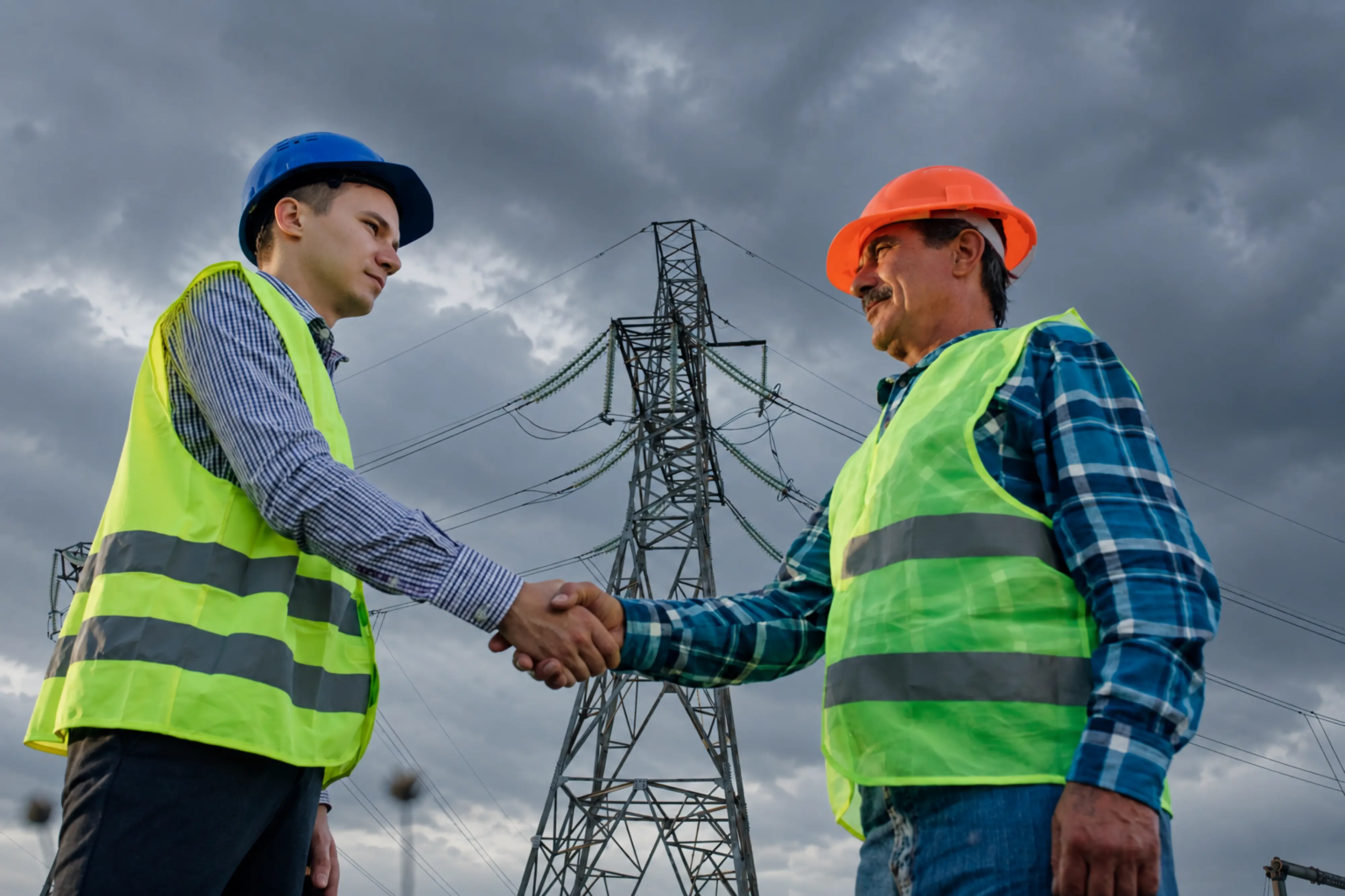
No utility keeps enough line crews on payroll to rebuild its grid alone after a major disaster. So, the utilities borrow crews from each other through mutual assistance.
The following examples exhibit the impact of mutual aid on utilities. When Hurricane Milton hit Florida in 2024, more than 50,000 workers from at least 43 states arrived to help. Similarly, during Hurricane Beryl in July 2024, CenterPoint Energy secured more than 12000 workers.
But how does the process work? Who makes the request, what resources are needed, and how are incoming crews assigned when multiple utilities need help at the same time?
This article covers in detail how mutual aid for utilities work, the current gaps in the process, and how to overcome them.
Mutual assistance, also called mutual aid, is a voluntary arrangement in which electric utilities help one another restore power after major storm or other disasters.
When a utility cannot handle the restoration with its available resources and crew, it can request additional workers, equipment, and other materials from utilities in less-affected areas.
Here are the key terms used in the mutual aid process:
These arrangements allow utilities to share resources during large emergencies without each utility having to maintain enough crews to handle every possible storm on its own.
Three principles hold across agreements:
Regional Mutual Assistance Groups (RMAGs) are networks of electric utilities that coordinate mutual aid during major storms, helping members share resource needs and arrange available crews and equipment.
EEI documents seven RMAGs in the U.S. which includes:
All RMAGs are not uniform in how they function. Their procedures vary, including payment deadlines (30 days in the West and 60 days in Texas), when the payment period begins, coordination calls, and crew release rules. Some utilities could also belong to multiple RMAGs.
Mutual assistance requests move up a level as the event grows:
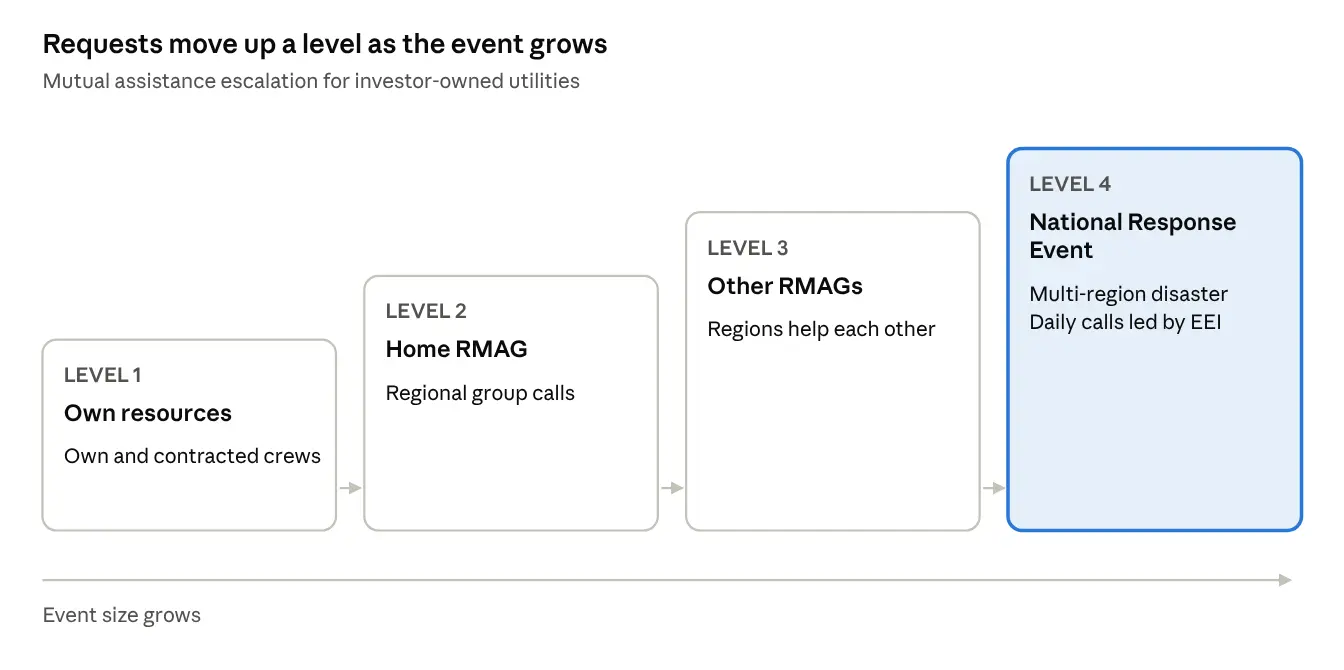
Going national makes sense when the home region can't cover the need, several regions are hit at once, or crews are competing across storms.
Scale decides the channel. Regional events go through an RMAG. When a widespread outage needs crews from several RMAGs, EEI can declare a National Response Event, reserved for events such as a major storm, hurricane or earthquake. For example: Superstorm Sandy (about 10 million customers out across 24 states) mutual aid moved from regional to national level.
A utility requests help when its forecast or damage assessment shows restoration will outrun its own crews and contractors. Common triggers:
The process runs in ten phases, from forecast to final cost recovery months later. Each phase hands records to the next, often across companies.
Payment rules vary by agreement: 60 days after the final invoice under EEI's agreement, 30 days in the West, 60 in Texas, and a 90-day invoice rule with no payment deadline for public power.
RAMP-UP (Resource Allocation Management Program for Utility Personnel is a network-based tool developed by EEI and its utility partners. It is used to coordinate and allocate restoration crews and other resources among utilities during regional and national emergencies. Its development was initiated by the National Response Executive Committee (NREC).
According to EEI's From Sandy to Today, it became the standard resource allocation platform for all seven RMAGs by 2017. One utility executive said it "saves so much time and streamlines processes."
RAMP-UP lets members:
RAMP-UP is strong in the regional allocation decision. However, the crew confirmation, rosters, check-in, field work, billing and recovery all happen in other systems.
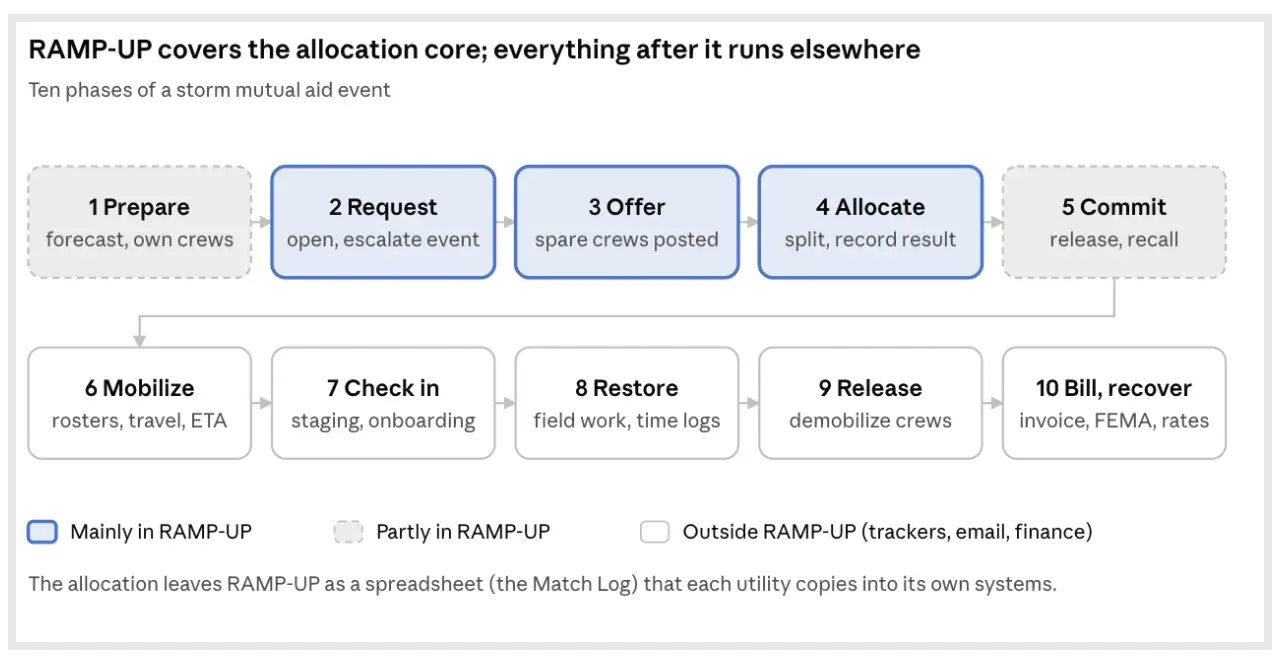
RAMP-UP helps utilities allocate available mutual aid resources equitably among utilities requesting assistance during major storms. But allocation is only one part of the mutual aid process. An allocation does not guarantee that the responding utility will confirm or release all the crews offered.
Once resources are allocated, utilities still need to confirm crew availability, update rosters, coordinate crew mobilization, assign work, manage demobilization, track timesheets, and prepare invoices.
These tasks are often spread across spreadsheets, emails, phone calls, and separate time-tracking tools, making information harder to keep consistent and up to date.
The fragmented operational workflows need to be brought together in one platform. It has to work alongside existing mutual aid networks and allocation processes, reducing repetitive data entry and making coordination easier to manage.
Who pays for mutual aid crews?
The utility that requests help pays the responder's actual costs, with no profit. It then recovers those costs from customers through its regulator (investor-owned utilities) or claims FEMA reimbursement (public power and co-ops).
Can a responding utility recall its crews?
Yes. The responder decides what it releases and can recall crews, for example if a second storm threatens its own territory.
What is an RMAG?
A Regional Mutual Assistance Group: a regional network of utilities that coordinates crew requests and offers. Most mutual aid agreements among investor-owned utilities are managed through RMAGs.
What is a National Response Event?
An EEI designation for widespread outages that need crews from several RMAGs, such as a major hurricane or earthquake. It was created after Superstorm Sandy.
Is RAMP-UP used by public power utilities and co-ops?
No. RAMP-UP serves EEI's investor-owned members and their RMAGs. Public power and co-ops coordinate through APPA and NRECA with their own agreement, state coordinators and tool.
How long does mutual aid payment take?
It depends on the agreement: 60 days after the final invoice under EEI's, 30 days in the West, 60 in Texas. Public power requires invoices within 90 days but sets no payment deadline.
