

Features
Industries
Who we serve
Resources
Sign in
Get Started - $500/month
No commitment. No implementation fee. Unlimited users. Cancel anytime

When a major storm rolls through, outages spread across your territory, and crews need to be mobilized fast.
Your utility has a storm plan. But does everyone follow the same processes every time? Can you measure how well it worked? And when it’s over, does your data actually show what went right and what needs fixing?
Measuring storm response maturity helps you answer this exactly. It shows how well-defined and repeatable your storm processes are, how smoothly your internal teams and outside partners work together, and where the weak spots are hiding.
This guide covers what storm response maturity is, why it’s worth measuring, how to score it step by step, and practical ways to raise your score.
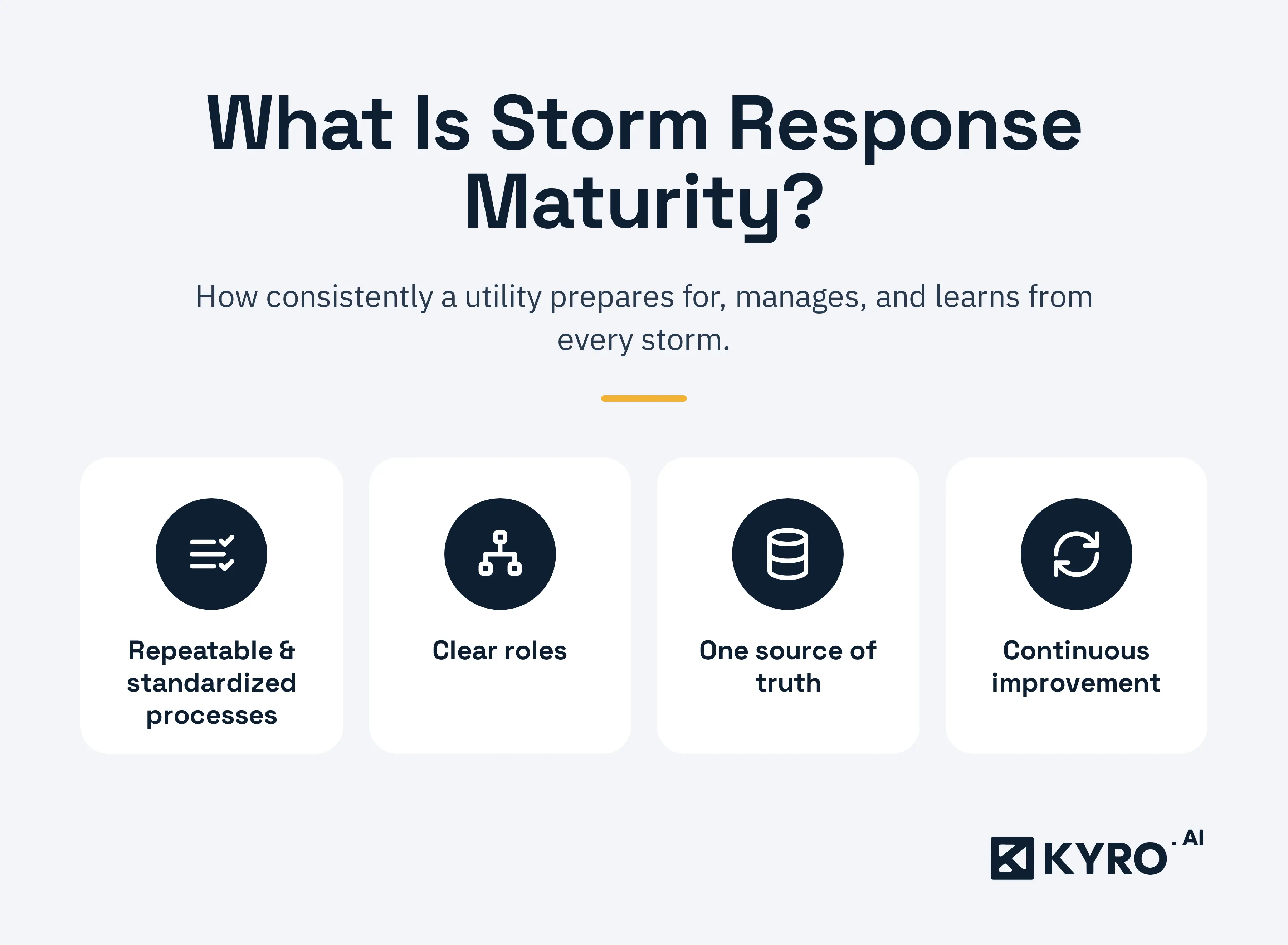
Storm response maturity is the extent to which a utility has established repeatable,
measurable, and continuously improving processes for managing storm-related
operations.
It covers the entire storm response lifecycle, from preparedness and crew mobilization to restoration, demobilization, and post-storm review.
A utility with low maturity may rely on manual coordination, fragmented records, and decisions made largely through individual experience. A high mature utility has documented workflows, clear responsibilities, reliable operational information, and a consistent way to measure performance.
The idea borrows from capability maturity models, like CMMI, which rate how established and repeatable an organization’s processes are on a staged scale.
Measuring storm response maturity helps to:
and prioritize improvements.
You don't need a complicated model to get started. A simple scoring framework can help you establish a baseline, compare capabilities, and identify where improvements will have the greatest impact.
The following method is a practical starting point for utilities. Adjust the assessment areas and scoring criteria to fit your operating model.
Focus on the five areas that most shape your storm response, using measurable indicators for each.
Indicators: callout-to-acceptance time, contractor qualifications on file, time to secure mutual assistance crews.
Indicators: storm roles assigned pre-season, documented escalation procedures, time to key decisions.
Indicators: number of systems holding crew data, status update frequency, ETR accuracy.
Indicators: crews checked in on time, consistent onboarding of external crews, time to release crews after restoration.
Indicators: after-action findings with owners, corrective actions closed before storm season.
Pick a scenario that reflects a real risk for your territory. For example, a major storm that leaves 10,000 customers without power and requires outside crews.
Score each capability (like preparedness, communication, mobilization, etc.) from 1 to 5 based on how well your utility can respond. A score of 1 means the process is unreliable, while 5 means it works consistently and meets response targets.
Use past storm records or exercises to support each score and identify gaps.
Look at how the process works in practice.
Maturity Score (%) = (Total Points Earned/Maximum Points) x 100
For example, assume you have scored ‘storm preparedness and planning’ capability 4/5
Maturity Score (%) = (4/5) x 100 = 80%
You can use the following suggested bands to make the results easier to communicate internally.
The lower-scoring storm response capabilities are where the utility should investigate for further improvements.
This is the step most teams skip, and it’s the one that matters most.
Self-assessments tend to run optimistic. Ask each team to back up its ratings with real records, such as:
Then compare your scores against what actually happened during recent storms. Bring in the people who run each process. They’ll tell you quickly whether a score reflects reality.
For additional guidance on tracking corrective actions and improvement plans, refer to FEMA's Improvement Planning resources.
Evaluating storm maturity score isn’t a one-time grade. Reassess after every major storm and at least once a year, update your targets as operational needs change, and use the results to decide where to invest, whether that’s training, process changes, resource planning, or technology.
Start with the storm capability where your utility scored the lowest. Focus on these practical changes to improve its storm maturity score.
Identify what went wrong, assign actions to fix it, and check whether those changes work next time. Reassess your maturity score after major storms to see what has improved and what still needs attention.
Assess key capabilities such as preparedness, crew mobilization, communication, restoration visibility, safety, cost tracking, and continuous improvement. Score each area against defined criteria, validate the results with operational evidence.
Storm readiness measures how prepared a utility is before a storm, including crew availability, equipment, and response plans. Storm response maturity measures how consistently
and effectively the utility manages these capabilities across different storm events and improves them over time.
An annual review to measure storm response maturity score can help track longer-term progress, whereas more frequent checks can help address specific weaknesses.
KYRO AI helps utilities move from manual coordination to repeatable, measurable storm processes. It standardizes workflows, automates crew callouts and availability checks, and keeps crew, assignment, and restoration data in one place. That makes performance easier to track after every storm. However, results still depend on sound processes, accurate data, staff adoption, and ongoing improvement.