
Features
Industries
Who we serve
Resources
Sign in
Get Started - $500/month
No commitment. No implementation fee. Unlimited users
Construction projects are an ever changing landscape. Crews might shift conductor routes to avoid obstacles, substitute equipment based on availability, or adjust foundation depths to fit actual site conditions. An on-site inspector will notice these differences immediately. The problem is that when the markup required to record that change is made on a paper, it usually takes weeks to get to the attention of concerned teams or simply sits forgotten in a truck. In many instances, the as-built information is never documented.
While a project is actively underway, delayed updates mean engineering teams do not see field changes fast enough. Other crews on the exact same project may be working from drawings that no longer reflect what has already been built. Issues that need urgent engineering review sit on paper instead of reaching the right people immediately. Ultimately, closeout stalls because as-builts are not ready, and the project stays open much longer than it should.
The long-term problem is even more expensive. Five years later, a new upgrade is planned for that exact same location. Engineering pulls the archived drawings to build a new engineering packet. Without the missing redlines from the previous job, the new packet relies entirely on outdated information. The packet goes to the field, the crew arrives, and absolutely nothing matches. The project grinds to a halt while designs get revised and schedules slip.
Both problems trace back to the exact same root cause: a redline failed to flow from the field back to engineering when the change was first discovered.
This failure creates an immediate logistical headache and serious long-term legal and operational risks. Beyond operational delays, having a robust redlining capability provides utilities with the necessary documentation to protect themselves in the event of litigation. Without accurate as-built documentation recording those real-world field changes, utilities leave themselves exposed.
Oversight teams working on programs for TNMP, Oncor, AEP, and CenterPoint Energy , have solved both sides of this problem using KYRO AI. Here is what that looks like in practice.
A landmark study by the National Institute of Standards and Technology (NIST GCR 04-867) estimated that inadequate interoperability in the U.S. capital facilities industry costs $15.8 billion per year. Owners and operators bear roughly two-thirds of that massive expense. A significant portion of this financial waste stems directly from redundant paper-based processes and the inability to share project data accurately across different phases.
Redlining sits precisely at the center of this problem. It represents critical field changes that fail to flow back into engineering records on time or at all.
These consequences quietly compound over time:
KYRO AI provides document markup and redlining tools built specifically for the field. They turn redlining from a messy paper exercise into a live digital workflow connecting inspectors and engineers on the exact same document.
The result is that drawings go out to the field and redlines come back to engineering through the exact same system. Both halves of document management finally run on one platform.
Texas-New Mexico Power (TNMP) runs a $150 million transmission and substation program across three separate areas of Texas. The core problem was a broken feedback loop. Documents were shared late, engineers waited for as-builts, and field crews worked from stale drawings. Information was completely stuck on both sides.
Redlining in KYRO AI addressed the return half of that loop directly. Instead of paper markups traveling back to the office on someone's arbitrary schedule, inspectors marked the changes on the construction drawings from the field, and engineering received them the same day. As-builts started reflecting what was actually built while the project was still active, not months after closeout.
Read the full case study: Closing the Field-to-Office Gap on TNMP’s $150M Program with KYRO
After the February 2021 winter storm, Oncor brought on more than 75 contract crews for over $100 million in distribution improvements. Ten oversight resources covered all of them. The challenge was not just tracking work at that massive scale. It was making sure every job's document trail was entirely complete at closeout.
Redlining became one piece of a much larger document flow. Each project's work order package lived securely in KYRO AI, including staking sheets, sag reports, material sheets, spec books, and the handbook. When the field did not match the plan, the markup went into that exact same package alongside the daily reports, inspection photos, and field documents. By the time a job reached closeout, the complete trail was already there with all redlines included.
Read the full case study: How 10 Oversight Resources Covered 75+ Crews on Oncor’s $100M+ Program with KYRO
CenterPoint Energy manages a massive distribution and transmission network serving millions of customers. The utility has invested heavily in standardized QA/QC processes, ensuring every inspection follows the same criteria, every issue is tracked, and every report is audit-ready.
Redlining fits perfectly into that quality workflow. When an inspector flags a discrepancy between the construction drawings and what was built, the markup becomes part of the project's QA/QC record in KYRO AI. It never becomes a loose piece of paper that might or might not reach engineering. For a utility where audit readiness and documentation accuracy are central to managing quality, having redlines flow through the same system as inspections means the as-built record is as rigorous as the rest of the QA/QC chain.
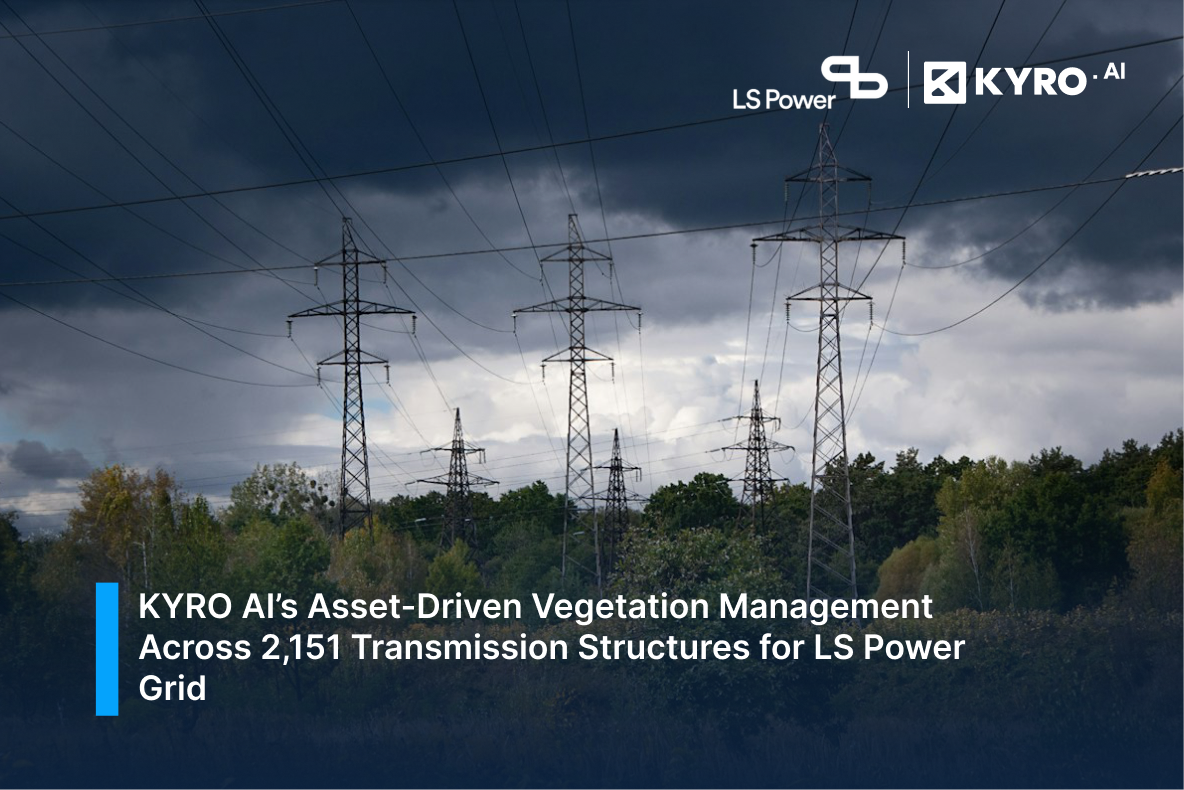
LS Power runs three massive field programs in KYRO AI, and redlining plays a critical role in two of them.
For transmission line construction, the team tracks 1,198 poles across 70 segments. When the physical build deviates from the original blueprints, crews mark up the drawing directly in KYRO AI from the field. That redlines automatically attaches to the structure’s permanent record alongside its ROW, foundation, and wire forms. By the time a structure reaches the final 5 percent held for turnover, the as-built drawing already reflects reality, built from markups captured live at each phase rather than reconstructed at closeout.
On the vegetation management side, redlining takes a different form. Instead of marking up blueprints, crews markup field photos to assign severity levels. If a crew spots a branch touching a live line, they draw a redline directly on the photo, flag it for urgent action, and submit it with the inspection report.
While this is not a traditional construction markup, it serves the exact same core purpose. It captures a visual field observation precisely where it happens and sends it straight back to the people who need to act on it, all through one unified system.
Read the full case studies: KYRO AI’s Asset-Driven Vegetation Management Across 2,151 Transmission Structures for LS Power and From Crew Form to Segment Total: How LS Power Grid Tracks 1,198 Poles Across 70 Segments with KYRO AI
Document management is usually described as a single capability: getting the right documents to the right people. But in utility construction, it actually requires two capabilities. The first is getting current drawings out to the field, and the second is getting the field's changes back to engineering. KYRO AI solves both.
Since assets are rarely built exactly to the initial drawings due to inevitable constructability challenges in the field, having a powerful redlining capability is an essential operational requirement. It equips utilities with the necessary documentation to protect themselves in legal disputes or litigation while keeping project closeouts fast and seamless.
When an inspector can open a drawing on site, mark it up where a change occurred, and send the redline back to engineering without paper or truck rides, everything improves. As-builts get done sooner, closeouts move faster, and the utility's records finally match what is in the ground.
Register for a Webinar to see how KYRO AI works on live projects.
What is redlining?
Redlining is simply marking up a blueprint when the physical site doesn't perfectly match the original plan. Engineering relies on these field notes to update the permanent as-built drawings, ensuring the utility has an accurate record of what is actually in the ground.
How do inspectors redline drawings in KYRO AI?
The inspector opens the most current drawing in KYRO AI on their phone or tablet. They mark the change directly on the digital drawing while on site, and the redline syncs instantly back to engineering.
Why do paper redlines cause delays?
Paper markups rely on manual handoffs, meaning a redlined drawing often sits in a truck until paperwork is batched days later. Even when crews email photos of their markups, those images easily get separated from the official work order package. This broken chain forces engineering to wait, stalling project closeouts and leaving the utility's official records completely disconnected from physical reality.