storm response with KYRO AI

Storm Restoration Ecosystem Explained: How Utilities, Contractors, Linemen, and Lenders Get Power Back

March 18, 2026
4 min read

Storm restoration is a four-party ecosystem involving utilities (who orchestrate recovery), prime contractors (who build and deploy crews), linemen (who physically repair the grid), and working capital providers (who finance the cash flow gap between work completion and invoice payment). Each party depends on real-time data from the others and when that data flow breaks down, power stays off longer and costs escalate for everyone.

When severe weather strikes, the immediate focus for millions of people is the loss of power. For the public, restoration is the moment the lights flicker back on. But behind that single moment lies a massive, high-stakes logistical machine that must mobilise across state lines, coordinate hundreds of organisations, and process millions of dollars in labour and materials, often within 72 hours of a storm making landfall.

According to the Edison Electric Institute, 65,000 workers from at least 44 states were deployed in response to Winter Storm Fern to help restore power for more than 200 million Americans. That scale of coordination does not happen by accident. It happens because of a deeply structured ecosystem that most people never see.

To understand why power comes back when it does, and why it sometimes takes longer than it should, you need to understand how that ecosystem actually works.
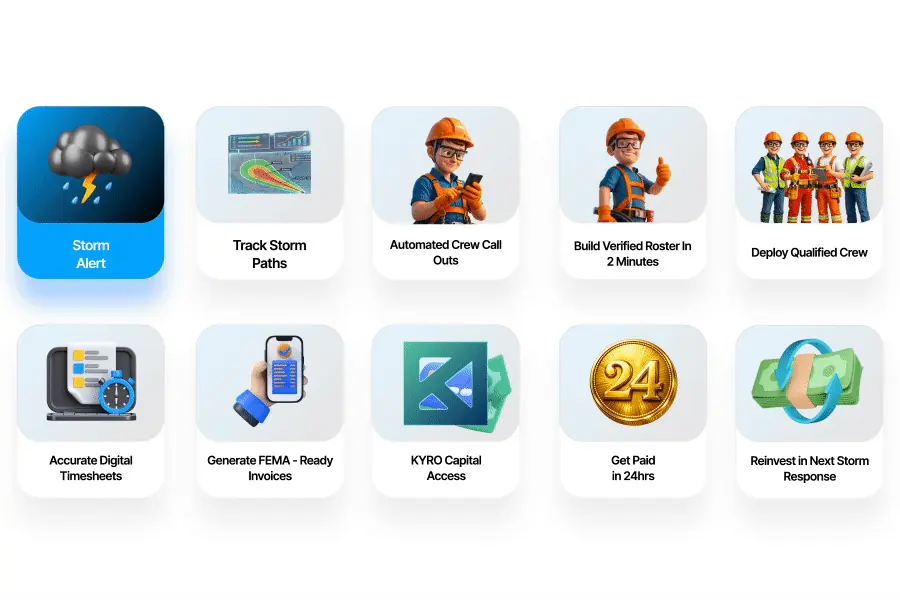
End-to-end storm response with KYRO AI StormShield

How the Storm Restoration Chain Actually Works — The Four Phases

Storm restoration follows four sequential phases. Each one must complete cleanly before the next can begin and a breakdown at any phase cascades through the entire chain.

Phase 1: Mobilization — The Storm Call

The process begins before a single bucket truck rolls onto a highway. When a utility's weather models predict significant infrastructure damage, it initiates a formal request for mutual aid support, known in the industry as the storm call.

Because utilities typically cannot staff a catastrophic event with internal crews alone, they rely on pre-approved networks of prime contractors under Master Services Agreements (MSAs). According to EEI mutual aid guidelines, utilities coordinate workforce deployment through regional mutual aid groups.  

The response window is brutally short. Contractors often have 60 minutes or less to assemble, vet, and submit a compliant crew roster to the utility. This first-come, first-served model means that roster speed is the only competitive differentiator that matters at mobilization.

Contractors who cannot build a verified roster in under an hour lose the work to those who build the fastest. But the caveat here isn't the speed alone. It's in the quality too.  

Read more: Storm response plan for utility contractors

Phase 2: Field Execution — The Physical Restoration

Once rosters are approved and mobilization orders are issued, the workforce who primarily are IBEW-certified linemen, deploys from staging areas across the country into the affected service territory.  

These skilled tradespeople travel into active disaster zones, often working 16-hour shifts in hazardous conditions to replace damaged transformers, restring downed conductors, reset protection equipment, and clear debris from access routes.

OSHA's emergency response standards (29 CFR 1910.269) govern working conditions during field execution, including rest requirements, personal protective equipment standards, and hazard communication protocols. Compliance during this phase is non-negotiable. OSHA enforcement in post-storm environments is active, and violations during mutual aid deployments carry the same penalties as standard operations.

NOTE: Penalties are usually around $165,514

Phase 3: Documentation and Billing — The Paper Mountain

As physical restoration concludes, the administrative burden begins and it is substantial. Crew supervisors submit timesheets on behalf of linemen, reconcile against work orders, and compile into invoices. These invoices must be backed by proof of work: Timesheet records, equipment logs, signed daily reports, and expense receipts, all formatted to the utility's specific billing requirements before payment will be considered.

According to FEMA's Public Assistance Programme and Policy Guide (PAPPG FY2024), eligible utilities seeking federal reimbursement for storm restoration costs must maintain documentation that ties every labour hour and material unit to a specific project worksheet. Contractors whose documentation fails this standard risk both delayed utility payment and reduced FEMA reimbursement for their utility clients, a double consequence that damages the relationship and future contract opportunities.

Phase 4: The Financial Bridge — Working Capital

There is a structural cash flow gap in storm restoration that every contractor faces regardless of size or reputation. Utilities and prime contractors typically pay on Net 30, 60, or 90-day terms. But by the time an invoice is submitted, the contractor has already paid for fuel, accommodation, equipment mobilisation, and most significantly, the linemen's wages.

To bridge this gap while awaiting payment, many contractors turn to working capital providers who purchase outstanding invoices at a discount in exchange for immediate cash. This practice of getting access to working capital solutions, called invoice factoring is a standard financing instrument in the utility contractor space.  

According to the Commercial Finance Association, factoring volumes in the construction and utilities sector exceed $12 billion annually in the U.S., with storm restoration contractors representing a significant and growing segment.

The Four Key Parties — Who They Are, What They Need, and Where They Struggle

I. The Utility — The Orchestrator

Who they are: Investor-owned utilities and cooperatives such as CenterPoint Energy, Florida Power & Light, and AEP. Entities responsible for maintaining reliable power delivery under NERC reliability standards and state PUC oversight.

Their priority: Restoring service safely, meeting regulatory restoration benchmarks, and maintaining financial accountability across hundreds of simultaneous contractor relationships.

The operational struggle: After a major storm, a utility's accounts payable team is flooded with hundreds of invoices arriving in different formats, spreadsheets, PDFs, paper timesheets, and custom contractor portals. Manually verifying that every billed hour matches a corresponding work order creates a processing bottleneck that can delay final invoice approval by weeks, holding up payment to contractors and FEMA documentation filing simultaneously.

II. The Prime Contractor — The Engine

Who they are: Companies holding Master Services Agreements with utilities, responsible for crew assembly, deployment, supervision, billing, and compliance. They sit at the centre of the ecosystem, accountable upward to the utility and downward to linemen and subcontractors.

Their priority: Winning the work by building accurate, credentialed crew rosters faster than competing contractors, then executing cleanly enough to protect the MSA relationship for the next event.

The operational struggle: Contractors face a crushing administrative burden at every storm. For a single major event, a mid-size contractor may need to re-onboard 200 to 500 workers, collecting W-4s, I-9s, drug test results, and OSHA certification records even for workers who deployed with them two weeks earlier. Most contractors still manage this through a fragmented combination of text messages, spreadsheets, and manual data entry that creates credential errors, roster gaps, and billing mistakes that persist into the documentation phase.

Read more: AI-validated roster building with KYRO AI

III. The Lineman — The Hero in the Field

For linemen - Get storm ready in 2 clicks

Who they are: IBEW-certified and non-union skilled tradespeople who physically restore the grid. They are the most visible party in storm restoration and the most underserved by the administrative systems around them.

Their priority: Finding deployment opportunities quickly, getting rostered accurately, and receiving correct payment without chasing down supervisors or contractors after the event.

The operational struggle: For most linemen, the storm call experience is a chaotic stream of text messages from multiple contractors simultaneously. They are asked to fill out the same registration forms for every event, often on paper or through ad hoc digital forms with no visibility into whether they have been successfully rostered, whether their certifications are current, or when payment will arrive. IBEW data indicates that credential expiration is one of the leading causes of last-minute de-rostering, costing linemen deployment opportunities they had already committed to.

IV. The Working Capital Provider — The Fuel

Who they are: Financial institutions, specialty lenders, and invoice factoring companies that advance cash to contractors against approved or near-approved invoices, enabling contractors to meet payroll and operational obligations while awaiting utility payment.

Their priority: Verifying that an invoice is legitimate, accurately documented, and likely to be approved before advancing funds, minimizing the risk of advancing against a disputed or rejected invoice.

The operational struggle: Working capital providers operate in a data desert. Without direct visibility into the utility's invoice approval status or the contractor's underlying timesheet data, they spend days, sometimes weeks, making phone calls, requesting documentation manually, and attempting to verify that the work represented on an invoice was performed and accepted. This friction delays funding decisions and increases the cost of capital for contractors who need it most urgently.

The Broken Link — Why Information Failure Drives Up Costs and Time

The greatest challenge in storm restoration is not wind speed or flood depth. It is the data silo.

Because each party in the ecosystem uses disconnected tools. Messaging apps for linemen, spreadsheets for contractors, legacy ERP systems for utilities, and manual document review for lenders. The same information gets re-entered, re-verified, and re-transmitted at every stage. The consequences are predictable and expensive:

  • Redundancy: Workers re-enter the same personal, credential, and availability data for every event because no system remembers them. A lineman who deployed on three storms in 2024 fills out the same registration form for the fourth event as if they were a new hire.
  • Errors: Manually transferring data from a text message to a spreadsheet to a timesheet to an invoice introduces transcription errors at every step. A single transposed employee ID or incorrect pay classification can delay invoice approval by weeks and trigger a dispute that damages the contractor-utility relationship.
  • Invisibility: Contractors cannot confirm whether their roster messages were received. Linemen cannot verify whether they are hired or on a waitlist. Lenders cannot determine whether the invoice they are being asked to fund reflects work that has been verified and accepted. Every party is making decisions with incomplete information under time pressure, a combination that produces systematic errors and systematic delays.

According to a DOE Grid Resilience report, administrative delays in storm restoration documentation, not physical repair complexity, account for a disproportionate share of total restoration timeline overruns in complex multi-contractor events.

The Solution — What a Connected Storm Restoration Ecosystem Looks Like

The ecosystem described above has traditionally been defined by manual processes and disconnected tools. The opportunity and the challenge is building a platform that serves all four parties simultaneously without forcing any of them to change how they think about their role.

The design principle is straightforward: each party needs a purpose-built experience, but all four experiences must draw from the same underlying data source.  

When a lineman registers, that registration should flow without re-entry through credentialing, rostering, timesheet generation, invoice compilation, and lender verification.

For the lineman: A native mobile experience that replaces chaotic text threads with a two-tap storm call response, proactive credential expiry alerts, and real-time roster confirmation, so linemen know they are hired before they start driving.

For the contractor: A consolidated operations module that combines storm call messaging, credential vetting, roster building, timesheet collection, and invoice generation into one workflow, replacing the spreadsheet-and-text-message system that currently governs most contractor operations.

For the utility: A standardized invoice review experience with verified timesheet backing, digital signature workflows, and audit-ready documentation formatted to their specific billing requirements, eliminating the manual verification bottleneck that delays payment.

For the working capital provider: A dedicated data portal providing real-time invoice status, underlying timesheet verification, credential confirmation, and a data quality score that reflects the integrity of the documentation chain, enabling faster, more confident funding decisions.

This is the model KYRO AI StormShield was built to deliver. Designed by operators who lived through the breakdowns across real storm events.

One Source of Truth — How Connected Data Changes Everything

The true value of a connected storm restoration platform is not four separate applications. It is four purpose-built views of the same verified data. A single source of truth that eliminates re-entry, reduces errors, and accelerates every phase of the restoration chain.

Here is what that data flow looks like in practice:

  1. A lineman accepts a storm call and completes registration through the mobile app. That single registration event triggers the entire downstream chain, no re-entry at any subsequent stage.
  1. The contractor sees the registration on their roster board with credentials validated automatically against current certification records. No manual credential checking. No phone calls to verify OSHA cards.
  1. The contractor submits crew timesheets with that lineman's classification, hours, and contracted rates pre-populated from the registration data. No manual timesheet compilation.
  1. The invoice is generated directly from verified timesheets, eliminating the manual compilation step where most billing errors originate. The invoice arrives at the utility in their required format, backed by timestamped, GPS-verified, classification-confirmed data.
  1. The utility reviews an invoice with complete proof-of-work documentation already attached, reducing approval time from weeks to days.
  1. The working capital provider sees a data quality score reflecting the integrity of the entire chain, from registration through invoice, enabling a same-day funding decision instead of a week of phone calls.

For an industry built on speed, accuracy, trust, and safety, where the difference between winning and losing the next storm call is measured in minutes, this connectivity is a competitive advantage.

Closing Thought

Storm restoration is one of the most logistically complex operations in the American economy, executed under time pressure, in disaster conditions, by hundreds of organizations that have never worked together before.  

The difference between a 48-hour restoration and a 5-day restoration is rarely the severity of the damage. It is almost always the quality of the data flowing between the four parties who must work together to make recovery happen.

When that data flows cleanly, from lineman registration through crew rostering through invoice approval through lender verification, the entire chain accelerates. When it breaks down, the consequences compound at every stage.

See how KYRO AI StormShield connects the storm restoration ecosystem end to end

Storm Restoration Ecosystem Explained: How Utilities, Contractors, Linemen, and Lenders Get Power Back

March 18, 2026
4 min read
March 24, 2026
Rabiya Farheen
Content Strategist
Author
Rabiya Farheen
Content Strategist
Contributor
Srinivas N G
Product Manager

Storm restoration is a four-party ecosystem involving utilities (who orchestrate recovery), prime contractors (who build and deploy crews), linemen (who physically repair the grid), and working capital providers (who finance the cash flow gap between work completion and invoice payment). Each party depends on real-time data from the others and when that data flow breaks down, power stays off longer and costs escalate for everyone.

When severe weather strikes, the immediate focus for millions of people is the loss of power. For the public, restoration is the moment the lights flicker back on. But behind that single moment lies a massive, high-stakes logistical machine that must mobilise across state lines, coordinate hundreds of organisations, and process millions of dollars in labour and materials, often within 72 hours of a storm making landfall.

According to the Edison Electric Institute, 65,000 workers from at least 44 states were deployed in response to Winter Storm Fern to help restore power for more than 200 million Americans. That scale of coordination does not happen by accident. It happens because of a deeply structured ecosystem that most people never see.

To understand why power comes back when it does, and why it sometimes takes longer than it should, you need to understand how that ecosystem actually works.

End-to-end storm response with KYRO AI StormShield

How the Storm Restoration Chain Actually Works — The Four Phases

Storm restoration follows four sequential phases. Each one must complete cleanly before the next can begin and a breakdown at any phase cascades through the entire chain.

Phase 1: Mobilization — The Storm Call

The process begins before a single bucket truck rolls onto a highway. When a utility's weather models predict significant infrastructure damage, it initiates a formal request for mutual aid support, known in the industry as the storm call.

Because utilities typically cannot staff a catastrophic event with internal crews alone, they rely on pre-approved networks of prime contractors under Master Services Agreements (MSAs). According to EEI mutual aid guidelines, utilities coordinate workforce deployment through regional mutual aid groups.  

The response window is brutally short. Contractors often have 60 minutes or less to assemble, vet, and submit a compliant crew roster to the utility. This first-come, first-served model means that roster speed is the only competitive differentiator that matters at mobilization.

Contractors who cannot build a verified roster in under an hour lose the work to those who build the fastest. But the caveat here isn't the speed alone. It's in the quality too.  

Read more: Storm response plan for utility contractors

Phase 2: Field Execution — The Physical Restoration

Once rosters are approved and mobilization orders are issued, the workforce who primarily are IBEW-certified linemen, deploys from staging areas across the country into the affected service territory.  

These skilled tradespeople travel into active disaster zones, often working 16-hour shifts in hazardous conditions to replace damaged transformers, restring downed conductors, reset protection equipment, and clear debris from access routes.

OSHA's emergency response standards (29 CFR 1910.269) govern working conditions during field execution, including rest requirements, personal protective equipment standards, and hazard communication protocols. Compliance during this phase is non-negotiable. OSHA enforcement in post-storm environments is active, and violations during mutual aid deployments carry the same penalties as standard operations.

NOTE: Penalties are usually around $165,514

Phase 3: Documentation and Billing — The Paper Mountain

As physical restoration concludes, the administrative burden begins and it is substantial. Crew supervisors submit timesheets on behalf of linemen, reconcile against work orders, and compile into invoices. These invoices must be backed by proof of work: Timesheet records, equipment logs, signed daily reports, and expense receipts, all formatted to the utility's specific billing requirements before payment will be considered.

According to FEMA's Public Assistance Programme and Policy Guide (PAPPG FY2024), eligible utilities seeking federal reimbursement for storm restoration costs must maintain documentation that ties every labour hour and material unit to a specific project worksheet. Contractors whose documentation fails this standard risk both delayed utility payment and reduced FEMA reimbursement for their utility clients, a double consequence that damages the relationship and future contract opportunities.

Phase 4: The Financial Bridge — Working Capital

There is a structural cash flow gap in storm restoration that every contractor faces regardless of size or reputation. Utilities and prime contractors typically pay on Net 30, 60, or 90-day terms. But by the time an invoice is submitted, the contractor has already paid for fuel, accommodation, equipment mobilisation, and most significantly, the linemen's wages.

To bridge this gap while awaiting payment, many contractors turn to working capital providers who purchase outstanding invoices at a discount in exchange for immediate cash. This practice of getting access to working capital solutions, called invoice factoring is a standard financing instrument in the utility contractor space.  

According to the Commercial Finance Association, factoring volumes in the construction and utilities sector exceed $12 billion annually in the U.S., with storm restoration contractors representing a significant and growing segment.

The Four Key Parties — Who They Are, What They Need, and Where They Struggle

I. The Utility — The Orchestrator

Who they are: Investor-owned utilities and cooperatives such as CenterPoint Energy, Florida Power & Light, and AEP. Entities responsible for maintaining reliable power delivery under NERC reliability standards and state PUC oversight.

Their priority: Restoring service safely, meeting regulatory restoration benchmarks, and maintaining financial accountability across hundreds of simultaneous contractor relationships.

The operational struggle: After a major storm, a utility's accounts payable team is flooded with hundreds of invoices arriving in different formats, spreadsheets, PDFs, paper timesheets, and custom contractor portals. Manually verifying that every billed hour matches a corresponding work order creates a processing bottleneck that can delay final invoice approval by weeks, holding up payment to contractors and FEMA documentation filing simultaneously.

II. The Prime Contractor — The Engine

Who they are: Companies holding Master Services Agreements with utilities, responsible for crew assembly, deployment, supervision, billing, and compliance. They sit at the centre of the ecosystem, accountable upward to the utility and downward to linemen and subcontractors.

Their priority: Winning the work by building accurate, credentialed crew rosters faster than competing contractors, then executing cleanly enough to protect the MSA relationship for the next event.

The operational struggle: Contractors face a crushing administrative burden at every storm. For a single major event, a mid-size contractor may need to re-onboard 200 to 500 workers, collecting W-4s, I-9s, drug test results, and OSHA certification records even for workers who deployed with them two weeks earlier. Most contractors still manage this through a fragmented combination of text messages, spreadsheets, and manual data entry that creates credential errors, roster gaps, and billing mistakes that persist into the documentation phase.

Read more: AI-validated roster building with KYRO AI

III. The Lineman — The Hero in the Field

For linemen - Get storm ready in 2 clicks

Who they are: IBEW-certified and non-union skilled tradespeople who physically restore the grid. They are the most visible party in storm restoration and the most underserved by the administrative systems around them.

Their priority: Finding deployment opportunities quickly, getting rostered accurately, and receiving correct payment without chasing down supervisors or contractors after the event.

The operational struggle: For most linemen, the storm call experience is a chaotic stream of text messages from multiple contractors simultaneously. They are asked to fill out the same registration forms for every event, often on paper or through ad hoc digital forms with no visibility into whether they have been successfully rostered, whether their certifications are current, or when payment will arrive. IBEW data indicates that credential expiration is one of the leading causes of last-minute de-rostering, costing linemen deployment opportunities they had already committed to.

IV. The Working Capital Provider — The Fuel

Who they are: Financial institutions, specialty lenders, and invoice factoring companies that advance cash to contractors against approved or near-approved invoices, enabling contractors to meet payroll and operational obligations while awaiting utility payment.

Their priority: Verifying that an invoice is legitimate, accurately documented, and likely to be approved before advancing funds, minimizing the risk of advancing against a disputed or rejected invoice.

The operational struggle: Working capital providers operate in a data desert. Without direct visibility into the utility's invoice approval status or the contractor's underlying timesheet data, they spend days, sometimes weeks, making phone calls, requesting documentation manually, and attempting to verify that the work represented on an invoice was performed and accepted. This friction delays funding decisions and increases the cost of capital for contractors who need it most urgently.

The Broken Link — Why Information Failure Drives Up Costs and Time

The greatest challenge in storm restoration is not wind speed or flood depth. It is the data silo.

Because each party in the ecosystem uses disconnected tools. Messaging apps for linemen, spreadsheets for contractors, legacy ERP systems for utilities, and manual document review for lenders. The same information gets re-entered, re-verified, and re-transmitted at every stage. The consequences are predictable and expensive:

  • Redundancy: Workers re-enter the same personal, credential, and availability data for every event because no system remembers them. A lineman who deployed on three storms in 2024 fills out the same registration form for the fourth event as if they were a new hire.
  • Errors: Manually transferring data from a text message to a spreadsheet to a timesheet to an invoice introduces transcription errors at every step. A single transposed employee ID or incorrect pay classification can delay invoice approval by weeks and trigger a dispute that damages the contractor-utility relationship.
  • Invisibility: Contractors cannot confirm whether their roster messages were received. Linemen cannot verify whether they are hired or on a waitlist. Lenders cannot determine whether the invoice they are being asked to fund reflects work that has been verified and accepted. Every party is making decisions with incomplete information under time pressure, a combination that produces systematic errors and systematic delays.

According to a DOE Grid Resilience report, administrative delays in storm restoration documentation, not physical repair complexity, account for a disproportionate share of total restoration timeline overruns in complex multi-contractor events.

The Solution — What a Connected Storm Restoration Ecosystem Looks Like

The ecosystem described above has traditionally been defined by manual processes and disconnected tools. The opportunity and the challenge is building a platform that serves all four parties simultaneously without forcing any of them to change how they think about their role.

The design principle is straightforward: each party needs a purpose-built experience, but all four experiences must draw from the same underlying data source.  

When a lineman registers, that registration should flow without re-entry through credentialing, rostering, timesheet generation, invoice compilation, and lender verification.

For the lineman: A native mobile experience that replaces chaotic text threads with a two-tap storm call response, proactive credential expiry alerts, and real-time roster confirmation, so linemen know they are hired before they start driving.

For the contractor: A consolidated operations module that combines storm call messaging, credential vetting, roster building, timesheet collection, and invoice generation into one workflow, replacing the spreadsheet-and-text-message system that currently governs most contractor operations.

For the utility: A standardized invoice review experience with verified timesheet backing, digital signature workflows, and audit-ready documentation formatted to their specific billing requirements, eliminating the manual verification bottleneck that delays payment.

For the working capital provider: A dedicated data portal providing real-time invoice status, underlying timesheet verification, credential confirmation, and a data quality score that reflects the integrity of the documentation chain, enabling faster, more confident funding decisions.

This is the model KYRO AI StormShield was built to deliver. Designed by operators who lived through the breakdowns across real storm events.

One Source of Truth — How Connected Data Changes Everything

The true value of a connected storm restoration platform is not four separate applications. It is four purpose-built views of the same verified data. A single source of truth that eliminates re-entry, reduces errors, and accelerates every phase of the restoration chain.

Here is what that data flow looks like in practice:

  1. A lineman accepts a storm call and completes registration through the mobile app. That single registration event triggers the entire downstream chain, no re-entry at any subsequent stage.
  1. The contractor sees the registration on their roster board with credentials validated automatically against current certification records. No manual credential checking. No phone calls to verify OSHA cards.
  1. The contractor submits crew timesheets with that lineman's classification, hours, and contracted rates pre-populated from the registration data. No manual timesheet compilation.
  1. The invoice is generated directly from verified timesheets, eliminating the manual compilation step where most billing errors originate. The invoice arrives at the utility in their required format, backed by timestamped, GPS-verified, classification-confirmed data.
  1. The utility reviews an invoice with complete proof-of-work documentation already attached, reducing approval time from weeks to days.
  1. The working capital provider sees a data quality score reflecting the integrity of the entire chain, from registration through invoice, enabling a same-day funding decision instead of a week of phone calls.

For an industry built on speed, accuracy, trust, and safety, where the difference between winning and losing the next storm call is measured in minutes, this connectivity is a competitive advantage.

Closing Thought

Storm restoration is one of the most logistically complex operations in the American economy, executed under time pressure, in disaster conditions, by hundreds of organizations that have never worked together before.  

The difference between a 48-hour restoration and a 5-day restoration is rarely the severity of the damage. It is almost always the quality of the data flowing between the four parties who must work together to make recovery happen.

When that data flows cleanly, from lineman registration through crew rostering through invoice approval through lender verification, the entire chain accelerates. When it breaks down, the consequences compound at every stage.

See how KYRO AI StormShield connects the storm restoration ecosystem end to end

Rabiya Farheen
Content Strategist

Rabiya Farheen is a content strategist and a writer who loves turning complex ideas into clear, meaningful stories, especially in the world of construction tech, AI, and B2B SaaS. She works closely with growing teams to create content that doesn’t just check SEO boxes, but actually helps people understand what a product does and why it matters. With a knack for research and a curiosity that never quits, Rabiya dives deep into industry trends, customer pain points, and data to craft content that feels super helpful and informative. When she’s not writing, she’s probably reading, painting, and exploring her creative side— or you'll find her hustling around for social causes, especially those that empower girls and women.

Discover more related blogs.