.jpg)
QUICK NOTE: NERC compliance means demonstrating your organization meets mandatory electric utility regulatory compliance or reliability standards for the bulk power system, across operations, cybersecurity, vegetation management, and emergency planning through continuous documentation, internal controls, and audit-ready evidence. FERC backs these standards with federal enforcement authority and penalties of up to $1 million per violation per day.
Every megawatt flowing across North America does so under a set of rules most people never see, until something goes wrong. NERC and FERC compliance isn't just a regulatory paperwork for its own sake. It's the operational backbone that keeps the bulk power system (BPS) from collapsing under the weight of cyber threats, vegetation failures, extreme weather, and equipment mismanagement.
If you're an owner, operator, or user of the bulk power system, this guide gives you a clear picture of what NERC and FERC require, where utilities most commonly fail, and what a modern electric utility regulatory compliance program actually looks like in 2026.
The North American Electric Reliability Corporation (NERC) is the regulatory authority responsible for developing and enforcing mandatory reliability standards for the bulk power system across the United States, Canada, and parts of Mexico.
NERC compliance means demonstrating that your organization meets those standards across operations, planning, cybersecurity, and physical infrastructure, through a continuous process of documentation, internal controls, audits, and self-reporting.
NERC compliance refers to the process of adhering to mandatory reliability and security standards for the Bulk Power System in North America, as mandated by the North American Electric Reliability Corporation and enforced through FERC authority. (Source: NERC Rules of Procedure, Section 400; FERC Order 672, 2006)
The Federal Energy Regulatory Commission (FERC) is the U.S. federal agency that regulates the interstate transmission of electricity, natural gas, and oil. FERC approved NERC as the Electric Reliability Organization (ERO) in 2006, granting it the authority to develop and enforce mandatory reliability standards.
In practice, this means:
Understanding FERC and NERC as a two-tier system is critical. NERC writes the rules. FERC backs them with federal regulatory power. Utilities operating in wildfire-prone or storm-impacted regions feel the pressure of both on every inspection cycle.
NERC standards apply to all owners, operators, and users of the bulk power system. This generally includes transmission lines at 100 kV or higher, certain large power plants, and other connected grid infrastructure.
This covers:
If you're unsure whether your organization is subject to NERC standards, the answer is almost certainly yes. And the cost of assuming otherwise is significant.
Among NERC's reliability standards, the Critical Infrastructure Protection (CIP) standards are the most demanding and most frequently audited. They address cybersecurity threats to bulk electric system assets and currently span CIP-002 through CIP-014, with CIP-015 now under active development to address internal network security monitoring.
The CIP standards require organizations to:
NERC has the authority to impose fines on entities that fail to maintain compliant cybersecurity programs. Given how frequently threat actors target utility infrastructure, CIP compliance is an operational survival requirement.
The compliance landscape shifted significantly in 2025, with three major developments that every bulk power system operator needs to have on their radar heading into 2026.
On March 11, 2025, NERC announced the most significant modifications to its Critical Infrastructure Protection (CIP) standards in several years. The driver: ransomware campaigns, nation-state intrusions, and supply chain compromises have moved from theoretical threats to documented incidents targeting utility infrastructure.
The updated CIP standards tighten requirements across four key areas:
For utilities that have not yet formalized a vendor risk management program, this is the most urgent gap to close in 2026.
Filed with FERC on December 17, 2024, and now entering full implementation, TPL-008-1 is a new transmission planning standard that requires utilities to formally assess the impact of extreme temperature events on their transmission systems and develop documented mitigation plans.
This means:
For utilities managing large transmission corridors, this means new analytical workloads for engineering teams and new documentation requirements for compliance teams. Both groups need to be engaged now.
In September 2024, FERC issued guidance targeting a growing reliability blind spot: inverter-based resources (IBRs), solar panels, wind turbines, and battery storage systems that now make up a significant and growing share of the generation mix.
IBRs behave fundamentally differently from conventional synchronous generators under grid stress conditions. Their proliferation has introduced reliability challenges that existing standards had not fully addressed, and FERC's guidance directly responds to that gap.
The guidance directs utilities to:
While not yet a binding standard, FERC guidance like this typically leads to formal rulemaking. Utilities should start aligning their IBR integration practices now.
The financial stakes of non-compliance are rising. NERC's 2024 enforcement report recorded a 20% year-over-year increase in total penalties, and the trend shows no sign of reversing.
Recent enforcement actions illustrate what's at risk:
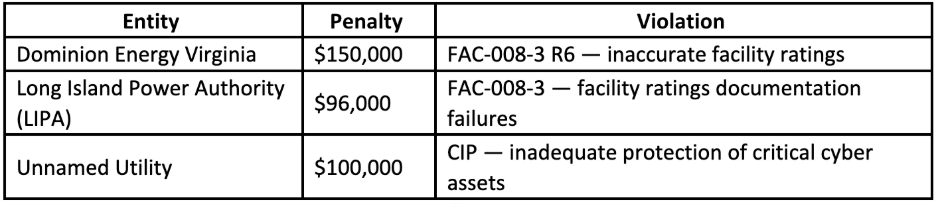
Beyond the fines themselves, enforcement actions are posted publicly on NERC's website. The reputational consequence of a public violation record compounds the financial impact and can trigger increased audit frequency and mandatory remediation obligations.
Based on current rulemaking activity, 2026 enforcement is expected to concentrate on:
Utilities that treat compliance as a once-a-year exercise are most exposed to this shifting enforcement focus. The organizations that consistently pass audits are doing the right things every day, not sprinting in the month before an auditor arrives.
Knowing where programs break down is the starting point for fixing them. The violations that recur most frequently across NERC audits include:
1. Facility Ratings (FAC-008, FAC-009) Inaccurate or outdated facility ratings are one of the top cited violations. These ratings define safe operating limits for transmission equipment, and errors here create real risk of equipment damage and cascading failures.
2. Protection System Miscoordination (PRC-019, PRC-024, PRC-025) Protection systems that don't coordinate correctly can fail to isolate faults quickly — or trip healthy equipment during stress events. Miscoordination violations indicate gaps in both engineering and documentation.
3. Vegetation Management (FAC-003) NERC FAC-003 governs clearance distances between transmission lines and vegetation. It's one of the most consequential standards on this list: the 2003 Northeast blackout that affected 50 million people originated from tree-line contact in Ohio.
KYRO AI's approach to NERC FAC-003 inspections eliminates the paperwork chaos that causes documentation failures before auditors arrive.
4. Cybersecurity (CIP series) Inadequate protection of Cyber Assets, particularly at the Low and Medium impact levels, remains a persistent compliance gap. Incomplete documentation, failed patch management, and access control weaknesses are the most common findings.
5. Emergency Preparedness (EOP standards) Gaps in emergency operations plans, inadequate drills, and missing coordination agreements with neighboring entities regularly surface during audits.
NERC compliance failures carry financial consequences that can threaten an organization's operating budget.
Key penalty facts:
Beyond fines, non-compliance findings can trigger mandatory remediation plans, increased audit frequency, and heightened regulatory scrutiny — all of which consume operational resources and leadership attention.
A compliance program built around annual audit preparation will always be reactive. The organizations that consistently perform well in NERC audits treat compliance as an operational discipline, not an event.
Every NERC standard requires demonstrable evidence tied to a specific Reliability Standard Audit Worksheet (RSAW). RSAWs are publicly available on NERC's website and define the exact evidence format auditors will check.
For FAC-003, that means GPS-tagged vegetation inspection records with dates, span-level vegetation clearance measurements, and annual cycle completion documentation, retained for a minimum of three years.
For CIP standards, it means access logs, patch records, and incident tickets with timestamps that align to your documented security policies. If your evidence can't be pulled and presented in this format within 24 hours of a request, your compliance program has a gap.
Manual compliance tracking creates gaps. Robust programs build internal controls that automatically flag deviations from compliant operating conditions. Automated monitoring reduces the window between a control failure and its detection. Platforms that digitize field operations from vegetation management software that works offline to real-time crew tracking close those gaps with continuous, structured data capture.
Organizations that conduct mock audits against NERC RSAWs before a real audit consistently outperform those that don't. These exercises surface documentation gaps, policy inconsistencies, and evidence of quality issues while there's still time to remediate.
NERC standards are not static. New standards addressing extreme weather impacts, supply chain risk, and internal network monitoring are either recently enacted or actively in development.
Compliance programs must include a standard-tracking function that catches new obligations before their effective dates.
For utilities managing large transmission corridors, manual vegetation programs are increasingly inadequate against the pace of new NERC and state-level requirements. Automation isn't a luxury or an option anymore. Utilities need them as a critical part of compliance architecture decisions.
Understanding how grid stress events escalate is essential context for every compliance professional. The grid today faces greater demand, more extreme weather, and more sophisticated cyber threats than 2003. The standards have evolved accordingly, and so must your compliance program.
Related reading: Top 8 Metrics That Define a Utility's Storm Readiness Score
NERC and FERC compliance is the foundation of reliable bulk power system operation in North America. Penalties are real, violations are recurring, and the standards continue to evolve. But organizations that build compliance into their operational DNA, through automated documentation, digital field operations, and continuous internal monitoring, transform audit preparation from a sprint into a steady state.
The utilities that consistently pass audits aren't doing something different in the month before the auditor arrives. They're doing the right things every day.
KYRO helps utility, vegetation management, and field service teams digitize operations, maintain audit-ready compliance records, and reduce operational risk. Talk to the team to see how KYRO supports NERC compliance programs.
Last verified against: NERC Reliability Standards February 2026 · FERC Order 672 · NERC CIP-015 standards development docket.
What is the difference between NERC and FERC?
NERC (North American Electric Reliability Corporation) develops and enforces mandatory reliability standards for the bulk power system. FERC (Federal Energy Regulatory Commission) is the U.S. federal agency that granted NERC its enforcement authority and approves all NERC standards before they take effect.
What are NERC CIP standards?
NERC CIP (Critical Infrastructure Protection) standards are mandatory cybersecurity requirements for bulk electric system assets. They cover asset identification, electronic and physical security, configuration management, incident response, and recovery planning.
How much are NERC penalties?
NERC can impose penalties of up to $1 million per violation per day. Penalties are scaled based on the severity of the violation, the compliance history of the entity, and the risk posed to the bulk power system.
Who enforces NERC standards?
NERC enforces standards directly and through six regional entities that conduct audits, spot checks, and self-certification reviews across the North American bulk power system.
What is NERC FAC-003?
NERC FAC-003 is the mandatory transmission vegetation management standard. It requires utilities to maintain minimum clearance distances between transmission lines and vegetation, conduct annual inspection cycles, and retain GPS-tagged documentation for at least three years. The 2003 Northeast blackout, which left 50 million people without power, originated from a FAC-003 failure in Ohio, making it one of NERC's most consequential standards.
How can utilities prepare for a NERC audit?
The most effective NERC audit preparation happens year-round, not in the weeks before the audit. Key steps: maintain continuous, timestamped documentation through digital field systems; conduct mock audits against published RSAWs at least annually; implement automated controls that flag deviations before they become violations; and assign a standards-tracking function to catch new obligations before their effective dates. Utilities that treat compliance as a daily operational discipline consistently outperform those that treat it as an annual event.

QUICK NOTE: NERC compliance means demonstrating your organization meets mandatory electric utility regulatory compliance or reliability standards for the bulk power system, across operations, cybersecurity, vegetation management, and emergency planning through continuous documentation, internal controls, and audit-ready evidence. FERC backs these standards with federal enforcement authority and penalties of up to $1 million per violation per day.
Every megawatt flowing across North America does so under a set of rules most people never see, until something goes wrong. NERC and FERC compliance isn't just a regulatory paperwork for its own sake. It's the operational backbone that keeps the bulk power system (BPS) from collapsing under the weight of cyber threats, vegetation failures, extreme weather, and equipment mismanagement.
If you're an owner, operator, or user of the bulk power system, this guide gives you a clear picture of what NERC and FERC require, where utilities most commonly fail, and what a modern electric utility regulatory compliance program actually looks like in 2026.
The North American Electric Reliability Corporation (NERC) is the regulatory authority responsible for developing and enforcing mandatory reliability standards for the bulk power system across the United States, Canada, and parts of Mexico.
NERC compliance means demonstrating that your organization meets those standards across operations, planning, cybersecurity, and physical infrastructure, through a continuous process of documentation, internal controls, audits, and self-reporting.
NERC compliance refers to the process of adhering to mandatory reliability and security standards for the Bulk Power System in North America, as mandated by the North American Electric Reliability Corporation and enforced through FERC authority. (Source: NERC Rules of Procedure, Section 400; FERC Order 672, 2006)
The Federal Energy Regulatory Commission (FERC) is the U.S. federal agency that regulates the interstate transmission of electricity, natural gas, and oil. FERC approved NERC as the Electric Reliability Organization (ERO) in 2006, granting it the authority to develop and enforce mandatory reliability standards.
In practice, this means:
Understanding FERC and NERC as a two-tier system is critical. NERC writes the rules. FERC backs them with federal regulatory power. Utilities operating in wildfire-prone or storm-impacted regions feel the pressure of both on every inspection cycle.
NERC standards apply to all owners, operators, and users of the bulk power system. This generally includes transmission lines at 100 kV or higher, certain large power plants, and other connected grid infrastructure.
This covers:
If you're unsure whether your organization is subject to NERC standards, the answer is almost certainly yes. And the cost of assuming otherwise is significant.
Among NERC's reliability standards, the Critical Infrastructure Protection (CIP) standards are the most demanding and most frequently audited. They address cybersecurity threats to bulk electric system assets and currently span CIP-002 through CIP-014, with CIP-015 now under active development to address internal network security monitoring.
The CIP standards require organizations to:
NERC has the authority to impose fines on entities that fail to maintain compliant cybersecurity programs. Given how frequently threat actors target utility infrastructure, CIP compliance is an operational survival requirement.
The compliance landscape shifted significantly in 2025, with three major developments that every bulk power system operator needs to have on their radar heading into 2026.
On March 11, 2025, NERC announced the most significant modifications to its Critical Infrastructure Protection (CIP) standards in several years. The driver: ransomware campaigns, nation-state intrusions, and supply chain compromises have moved from theoretical threats to documented incidents targeting utility infrastructure.
The updated CIP standards tighten requirements across four key areas:
For utilities that have not yet formalized a vendor risk management program, this is the most urgent gap to close in 2026.
Filed with FERC on December 17, 2024, and now entering full implementation, TPL-008-1 is a new transmission planning standard that requires utilities to formally assess the impact of extreme temperature events on their transmission systems and develop documented mitigation plans.
This means:
For utilities managing large transmission corridors, this means new analytical workloads for engineering teams and new documentation requirements for compliance teams. Both groups need to be engaged now.
In September 2024, FERC issued guidance targeting a growing reliability blind spot: inverter-based resources (IBRs), solar panels, wind turbines, and battery storage systems that now make up a significant and growing share of the generation mix.
IBRs behave fundamentally differently from conventional synchronous generators under grid stress conditions. Their proliferation has introduced reliability challenges that existing standards had not fully addressed, and FERC's guidance directly responds to that gap.
The guidance directs utilities to:
While not yet a binding standard, FERC guidance like this typically leads to formal rulemaking. Utilities should start aligning their IBR integration practices now.
The financial stakes of non-compliance are rising. NERC's 2024 enforcement report recorded a 20% year-over-year increase in total penalties, and the trend shows no sign of reversing.
Recent enforcement actions illustrate what's at risk:

Beyond the fines themselves, enforcement actions are posted publicly on NERC's website. The reputational consequence of a public violation record compounds the financial impact and can trigger increased audit frequency and mandatory remediation obligations.
Based on current rulemaking activity, 2026 enforcement is expected to concentrate on:
Utilities that treat compliance as a once-a-year exercise are most exposed to this shifting enforcement focus. The organizations that consistently pass audits are doing the right things every day, not sprinting in the month before an auditor arrives.
Knowing where programs break down is the starting point for fixing them. The violations that recur most frequently across NERC audits include:
1. Facility Ratings (FAC-008, FAC-009) Inaccurate or outdated facility ratings are one of the top cited violations. These ratings define safe operating limits for transmission equipment, and errors here create real risk of equipment damage and cascading failures.
2. Protection System Miscoordination (PRC-019, PRC-024, PRC-025) Protection systems that don't coordinate correctly can fail to isolate faults quickly — or trip healthy equipment during stress events. Miscoordination violations indicate gaps in both engineering and documentation.
3. Vegetation Management (FAC-003) NERC FAC-003 governs clearance distances between transmission lines and vegetation. It's one of the most consequential standards on this list: the 2003 Northeast blackout that affected 50 million people originated from tree-line contact in Ohio.
KYRO AI's approach to NERC FAC-003 inspections eliminates the paperwork chaos that causes documentation failures before auditors arrive.
4. Cybersecurity (CIP series) Inadequate protection of Cyber Assets, particularly at the Low and Medium impact levels, remains a persistent compliance gap. Incomplete documentation, failed patch management, and access control weaknesses are the most common findings.
5. Emergency Preparedness (EOP standards) Gaps in emergency operations plans, inadequate drills, and missing coordination agreements with neighboring entities regularly surface during audits.
NERC compliance failures carry financial consequences that can threaten an organization's operating budget.
Key penalty facts:
Beyond fines, non-compliance findings can trigger mandatory remediation plans, increased audit frequency, and heightened regulatory scrutiny — all of which consume operational resources and leadership attention.
A compliance program built around annual audit preparation will always be reactive. The organizations that consistently perform well in NERC audits treat compliance as an operational discipline, not an event.
Every NERC standard requires demonstrable evidence tied to a specific Reliability Standard Audit Worksheet (RSAW). RSAWs are publicly available on NERC's website and define the exact evidence format auditors will check.
For FAC-003, that means GPS-tagged vegetation inspection records with dates, span-level vegetation clearance measurements, and annual cycle completion documentation, retained for a minimum of three years.
For CIP standards, it means access logs, patch records, and incident tickets with timestamps that align to your documented security policies. If your evidence can't be pulled and presented in this format within 24 hours of a request, your compliance program has a gap.
Manual compliance tracking creates gaps. Robust programs build internal controls that automatically flag deviations from compliant operating conditions. Automated monitoring reduces the window between a control failure and its detection. Platforms that digitize field operations from vegetation management software that works offline to real-time crew tracking close those gaps with continuous, structured data capture.
Organizations that conduct mock audits against NERC RSAWs before a real audit consistently outperform those that don't. These exercises surface documentation gaps, policy inconsistencies, and evidence of quality issues while there's still time to remediate.
NERC standards are not static. New standards addressing extreme weather impacts, supply chain risk, and internal network monitoring are either recently enacted or actively in development.
Compliance programs must include a standard-tracking function that catches new obligations before their effective dates.
For utilities managing large transmission corridors, manual vegetation programs are increasingly inadequate against the pace of new NERC and state-level requirements. Automation isn't a luxury or an option anymore. Utilities need them as a critical part of compliance architecture decisions.
Understanding how grid stress events escalate is essential context for every compliance professional. The grid today faces greater demand, more extreme weather, and more sophisticated cyber threats than 2003. The standards have evolved accordingly, and so must your compliance program.
Related reading: Top 8 Metrics That Define a Utility's Storm Readiness Score
NERC and FERC compliance is the foundation of reliable bulk power system operation in North America. Penalties are real, violations are recurring, and the standards continue to evolve. But organizations that build compliance into their operational DNA, through automated documentation, digital field operations, and continuous internal monitoring, transform audit preparation from a sprint into a steady state.
The utilities that consistently pass audits aren't doing something different in the month before the auditor arrives. They're doing the right things every day.
KYRO helps utility, vegetation management, and field service teams digitize operations, maintain audit-ready compliance records, and reduce operational risk. Talk to the team to see how KYRO supports NERC compliance programs.
Last verified against: NERC Reliability Standards February 2026 · FERC Order 672 · NERC CIP-015 standards development docket.
What is the difference between NERC and FERC?
NERC (North American Electric Reliability Corporation) develops and enforces mandatory reliability standards for the bulk power system. FERC (Federal Energy Regulatory Commission) is the U.S. federal agency that granted NERC its enforcement authority and approves all NERC standards before they take effect.
What are NERC CIP standards?
NERC CIP (Critical Infrastructure Protection) standards are mandatory cybersecurity requirements for bulk electric system assets. They cover asset identification, electronic and physical security, configuration management, incident response, and recovery planning.
How much are NERC penalties?
NERC can impose penalties of up to $1 million per violation per day. Penalties are scaled based on the severity of the violation, the compliance history of the entity, and the risk posed to the bulk power system.
Who enforces NERC standards?
NERC enforces standards directly and through six regional entities that conduct audits, spot checks, and self-certification reviews across the North American bulk power system.
What is NERC FAC-003?
NERC FAC-003 is the mandatory transmission vegetation management standard. It requires utilities to maintain minimum clearance distances between transmission lines and vegetation, conduct annual inspection cycles, and retain GPS-tagged documentation for at least three years. The 2003 Northeast blackout, which left 50 million people without power, originated from a FAC-003 failure in Ohio, making it one of NERC's most consequential standards.
How can utilities prepare for a NERC audit?
The most effective NERC audit preparation happens year-round, not in the weeks before the audit. Key steps: maintain continuous, timestamped documentation through digital field systems; conduct mock audits against published RSAWs at least annually; implement automated controls that flag deviations before they become violations; and assign a standards-tracking function to catch new obligations before their effective dates. Utilities that treat compliance as a daily operational discipline consistently outperform those that treat it as an annual event.

Rabiya Farheen is a content strategist and a writer who loves turning complex ideas into clear, meaningful stories, especially in the world of construction tech, AI, and B2B SaaS. She works closely with growing teams to create content that doesn’t just check SEO boxes, but actually helps people understand what a product does and why it matters. With a knack for research and a curiosity that never quits, Rabiya dives deep into industry trends, customer pain points, and data to craft content that feels super helpful and informative. When she’s not writing, she’s probably reading, painting, and exploring her creative side— or you'll find her hustling around for social causes, especially those that empower girls and women.