
hurricane operation checklist

Hurricane Season 2026: The Operations Checklist Every Utility and Contractor Needs Right Now

June 23, 2026
3 min read

NOAA's 2026 Atlantic hurricane season forecast is out. The forecast tells you how many storms the Atlantic is expected to produce. The number of storms expected and the damage they can bring is a warning sign for utilities to be well prepared. Hurricane forecasts are not just weather updates. They are a reminder to review response plans, verify crew readiness, confirm resource availability, and close operational gaps before storm season reaches its peak.  

The work done now can make the difference between a coordinated response and a chaotic recovery when a storm threatens your service territory.  The preparation you do before August 1 is the only variable you actually control.

NOAA 2026 Atlantic Hurricane Season Forecast
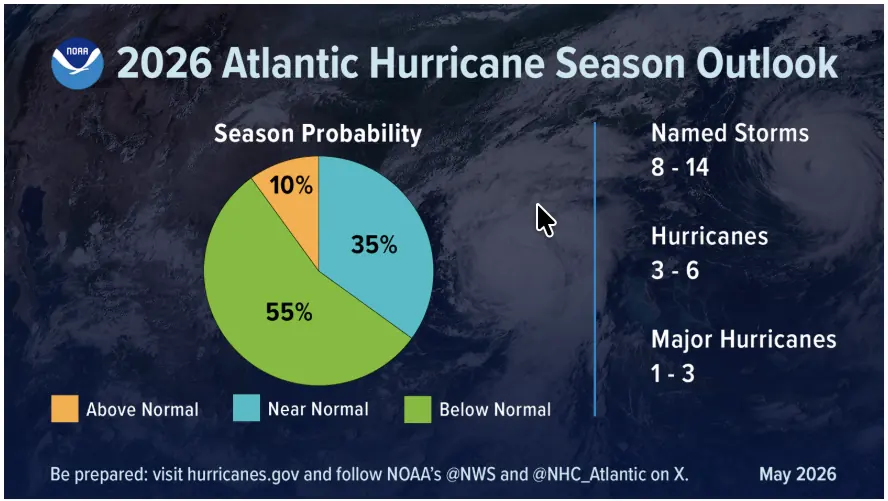
Source: NOAA Climate Prediction Center, May 21, 2026

What the 2026 NOAA Forecast Actually Means

Below-normal does not mean safe. It means the Atlantic is expected to be quieter than average. The storms that do form under El Niño wind shear conditions tend to develop faster and give less lead time before landfall.  

"It only takes one." NOAA Administrator Neil Jacobs, May 2026 Forecast Briefing

Hurricane Andrew made landfall during a below-normal forecast year. So did Alicia. The 2015 season, the last below-normal year before 2026, still produced 12 named storms. History shows that seasonal outlooks don't predict impact. For utilities and contractors, the real question isn't how many storms form, but whether crews, equipment, documentation, and response plans are ready when one heads your way.

(NOAA – National Oceanic Atmospheric Administration)

The 12-Action Checklist Before August 1

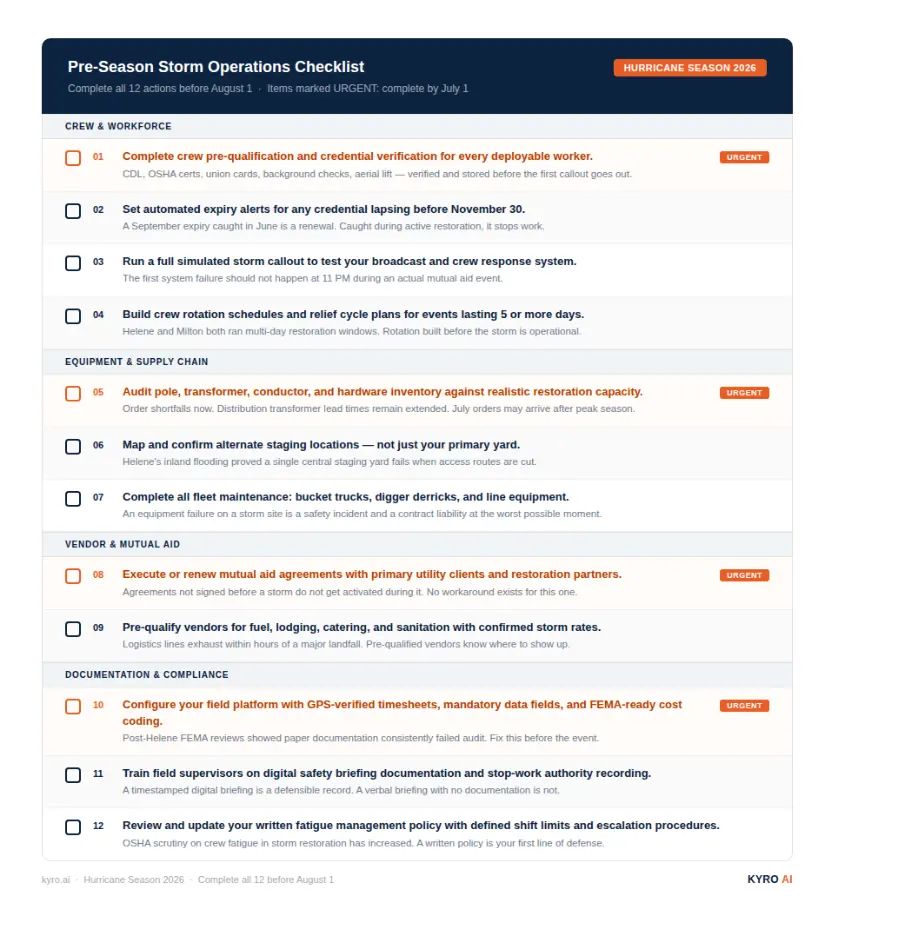
Four items are marked urgently and need to be completed by July 1. The rest must be done before August 1, when the probability curve for major landfalls starts climbing sharply. Every item on this list traces back to a documented failure from Helene, Milton, or both.

Pre-Season Storm Operations Checklist — 2026

Urgent items: July 1. All remaining items: August 1.

  • Complete crew pre-qualification and credential verification for every deployable worker. CDL, OSHA certs, union cards, background checks, aerial lift certifications, verified and stored before the first callout goes out. Both Helene and Milton saw utility supervisors halt work when crews arrived without current credentials.  

  • Set automated expiry alerts for any credential lapsing before November 30. A September expiry caught in June is a renewal. Caught in September during active restoration, it is a stopped work order.  

  • Run a full simulated storm callout to test your broadcast and crew response system. The first system failure should not happen at 11 PM during an actual mutual aid event.  

  • Build crew rotation schedules and relief cycle plans for events lasting 5 or more days. Helene and Milton both ran multi-day restoration windows. Rotation built before the storm is operational. Rotation improvised during it creates fatigue incidents.

See our crew fatigue compliance guide.  

  • Audit pole, transformer, conductor, and hardware inventory against your realistic restoration capacity. Order shortfalls now. Distribution transformer lead times have not normalized since 2020. July orders may not arrive before peak season ends.  

  • Map and confirm alternate staging locations — not just your primary yard. Helene's inland flooding proved that a single central staging yard fails when routes are cut. Distributed staging across your territory or mobilization area is now a hard requirement for catastrophic events.  

  • Complete all fleet maintenance: bucket trucks, digger derricks, and line equipment. An equipment failure on a storm site is a safety incident and a contract liability at the worst possible moment.  

  • Execute or renew mutual aid agreements with your primary utility clients and restoration partners. Agreements not signed before a storm do not get activated during it. No workaround exists for this one.  

  • Pre-qualify vendors for fuel, lodging, catering, and sanitation with confirmed storm rates. Logistics lines exhaust within hours of a major landfall. Pre-qualified vendors know where to show up. Cold calls at 2 AM do not produce the same result.  

  • Configure your field platform with GPS-verified timesheets, mandatory data fields, and FEMA-ready cost coding. Post-Helene FEMA reimbursement reviews showed paper-based documentation consistently failed audit. This is a pre-event fix, not a post-event one.

See the full guide on protecting FEMA reimbursement from day one.  
  • Train field supervisors on digital safety briefing documentation and stop-work authority recording. A timestamped digital briefing is a defensible record. A verbal briefing with no documentation is not.  

  • Review and update your written fatigue management policy with defined shift limits and escalation procedures. OSHA scrutiny on crew fatigue in storm restoration has increased. A written policy with specific thresholds is your first line of defense.

See our OSHA fatigue compliance guide.  

Operation checklist for utility and contractors

What Helene and Milton Changed About How Contractors Should Prepare

Every item on this checklist traces back to a documented failure from Helene, Milton, or both. Here's what happened.

  • Helene — Category 4, Sept. 26, 2024

The worst damage wasn't coastal surge. Inland flooding through the Appalachians wiped out road access across Virginia and the Carolinas for days. Staging plans built around a single yard collapsed entirely. Duke Energy Carolinas lost 2 million customers. North Carolina estimated $59.6 billion in total damage.  

The lesson: distributed staging locations are not optional in catastrophic events.

  • Helene — FEMA documentation failure
    Mutual aid crews came from across the country. When FEMA reviews began, the same finding surfaced repeatedly: labor records collected on paper were incomplete or missing. Legitimate costs went unreimbursed because the documentation couldn't survive audit.  

  • Milton — Category 3, Oct. 9, 2024
    Duke Energy Florida restored 95% of a million reported outages within 96 hours, replacing 1,640 poles, 1,350 transformers, and nearly a million feet of cable. That pace came from inventory decisions made weeks before the storm. Contractors without pre-positioned materials waited days to supply that faster-moving organizations had already locked in.

Both storms — the credential failure that keeps repeating

At multiple sites across both events, utility supervisors halted work when mutual aid crews arrived without current certifications, union cards, or client-required clearances. The fix is not faster credentialing at the gate. It's completing verification before the callout goes out, which is exactly what KYRO AI’s KYRO Verified does.

Crew Pre-Qualification: The Competitive Advantage Nobody Talks About

When a utility issues a mutual aid callout, work assignments happen in the first few hours. The contractors with verified deployment-ready rosters get the first assignments. The contractors still collecting CDL copies and background checks results hours later to get whatever is left, or nothing.

Pre-qualification means every worker in your deployable roster has verified, current credentials stored before the season begins. It also means automated expiry monitoring, so a certification lapsing in July does not produce a stopped-work order in September.

Watch this video to understand what KYRO AI does.  

KYRO Verified stores credentials once and carries them automatically into every subsequent deployment, eliminating the per-event paperwork cycle that slows mobilization. KYRO AI gets your operation storm-ready before August

Crew pre-qualification via KYRO Verified, GPS-verified timesheets, digital safety documentation, and FEMA-ready cost coding on one platform without any setup fees. Get your linemen ready for the next storm and get your crew operational in days.

See KYRO AI for Storm Operations →  

Hurricane Season 2026: The Operations Checklist Every Utility and Contractor Needs Right Now

June 23, 2026
3 min read
June 24, 2026
Rabiya Farheen
Content Strategist
Author
Rabiya Farheen
Content Strategist

NOAA's 2026 Atlantic hurricane season forecast is out. The forecast tells you how many storms the Atlantic is expected to produce. The number of storms expected and the damage they can bring is a warning sign for utilities to be well prepared. Hurricane forecasts are not just weather updates. They are a reminder to review response plans, verify crew readiness, confirm resource availability, and close operational gaps before storm season reaches its peak.  

The work done now can make the difference between a coordinated response and a chaotic recovery when a storm threatens your service territory.  The preparation you do before August 1 is the only variable you actually control.

NOAA 2026 Atlantic Hurricane Season Forecast

Source: NOAA Climate Prediction Center, May 21, 2026

What the 2026 NOAA Forecast Actually Means

Below-normal does not mean safe. It means the Atlantic is expected to be quieter than average. The storms that do form under El Niño wind shear conditions tend to develop faster and give less lead time before landfall.  

"It only takes one." NOAA Administrator Neil Jacobs, May 2026 Forecast Briefing

Hurricane Andrew made landfall during a below-normal forecast year. So did Alicia. The 2015 season, the last below-normal year before 2026, still produced 12 named storms. History shows that seasonal outlooks don't predict impact. For utilities and contractors, the real question isn't how many storms form, but whether crews, equipment, documentation, and response plans are ready when one heads your way.

(NOAA – National Oceanic Atmospheric Administration)

The 12-Action Checklist Before August 1

Four items are marked urgently and need to be completed by July 1. The rest must be done before August 1, when the probability curve for major landfalls starts climbing sharply. Every item on this list traces back to a documented failure from Helene, Milton, or both.

Pre-Season Storm Operations Checklist — 2026

Urgent items: July 1. All remaining items: August 1.

  • Complete crew pre-qualification and credential verification for every deployable worker. CDL, OSHA certs, union cards, background checks, aerial lift certifications, verified and stored before the first callout goes out. Both Helene and Milton saw utility supervisors halt work when crews arrived without current credentials.  

  • Set automated expiry alerts for any credential lapsing before November 30. A September expiry caught in June is a renewal. Caught in September during active restoration, it is a stopped work order.  

  • Run a full simulated storm callout to test your broadcast and crew response system. The first system failure should not happen at 11 PM during an actual mutual aid event.  

  • Build crew rotation schedules and relief cycle plans for events lasting 5 or more days. Helene and Milton both ran multi-day restoration windows. Rotation built before the storm is operational. Rotation improvised during it creates fatigue incidents.

See our crew fatigue compliance guide.  

  • Audit pole, transformer, conductor, and hardware inventory against your realistic restoration capacity. Order shortfalls now. Distribution transformer lead times have not normalized since 2020. July orders may not arrive before peak season ends.  

  • Map and confirm alternate staging locations — not just your primary yard. Helene's inland flooding proved that a single central staging yard fails when routes are cut. Distributed staging across your territory or mobilization area is now a hard requirement for catastrophic events.  

  • Complete all fleet maintenance: bucket trucks, digger derricks, and line equipment. An equipment failure on a storm site is a safety incident and a contract liability at the worst possible moment.  

  • Execute or renew mutual aid agreements with your primary utility clients and restoration partners. Agreements not signed before a storm do not get activated during it. No workaround exists for this one.  

  • Pre-qualify vendors for fuel, lodging, catering, and sanitation with confirmed storm rates. Logistics lines exhaust within hours of a major landfall. Pre-qualified vendors know where to show up. Cold calls at 2 AM do not produce the same result.  

  • Configure your field platform with GPS-verified timesheets, mandatory data fields, and FEMA-ready cost coding. Post-Helene FEMA reimbursement reviews showed paper-based documentation consistently failed audit. This is a pre-event fix, not a post-event one.

See the full guide on protecting FEMA reimbursement from day one.  

  • Train field supervisors on digital safety briefing documentation and stop-work authority recording. A timestamped digital briefing is a defensible record. A verbal briefing with no documentation is not.  

  • Review and update your written fatigue management policy with defined shift limits and escalation procedures. OSHA scrutiny on crew fatigue in storm restoration has increased. A written policy with specific thresholds is your first line of defense.

See our OSHA fatigue compliance guide.  

Operation checklist for utility and contractors

What Helene and Milton Changed About How Contractors Should Prepare

Every item on this checklist traces back to a documented failure from Helene, Milton, or both. Here's what happened.

  • Helene — Category 4, Sept. 26, 2024

The worst damage wasn't coastal surge. Inland flooding through the Appalachians wiped out road access across Virginia and the Carolinas for days. Staging plans built around a single yard collapsed entirely. Duke Energy Carolinas lost 2 million customers. North Carolina estimated $59.6 billion in total damage.  

The lesson: distributed staging locations are not optional in catastrophic events.

  • Helene — FEMA documentation failure
    Mutual aid crews came from across the country. When FEMA reviews began, the same finding surfaced repeatedly: labor records collected on paper were incomplete or missing. Legitimate costs went unreimbursed because the documentation couldn't survive audit.  

  • Milton — Category 3, Oct. 9, 2024
    Duke Energy Florida restored 95% of a million reported outages within 96 hours, replacing 1,640 poles, 1,350 transformers, and nearly a million feet of cable. That pace came from inventory decisions made weeks before the storm. Contractors without pre-positioned materials waited days to supply that faster-moving organizations had already locked in.

Both storms — the credential failure that keeps repeating

At multiple sites across both events, utility supervisors halted work when mutual aid crews arrived without current certifications, union cards, or client-required clearances. The fix is not faster credentialing at the gate. It's completing verification before the callout goes out, which is exactly what KYRO AI’s KYRO Verified does.

Crew Pre-Qualification: The Competitive Advantage Nobody Talks About

When a utility issues a mutual aid callout, work assignments happen in the first few hours. The contractors with verified deployment-ready rosters get the first assignments. The contractors still collecting CDL copies and background checks results hours later to get whatever is left, or nothing.

Pre-qualification means every worker in your deployable roster has verified, current credentials stored before the season begins. It also means automated expiry monitoring, so a certification lapsing in July does not produce a stopped-work order in September.

Watch this video to understand what KYRO AI does.  

KYRO Verified stores credentials once and carries them automatically into every subsequent deployment, eliminating the per-event paperwork cycle that slows mobilization. KYRO AI gets your operation storm-ready before August

Crew pre-qualification via KYRO Verified, GPS-verified timesheets, digital safety documentation, and FEMA-ready cost coding on one platform without any setup fees. Get your linemen ready for the next storm and get your crew operational in days.

See KYRO AI for Storm Operations →  

Rabiya Farheen
Content Strategist

Rabiya Farheen is a content strategist and a writer who loves turning complex ideas into clear, meaningful stories, especially in the world of utility, tech, AI, and B2B SaaS. She works closely with growing teams to create content that doesn’t just check SEO boxes, but actually helps people understand what a product does and why it matters. With a knack for research and a curiosity that never quits, Rabiya dives deep into industry trends, customer pain points, and data to craft content that feels super helpful and informative. When she’s not writing, she’s probably reading, painting, and exploring her creative side— or you'll find her hustling around for social causes, especially those that empower girls and women.

Discover more related blogs.