Working Capital
Working Capital for Utility Contractors
Cash flow gaps kill contractor growth. KYRO Capital closes the gap between work done and payment received — backed by verified field data from KYRO's platform.
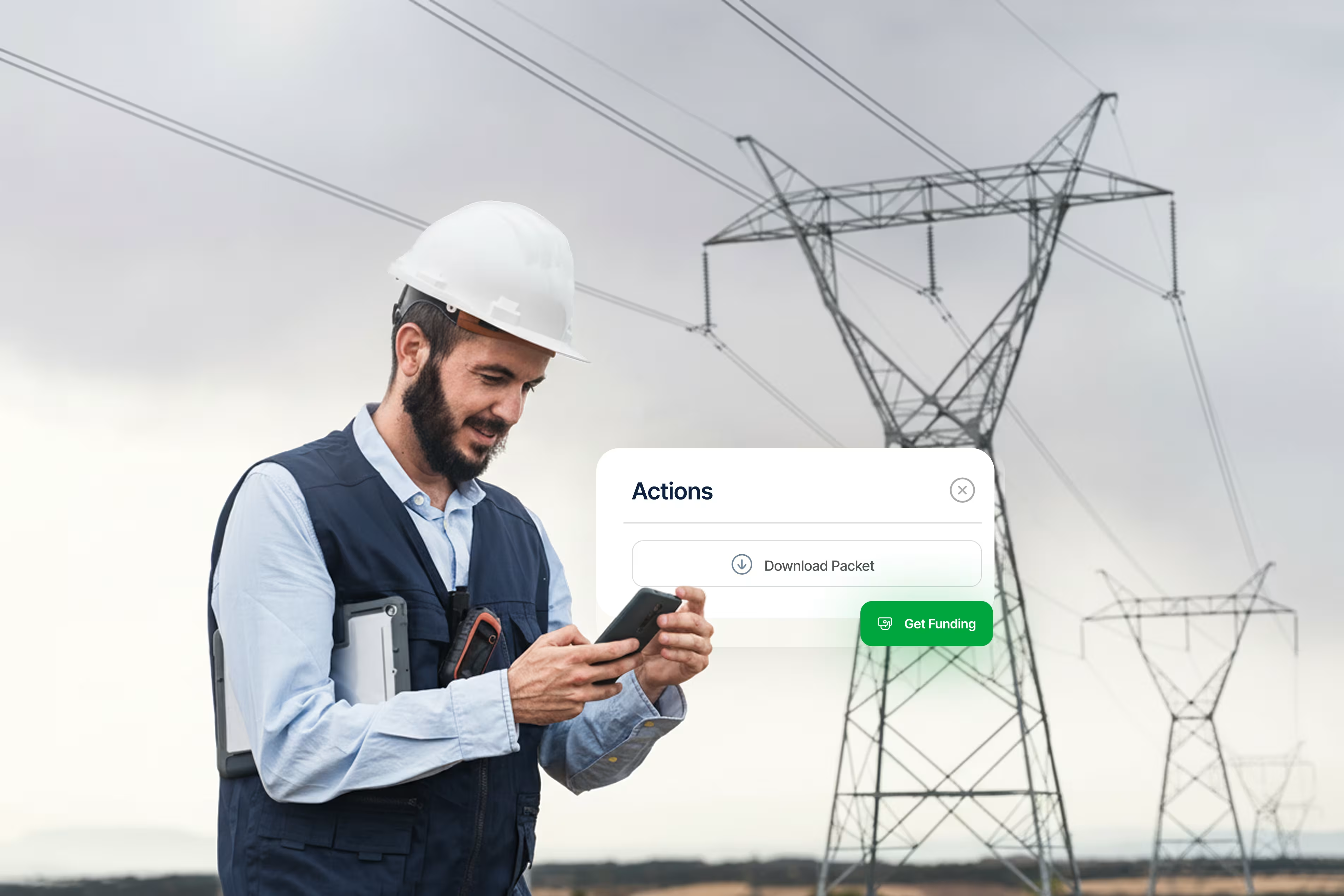





The working capital challenge for field service companies
Revenue is real but locked in accounts receivable for 60–180 days
Equipment, payroll, and materials costs are due now — payment isn't
A contractor doesn't run out of work. They run out of cash.
Vendor consolidation happens when small firms can't bridge the cash flow gap — and the grid loses its local bench of vendors
How KYRO AI Helps You
Construction Company Funding
The working capital challenge in construction is structural, not accidental. Utilities and prime customers set payment terms of 60–120 days. Contractors fund labor, equipment, and materials from day one. The gap between cash out and cash in can represent millions of dollars in tied-up capital — capital that could otherwise be hiring new crews, investing in equipment, or taking on larger work scopes. KYRO Capital closes this gap. When contractors use KYRO's platform to manage their operations, their approved invoices come with the verified field data — GPS-stamped timesheets, AI-validated expenses, complete audit trail — that factoring lenders need to approve funding quickly. What takes weeks with traditional lenders takes hours with KYRO Capital, because the documentation is already there.
Accounts Receivable & Invoice Factoring
Accounts receivable management in utility and construction is both a financial and an operational challenge. The gap between completing work and collecting payment is driven by two compounding problems: long utility payment terms (60–120 days is standard) and documentation bottlenecks that extend actual payment timelines even further. KYRO addresses both: faster, more accurate invoices reduce the documentation disputes that extend payment cycles; KYRO Capital's factoring partnerships give contractors access to capital against approved invoices in as little as 24 hours.
Construction Contract Financing
Cash flow challenges compound down the subcontractor chain. When a prime contractor waits 90 days to get paid, their subcontractors wait even longer. KYRO Capital is available across the full contractor chain — prime contractors and subcontractors at every tier. Subcontractors using KYRO can access KYRO Capital funding directly from an approved invoice within the platform. The 'Get Quick Funding' workflow initiates without leaving KYRO, KYRO's verified field data supports the lender's review, and funding is provided in as little as 24 hours. Every tier of the subcontractor chain — not just prime contractors — has access to faster working capital.
The KYRO impact
Measurable results across major utilities and vendors.
24 hrs
Funding via KYRO Capital
$1.4T
Grid Investment Needing Vendor Capacity
100%
Working Capital Improvement From Closing the Invoice Gap
Founder Proof Points — From Authority Magazine Interview

Hari Vasudevan | Founder & CEO, KYRO AI
Pushing the Boundaries of AI
Pushing the Boundaries of AI
"Working capital improved by 100 percent even as the business grew by over 50 percent, invoices became more accurate, and we started getting paid on time. A contractor doesn't run out of work, they run out of cash."
on KYRO's financial impact
"A zero could become an 'O' or a single digit could be mistyped. Time got charged to the wrong job, invoices went out wrong, and because incorrect invoices didn't get paid, our cash flow took a hit. In one stretch, that simple and routinely overlooked disconnect nearly cost us $10 million."
the real-world problem that sparked KYRO AI
Thought Leadership — Featured on This Page

Five Things You Need To Know To Help Shape The Future of AI
Hari Vasudevan on data quality as AI's foundation, agentic AI in storm response, responsible AI governance, and why the best AI doesn't have to be fancy — just grounded in real field problems.
Read post
.png)
Modernizing the Utility Grid: Overcoming Payment and Capacity Challenges
As utilities commit $1.4 trillion in grid upgrades, manual workflows and long payment cycles constrain the local vendor ecosystem. Digital transformation is the prerequisite for a resilient grid.
Read post

Why Local Vendor Financial Health Is an American Energy Security Issue
DSOs of 60–180 days are constraining the local vendors utilities depend on. Smarter work verification, faster payments, and better capital access are prerequisites for grid resilience.
Read post

Construction CFOs: The Deciding Factor in the Data Center Race
Data center construction is surging 30% YoY while all other commercial construction fell 1.4%. The CFOs who look through the windshield — not the rear-view mirror — will capture the opportunity.
Read post

Smarter, Faster & Leaner: Using the 80/20 Rule to Deploy AI in Construction Finance
How the 80/20 rule guides AI deployment where it delivers the greatest impact — reducing risk, streamlining operations, and accelerating digital transformation in construction finance.
Read post
FAQ's
How does accounts receivable factoring work?
Accounts receivable factoring converts outstanding invoices into immediate cash. A contractor sells a utility invoice to a factoring company at a small discount — typically 1–5% — and receives 80–95% of the face value within 24–48 hours. The factoring company then collects payment from the utility when the invoice comes due. For utility and construction contractors with 60–180-day DSOs, factoring transforms receivables from a working capital drain into a reliable cash flow source. KYRO Capital's factoring partnerships are structured specifically for this industry, using KYRO's verified field data to speed the lender's review process.
What is construction contract financing?
Construction contract financing provides capital to contractors to fund the labor, materials, and equipment required to execute a construction contract — bridging the gap between contract execution and invoice payment. For large utility capital programs or data center construction projects, where work may begin months before the first invoice is approved and paid, construction contract financing is an essential tool. KYRO Capital's partnerships support this use case, with verified KYRO field data backing the lender's review of project progress and invoice accuracy.
Why do contractors run out of cash even when they have work?
As Neil Shah, President & CEO of CFMA, said on the From Boots to Boardroom podcast: 'A contractor doesn't run out of work, they run out of cash.' The core problem is timing: contractors pay for labor, equipment, and materials now, but get paid by utilities and prime customers months later. An $80M-revenue storm restoration contractor with a 58-day DSO has approximately $13M tied up at any given time. Bridging that gap with financing at 7–10% annual cost exceeds $1.25M per year — on 5–8% margins. KYRO Capital closes this gap with data-backed working capital access.