

OSHA Tree Trimming Regulations: Safety Requirements for Working Near Power Lines
Tree trimming near energized power lines is one of the most hazardous jobs in utility vegetation management. Federal fatal work injury data shows why the risks are taken seriously. Crews run chainsaws, climb trees, operate aerial lifts and work around heavy machinery, often just a few feet from live conductors. One mistake can mean electrocution, a serious injury or a fatality.
For vegetation management contractors, OSHA compliance is more than handing out personal protective equipment (PPE). It means assigning qualified workers, keeping safe distances from energized lines, inspecting equipment, identifying hazards and documenting every safety procedure.
Knowing which OSHA standards apply helps contractors protect their crews, meet utility contract requirements and keep field operations safe.
Why OSHA Compliance Matters in Utility Vegetation Management
Crews clearing vegetation around power lines face several hazards at once:
- Electrical contact. Branches, climbing gear, tools or aerial lifts can touch energized conductors. At higher voltages, current can arc without direct contact. (See OSHA's electrical safety overview.)
- Falling trees and branches. Unstable trees and poorly controlled cuts cause serious injuries.
- Working at heights. Climbers and aerial lift operators face fall hazards throughout the job.
- Equipment injuries. Chainsaws, chippers and bucket trucks need proper operation and maintenance.
- Environmental conditions. Wind, rain, heat and uneven terrain all raise the risk.
OSHA regulations set the minimum safety requirements employers must meet to identify and control these hazards. Contractors need to know which standards apply to their work and make sure crews follow them.
Compliance also helps contractors meet utility safety expectations, avoid work stoppages and keep the records needed to prove safety procedures are actually being followed.
OSHA Standards That Apply to Utility Tree Trimming
Several OSHA standards cover tree trimming, electrical work, PPE and equipment. Which ones apply depends on the work, the employer and the type of utility operation.
1. 29 CFR 1910.269: Electric Power Generation, Transmission, and Distribution
29 CFR 1910.269 is the most important standard for line-clearance tree trimming.
It covers clearing trees and vegetation around power generation, transmission and distribution lines. It also sets requirements for employee qualifications, job briefings, electrical safety practices, protective equipment and tree-trimming operations.
The standard applies when line-clearance work is done on behalf of an organization that operates, or controls the operating procedures for, those lines and equipment. In practice, if a utility hires you to clear its lines, 1910.269 almost certainly applies.
Requirements differ for qualified electrical employees and line-clearance tree trimmers who are not electrically qualified. Contractors have to get this distinction right. Each worker needs training that matches their role, and employers must make sure crews follow the electrical safety procedures that apply to them.
2. 29 CFR 1910.132–1910.138: Personal Protective Equipment
OSHA's PPE requirements require employers to assess hazards and provide the right protection. Under 29 CFR 1910.132, employers must:
- Assess the workplace for hazards that require PPE
- Select equipment suited to those hazards
- Make sure PPE fits each worker
- Train workers on its use, limits, maintenance and disposal
- Replace defective or damaged equipment
Other relevant sections:
OSHA's PPE guide covers hazard assessment in detail.
3. 29 CFR 1910.1200: Hazard Communication
Crews often handle fuel, lubricants and herbicides. OSHA's Hazard Communication Standard requires employers to communicate chemical hazards through labels, safety data sheets (SDS) and training. OSHA's HazCom overviewsummarizes these duties.
If your crews use herbicides or other hazardous chemicals, make sure they understand the risks, handling procedures and required protective measures. See the EPA's pesticide worker safety guidance.
4. 29 CFR 1926: Construction Safety Standards
Some vegetation work may fall under OSHA's construction standards, depending on what's being done. 29 CFR 1926 Subpart M, for example, covers fall protection in construction.
Don't assume construction fall-protection rules apply to every tree-trimming job, though. The electric power, general industry and construction standards have different scopes, so identify which fit the specific operation.
Best Practices for OSHA Compliance in Tree Trimming
Follow these best practices to meet OSHA's Compliance in Tree Trimming and to avoid penalities and risks:
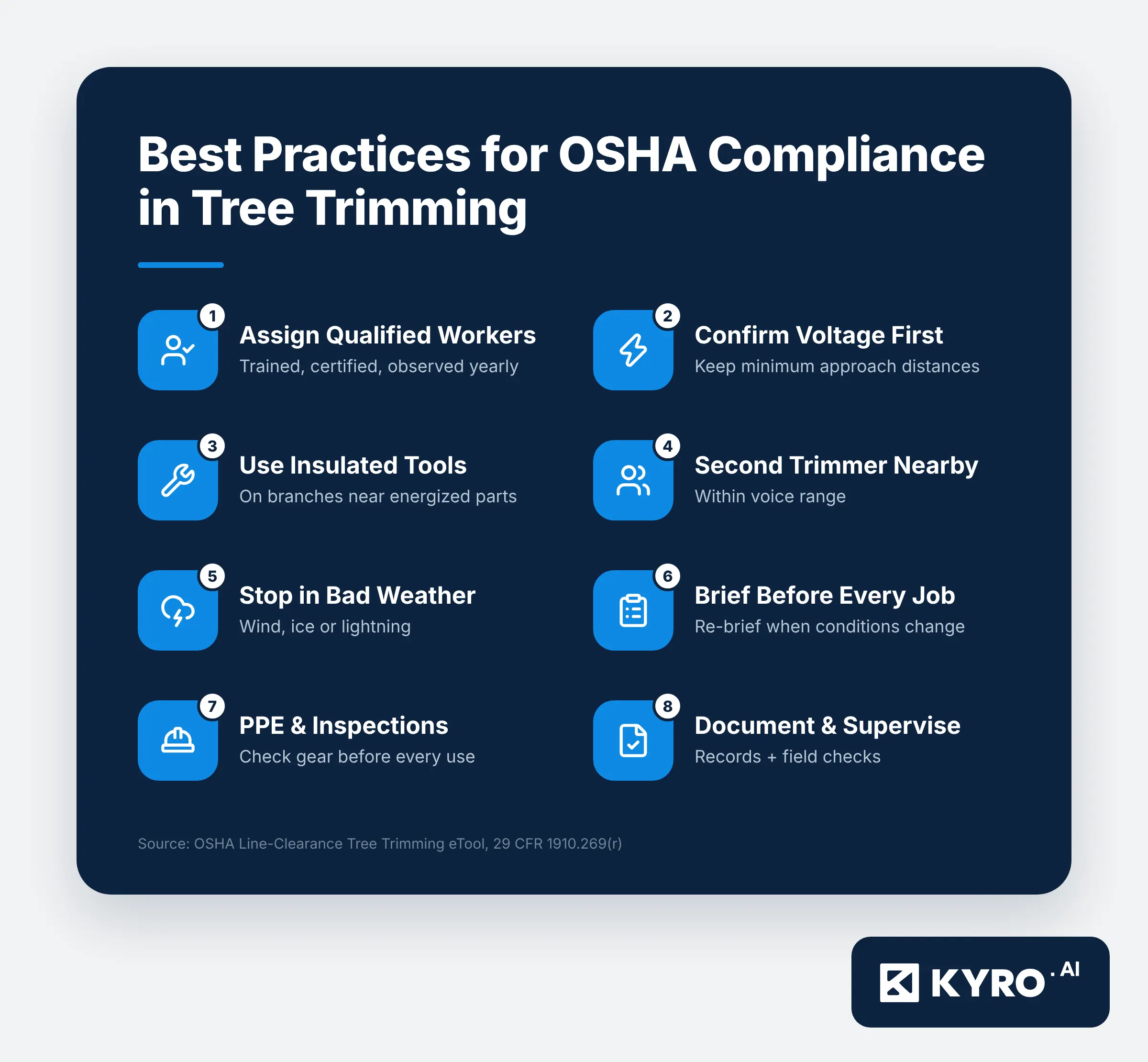
- Assign the right workers. Only trained line-clearance tree trimmers or qualified employees should work within 10 feet of energized lines. Certify their training in safe work practices and emergency procedures, and observe their work at least once a year.
- Confirm voltage and keep approach distances. Determine line voltage before starting, or treat all lines as the highest voltage present. Bodies, ladders and aerial devices stay outside the minimum approach distance. Unqualified workers stay 10 feet back from lines at 50 kV or less (1910.333).
- Use insulated tools on branches touching, or within the approach distance of, energized parts.
- Have a second trimmer within voice range when working within 10 feet of conductors above 750 volts, removing limbs inside the approach distance, or roping branches off lines.
- Stop work in bad weather. Don't trim during high winds, icing or lightning unless the lines are deenergized.
- Brief before every job. Cover hazards, tree conditions, weather, equipment positioning and emergency plans, and brief again when conditions change.
- Provide PPE and inspect equipment. Supply helmets, eye, face and hearing protection, chainsaw-resistant clothing, footwear, fall protection and electrical protective equipment. Inspect saws, chippers, climbing ropes, saddles and aerial lifts before use.
- Document and supervise. Record qualifications, briefings, inspections, near misses and corrective actions. Supervisors should verify field practices and correct unsafe conditions immediately.
Common OSHA Violations in Utility Vegetation Management
The most common compliance failures:
- Insufficient clearance from power lines. Workers or equipment approaching energized conductors without following minimum approach distances.
- Inadequate training. Assigning line-clearance work to employees who lack the required training or qualifications.
- Missing or defective PPE. Not providing the right equipment, or leaving damaged gear in use.
- Poor equipment maintenance. Running defective chainsaws, aerial lifts, climbing gear or other machinery.
- Incomplete job briefings. Starting work without discussing hazards, procedures and emergency plans.
- Weak documentation. Missing training, inspection or incident records.
Regular safety audits help address the gaps and common safety risks in vegetation management before they lead to injuries or citations.
What Happens When Contractors Violate OSHA Standards?
When contractors fail to meet OSHA standards, the consequences can go beyond fines, putting workers at risk and exposing businesses to legal action, project delays, and reputational damage.
Financial Penalties and Contract Risk
OSHA can issue citations and fines when employers violate safety requirements. Penalty amounts depend on how the violation is classified, among other factors, and are adjusted each year. See OSHA's penalties page for current amounts.
For utility contractors, repeated safety failures can also hurt contract eligibility, vendor evaluations and future project opportunities.
Worker Injuries, Fatalities and Operational Fallout
The most serious consequence is harm to workers. Electrical contact, falling branches, equipment failures and falls can cause life-threatening injuries or deaths. NIOSH's FACE program investigates such deaths, with tree care as a priority area.
An incident can also bring work stoppages, investigations, project delays and higher operating costs.
Real-World Scenarios of OSHA penalties
OSHA penalties highlight the risks of overlooking vegetation management safety. In 2024, OSHA proposed $29,035 against Serious Tree Services after an arborist was electrocuted near a power line. The penalty was later reduced through an informal settlement. In 2025, Discount Tree Care faced $25,250 in proposed penalties following another fatal electrical incident.
Other cases involved fall protection and equipment safety. Adler Tree Service agreed to a $10,000 formal settlement after a fatal fall in 2022, while Countryside Tree Service faced $66,986 in penalties assessed by an administrative law judge following a fatal wood chipper incident in 2016.
Following OSHA compliance best practices for tree trimming operations can help contractors reduce workplace risks and avoid violations.
How Digital Tools Help Meet OSHA Compliance for Utility Vegetation Management
Paper records and spreadsheets make it hard to track qualifications, inspections, briefings and incident reports across multiple crews. Digital field tools organize these records and improve visibility into field work.
With a digital platform, contractors can:
- Maintain worker records. Store training documents, certifications and qualifications so they're easy to verify before deployment.
- Capture field documentation. Record job briefings, inspections, hazard assessments and incident reports from mobile devices.
- Track work activities. Keep timestamped records of crew activities and assignments.
- Improve accountability. Route submitted records through supervisor review and approval.
- Retrieve records quickly. Keep documentation ready for internal audits, utility reviews and regulatory inquiries.
KYRO AI helps utilities and contractors manage field operations, worker credentials and digital documentation in one platform. Its vegetation management software supports field data collection, crew coordination and documentation. Contractors can also use KYRO AI's digital timesheet system to keep labor records organized and improve visibility into field activities.
Digital tools don't make an operation OSHA-compliant on their own. Employers are still responsible for choosing the right safety procedures, training workers, providing protective equipment and verifying that requirements are met.
Frequently Asked Questions
What OSHA regulations apply to tree trimming near power lines?
29 CFR 1910.269 is the key standard for line-clearance tree trimming done on behalf of organizations that operate or control power lines and equipment. Depending on the work, requirements covering PPE, electrical safety, hazard communication and fall protection may also apply.
How close can tree trimmers get to energized power lines?
It depends on voltage and worker qualifications. Line-clearance tree trimming covers work within 10 feet of lines carrying up to 50 kV to ground, with more clearance for higher voltages. Specially trained line-clearance tree trimmers can work within certain distances under specific safety requirements.
What qualifications do line-clearance tree trimmers need?
Training appropriate to their duties, including electrical hazard awareness, safe cutting practices, emergency procedures and approach-distance requirements. Electrically qualified employees need additional knowledge of electrical equipment and its hazards.
What PPE do utility vegetation management workers need?
It depends on the job hazards. Workers may need protective helmets, eye and face protection, hearing protection, chainsaw-resistant clothing, safety footwear, fall protection and electrical insulating equipment. Employers must assess hazards and select PPE accordingly.
Are contractors responsible for OSHA compliance on utility projects?
Yes. As employers, contractors must comply with applicable OSHA requirements. Utilities may also carry safety responsibilities depending on their control over the work. Contractors should follow utility-specific procedures and make sure crews are trained and equipped.