.jpg)
QUICK ANSWER: The storm call process for linemen has two compounding problems: it is too long, requiring 20 to 45 minutes of data entry and document uploads per contractor — and it is repeated in every single event, even with contractors the lineman has worked with before. A persistent verified profile solves both: build it once, reuse it every time, respond in two confirmations instead of forty-five minutes of repeated paperwork.
Storm response demands speed. According to the Edison Electric Institute's 2024 Mutual Aid Operational Guidelines, utilities require contractors to submit verified crew rosters within 60 minutes of a storm call and first-come, first-served roster acceptance means speed is the only variable that determines who wins the deployment.
For most linemen, that 60-minute window begins with a text message and endless phone calls. They will also be put in a position to submit multiple onboarding forms. Forms they have already completed multiple times, for the same contractor, for credentials that have not changed since the last event.
A standard storm call onboarding form requires a lineman to complete the following in full, from scratch, under time pressure:
From text message to form submission, this takes 20 to 45 minutes per contractor, longer in field conditions on a mobile device.
According to IBEW's 2024 workforce deployment data, the average lineman, maintains active relationships with three to five contractors during peak storm season. Meaning, a single major event can require completing this process in parallel, three to five times, inside the same 60-minute window.
A lineman who deployed with the same contractor two weeks ago is treated as a brand new hire when the next storm call arrives. There is no persistent profile. No system memory. There is no information carried forward from previous events. Every document is re-uploaded. Every personal detail gets re-entered. Every tax form gets resubmitted. For a lineman who deploys six to eight times per year, the combined administrative burden runs into dozens of hours of repeated, duplicated paperwork, zero of which contributes to actually restoring power.
Beyond time and repetition, the current system has three additional problems that compound the core issues:
The solution to both core storm call problems is a persistent verified profile built once and reused across every subsequent storm call.
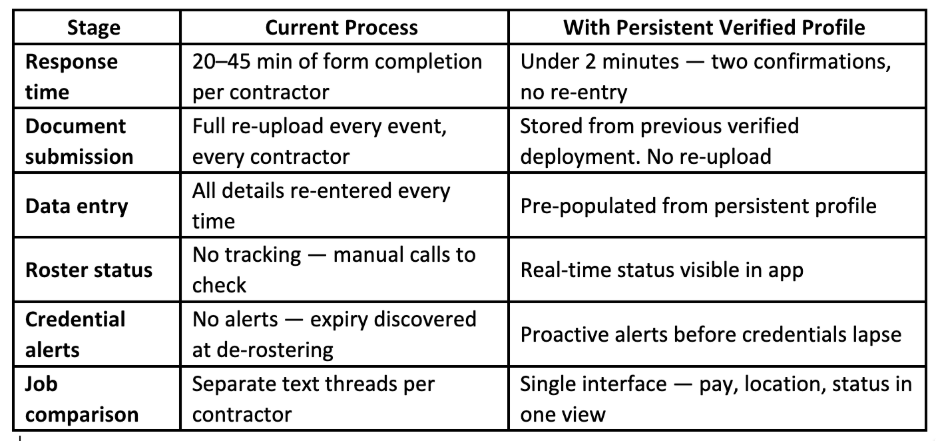
KYRO AI StormShield implements the persistent profile model, fixing the length problem with a one-time setup and the repetition problem by eliminating re-entry entirely after the first verified deployment.
One-time setup. A lineman uploads their required documents once — Medical Card, Passport or State ID, UTN, SSN documentation, CDL, Voided Check, W-4 and I-9. These are stored securely and reused across every KYRO AI-connected contractor and every subsequent event. The lengthy setup happens just once.
KYRO Verified status. After background checks are validated and all documents are verified, the lineman’s profile is marked KYRO Verified. This tells contractors that the paperwork is complete, and the worker is ready for immediate roster consideration.
Two-confirmation response. With a verified profile in place, responding to a new storm call requires two actions: confirm availability, and accept the opportunity. No new uploads. No waiting for a callback. Contractor name, deployment location, pay details, and real-time application status all visible in a single interface.
Proactive credential alerts. KYRO AI StormShield monitors expiration dates across stored credentials and sends alerts before documents lapse, so linemen know about an expiring CDL weeks before a storm call arrives. This prevents de-rostering.
When the storm call process is too long and repeated every time, the consequences cascade through the entire restoration chain. Linemen spend 30–45 minutes on paperwork instead of mobilizing. Contractor rosters take longer to build. Utility crew submissions arrive later. Restoration work starts later. Customers wait longer.
According to the American Public Power Association's Storm Restoration Best Practices Guidebook, coordination delays including slow mutual aid requests, logistics bottlenecks, and crew communication gaps are a primary driver of extended restoration timelines, independent of the physical scale of infrastructure damage.
EEI's 2024 data shows U.S. utilities deployed more than 50,000 mutual aid workers in response to major 2023 storm events. At that scale, a 15-minute reduction in per-lineman onboarding time represents over 12,500 hours saved in a single storm season. Hours that translate directly into faster restoration for the communities depending on it.
Both problems in the storm call process are solved by the same thing: a persistent verified identity built once, carried everywhere, and ready the moment the next storm call arrives.
When linemen respond in two confirmations instead of forty-five minutes of repeated forms, contractors roster faster; utilities get crews sooner, and communities get their power back quicker. That is what happens when the process finally matches the urgency it is supposed to serve.
See how KYRO AI StormShield works for linemen!
Reviewed for accuracy by the KYRO AI Operations Team before publication.
Last verified: EEI Mutual Aid Guidelines 2025 · IBEW Deployment Data 2025 · OSHA 29 CFR 1910.269
It requires full data entry, document re-upload, and tax form resubmission for every event, even with familiar contractors. There is no persistent profile, so each contractor treats each event as a fresh onboarding. The process takes 20 to 45 minutes per contractor, multiplied by however many opportunities the lineman is responding to simultaneously.
Storm call systems have no memory between events. There is no shared credential infrastructure, so every contractor requires full re-submission regardless of prior deployment history. A lineman who worked with the same contractor last week starts from zero at the next storm call — same forms, same uploads, same process from scratch.
KYRO Verified is a profile status assigned after a lineman completes a storm deployment through KYRO AI StormShield with all credentials on file. It tells contractors the profile is documentation-complete and deployment-ready. No re-verification needed. For linemen, it increases roster visibility. For contractors, it compresses roster-building time under the 60-minute deadline.
Without one: 20 to 45 minutes per contractor per event. With a persistent verified profile through KYRO AI StormShield: under 2 minutes — two confirmations with no data re-entry and no document re-upload. The one-time profile setup replaces the repeated onboarding cycle entirely.
Credential expiration is the leading cause — a CDL renewal missed, an OSHA card lapsed, a medical certificate outdated. Per IBEW 2024 data, this is one of the most common reasons linemen are removed from rosters they committed to. KYRO AI StormShield sends proactive expiry alerts before credentials lapse, not after the roster is submitted.

QUICK ANSWER: The storm call process for linemen has two compounding problems: it is too long, requiring 20 to 45 minutes of data entry and document uploads per contractor — and it is repeated in every single event, even with contractors the lineman has worked with before. A persistent verified profile solves both: build it once, reuse it every time, respond in two confirmations instead of forty-five minutes of repeated paperwork.
Storm response demands speed. According to the Edison Electric Institute's 2024 Mutual Aid Operational Guidelines, utilities require contractors to submit verified crew rosters within 60 minutes of a storm call and first-come, first-served roster acceptance means speed is the only variable that determines who wins the deployment.
For most linemen, that 60-minute window begins with a text message and endless phone calls. They will also be put in a position to submit multiple onboarding forms. Forms they have already completed multiple times, for the same contractor, for credentials that have not changed since the last event.
A standard storm call onboarding form requires a lineman to complete the following in full, from scratch, under time pressure:
From text message to form submission, this takes 20 to 45 minutes per contractor, longer in field conditions on a mobile device.
According to IBEW's 2024 workforce deployment data, the average lineman, maintains active relationships with three to five contractors during peak storm season. Meaning, a single major event can require completing this process in parallel, three to five times, inside the same 60-minute window.
A lineman who deployed with the same contractor two weeks ago is treated as a brand new hire when the next storm call arrives. There is no persistent profile. No system memory. There is no information carried forward from previous events. Every document is re-uploaded. Every personal detail gets re-entered. Every tax form gets resubmitted. For a lineman who deploys six to eight times per year, the combined administrative burden runs into dozens of hours of repeated, duplicated paperwork, zero of which contributes to actually restoring power.
Beyond time and repetition, the current system has three additional problems that compound the core issues:
The solution to both core storm call problems is a persistent verified profile built once and reused across every subsequent storm call.

KYRO AI StormShield implements the persistent profile model, fixing the length problem with a one-time setup and the repetition problem by eliminating re-entry entirely after the first verified deployment.
One-time setup. A lineman uploads their required documents once — Medical Card, Passport or State ID, UTN, SSN documentation, CDL, Voided Check, W-4 and I-9. These are stored securely and reused across every KYRO AI-connected contractor and every subsequent event. The lengthy setup happens just once.
KYRO Verified status. After background checks are validated and all documents are verified, the lineman’s profile is marked KYRO Verified. This tells contractors that the paperwork is complete, and the worker is ready for immediate roster consideration.
Two-confirmation response. With a verified profile in place, responding to a new storm call requires two actions: confirm availability, and accept the opportunity. No new uploads. No waiting for a callback. Contractor name, deployment location, pay details, and real-time application status all visible in a single interface.
Proactive credential alerts. KYRO AI StormShield monitors expiration dates across stored credentials and sends alerts before documents lapse, so linemen know about an expiring CDL weeks before a storm call arrives. This prevents de-rostering.
When the storm call process is too long and repeated every time, the consequences cascade through the entire restoration chain. Linemen spend 30–45 minutes on paperwork instead of mobilizing. Contractor rosters take longer to build. Utility crew submissions arrive later. Restoration work starts later. Customers wait longer.
According to the American Public Power Association's Storm Restoration Best Practices Guidebook, coordination delays including slow mutual aid requests, logistics bottlenecks, and crew communication gaps are a primary driver of extended restoration timelines, independent of the physical scale of infrastructure damage.
EEI's 2024 data shows U.S. utilities deployed more than 50,000 mutual aid workers in response to major 2023 storm events. At that scale, a 15-minute reduction in per-lineman onboarding time represents over 12,500 hours saved in a single storm season. Hours that translate directly into faster restoration for the communities depending on it.
Both problems in the storm call process are solved by the same thing: a persistent verified identity built once, carried everywhere, and ready the moment the next storm call arrives.
When linemen respond in two confirmations instead of forty-five minutes of repeated forms, contractors roster faster; utilities get crews sooner, and communities get their power back quicker. That is what happens when the process finally matches the urgency it is supposed to serve.
See how KYRO AI StormShield works for linemen!
Reviewed for accuracy by the KYRO AI Operations Team before publication.
Last verified: EEI Mutual Aid Guidelines 2025 · IBEW Deployment Data 2025 · OSHA 29 CFR 1910.269
It requires full data entry, document re-upload, and tax form resubmission for every event, even with familiar contractors. There is no persistent profile, so each contractor treats each event as a fresh onboarding. The process takes 20 to 45 minutes per contractor, multiplied by however many opportunities the lineman is responding to simultaneously.
Storm call systems have no memory between events. There is no shared credential infrastructure, so every contractor requires full re-submission regardless of prior deployment history. A lineman who worked with the same contractor last week starts from zero at the next storm call — same forms, same uploads, same process from scratch.
KYRO Verified is a profile status assigned after a lineman completes a storm deployment through KYRO AI StormShield with all credentials on file. It tells contractors the profile is documentation-complete and deployment-ready. No re-verification needed. For linemen, it increases roster visibility. For contractors, it compresses roster-building time under the 60-minute deadline.
Without one: 20 to 45 minutes per contractor per event. With a persistent verified profile through KYRO AI StormShield: under 2 minutes — two confirmations with no data re-entry and no document re-upload. The one-time profile setup replaces the repeated onboarding cycle entirely.
Credential expiration is the leading cause — a CDL renewal missed, an OSHA card lapsed, a medical certificate outdated. Per IBEW 2024 data, this is one of the most common reasons linemen are removed from rosters they committed to. KYRO AI StormShield sends proactive expiry alerts before credentials lapse, not after the roster is submitted.


Srinivas N G is a Product Manager and MBA graduate from IIT Madras, focused on building products that simplify complex workforce operations. With a strong foundation in product and operations management, he works at the intersection of product development and process optimisation. Designing systems that are structured, scalable, and intuitive. He believes customer satisfaction and business growth must always move in parallel. His approach centres on simplifying workflows and creating products that are as self explanatory as possible, reducing friction for users operating in high pressure environments. Outside of work, Srinivas loves exploring new places, and culinary arts.