
You Did the Work. Now Get Paid.

June 25, 2026
7 min read

Utility contractors wait 60, 90, sometimes 180 days to get paid for work already completed. KYRO Capital changes that. Here's what you need to know — and why the 3% flat discount is the simplest deal in the industry.

Let's start with something every utility contractor knows in their bones: the work doesn't stop when the invoice gets sent. Crews still need to be paid. Equipment still needs fuel. Materials still need to be ordered for the next job. But the money? That's somewhere in a utility's accounts payable queue, waiting its turn.

The average utility invoice takes 60 to 90 days to get paid. On storm work, emergency restoration, or large T&D capital projects, that can stretch to 180 days — sometimes longer if there's a dispute over a line item or a piece of missing paperwork.

That gap — between when the work is done and when the check arrives — is where contractors get squeezed. It limits how many jobs you can run at once. It puts pressure on your credit line. And it forces you to make decisions about your business based on cash timing instead of business opportunity.

KYRO Capital exists to close that gap. And there are two ways it does it — what we call Model A and Model B. Understanding the difference between them is worth five minutes of your time.

The question isn't whether to use working capital. It's whether the clock is running against you — or for you.

Model A: The Traditional Way

You've probably seen this structure before, even if you didn't know the name for it.

Under Model A, a working capital provider advances you 80% of your invoice on day one. In exchange, you pay interest — typically the Prime rate plus a spread — for every single day that invoice remains unpaid. When the utility finally pays, the provider takes their cut and sends you the rest.
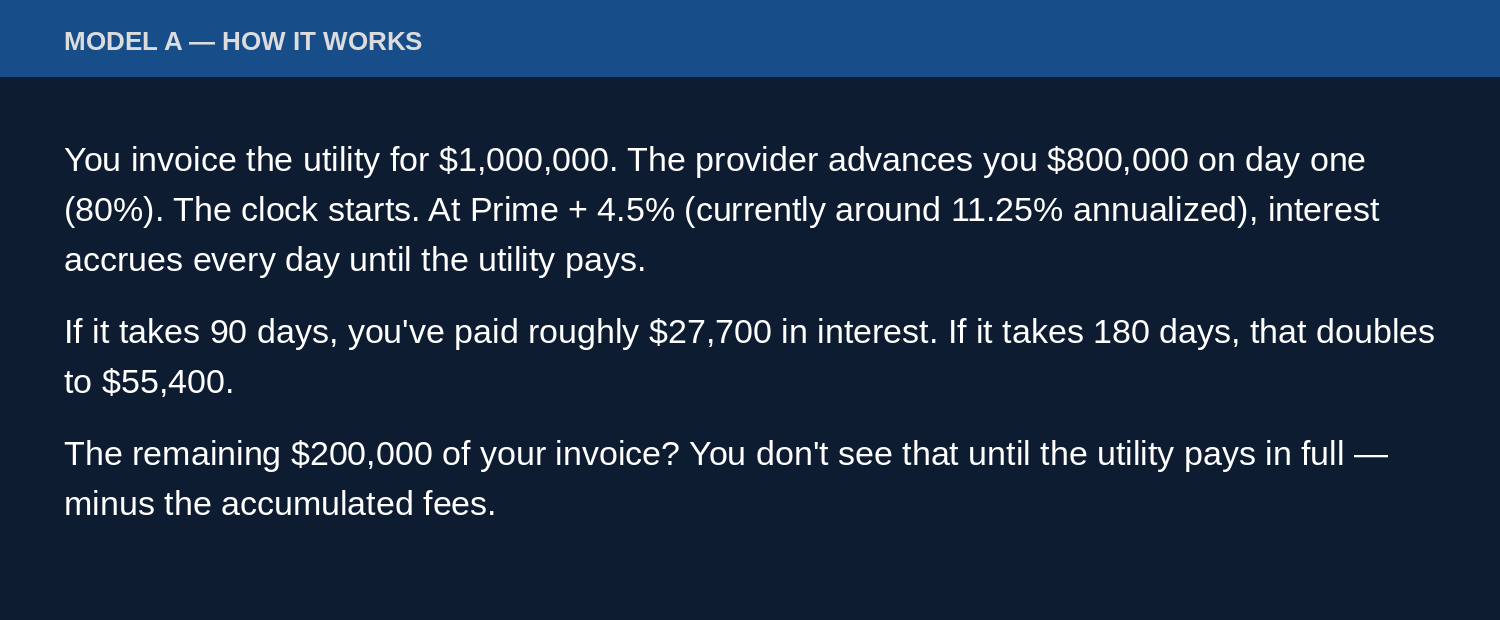
Information panel titled "Model A — How It Works" explaining that a $1,000,000 invoice yields an $800,000 advance at 80%, with interest accruing daily at ~11.25% annualized — totaling $27,700 at 90 days or $55,400 at 180 days, with the remaining $200,000 held back until the utility pays in full.
Model A advances 80% of your invoice on day one — but interest accrues every day until the utility pays, putting the cost of delays entirely on you.

Model A gives you working capital, and that's real. But notice what it doesn't do: it doesn't protect you from delays. If the utility disputes a line item and payment stretches from 60 days to 120 days, your interest bill doubles. If their AP department is backed up and a 45-day payment becomes a 90-day payment, you absorb every extra day. The provider is earning interest the whole time. You're carrying the risk.

That's the part most contractors don't fully appreciate until they get the reconciliation statement.

Model B: The Risk Shifts — Completely

Model B works on a completely different principle. Instead of lending against your invoice, KYRO Capital buys your invoice outright — at 97 cents on the dollar.

You get $970,000 on day one against a $1,000,000 invoice. Transaction closed. Done.
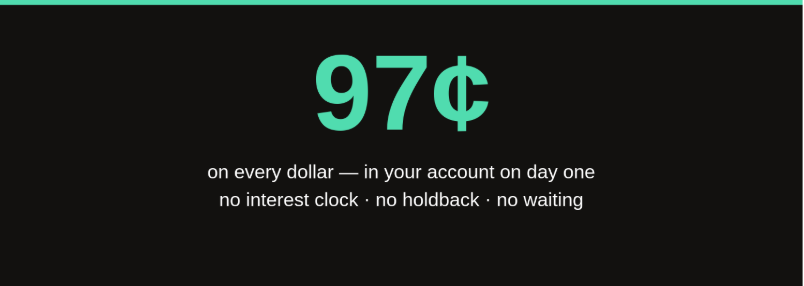
Information panel with large teal "97¢" statistic centered, with white subtext reading "on every dollar — in your account on day one, no interest clock, no holdback, no waiting."
With Model B, you receive 97 cents on every dollar — on day one, with no interest clock and no holdback.

Now here's the part that matters most: once KYRO Capital has purchased that invoice, everything that happens next is our problem, not yours.

If the utility takes 90 days to pay — that's our problem. If they take 180 days — still our problem. You have already been paid. The risk of slow payment has shifted from your business to ours.
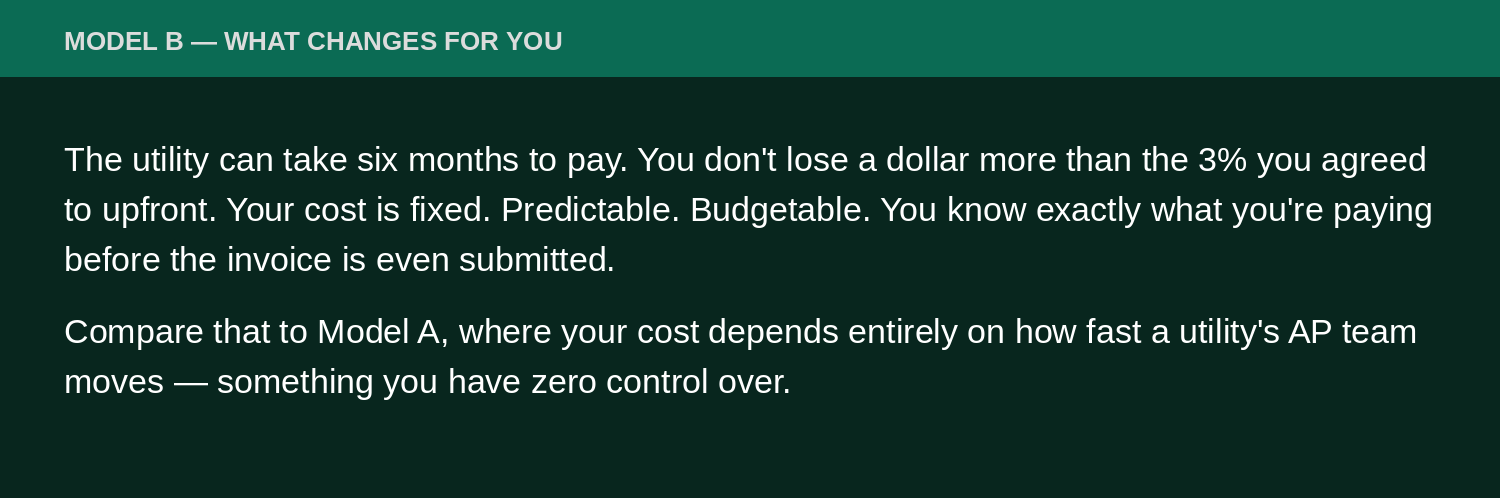
Information panel titled "Model B — What Changes For You" explaining that regardless of how long the utility takes to pay, the contractor's cost remains fixed at 3% upfront — unlike Model A where cost depends entirely on the utility's payment speed.
Under Model B, your cost is locked at 3% the moment you sell the invoice — no matter how long the utility takes to pay.

Let's Make This Concrete

Imagine two contractors. Same job. Same $1,000,000 invoice. Both use working capital. But one uses Model A, one uses Model B.
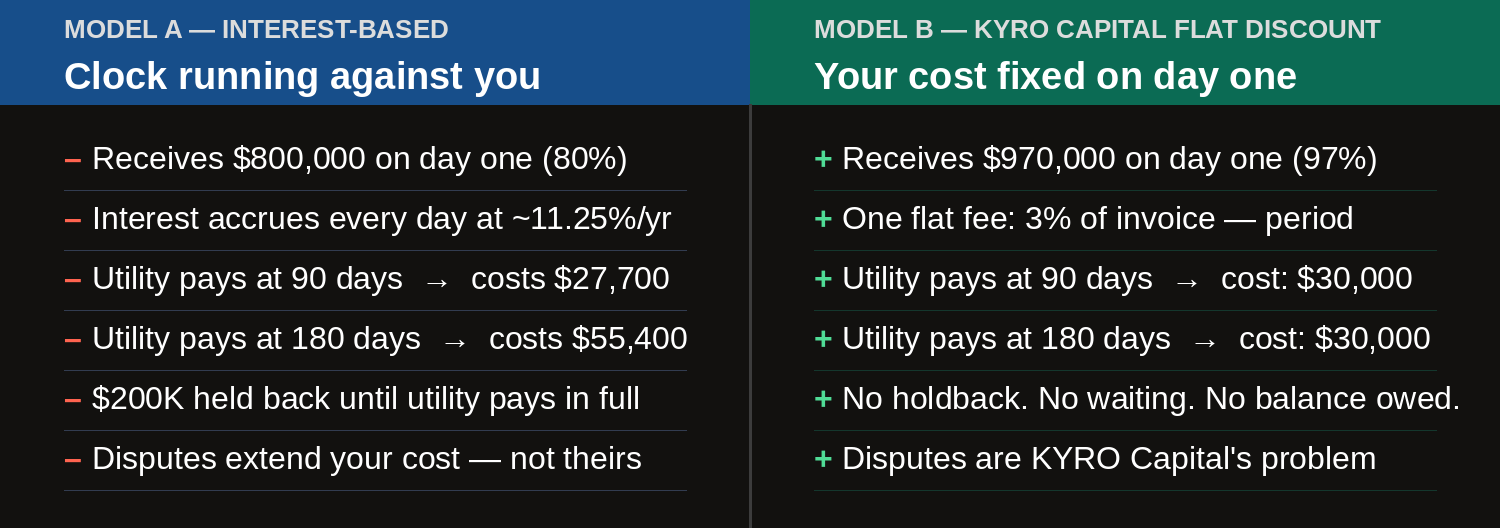
Split comparison panel with a blue left column for Model A (interest-based) and teal right column for Model B (KYRO Capital flat discount). Model A shows an $800,000 advance, daily interest, costs of $27,700 at 90 days and $55,400 at 180 days, a $200K holdback, and disputes extending contractor costs. Model B shows a $970,000 advance, one flat 3% fee, the same $30,000 cost at both 90 and 180 days, no holdback, and disputes handled by KYRO Capital.
Side by side, the difference is clear: Model A keeps the clock running against you, while Model B locks your cost on day one.

The math tells the story plainly. Under Model A, every extra day the utility takes comes out of your pocket. Under Model B, you paid your cost upfront and walked away. Whether the utility pays in 30 days or 180 days, your number is the same: $30,000 on a million-dollar invoice.

What Does "The Risk Shifts" Actually Mean?

We keep saying "the risk shifts to KYRO Capital." Let's make that phrase real.

When KYRO Capital buys your invoice, we are betting that the utility will pay it. If they delay — we eat the carrying cost. If their payment cycles slow down during a budget crunch — that's our balance sheet problem, not yours.

This is a fundamentally different relationship than a loan. With a loan, you owe money regardless of what happens. With Model B, you sold an asset — your receivable — at an agreed price. That transaction is done.
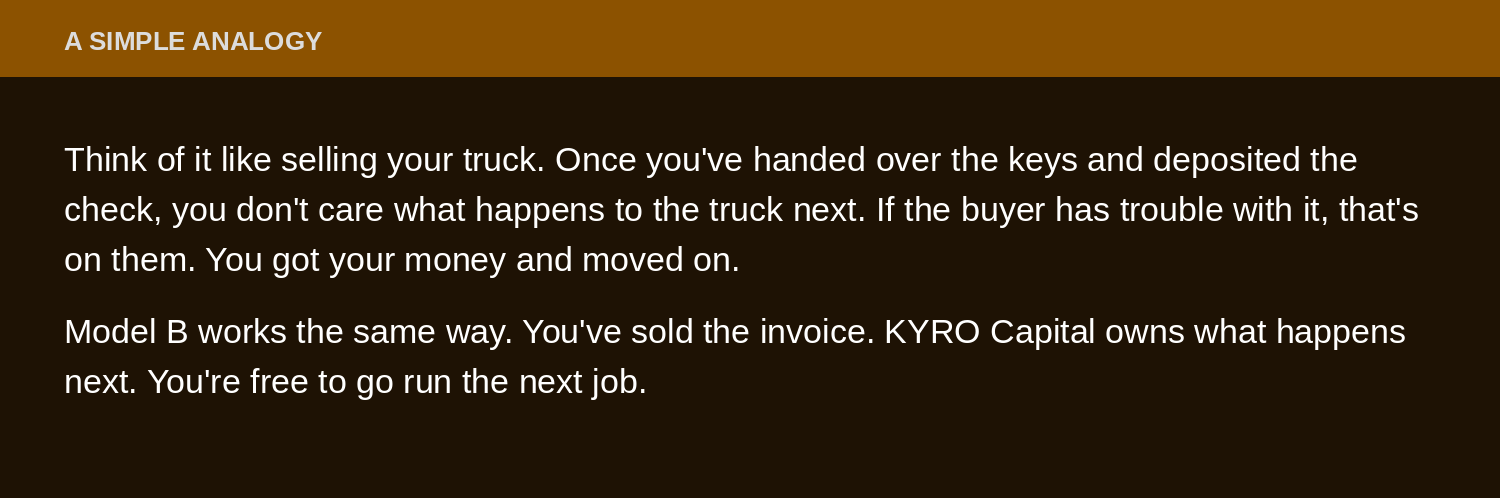
Information panel titled "A Simple Analogy" comparing Model B invoice selling to selling a truck: once you've handed over the keys and deposited the check, what happens to the asset afterward is the buyer's problem — not yours. Model B works the same way; KYRO Capital owns the invoice and what comes next.
Selling an invoice through Model B is like selling your truck — once the deal is done, what happens next isn't your problem.

When Does Model A Make More Sense?

To be fair: there's a breakeven point. Because Model A charges interest daily, it's actually cheaper than Model B if the utility pays very quickly — within about 97 days at current rates. If you have a utility relationship where invoices reliably clear in 30 or 45 days with no disputes, Model A's interest cost for that short window can be less than the 3% flat fee.

But here's the reality for most utility contractors: few invoices on storm restoration, capital construction, or T&D build-out projects pay in 30 days. The average is closer to 60 to 90. Disputed invoices routinely age past 120 days. And any dispute — a missing GPS photo, a line-item question, a PO mismatch — can add weeks to that clock.

How KYRO AI Makes Model B Possible

Here is something worth understanding about why KYRO Capital can offer a flat 3% and absorb the collection risk: it only works because of the quality of the invoices coming through the KYRO AI platform.

When invoices are built right — with proper backup documentation, GPS-tagged photos, T&M records that match the approved scope, and PO verification done before submission — they don't get disputed. They get approved on first review. And when invoices get approved quickly, the working capital provider's money comes back faster, which makes the math work.

KYRO AI automates that process at the point of submission:

1. Field crews capture everything digitally — time, materials, equipment, photos — at the job site, through the KYRO app. Nothing reconstructed after the fact.

2. KYRO generates the invoice directly from those timesheets and expense records, eliminating re-keying errors and ensuring every billable item is traceable.

3. Documentation is auto-assembled — inspection records, delivery confirmations, GPS tags, T&M backup — packaged alongside the invoice automatically.

4. KYRO AI validates the invoice against the PO and approved scope before it ever goes out the door. Line-item mismatches get caught here — not by the utility's AP team three weeks later.

5. KYRO Capital funds the clean invoice — same day. No chasing documents, no re-submissions, no delays.

The result is that somewhere around 30% of standard invoices in the industry get kicked back for missing documentation or billing errors. KYRO-processed invoices get kicked back at a fraction of that rate. For the contractor, that means faster payment. For KYRO Capital, it means the invoices we're buying are cleaner assets — and that's what makes the flat 3% sustainable.

Clean invoices get paid faster. Faster payment means lower risk. Lower risk means KYRO Capital can offer you a better deal.

The Bottom Line

Working capital is not the question. The question is whether the structure you're using puts the risk on you or on the provider.

Model A puts the risk on you. Every day of delay costs you money you didn't plan for. You're 80% funded and watching the clock.

Model B puts the risk on KYRO Capital. You get 97 cents on the dollar on day one. Your cost is locked at 3%. Whether the utility pays this month or six months from now — that's our problem. You're whole. You're funded. You can go run the next job.

If your invoices are clean and your utility pays fast, Model A might be slightly cheaper. But if you're like most utility contractors — doing storm work, capital construction, or T&D projects where payment cycles are long and disputes are a real possibility — Model B is likely the better deal by a significant margin.

Use our Invoice Factoring Cost Calculator to see exactly what Model A and Model B would cost on your next invoice — and which one comes out ahead for your payment window.

Start with the calculator. See your numbers. Then let's talk.

KYRO Capital is a credit program of KYRO Technologies, Inc. KYRO AI is the field-to-finance platform purpose-built for utility infrastructure and construction contractors. From Boots to Boardroom is presented by KYRO AI — a podcast for the people building the infrastructure that powers America.

You Did the Work. Now Get Paid.

June 25, 2026
7 min read
June 25, 2026
Hari Vasudevan
Founder & CEO of KYRO AI
Author
Hari Vasudevan
Founder & CEO of KYRO AI

Utility contractors wait 60, 90, sometimes 180 days to get paid for work already completed. KYRO Capital changes that. Here's what you need to know — and why the 3% flat discount is the simplest deal in the industry.

Let's start with something every utility contractor knows in their bones: the work doesn't stop when the invoice gets sent. Crews still need to be paid. Equipment still needs fuel. Materials still need to be ordered for the next job. But the money? That's somewhere in a utility's accounts payable queue, waiting its turn.

The average utility invoice takes 60 to 90 days to get paid. On storm work, emergency restoration, or large T&D capital projects, that can stretch to 180 days — sometimes longer if there's a dispute over a line item or a piece of missing paperwork.

That gap — between when the work is done and when the check arrives — is where contractors get squeezed. It limits how many jobs you can run at once. It puts pressure on your credit line. And it forces you to make decisions about your business based on cash timing instead of business opportunity.

KYRO Capital exists to close that gap. And there are two ways it does it — what we call Model A and Model B. Understanding the difference between them is worth five minutes of your time.

The question isn't whether to use working capital. It's whether the clock is running against you — or for you.

Model A: The Traditional Way

You've probably seen this structure before, even if you didn't know the name for it.

Under Model A, a working capital provider advances you 80% of your invoice on day one. In exchange, you pay interest — typically the Prime rate plus a spread — for every single day that invoice remains unpaid. When the utility finally pays, the provider takes their cut and sends you the rest.

Information panel titled "Model A — How It Works" explaining that a $1,000,000 invoice yields an $800,000 advance at 80%, with interest accruing daily at ~11.25% annualized — totaling $27,700 at 90 days or $55,400 at 180 days, with the remaining $200,000 held back until the utility pays in full.
Model A advances 80% of your invoice on day one — but interest accrues every day until the utility pays, putting the cost of delays entirely on you.

Model A gives you working capital, and that's real. But notice what it doesn't do: it doesn't protect you from delays. If the utility disputes a line item and payment stretches from 60 days to 120 days, your interest bill doubles. If their AP department is backed up and a 45-day payment becomes a 90-day payment, you absorb every extra day. The provider is earning interest the whole time. You're carrying the risk.

That's the part most contractors don't fully appreciate until they get the reconciliation statement.

Model B: The Risk Shifts — Completely

Model B works on a completely different principle. Instead of lending against your invoice, KYRO Capital buys your invoice outright — at 97 cents on the dollar.

You get $970,000 on day one against a $1,000,000 invoice. Transaction closed. Done.

Information panel with large teal "97¢" statistic centered, with white subtext reading "on every dollar — in your account on day one, no interest clock, no holdback, no waiting."
With Model B, you receive 97 cents on every dollar — on day one, with no interest clock and no holdback.

Now here's the part that matters most: once KYRO Capital has purchased that invoice, everything that happens next is our problem, not yours.

If the utility takes 90 days to pay — that's our problem. If they take 180 days — still our problem. You have already been paid. The risk of slow payment has shifted from your business to ours.

Information panel titled "Model B — What Changes For You" explaining that regardless of how long the utility takes to pay, the contractor's cost remains fixed at 3% upfront — unlike Model A where cost depends entirely on the utility's payment speed.
Under Model B, your cost is locked at 3% the moment you sell the invoice — no matter how long the utility takes to pay.

Let's Make This Concrete

Imagine two contractors. Same job. Same $1,000,000 invoice. Both use working capital. But one uses Model A, one uses Model B.

Split comparison panel with a blue left column for Model A (interest-based) and teal right column for Model B (KYRO Capital flat discount). Model A shows an $800,000 advance, daily interest, costs of $27,700 at 90 days and $55,400 at 180 days, a $200K holdback, and disputes extending contractor costs. Model B shows a $970,000 advance, one flat 3% fee, the same $30,000 cost at both 90 and 180 days, no holdback, and disputes handled by KYRO Capital.
Side by side, the difference is clear: Model A keeps the clock running against you, while Model B locks your cost on day one.

The math tells the story plainly. Under Model A, every extra day the utility takes comes out of your pocket. Under Model B, you paid your cost upfront and walked away. Whether the utility pays in 30 days or 180 days, your number is the same: $30,000 on a million-dollar invoice.

What Does "The Risk Shifts" Actually Mean?

We keep saying "the risk shifts to KYRO Capital." Let's make that phrase real.

When KYRO Capital buys your invoice, we are betting that the utility will pay it. If they delay — we eat the carrying cost. If their payment cycles slow down during a budget crunch — that's our balance sheet problem, not yours.

This is a fundamentally different relationship than a loan. With a loan, you owe money regardless of what happens. With Model B, you sold an asset — your receivable — at an agreed price. That transaction is done.

Information panel titled "A Simple Analogy" comparing Model B invoice selling to selling a truck: once you've handed over the keys and deposited the check, what happens to the asset afterward is the buyer's problem — not yours. Model B works the same way; KYRO Capital owns the invoice and what comes next.
Selling an invoice through Model B is like selling your truck — once the deal is done, what happens next isn't your problem.

When Does Model A Make More Sense?

To be fair: there's a breakeven point. Because Model A charges interest daily, it's actually cheaper than Model B if the utility pays very quickly — within about 97 days at current rates. If you have a utility relationship where invoices reliably clear in 30 or 45 days with no disputes, Model A's interest cost for that short window can be less than the 3% flat fee.

But here's the reality for most utility contractors: few invoices on storm restoration, capital construction, or T&D build-out projects pay in 30 days. The average is closer to 60 to 90. Disputed invoices routinely age past 120 days. And any dispute — a missing GPS photo, a line-item question, a PO mismatch — can add weeks to that clock.

How KYRO AI Makes Model B Possible

Here is something worth understanding about why KYRO Capital can offer a flat 3% and absorb the collection risk: it only works because of the quality of the invoices coming through the KYRO AI platform.

When invoices are built right — with proper backup documentation, GPS-tagged photos, T&M records that match the approved scope, and PO verification done before submission — they don't get disputed. They get approved on first review. And when invoices get approved quickly, the working capital provider's money comes back faster, which makes the math work.

KYRO AI automates that process at the point of submission:

1. Field crews capture everything digitally — time, materials, equipment, photos — at the job site, through the KYRO app. Nothing reconstructed after the fact.

2. KYRO generates the invoice directly from those timesheets and expense records, eliminating re-keying errors and ensuring every billable item is traceable.

3. Documentation is auto-assembled — inspection records, delivery confirmations, GPS tags, T&M backup — packaged alongside the invoice automatically.

4. KYRO AI validates the invoice against the PO and approved scope before it ever goes out the door. Line-item mismatches get caught here — not by the utility's AP team three weeks later.

5. KYRO Capital funds the clean invoice — same day. No chasing documents, no re-submissions, no delays.

The result is that somewhere around 30% of standard invoices in the industry get kicked back for missing documentation or billing errors. KYRO-processed invoices get kicked back at a fraction of that rate. For the contractor, that means faster payment. For KYRO Capital, it means the invoices we're buying are cleaner assets — and that's what makes the flat 3% sustainable.

Clean invoices get paid faster. Faster payment means lower risk. Lower risk means KYRO Capital can offer you a better deal.

The Bottom Line

Working capital is not the question. The question is whether the structure you're using puts the risk on you or on the provider.

Model A puts the risk on you. Every day of delay costs you money you didn't plan for. You're 80% funded and watching the clock.

Model B puts the risk on KYRO Capital. You get 97 cents on the dollar on day one. Your cost is locked at 3%. Whether the utility pays this month or six months from now — that's our problem. You're whole. You're funded. You can go run the next job.

If your invoices are clean and your utility pays fast, Model A might be slightly cheaper. But if you're like most utility contractors — doing storm work, capital construction, or T&D projects where payment cycles are long and disputes are a real possibility — Model B is likely the better deal by a significant margin.

Use our Invoice Factoring Cost Calculator to see exactly what Model A and Model B would cost on your next invoice — and which one comes out ahead for your payment window.

Start with the calculator. See your numbers. Then let's talk.

KYRO Capital is a credit program of KYRO Technologies, Inc. KYRO AI is the field-to-finance platform purpose-built for utility infrastructure and construction contractors. From Boots to Boardroom is presented by KYRO AI — a podcast for the people building the infrastructure that powers America.

Hari Vasudevan
Founder & CEO of KYRO AI

Hari Vasudevan, PE, is a serial entrepreneur and engineer focused on AI-driven solutions for utilities, construction, and storm response. As Founder and CEO of KYRO AI, he leads the development of AI-powered software that helps utility, vegetation, and field service teams digitize operations, improve storm response and restoration, and reduce operational risk. He also serves as Vice Chair and Strategic Advisor for the Edison Electric Institute’s Transmission Subject Area Committee and holds bachelor’s and master’s degrees in civil engineering with professional engineering licensure in multiple states.

Discover more related blogs.