Powering America: Inside the Electric Grid with Scott Aaronson of Edison Electric Institute

June 13, 2026
7 min read

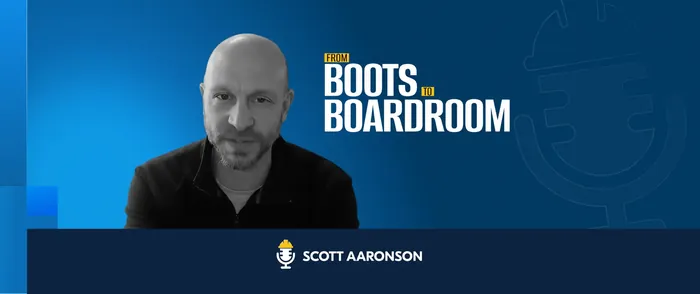
If there's one conversation that captures why the electric utility industry is the most exciting — and most consequential — industry in America right now, it's my sit-down with Scott Aaronson. At the time of our conversation, he was serving as Senior Vice President of Energy Security and Industry Operations at the Edison Electric Institute.

I've been attending EEI events since 2009, and I'll say this plainly: I built my first business, ThinkPower Solutions, thanks in large part to my engagement with Edison Electric Institute. So this episode is personal to me, and I encourage every entrepreneur to get involved with the trade associations that matter in their space.

But this episode isn't about me. It's about an industry that is undergoing the most profound transformation in a generation — and the people leading through it.

From Capitol Hill to Critical Infrastructure

Scott's origin story starts in politics. He worked campaigns, followed a winning candidate to Washington, D.C., planned to stay five years, and has now been there for 25. Before joining EEI in 2009, he spent years on Capitol Hill advising members of Congress, including serving on the staff of Congressman Tom Lantos — the only Holocaust survivor to ever serve in Congress. When Lantos passed away in 2008, Scott had a six-week-old newborn at home and had to help close one congressional office and stand up a new one. That experience, as painful as it was, taught him something he now preaches to his team: resilience isn't about avoiding bad days — it's about what you do with them.

His leadership philosophy comes through a golf analogy that stuck with me. A golf coach once told him: "I have never had a student who gripped the club too light." The harder you grip, the slower you swing. Scott applies that directly to management — if you micromanage, if you over-grip, your team becomes stilted, unimaginative, and just does what they're told. The best leaders he's been around provide strategic guidance and resources, then let the team find the path. Smart people in positions to succeed. That's his formula.

What EEI Actually Does

For those outside the industry, Edison Electric Institute is the trade association representing all of America's investor-owned electric companies — about 62 holding companies and roughly 120 operating companies. They've been around since the 1930s, back when Thomas Edison and Nikola Tesla were still alive. (Scott's book recommendation for listeners: Empires of Light by Jill Jonnes — a fascinating account of Edison, Tesla, and Westinghouse building the electric grid in the 1880s and 1890s.)

EEI's mission is to support reliable, resilient, safe, and affordable electricity. They do benchmarking, leading practices, policy advocacy, publications, and partnerships — all with an eye toward keeping the lights on for Americans. And right now, that mission has never been more complex or more important.

The AI Demand Tsunami

Here's the context that makes this moment so extraordinary. For the last 20 years, electricity demand in the United States has been flat or declining. That means for most professionals' entire careers, the industry hasn't had to deal with growth. Now, seemingly overnight, demand is surging — driven by AI data centers, repatriation of manufacturing, EV charging infrastructure, building electrification, heat pumps, and more.

The numbers Scott shared are staggering. Over the last decade, EEI's members have invested about $1.3 trillion in capital expenditures. Over the next five years, they're on pace to spend at least $1.1 trillion — and Scott considers that a conservative estimate.

Data centers currently consume about 4% of US electricity, on track to more than double by 2028. The US faces a projected shortfall of 45 gigawatts of power — roughly equivalent to the entire generation capacity of Illinois. Globally, data center demand is expected to reach the equivalent of Japan's total electricity consumption by 2030 and India's by 2035.

Scott's take is measured and wise. He acknowledges there may be some froth in the AI bubble — just like the dot-com era, there will likely be a retraction. But just as the internet didn't go away after the dot-com bust, AI isn't going anywhere either. The infrastructure we build now will serve us for decades. The challenge is building responsibly so we don't overbuild, don't strand assets, and don't pass unnecessary costs to ratepayers.

One stat he shared that really frames the tension: when someone asked Amazon what they consider a long-term investment, their answer was five years. In the electric power sector, a long-term investment is five decades. That mismatch in time horizons is the central challenge of our moment.

The Value of the Grid

One of the most compelling arguments Scott makes — and one I think every policymaker and hyperscaler CEO needs to hear — is about the irreplaceable value of the grid itself.

Yes, AI data centers may build some of their own generation. But none of them want to operate without the grid behind them, because the grid provides the resilience and backup that no standalone facility can match. Scott drew a parallel to the military's experience 30 years ago: the military had land and demand and figured they'd just get into the utility business themselves. A few years later, they realized it's incredibly hard to be your own balancing authority with no ecosystem resilience. When utility engineers eventually got on base and saw the engineering decisions that had been made, it wasn't pretty.

The lesson for hyperscalers is clear: if you're going to bring your own generation, do it with an eye toward interconnecting with the grid from day one. Certain engineering and procurement decisions you make now will be very different — and much more costly to fix later — if you're not planning for interconnection.

And here's the affordability angle that matters to every residential ratepayer. The grid's fixed costs — the poles, the wires, the substations — need to be spread across a broad base of customers. Bringing large industrial and data center loads onto the grid actually helps, because it spreads those fixed costs more effectively. The hyperscalers understand this too: they don't want to be the reason residential rates spike uncontrollably, because that creates political and regulatory risk for their own businesses.

Affordability: The Kitchen Table Issue

Scott was candid about the affordability challenge. One in five American households now struggles to pay their electric bills. In some areas, rates have increased $20-27 per month due to infrastructure buildout. The 2024 elections showed that energy costs are a top-of-mind issue in Georgia, Virginia, New Jersey, and New York City.

But context matters. Electricity costs in the United States have historically remained at or below inflationary levels — something that's not true in most of the world. In parts of Europe, air conditioning still isn't the norm because electricity is so expensive. The US has maintained affordable power for decades, and the industry intends to keep it that way.

The key, as Scott put it, is cost allocation — making sure that everyone who benefits from the grid pays their fair share, with the largest beneficiaries bearing proportional costs. Electric companies also maintain robust programs for customers who are struggling, from LIHEAP assistance to the moratorium on shutoffs during the pandemic.

Storm Response and the Power of Mutual Assistance

This is where Scott's passion really came through, and I say that as someone who has personally been involved in storm restoration work — from the 765 kV AEP line restoration in Tennessee to multiple hurricane responses along the Gulf Coast and Eastern Seaboard.

The concept of mutual assistance in the electric industry goes all the way back to the 1880s, when the original Edison illuminating companies in Boston, Manhattan, Philadelphia, and Pittsburgh would send people to help each other because nobody else on earth knew how to fix the equipment. That spirit has scaled dramatically over 140 years.

After Superstorm Sandy in 2012 — which left Scott's own family without power for 18 days in New Jersey — EEI created the National Response Event Framework. The system works in layers: individual companies self-support first, then go to Regional Mutual Assistance Groups (RMAGs), and if those are overwhelmed, the national framework kicks in with industry and government working hand in glove.

The Florida story illustrates the power of resilience investment. After four hurricanes in 2005, including Wilma (4.6 million without power, 18 days to restore), Florida utilities invested $3 billion in storm hardening — smart meters, composite and concrete poles, undergrounding, flood monitoring. When Hurricane Irma hit in 2017 with similar intensity (4.8 million without power, all 67 counties affected), full restoration took just six days. A 12-day improvement. Florida's GDP at the time was roughly a billion dollars a day. Spend $3 billion, save 12 days of economic output. Even a non-engineer can appreciate that math.

Scott also shared the story that has stayed with him most in his career: EEI helped get more than 3,000 line crew and support personnel to Puerto Rico after Hurricane Maria in 2017. It took eight months to fully restore power. He was on the island multiple times and remembers being up in the mountains, in the hardest-to-reach areas, around day 200 of the outage. A woman came out with cookies for the line crews, with the biggest smile on her face. On the mainland, people lose their minds after 200 minutes without power. This woman had been without it for 200 days and was grateful beyond words.

That moment, Scott said, is when it all came together — the public service, the organizing of an entire industry, the solving of hard problems. It's why he does what he does.

The Spare Transformer Program and SpareConnect

For the infrastructure nerds among us (and I count myself among them), Scott walked through the STEP program — the Spare Transformer Equipment Program — born out of 9/11 when critical large power transformers beneath the World Trade Center were destroyed.

These aren't the garbage-can-sized transformers on the pole outside your house. These are school-bus-sized pieces of equipment sitting in 55,000 substations across North America. They're expensive, have long lead times to procure, and require extraordinary logistics to move — trucking, rail, barging, and specialized riggers.

STEP's formal trigger is a presidentially declared terrorist incident, which thankfully hasn't happened since 9/11. But the industry also developed SpareConnect — essentially Match.com for transformers — where procurement leaders can query a database, find peer companies with compatible equipment nearby, and create bilateral sharing agreements. It's been used numerous times and represents the collaborative spirit that makes this industry unique.

Cybersecurity: Left of Boom, Right of Boom

Scott's discussion of cyber threats was sobering. Since 2018, the Director of National Intelligence has assessed that China, Russia, and other nation-states are looking to hold US critical infrastructure at risk. The electric grid, because it's genuinely critical to health, safety, and national security, is a prime target.

But Scott's framework for thinking about it is practical, not alarmist. He borrowed the Department of Defense's "boom continuum" concept: left of boom (before the bad thing happens), you prepare, protect, detect, and defend. Right of boom, you respond and recover. If you only focus on prevention, you're missing half the strategy.

He shared an anecdote about an EEI member that ran a phishing exercise on 10,000 employees and had a 30% failure rate. Through education and a mix of carrots and sticks, they got it down to 3%. That's remarkable — but 3% of 10,000 is still 300 people clicking on something they shouldn't. As Scott put it: "There's hardware, there's software, and there's wetware. We are the wetware. We are idiots. We will click on something."

The lesson isn't that we can prevent every attack. It's that we drive the number down as low as possible, build a culture of security, and make sure that when something does happen, it's bad but not catastrophic.

He also pointed to Ukraine's experience in 2015-2016, when Russian cyberattacks knocked out power for 225,000 people on Eastern Orthodox Christmas. The Ukrainians restored service in six hours by putting people in the field, manning central stations, and talking to each other — essentially running the grid without the digital overlay. It wasn't pretty, but it worked. That capability — the ability to operate manually when digital systems are compromised — is something the US needs to maintain.

AI: Neither Good nor Bad — Just a Tool

Scott's perspective on AI within the utility industry is refreshingly balanced. He reminded me that the industry has been using machine learning for system optimization for over a decade. What's new is large language models, generative AI, and the emerging agentic AI capabilities.

The most promising use cases he sees include customer service optimization, vegetation management prioritization, predictive maintenance (knowing when equipment will fail before it fails), and load flow optimization. CenterPoint Energy, for example, is using AI in vegetation management to predict fuse failures with close to 80% accuracy.

And then there's AI as a cyber defense tool — machines fighting machines. It sounds like a movie plot, but it's becoming reality and it's necessary.

His bottom line: AI is neither inherently good nor bad. It's a tool. It's coming whether we like it or not. The companies that embrace it will thrive. The companies that don't will be left behind.

Linemen: The Job AI Won't Replace

This is a point I want to emphasize because it matters for workforce development. As AI potentially displaces certain jobs, line workers are not among them. We need humans in the field, and we need more of them than ever to build out the grid at the scale required.

It's a phenomenal career. It pays well. You don't need a college degree. Veterans and people with a public service orientation are a natural fit. And the National Lineworker Rodeo in Overland Park, Kansas every October is one of the coolest industry events you'll ever attend.

Scott also made an important point about nuclear workforce. When Vogtle Units 3 and 4 were completed in Georgia, the US had a trained workforce of welders, pipe fitters, and skilled trades who knew how to build nuclear. Instead of immediately deploying them to the next project, we let them disperse back to their day jobs. As small modular reactors and nuclear expansion become reality, we'll need to rebuild that expertise from scratch. It's a missed opportunity, and one Scott hopes we don't repeat.

The Industry That Powers Everything Else

Scott calls the electric power sector an "apex industry" — about 5% of US GDP, but the first 5%, because nothing else happens without electricity. Seven million people are directly or indirectly employed by the sector.

But he's also quick to note the interdependencies. The electric sector relies on water for cooling, telecom for communications, transportation for moving fuel and equipment, and financial services for capital markets access. No critical infrastructure sector operates in isolation.

For anyone considering a career — whether you're an engineer, a project manager, a financier, a lineman, or a cybersecurity professional — there is no cooler industry to be in right now. It's growing. It's spending over a trillion dollars. It's solving problems that are critical to national security, economic competitiveness, and the daily lives of every American. And it's an industry where people genuinely help each other.

As Scott put it: "Wave your arms wildly. All of this doesn't happen without electricity."

Final Thoughts

Scott Aaronson is one of the most competent and passionate people I know in this industry. His energy is infectious — pun fully intended — and his depth of knowledge across security, resilience, policy, and operations is remarkable.

If there's one takeaway from our conversation, it's this: the electric grid is a national treasure, and the people who build, operate, protect, and restore it are performing a form of public service that most Americans never think about until the lights go out. We need to invest in the grid, invest in the workforce, and recognize that in an era of AI, electrification, and growing threats, there has never been a more important time to get this right.

Listen to the full episode on From Boots to Boardroom.

From Boots to Boardroom is presented by KYRO AI — Digitize work and maximize profits.

Powering America: Inside the Electric Grid with Scott Aaronson of Edison Electric Institute

June 13, 2026
7 min read
June 15, 2026
Hari Vasudevan
Founder & CEO of KYRO AI
Author
Hari Vasudevan
Founder & CEO of KYRO AI

If there's one conversation that captures why the electric utility industry is the most exciting — and most consequential — industry in America right now, it's my sit-down with Scott Aaronson. At the time of our conversation, he was serving as Senior Vice President of Energy Security and Industry Operations at the Edison Electric Institute.

I've been attending EEI events since 2009, and I'll say this plainly: I built my first business, ThinkPower Solutions, thanks in large part to my engagement with Edison Electric Institute. So this episode is personal to me, and I encourage every entrepreneur to get involved with the trade associations that matter in their space.

But this episode isn't about me. It's about an industry that is undergoing the most profound transformation in a generation — and the people leading through it.

From Capitol Hill to Critical Infrastructure

Scott's origin story starts in politics. He worked campaigns, followed a winning candidate to Washington, D.C., planned to stay five years, and has now been there for 25. Before joining EEI in 2009, he spent years on Capitol Hill advising members of Congress, including serving on the staff of Congressman Tom Lantos — the only Holocaust survivor to ever serve in Congress. When Lantos passed away in 2008, Scott had a six-week-old newborn at home and had to help close one congressional office and stand up a new one. That experience, as painful as it was, taught him something he now preaches to his team: resilience isn't about avoiding bad days — it's about what you do with them.

His leadership philosophy comes through a golf analogy that stuck with me. A golf coach once told him: "I have never had a student who gripped the club too light." The harder you grip, the slower you swing. Scott applies that directly to management — if you micromanage, if you over-grip, your team becomes stilted, unimaginative, and just does what they're told. The best leaders he's been around provide strategic guidance and resources, then let the team find the path. Smart people in positions to succeed. That's his formula.

What EEI Actually Does

For those outside the industry, Edison Electric Institute is the trade association representing all of America's investor-owned electric companies — about 62 holding companies and roughly 120 operating companies. They've been around since the 1930s, back when Thomas Edison and Nikola Tesla were still alive. (Scott's book recommendation for listeners: Empires of Light by Jill Jonnes — a fascinating account of Edison, Tesla, and Westinghouse building the electric grid in the 1880s and 1890s.)

EEI's mission is to support reliable, resilient, safe, and affordable electricity. They do benchmarking, leading practices, policy advocacy, publications, and partnerships — all with an eye toward keeping the lights on for Americans. And right now, that mission has never been more complex or more important.

The AI Demand Tsunami

Here's the context that makes this moment so extraordinary. For the last 20 years, electricity demand in the United States has been flat or declining. That means for most professionals' entire careers, the industry hasn't had to deal with growth. Now, seemingly overnight, demand is surging — driven by AI data centers, repatriation of manufacturing, EV charging infrastructure, building electrification, heat pumps, and more.

The numbers Scott shared are staggering. Over the last decade, EEI's members have invested about $1.3 trillion in capital expenditures. Over the next five years, they're on pace to spend at least $1.1 trillion — and Scott considers that a conservative estimate.

Data centers currently consume about 4% of US electricity, on track to more than double by 2028. The US faces a projected shortfall of 45 gigawatts of power — roughly equivalent to the entire generation capacity of Illinois. Globally, data center demand is expected to reach the equivalent of Japan's total electricity consumption by 2030 and India's by 2035.

Scott's take is measured and wise. He acknowledges there may be some froth in the AI bubble — just like the dot-com era, there will likely be a retraction. But just as the internet didn't go away after the dot-com bust, AI isn't going anywhere either. The infrastructure we build now will serve us for decades. The challenge is building responsibly so we don't overbuild, don't strand assets, and don't pass unnecessary costs to ratepayers.

One stat he shared that really frames the tension: when someone asked Amazon what they consider a long-term investment, their answer was five years. In the electric power sector, a long-term investment is five decades. That mismatch in time horizons is the central challenge of our moment.

The Value of the Grid

One of the most compelling arguments Scott makes — and one I think every policymaker and hyperscaler CEO needs to hear — is about the irreplaceable value of the grid itself.

Yes, AI data centers may build some of their own generation. But none of them want to operate without the grid behind them, because the grid provides the resilience and backup that no standalone facility can match. Scott drew a parallel to the military's experience 30 years ago: the military had land and demand and figured they'd just get into the utility business themselves. A few years later, they realized it's incredibly hard to be your own balancing authority with no ecosystem resilience. When utility engineers eventually got on base and saw the engineering decisions that had been made, it wasn't pretty.

The lesson for hyperscalers is clear: if you're going to bring your own generation, do it with an eye toward interconnecting with the grid from day one. Certain engineering and procurement decisions you make now will be very different — and much more costly to fix later — if you're not planning for interconnection.

And here's the affordability angle that matters to every residential ratepayer. The grid's fixed costs — the poles, the wires, the substations — need to be spread across a broad base of customers. Bringing large industrial and data center loads onto the grid actually helps, because it spreads those fixed costs more effectively. The hyperscalers understand this too: they don't want to be the reason residential rates spike uncontrollably, because that creates political and regulatory risk for their own businesses.

Affordability: The Kitchen Table Issue

Scott was candid about the affordability challenge. One in five American households now struggles to pay their electric bills. In some areas, rates have increased $20-27 per month due to infrastructure buildout. The 2024 elections showed that energy costs are a top-of-mind issue in Georgia, Virginia, New Jersey, and New York City.

But context matters. Electricity costs in the United States have historically remained at or below inflationary levels — something that's not true in most of the world. In parts of Europe, air conditioning still isn't the norm because electricity is so expensive. The US has maintained affordable power for decades, and the industry intends to keep it that way.

The key, as Scott put it, is cost allocation — making sure that everyone who benefits from the grid pays their fair share, with the largest beneficiaries bearing proportional costs. Electric companies also maintain robust programs for customers who are struggling, from LIHEAP assistance to the moratorium on shutoffs during the pandemic.

Storm Response and the Power of Mutual Assistance

This is where Scott's passion really came through, and I say that as someone who has personally been involved in storm restoration work — from the 765 kV AEP line restoration in Tennessee to multiple hurricane responses along the Gulf Coast and Eastern Seaboard.

The concept of mutual assistance in the electric industry goes all the way back to the 1880s, when the original Edison illuminating companies in Boston, Manhattan, Philadelphia, and Pittsburgh would send people to help each other because nobody else on earth knew how to fix the equipment. That spirit has scaled dramatically over 140 years.

After Superstorm Sandy in 2012 — which left Scott's own family without power for 18 days in New Jersey — EEI created the National Response Event Framework. The system works in layers: individual companies self-support first, then go to Regional Mutual Assistance Groups (RMAGs), and if those are overwhelmed, the national framework kicks in with industry and government working hand in glove.

The Florida story illustrates the power of resilience investment. After four hurricanes in 2005, including Wilma (4.6 million without power, 18 days to restore), Florida utilities invested $3 billion in storm hardening — smart meters, composite and concrete poles, undergrounding, flood monitoring. When Hurricane Irma hit in 2017 with similar intensity (4.8 million without power, all 67 counties affected), full restoration took just six days. A 12-day improvement. Florida's GDP at the time was roughly a billion dollars a day. Spend $3 billion, save 12 days of economic output. Even a non-engineer can appreciate that math.

Scott also shared the story that has stayed with him most in his career: EEI helped get more than 3,000 line crew and support personnel to Puerto Rico after Hurricane Maria in 2017. It took eight months to fully restore power. He was on the island multiple times and remembers being up in the mountains, in the hardest-to-reach areas, around day 200 of the outage. A woman came out with cookies for the line crews, with the biggest smile on her face. On the mainland, people lose their minds after 200 minutes without power. This woman had been without it for 200 days and was grateful beyond words.

That moment, Scott said, is when it all came together — the public service, the organizing of an entire industry, the solving of hard problems. It's why he does what he does.

The Spare Transformer Program and SpareConnect

For the infrastructure nerds among us (and I count myself among them), Scott walked through the STEP program — the Spare Transformer Equipment Program — born out of 9/11 when critical large power transformers beneath the World Trade Center were destroyed.

These aren't the garbage-can-sized transformers on the pole outside your house. These are school-bus-sized pieces of equipment sitting in 55,000 substations across North America. They're expensive, have long lead times to procure, and require extraordinary logistics to move — trucking, rail, barging, and specialized riggers.

STEP's formal trigger is a presidentially declared terrorist incident, which thankfully hasn't happened since 9/11. But the industry also developed SpareConnect — essentially Match.com for transformers — where procurement leaders can query a database, find peer companies with compatible equipment nearby, and create bilateral sharing agreements. It's been used numerous times and represents the collaborative spirit that makes this industry unique.

Cybersecurity: Left of Boom, Right of Boom

Scott's discussion of cyber threats was sobering. Since 2018, the Director of National Intelligence has assessed that China, Russia, and other nation-states are looking to hold US critical infrastructure at risk. The electric grid, because it's genuinely critical to health, safety, and national security, is a prime target.

But Scott's framework for thinking about it is practical, not alarmist. He borrowed the Department of Defense's "boom continuum" concept: left of boom (before the bad thing happens), you prepare, protect, detect, and defend. Right of boom, you respond and recover. If you only focus on prevention, you're missing half the strategy.

He shared an anecdote about an EEI member that ran a phishing exercise on 10,000 employees and had a 30% failure rate. Through education and a mix of carrots and sticks, they got it down to 3%. That's remarkable — but 3% of 10,000 is still 300 people clicking on something they shouldn't. As Scott put it: "There's hardware, there's software, and there's wetware. We are the wetware. We are idiots. We will click on something."

The lesson isn't that we can prevent every attack. It's that we drive the number down as low as possible, build a culture of security, and make sure that when something does happen, it's bad but not catastrophic.

He also pointed to Ukraine's experience in 2015-2016, when Russian cyberattacks knocked out power for 225,000 people on Eastern Orthodox Christmas. The Ukrainians restored service in six hours by putting people in the field, manning central stations, and talking to each other — essentially running the grid without the digital overlay. It wasn't pretty, but it worked. That capability — the ability to operate manually when digital systems are compromised — is something the US needs to maintain.

AI: Neither Good nor Bad — Just a Tool

Scott's perspective on AI within the utility industry is refreshingly balanced. He reminded me that the industry has been using machine learning for system optimization for over a decade. What's new is large language models, generative AI, and the emerging agentic AI capabilities.

The most promising use cases he sees include customer service optimization, vegetation management prioritization, predictive maintenance (knowing when equipment will fail before it fails), and load flow optimization. CenterPoint Energy, for example, is using AI in vegetation management to predict fuse failures with close to 80% accuracy.

And then there's AI as a cyber defense tool — machines fighting machines. It sounds like a movie plot, but it's becoming reality and it's necessary.

His bottom line: AI is neither inherently good nor bad. It's a tool. It's coming whether we like it or not. The companies that embrace it will thrive. The companies that don't will be left behind.

Linemen: The Job AI Won't Replace

This is a point I want to emphasize because it matters for workforce development. As AI potentially displaces certain jobs, line workers are not among them. We need humans in the field, and we need more of them than ever to build out the grid at the scale required.

It's a phenomenal career. It pays well. You don't need a college degree. Veterans and people with a public service orientation are a natural fit. And the National Lineworker Rodeo in Overland Park, Kansas every October is one of the coolest industry events you'll ever attend.

Scott also made an important point about nuclear workforce. When Vogtle Units 3 and 4 were completed in Georgia, the US had a trained workforce of welders, pipe fitters, and skilled trades who knew how to build nuclear. Instead of immediately deploying them to the next project, we let them disperse back to their day jobs. As small modular reactors and nuclear expansion become reality, we'll need to rebuild that expertise from scratch. It's a missed opportunity, and one Scott hopes we don't repeat.

The Industry That Powers Everything Else

Scott calls the electric power sector an "apex industry" — about 5% of US GDP, but the first 5%, because nothing else happens without electricity. Seven million people are directly or indirectly employed by the sector.

But he's also quick to note the interdependencies. The electric sector relies on water for cooling, telecom for communications, transportation for moving fuel and equipment, and financial services for capital markets access. No critical infrastructure sector operates in isolation.

For anyone considering a career — whether you're an engineer, a project manager, a financier, a lineman, or a cybersecurity professional — there is no cooler industry to be in right now. It's growing. It's spending over a trillion dollars. It's solving problems that are critical to national security, economic competitiveness, and the daily lives of every American. And it's an industry where people genuinely help each other.

As Scott put it: "Wave your arms wildly. All of this doesn't happen without electricity."

Final Thoughts

Scott Aaronson is one of the most competent and passionate people I know in this industry. His energy is infectious — pun fully intended — and his depth of knowledge across security, resilience, policy, and operations is remarkable.

If there's one takeaway from our conversation, it's this: the electric grid is a national treasure, and the people who build, operate, protect, and restore it are performing a form of public service that most Americans never think about until the lights go out. We need to invest in the grid, invest in the workforce, and recognize that in an era of AI, electrification, and growing threats, there has never been a more important time to get this right.

Listen to the full episode on From Boots to Boardroom.

From Boots to Boardroom is presented by KYRO AI — Digitize work and maximize profits.
Hari Vasudevan
Founder & CEO of KYRO AI

Hari Vasudevan, PE, is a serial entrepreneur and engineer focused on AI-driven solutions for utilities, construction, and storm response. As Founder and CEO of KYRO AI, he leads the development of AI-powered software that helps utility, vegetation, and field service teams digitize operations, improve storm response and restoration, and reduce operational risk. He also serves as Vice Chair and Strategic Advisor for the Edison Electric Institute’s Transmission Subject Area Committee and holds bachelor’s and master’s degrees in civil engineering with professional engineering licensure in multiple states.

Discover more related blogs.