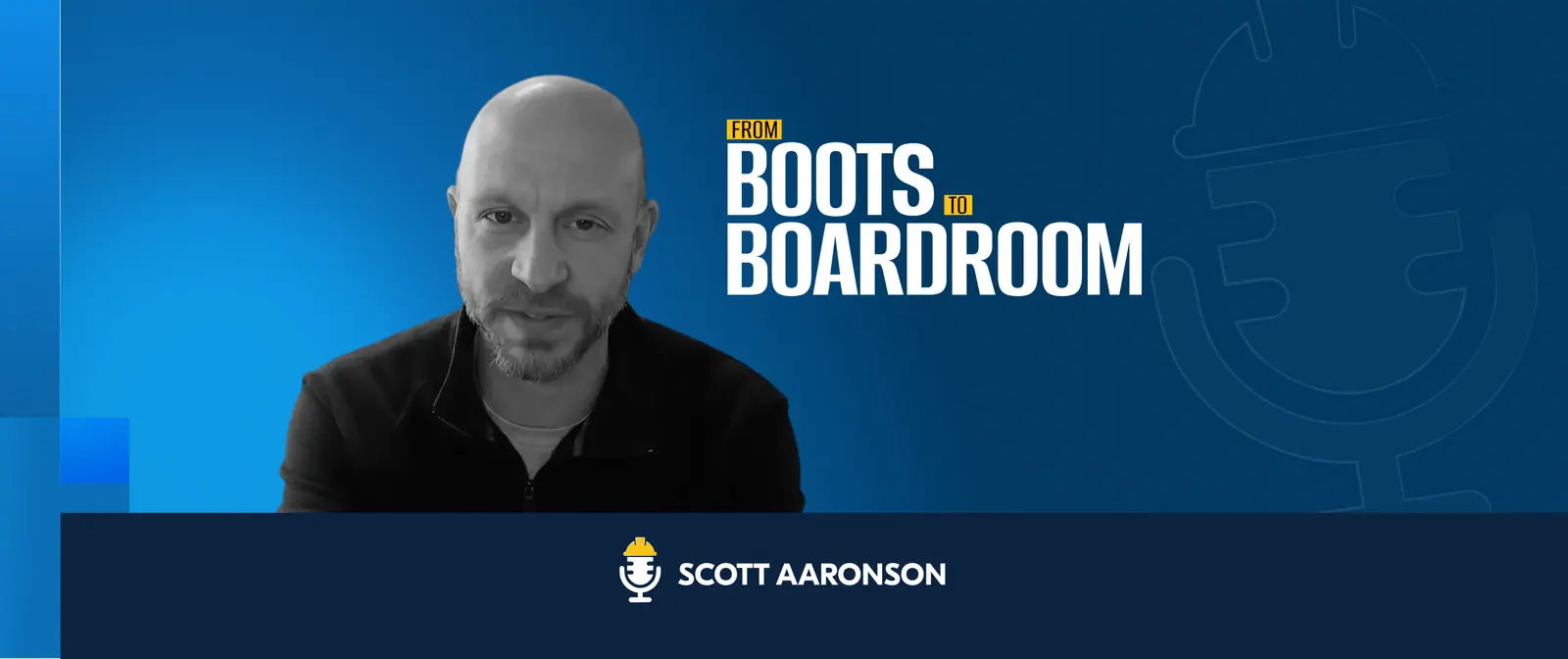
From East Texas to Entrepreneur: How Brian McFarlin Is Reshaping the Utility Industry at 40 Years and Counting

June 6, 2026
6 min read

Before I tell you about Brian McFarlin's 40-year career in the electric utility industry — the management consulting, the 22 years at Oncor, the startup he's building now — I need to tell you what he did for me. Because it changed the trajectory of my life.

I had started Think Power Solutions and was knocking on Oncor's doors for years. We were serving other utilities, but I wanted to be in the Oncor system. Brian was about to leave Oncor — he'd already decided where he was going next — but he was still generous enough to set up a meeting that proved pivotal. He brought together Todd Whitley, Colin Martin, Todd Rosenberger, himself, and me. We brought in pizzas. We made our case. And that meeting put Think Power over the hump and into the Oncor system.

The rest, as they say, is history. We went on to compete with Brian's companies for the next decade — and I mean compete hard. But when I asked him on the show why he did it, knowing full well we'd be competitors, his answer was pure Brian: "I don't call my competitors in the field competitors. I call them industry peers. Because I will team up with anybody if it makes sense."

He saw a young entrepreneur with a construction management software platform, working hard, being met with resistance from people who didn't want to change. "All it needs is a helping hand," he told himself. And he extended that hand. I've told Brian this privately many times, and I wanted to say it publicly on the record: I deeply, deeply appreciate what he did. That moment was the pivotal turning point for Think Power Solutions.

A Second-Generation Utility Man from East Texas

Brian McFarlin didn't just choose this industry — he was born into it. His father worked at Dallas Power & Light, one of the predecessor companies to Oncor, for 40 to 42 years starting around 1950. Before Brian left Oncor himself, the McFarlin name had been associated with the company for nearly 75 years combined, with a period where father and son overlapped before his dad retired.

Brian grew up in a small town in the oil belt of East Texas — blue collar, hardworking, the kind of place where everybody knows your name. One of six kids, so there was built-in competitiveness from the start. He still lives in that same small town today, and his own children went to school there, taught and administered by many of Brian's former classmates.

That small-town foundation shaped a leadership style built on relationships, listening, and observation. "I love to listen. I love to people watch and I love to observe," Brian told me. "Maybe not talk as much in some situations, but just to learn and to build those relationships." He's the duck on the pond — floating peacefully on the surface while paddling furiously underneath. Don't let the laid-back personality fool you. Brian McFarlin does not like to lose.

He earned his mechanical engineering degree from Texas A&M — a proud Aggie — and holds a professional engineering license in Texas. From there, he spent nearly a decade in management consulting serving more than 20 of North America's largest electric utilities before joining Oncor for 22 years. Now he's in his fourth career chapter as president of Utility Engineering, a full-service engineering firm that's part of Utility Innovation Group.

At 40 years in, most people would be thinking about winding down. Not Brian. "I'm not ready to hang it up yet," he said. "I cannot stand status quo. I just cannot tolerate things staying the way they are. We always ought to be moving things forward."

The Road to Success Is Littered with Great Strategy That Never Gets Implemented

If there's one takeaway from Brian's management consulting career that defines everything he does today, it's this: execution matters more than strategy.

"I don't think I ever walked into a client and brought a solution that they hadn't thought of before," Brian told me. "The road to success and greatness is littered all along the way with great strategy that just doesn't get implemented. It's about implementation. It's about getting it across the finish line."

In a large corporation, it's easy to develop a beautiful strategy, present it at a meeting, and then just let it sit. Nobody kills it — it just never moves. And for someone with an entrepreneurial mindset, that friction is maddening. Entrepreneurs don't want meetings for the sake of meetings. We want action-driven meetings. We're task force-driven, not committee-driven.

Brian also made an observation about the transition from school to career that I think is profound: all through school, you're tested on answers. There's a right answer and a wrong answer. Then you get to the professional world and there are no answers — only decisions. Learning to make decisions, to stand behind them, and to move forward even when you're not 100% certain is one of the most important skills in business and in life.

"I'm not an armchair quarterback that goes back and says I wish I would have," Brian said. "I made the best decision with what I knew at the time. And then I just move on."

I teach my kids the same thing: the most important skill in life is decision-making. You make decisions all day, every day, little do you realize it. Some turn out wrong. You learn. You make a better one next time. It's like the NFL draft — you take a player, it doesn't work out, you cut him and draft someone else. I love how Sean McVay and the Rams traded Jared Goff for Matthew Stafford and won a Super Bowl. That's decisive leadership.

Brian added something important: you cannot be afraid to fail. If you're afraid of getting a black eye, you'll be so slow and cautious that you'll never make a decision until everything is perfectly lined up — which is never.

Where the Industry Stands: $1.9 Trillion and Counting

Brian and I spent a good portion of our conversation on the state of the utility industry — and the numbers are staggering. The industry has invested approximately $1.4 trillion since 2014, about $180 billion in 2024 alone, and is on track to invest roughly $1.9 trillion through 2029. AI-driven data center buildouts are accelerating that timeline. OpenAI's $300 billion deal with Oracle for data centers alone should give people a sense of the scale.

Yet despite all that investment, reliability has barely budged. The average American still loses about six hours of power per year. SAIDI and SAIFI values are meandering in the same range. Brian offered several thoughtful explanations for why: much of the investment may not have been fully implemented yet; automated metering infrastructure that came online from roughly 2005 to 2013 provides more accurate outage data than we had before (so we may be measuring things we previously missed); and population density has increased dramatically — a storm hitting Dallas-Fort Worth today affects far more customers than the same storm would have 30 years ago.

But Brian's biggest concern isn't the wires. It's the generation.

"Most people do not sit down and think about this," he said. "The generation of electricity is a unique supply chain. The amount being made has to equal the amount being used at any given instance. There's no inventory in that system."

With data centers consuming power equivalent to what used to be a 1,000 to 1,500 megawatt steam electric station, and with the renewable energy support phasing under recent legislation, the question of where new generation capacity will come from is urgent. Brian referenced Winter Storm Uri in 2021, when Texas came dangerously close to a full grid blackout — not because of a supply shortfall per se, but because the event exposed how fragile the balance between supply and demand really is.

He also shared a vivid memory from the 2003 Northeast blackout. He was doing consulting for FirstEnergy at the time and couldn't even get out of the parking garage because the gate arm wouldn't raise. It took three-plus days to bring that grid back up. Now imagine that happening because of chronic supply shortages rather than a one-time event.

This is why one of Utility Innovation Group's other operating companies is focused specifically on microgrids and distributed energy for large, concentrated load centers like data centers — finding ways to provide power without relying entirely on the traditional grid.

AI: Sweeping, Inevitable, and Just Getting Started

When I asked Brian about AI's impact on the utility industry, his answer captured where many veteran industry leaders are right now: fascinated, committed, and still processing the full scope of what's coming.

"I don't know that my mind can comprehend completely what is going to change," he admitted. "AI has a very broad capability, all the way from working in finance and accounting to engineering and all the way down in the field. I think it's going to be sweeping."

Brian noted that his thinking has evolved rapidly. He used to think of AI as something an outside firm would do — some specialized capability over there. Now Utility Engineering is actively bringing AI capabilities in-house, working through patent processes on proprietary technology. The ability to take massive amounts of data — photographs, LiDAR, photogrammetry — and have AI analyze it for vegetation management issues, broken cross-arm braces, and other infrastructure problems is already transforming what they can offer clients.

He's still working through how AI will affect more complex engineering work — "I don't know yet how AI is going to design a substation," he said — but he believes elements of standard design work will increasingly be handled by AI, with engineers fine-tuning the output. My view is that the day isn't far off, and someone is probably already doing it.

The broader point Brian and I agreed on: utilities have traditionally been reactive — responding to outages, responding to storm damage. AI's real promise is shifting the industry toward being genuinely proactive. I shared the example of our friends at CenterPoint Energy, where AI-driven systems can now predict with 85% accuracy which fuses will fail during a storm event and pre-position vegetation management and restoration crews accordingly. That's the direction the entire industry is heading.

Attracting the Next Generation

Brian has long been an advocate for bringing young people into the utility industry, and his pitch is compelling. If you're an engineer, there's no better industry — it supports every discipline from electrical to mechanical to civil to nuclear to chemical. If you're more vocationally inclined and don't want to pursue a four-year degree, the industry supports that path too, with technical colleges and apprenticeships that lead to excellent livings.

I brought up my interview with Darrell Hallmark — whom Brian knows well and whose episode he'd already listened to — as proof that someone with a GED can build a phenomenal career and phenomenal wealth in this industry. It supports everyone, as long as you're willing to work hard and, ideally, think entrepreneurially.

Brian's concern is that most young people simply don't know this industry exists. They flip a switch, the lights come on, and they never think about the extraordinary supply chain and infrastructure behind it. "We're conservative in this industry," Brian said. "But I think we've got to get a little more energetic with the kids and talk about what's out there."

With distribution automation, LiDAR, photogrammetry, AI-driven analysis, and the massive buildout ahead — $1.9 trillion through 2029 — the opportunities for the next generation are unlike anything the industry has seen before. We just need to tell them about it.

The Setback That Launched a New Career

I asked Brian about failure, and he shared something that resonated deeply. After nearly a decade in management consulting, where he'd become a recognized supply chain expert focused on outsourced contracting strategy, he was passed over for a leadership position. It was one of the toughest blows of his professional career.

But that disappointment planted a seed. It made him start thinking about how to take everything he knew — the deep understanding of both the utility side and the contractor side of the business — and apply it differently. That reflection eventually led him to cross over to the services side, where he's now building Utility Engineering.

"You got to be tough," Brian said. "You got to take some things on the chin and get up and keep going. You got to be resilient. There are factors outside of your control. Decisions are made and you just go on."

He added something I want every young professional to hear: he has no animosity and no hard feelings. "It is what it was, and I just moved on." That kind of grace under disappointment is rare, and it's clearly served him well — because the career path that followed has been one of the most rewarding chapters of his professional life.

If He Were Governor of Texas

When I made Brian the governor of Texas, he immediately demonstrated that he actually knows how Texas government works — something most people don't. The Texas governor's powers are limited primarily to vetoing legislation and calling special sessions. "So I would call special sessions," Brian said, "until we focus on power generation and homeowners' property taxes."

On property taxes, Brian articulated a problem that's affecting real Texans every day: people who've paid off their homes are being taxed out of them because appraisal values have skyrocketed. The system was fine when housing costs were stable, but after the last decade of price increases, people on fixed incomes — particularly older homeowners — literally can't afford to stay in houses they own outright. Brian said something that would be heresy in some Texas circles: he's not so much against an income tax if that's what it would take to fix the property tax problem.

On power generation, his concern ties directly to everything we discussed about the grid: with data center demand surging and renewable energy support phasing out, Texas needs to address where its future generation capacity will come from before the grid runs into real supply problems.

Closing Thoughts

Brian McFarlin's 40-year career is a study in how relationships, execution, and resilience compound over time. He learned relationships in a small East Texas town where everybody knew your name. He learned execution in management consulting, where great strategy dies without implementation. He learned resilience when a career setback redirected him toward entrepreneurship. And he learned generosity somewhere along the way — generous enough to help a young entrepreneur break into a system that had been closed to him, knowing full well they'd compete for the next decade.

I asked Brian on the show why he helped me get started at Oncor, and his answer revealed something important about how he sees the world: "I have a very soft heart for entrepreneurs. They drive the innovation in America. All it needs is a helping hand."

He gave me that hand. And here we are — Think Power was built and sold, KYRO is growing, and Brian is still out there at Utility Engineering, paddling away under the surface of that calm pond, driving change in an industry he's loved since the day he was born.

Brian, my friend — thank you. For the pizza meeting, for the decades of friendship, and for showing everybody what it looks like to compete with integrity and lead with generosity. Here's to the next 40 years. Or at least a few more.

About From Boots to Boardroom

From Boots to Boardroom shares the journey of those who power America — from the job site to the boardroom, leading with grit, tenacity, empathy, and vision. Not every leader sits in a corner office.

Listen to the full episode with Brian McFarlin and subscribe to the podcast here.

This episode sponsored by KYRO AI: Digitize work and maximize profits. Learn more at kyro.ai

From East Texas to Entrepreneur: How Brian McFarlin Is Reshaping the Utility Industry at 40 Years and Counting

June 6, 2026
6 min read
June 6, 2026
Hari Vasudevan
Founder & CEO of KYRO AI
Author
Hari Vasudevan
Founder & CEO of KYRO AI

Before I tell you about Brian McFarlin's 40-year career in the electric utility industry — the management consulting, the 22 years at Oncor, the startup he's building now — I need to tell you what he did for me. Because it changed the trajectory of my life.

I had started Think Power Solutions and was knocking on Oncor's doors for years. We were serving other utilities, but I wanted to be in the Oncor system. Brian was about to leave Oncor — he'd already decided where he was going next — but he was still generous enough to set up a meeting that proved pivotal. He brought together Todd Whitley, Colin Martin, Todd Rosenberger, himself, and me. We brought in pizzas. We made our case. And that meeting put Think Power over the hump and into the Oncor system.

The rest, as they say, is history. We went on to compete with Brian's companies for the next decade — and I mean compete hard. But when I asked him on the show why he did it, knowing full well we'd be competitors, his answer was pure Brian: "I don't call my competitors in the field competitors. I call them industry peers. Because I will team up with anybody if it makes sense."

He saw a young entrepreneur with a construction management software platform, working hard, being met with resistance from people who didn't want to change. "All it needs is a helping hand," he told himself. And he extended that hand. I've told Brian this privately many times, and I wanted to say it publicly on the record: I deeply, deeply appreciate what he did. That moment was the pivotal turning point for Think Power Solutions.

A Second-Generation Utility Man from East Texas

Brian McFarlin didn't just choose this industry — he was born into it. His father worked at Dallas Power & Light, one of the predecessor companies to Oncor, for 40 to 42 years starting around 1950. Before Brian left Oncor himself, the McFarlin name had been associated with the company for nearly 75 years combined, with a period where father and son overlapped before his dad retired.

Brian grew up in a small town in the oil belt of East Texas — blue collar, hardworking, the kind of place where everybody knows your name. One of six kids, so there was built-in competitiveness from the start. He still lives in that same small town today, and his own children went to school there, taught and administered by many of Brian's former classmates.

That small-town foundation shaped a leadership style built on relationships, listening, and observation. "I love to listen. I love to people watch and I love to observe," Brian told me. "Maybe not talk as much in some situations, but just to learn and to build those relationships." He's the duck on the pond — floating peacefully on the surface while paddling furiously underneath. Don't let the laid-back personality fool you. Brian McFarlin does not like to lose.

He earned his mechanical engineering degree from Texas A&M — a proud Aggie — and holds a professional engineering license in Texas. From there, he spent nearly a decade in management consulting serving more than 20 of North America's largest electric utilities before joining Oncor for 22 years. Now he's in his fourth career chapter as president of Utility Engineering, a full-service engineering firm that's part of Utility Innovation Group.

At 40 years in, most people would be thinking about winding down. Not Brian. "I'm not ready to hang it up yet," he said. "I cannot stand status quo. I just cannot tolerate things staying the way they are. We always ought to be moving things forward."

The Road to Success Is Littered with Great Strategy That Never Gets Implemented

If there's one takeaway from Brian's management consulting career that defines everything he does today, it's this: execution matters more than strategy.

"I don't think I ever walked into a client and brought a solution that they hadn't thought of before," Brian told me. "The road to success and greatness is littered all along the way with great strategy that just doesn't get implemented. It's about implementation. It's about getting it across the finish line."

In a large corporation, it's easy to develop a beautiful strategy, present it at a meeting, and then just let it sit. Nobody kills it — it just never moves. And for someone with an entrepreneurial mindset, that friction is maddening. Entrepreneurs don't want meetings for the sake of meetings. We want action-driven meetings. We're task force-driven, not committee-driven.

Brian also made an observation about the transition from school to career that I think is profound: all through school, you're tested on answers. There's a right answer and a wrong answer. Then you get to the professional world and there are no answers — only decisions. Learning to make decisions, to stand behind them, and to move forward even when you're not 100% certain is one of the most important skills in business and in life.

"I'm not an armchair quarterback that goes back and says I wish I would have," Brian said. "I made the best decision with what I knew at the time. And then I just move on."

I teach my kids the same thing: the most important skill in life is decision-making. You make decisions all day, every day, little do you realize it. Some turn out wrong. You learn. You make a better one next time. It's like the NFL draft — you take a player, it doesn't work out, you cut him and draft someone else. I love how Sean McVay and the Rams traded Jared Goff for Matthew Stafford and won a Super Bowl. That's decisive leadership.

Brian added something important: you cannot be afraid to fail. If you're afraid of getting a black eye, you'll be so slow and cautious that you'll never make a decision until everything is perfectly lined up — which is never.

Where the Industry Stands: $1.9 Trillion and Counting

Brian and I spent a good portion of our conversation on the state of the utility industry — and the numbers are staggering. The industry has invested approximately $1.4 trillion since 2014, about $180 billion in 2024 alone, and is on track to invest roughly $1.9 trillion through 2029. AI-driven data center buildouts are accelerating that timeline. OpenAI's $300 billion deal with Oracle for data centers alone should give people a sense of the scale.

Yet despite all that investment, reliability has barely budged. The average American still loses about six hours of power per year. SAIDI and SAIFI values are meandering in the same range. Brian offered several thoughtful explanations for why: much of the investment may not have been fully implemented yet; automated metering infrastructure that came online from roughly 2005 to 2013 provides more accurate outage data than we had before (so we may be measuring things we previously missed); and population density has increased dramatically — a storm hitting Dallas-Fort Worth today affects far more customers than the same storm would have 30 years ago.

But Brian's biggest concern isn't the wires. It's the generation.

"Most people do not sit down and think about this," he said. "The generation of electricity is a unique supply chain. The amount being made has to equal the amount being used at any given instance. There's no inventory in that system."

With data centers consuming power equivalent to what used to be a 1,000 to 1,500 megawatt steam electric station, and with the renewable energy support phasing under recent legislation, the question of where new generation capacity will come from is urgent. Brian referenced Winter Storm Uri in 2021, when Texas came dangerously close to a full grid blackout — not because of a supply shortfall per se, but because the event exposed how fragile the balance between supply and demand really is.

He also shared a vivid memory from the 2003 Northeast blackout. He was doing consulting for FirstEnergy at the time and couldn't even get out of the parking garage because the gate arm wouldn't raise. It took three-plus days to bring that grid back up. Now imagine that happening because of chronic supply shortages rather than a one-time event.

This is why one of Utility Innovation Group's other operating companies is focused specifically on microgrids and distributed energy for large, concentrated load centers like data centers — finding ways to provide power without relying entirely on the traditional grid.

AI: Sweeping, Inevitable, and Just Getting Started

When I asked Brian about AI's impact on the utility industry, his answer captured where many veteran industry leaders are right now: fascinated, committed, and still processing the full scope of what's coming.

"I don't know that my mind can comprehend completely what is going to change," he admitted. "AI has a very broad capability, all the way from working in finance and accounting to engineering and all the way down in the field. I think it's going to be sweeping."

Brian noted that his thinking has evolved rapidly. He used to think of AI as something an outside firm would do — some specialized capability over there. Now Utility Engineering is actively bringing AI capabilities in-house, working through patent processes on proprietary technology. The ability to take massive amounts of data — photographs, LiDAR, photogrammetry — and have AI analyze it for vegetation management issues, broken cross-arm braces, and other infrastructure problems is already transforming what they can offer clients.

He's still working through how AI will affect more complex engineering work — "I don't know yet how AI is going to design a substation," he said — but he believes elements of standard design work will increasingly be handled by AI, with engineers fine-tuning the output. My view is that the day isn't far off, and someone is probably already doing it.

The broader point Brian and I agreed on: utilities have traditionally been reactive — responding to outages, responding to storm damage. AI's real promise is shifting the industry toward being genuinely proactive. I shared the example of our friends at CenterPoint Energy, where AI-driven systems can now predict with 85% accuracy which fuses will fail during a storm event and pre-position vegetation management and restoration crews accordingly. That's the direction the entire industry is heading.

Attracting the Next Generation

Brian has long been an advocate for bringing young people into the utility industry, and his pitch is compelling. If you're an engineer, there's no better industry — it supports every discipline from electrical to mechanical to civil to nuclear to chemical. If you're more vocationally inclined and don't want to pursue a four-year degree, the industry supports that path too, with technical colleges and apprenticeships that lead to excellent livings.

I brought up my interview with Darrell Hallmark — whom Brian knows well and whose episode he'd already listened to — as proof that someone with a GED can build a phenomenal career and phenomenal wealth in this industry. It supports everyone, as long as you're willing to work hard and, ideally, think entrepreneurially.

Brian's concern is that most young people simply don't know this industry exists. They flip a switch, the lights come on, and they never think about the extraordinary supply chain and infrastructure behind it. "We're conservative in this industry," Brian said. "But I think we've got to get a little more energetic with the kids and talk about what's out there."

With distribution automation, LiDAR, photogrammetry, AI-driven analysis, and the massive buildout ahead — $1.9 trillion through 2029 — the opportunities for the next generation are unlike anything the industry has seen before. We just need to tell them about it.

The Setback That Launched a New Career

I asked Brian about failure, and he shared something that resonated deeply. After nearly a decade in management consulting, where he'd become a recognized supply chain expert focused on outsourced contracting strategy, he was passed over for a leadership position. It was one of the toughest blows of his professional career.

But that disappointment planted a seed. It made him start thinking about how to take everything he knew — the deep understanding of both the utility side and the contractor side of the business — and apply it differently. That reflection eventually led him to cross over to the services side, where he's now building Utility Engineering.

"You got to be tough," Brian said. "You got to take some things on the chin and get up and keep going. You got to be resilient. There are factors outside of your control. Decisions are made and you just go on."

He added something I want every young professional to hear: he has no animosity and no hard feelings. "It is what it was, and I just moved on." That kind of grace under disappointment is rare, and it's clearly served him well — because the career path that followed has been one of the most rewarding chapters of his professional life.

If He Were Governor of Texas

When I made Brian the governor of Texas, he immediately demonstrated that he actually knows how Texas government works — something most people don't. The Texas governor's powers are limited primarily to vetoing legislation and calling special sessions. "So I would call special sessions," Brian said, "until we focus on power generation and homeowners' property taxes."

On property taxes, Brian articulated a problem that's affecting real Texans every day: people who've paid off their homes are being taxed out of them because appraisal values have skyrocketed. The system was fine when housing costs were stable, but after the last decade of price increases, people on fixed incomes — particularly older homeowners — literally can't afford to stay in houses they own outright. Brian said something that would be heresy in some Texas circles: he's not so much against an income tax if that's what it would take to fix the property tax problem.

On power generation, his concern ties directly to everything we discussed about the grid: with data center demand surging and renewable energy support phasing out, Texas needs to address where its future generation capacity will come from before the grid runs into real supply problems.

Closing Thoughts

Brian McFarlin's 40-year career is a study in how relationships, execution, and resilience compound over time. He learned relationships in a small East Texas town where everybody knew your name. He learned execution in management consulting, where great strategy dies without implementation. He learned resilience when a career setback redirected him toward entrepreneurship. And he learned generosity somewhere along the way — generous enough to help a young entrepreneur break into a system that had been closed to him, knowing full well they'd compete for the next decade.

I asked Brian on the show why he helped me get started at Oncor, and his answer revealed something important about how he sees the world: "I have a very soft heart for entrepreneurs. They drive the innovation in America. All it needs is a helping hand."

He gave me that hand. And here we are — Think Power was built and sold, KYRO is growing, and Brian is still out there at Utility Engineering, paddling away under the surface of that calm pond, driving change in an industry he's loved since the day he was born.

Brian, my friend — thank you. For the pizza meeting, for the decades of friendship, and for showing everybody what it looks like to compete with integrity and lead with generosity. Here's to the next 40 years. Or at least a few more.

About From Boots to Boardroom

From Boots to Boardroom shares the journey of those who power America — from the job site to the boardroom, leading with grit, tenacity, empathy, and vision. Not every leader sits in a corner office.

Listen to the full episode with Brian McFarlin and subscribe to the podcast here.

This episode sponsored by KYRO AI: Digitize work and maximize profits. Learn more at kyro.ai

Hari Vasudevan
Founder & CEO of KYRO AI

Hari Vasudevan, PE, is a serial entrepreneur and engineer focused on AI-driven solutions for utilities, construction, and storm response. As Founder and CEO of KYRO AI, he leads the development of AI-powered software that helps utility, vegetation, and field service teams digitize operations, improve storm response and restoration, and reduce operational risk. He also serves as Vice Chair and Strategic Advisor for the Edison Electric Institute’s Transmission Subject Area Committee and holds bachelor’s and master’s degrees in civil engineering with professional engineering licensure in multiple states.

Discover more related blogs.