Some conversations stay with you long after they end. My recent podcast episode with RL Grubbs — decorated Vietnam veteran, journeyman lineman, and safety pioneer — was one of those conversations. Over more than an hour, RL shared stories that spanned five decades in the utility industry, from working as a "grunt" (lineman's helper) in the 1960s to becoming one of the industry's most respected safety professionals.
What struck me most wasn't just the breadth of his experience, but the profound transformation he witnessed and helped drive: the evolution of an industry where one in every two linemen could expect to die on the job to one where that number is now one in 2,000. That's a shift from 50% fatality rate to 0.05% — a 1,000-fold improvement.
Let that sink in for a moment.
RL's journey into the utility industry began in a way common to many young men in 1960s Texas: he graduated high school at 17, bought a truck, and went to work. At 18, he became a lineman's helper — affectionately known as a "grunt" — because the hazardous occupation regulations required you to be 21 to actually be a lineman. The irony? You had to be 21 to climb a utility pole, but at 18, Uncle Sam decided you were old enough to serve in Vietnam.
And serve he did. After receiving his draft notice (or as RL wryly puts it, "a letter from a high-ranking government official urging me to sign a contract with the United States government"), he joined the Army and was shipped to Vietnam. There, as a light weapons infantry soldier — another type of "grunt" — he progressed from point man to squad leader.
During one engagement with a vastly superior enemy force, RL made a tactical error that nearly cost him his life. "You should never raise your head up when you're facing a superior force too many times in the same position," he explained. "And I evidently made that mistake." A Viet Cong soldier was waiting. The AK-47 round entered his right shoulder and exited his left hip, causing catastrophic damage to his lung and ribs.
After surgeries in Vietnam, Japan, and eventually San Antonio's Brooks Army Hospital, RL returned home — a Purple Heart recipient with a new perspective on life, risk, and the value of safety protocols. When he returned to the power company asking for his job back, they not only rehired him but gave him credit for his time served. A few years later, he earned his journeyman lineman status.
"Once a lineman, always a lineman," RL says. And he means it.
RL's transition from lineman to safety professional came in the early 1980s, at a time when the industry's approach to safety was fundamentally reactive. Companies focused almost exclusively on the top of the safety triangle — fatalities — the most catastrophic but also the rarest incidents.
For context, the safety triangle (also known as Heinrich's triangle) looks like this from bottom to top: near misses at the base, then minor first aid injuries, then OSHA recordables, then disabling injuries, and finally fatalities at the apex. The insight that transformed safety was recognizing that these levels are connected — for roughly every 600 near misses, you get 300 minor injuries, 30 recordables, 10 disabling injuries, and 1 fatality.
"That's what we focused on then," RL explained, referring to just the fatalities. "The company I was working with had about 5,000 employees, but we did have a fatality about every two years. And it was regular."
The breakthrough came when safety professionals started focusing on the bottom of the triangle instead. By addressing near misses and minor incidents, they could prevent the cascade that led to catastrophic outcomes. RL went back to school using the Texas Hazelwood Act (which provides free college education to Texas veterans) and earned his associate degree in occupational safety and health from Lamar University.
Armed with formal education and decades of field experience, RL and his peers began transforming the industry's safety culture. Instead of one fatality every two years, companies began seeing them every five years, then every ten years. The focus expanded beyond electrical hazards to include chemical hazards, ergonomic issues, hearing loss, and other occupational health concerns that affected linemen's long-term wellbeing.
As RL put it: "We started trying to figure out how can we fix things like that. And the top of the triangle was pretty much taking care of itself."
One of the most fascinating parts of our conversation was RL's perspective on OSHA, which was established in 1970 — right as RL was transitioning from Vietnam to civilian life. He witnessed firsthand the initial resistance from both companies and workers.
"There was a lot of pushback, both from the companies and from the employees," RL recalled. "The employees [thought], how can this politician in Washington know what I do for a living?"
The resistance wasn't entirely unfounded. In its early days, OSHA made some missteps. RL shared a memorable example: a company up north that harvested ice blocks from frozen rivers in winter to use for cooling water in summer had a rule that ice couldn't come in contact with drinking water (because river ice wasn't potable). When OSHA codified this into regulation, it made it difficult for anyone to make ice water — they had to put ice in a container, seal it, and drop the container into the water.
But OSHA learned and evolved. Over the decades, they streamlined thousands of rules, made construction and general industry regulations mirror each other (critical for linemen who move between both categories throughout a workday), and shifted from pure enforcement to partnership.
"I have never run across an OSHA compliance officer that I could not get along with," RL told me. "I think their heart's in the right place. They're trying to help."
To drive this point home, RL spends the entire two-hour OSHA introduction section of his training courses "singing the praises of OSHA" and showing participants the dramatic decline in workplace fatalities post-OSHA. During the height of the Vietnam War, he notes, legislators compared the two activities causing the most fatalities among young men: combat in Vietnam and working on the job. The parallel was sobering — and it drove home the need for federal intervention in workplace safety.
Throughout our conversation, RL shared several "RL-isms" — principles he's developed over his career that I've found incredibly valuable. Here are three that particularly resonated:
"90% of the rules are written for 10% of the employees"
At first, this sounds counterintuitive. But RL explains it brilliantly: "Have you ever partied a little bit too much the night before and showed up for work still under the influence? Have you ever sat up with a sick child all night and you're really exhausted? Do you have an elderly parent and you're waiting on that phone call?"
If you answered yes to any of these, "you are part of that 10% at that point in time," he says. "The trick is you don't live in that 10%. But you have to be thankful that somebody has put some redundant rules in place that help you make it through that 10%."
In other words, the rules aren't there to restrict the 90% of the time when you're sharp and focused. They're there to protect you during the 10% of the time when you're not at your best. And we all have those times.
Safety manuals distinguish between "should" rules (good ideas you can deviate from with good reason) and "shall" rules (carrying the force of law). But RL argues the most important rule is what he calls the "rule of should" — your internal voice of self-preservation.
"Whenever you're out working and that voice tells you, 'I should reposition this truck,' 'I should reposition my ladder,' 'I should put some additional covering on there' — that's when that rule of self-preservation is telling you, you should do this. That is, in my opinion, the most important rule there is."
If everyone followed their internal "should," RL believes we could do away with most safety rules. It's a powerful reminder that safety isn't just about compliance — it's about listening to your instincts when something doesn't feel right.
"No one violates a life-threatening rule"
This one seems paradoxical at first. We've all heard of fatal accidents where rules were clearly violated. But RL's point is subtle and important: "You will not violate that rule if you think you're going to get hurt doing it. You think you're good enough to violate the rule."
Skilled professionals, precisely because of their expertise, sometimes believe they can "dance around those rules." And 99% of the time, they can. "But once when you happen to be in that 10%," RL warns, "or if somebody else does something inappropriate and you don't anticipate that, that's whenever you can get in trouble."
It's a humbling reminder that experience and skill, while valuable, can also breed overconfidence — and overconfidence can be fatal.
One of the most sobering parts of our conversation was when we discussed the hidden costs of the utility industry — costs that don't show up in OSHA statistics but profoundly impact workers and their families.
The construction industry has the highest suicide rate of any industry in America. Long hours, extended periods away from home, and the physical and mental stress of the work take their toll. And when disaster strikes — hurricanes, ice storms, wildfires — linemen can work 20, 30, even 40+ hours straight to restore power.
"In our profession, the divorce rate is very high," RL shared. "I missed a lot of birthdays, anniversaries. I missed holidays. That does have an impact on the family. And then if the family does separate and divorce, that's a very traumatic occurrence for the guy working and his mind is not necessarily on their job."
He noted something fascinating from his data analysis: younger workers had more incidents overall, but more experienced workers had more severe incidents. Why? Because seasoned professionals were "relying on their experience instead of" following protocols. When you combine that overconfidence with being in that "10%" state — exhausted from a sick child, worried about an aging parent, or distracted by a crumbling marriage — the risk multiplies.
This is where I see tremendous potential for AI and technology to help. Not to replace human judgment, but to provide nudges: alerting project managers when a crew has been working too long without rest, when someone hasn't taken a break in hours, when patterns suggest someone might be in that vulnerable 10%. Simple interventions — a safety message, a five-minute call home to reconnect with family — can make a profound difference.
As RL put it: "There's things you can do that's not gonna cost the company a great deal of money."
I have to share the story of how RL came to work with Think Power Solutions, because it says everything about his character.
In 2018, my company was involved in an incident in Texas. We were young, growing rapidly, and about to face a reckoning with a major utility customer. Our mutual friend Jason Riddle introduced me to RL. At the time, RL was about to drive to Oklahoma to teach an OSHA class. Instead, he cancelled that trip, drove to meet us, and helped us face what he called "the fire."
Nobody else would have touched our company with a hundred-foot pole at that moment. But RL saw something — a young company that wanted to do right by its people. After helping us through that crisis, I asked him to stay on and build our safety program. He did, and the culture he established — entrepreneurial, psychologically safe, with strong stop-work authority — continues to benefit the company to this day.
"I did not really want to go work a fatality," RL told me, with characteristic understatement. "That is really not good work. I have unfortunately worked several of them and it just takes a toll on you. But you sounded like your heart was in the right place. You wanted to try to do the right thing. And so I said, okay, I'm going to help you with that."
I can't sing RL's praises highly enough. His credibility — built from decades as a working lineman — gave him the ability to influence safety culture in a way no outsider ever could. As he explained: "It's a whole lot easier. I think it carries more emphasis if one of the employees says, hey, don't do that, that'll hurt you, than a safety man's saying it."
Before we wrapped up our conversation, RL mentioned one more thing that made me smile: he was a technical advisor on the movie "Life on the Line" starring John Travolta. His role? To tell Hollywood what was actually possible versus impossible when depicting lineman work.
As compensation, he got to be an extra in a bar scene where bikers start a fight with linemen. The scene was based on a real incident from one of the locals — when one lineman stood up to a biker, every lineman in the bar stood up with him. "And everybody kind of calmed down then," RL recalled with a chuckle.
If you look in the movie credits under "lineman technical advisor," you'll see RL Grubbs. "That's one of my one shot at fame," he said.
At the end of our conversation, I asked RL what he would do if he were president for a day with full control of Congress. Without hesitation, he said he'd improve support for veterans — especially those struggling with homelessness, injuries from combat, and exposure to Agent Orange. (RL himself was recently diagnosed with leukemia from Agent Orange exposure, though thankfully he's now in remission after treatment that cost about $100,000 a month but didn't cost him a penny thanks to VA benefits.)
"As a Vietnam veteran and an Army veteran," he said, "I really have a soft spot in my heart for old soldiers."
That soft spot extends to young linemen, too. RL still teaches OSHA 10 and OSHA 30 classes, tailoring all his instruction to the line industry. He even volunteers at a lineman school, helping people who "were making hamburgers yesterday and they're learning how to build power lines today."
The utility industry needs these workers. With AI driving unprecedented demand for power — $1.3 trillion invested from 2014 and another $1.9 trillion projected by 2029 — we need more linemen than ever. And we need safety professionals like RL to keep them safe.
RL ends almost every safety meeting the same way: "I appreciate y'all's attention. And you be careful now you're here."
Simple words. But from someone who has dedicated five decades to making sure people make it home safe to their families every night, they carry enormous weight.
RL Grubbs — Real Lineman — represents the best of an industry that literally powers America. His journey from grunt to Purple Heart recipient to journeyman lineman to safety pioneer embodies the values of service, perseverance, and genuine care for fellow workers that make this industry special.
Thank you, RL, for your service to our country and to your profession. And to everyone reading this: be careful out there.
From Boots to Boardroom shares the journey of those who power America — from the job site to the boardroom, leading with grit, tenacity, empathy, and vision. Not every leader sits in a corner office.
Listen to the full episode with RL Grubbs and subscribe to the podcast at www.frombootstoboardroom.com.
To contact RL Grubbs for OSHA training or safety consulting, email him at texassafe@aol.com.
This episode sponsored by Kyro AI: Digitize work and maximize profits. Learn more at kyro.ai
Some conversations stay with you long after they end. My recent podcast episode with RL Grubbs — decorated Vietnam veteran, journeyman lineman, and safety pioneer — was one of those conversations. Over more than an hour, RL shared stories that spanned five decades in the utility industry, from working as a "grunt" (lineman's helper) in the 1960s to becoming one of the industry's most respected safety professionals.
What struck me most wasn't just the breadth of his experience, but the profound transformation he witnessed and helped drive: the evolution of an industry where one in every two linemen could expect to die on the job to one where that number is now one in 2,000. That's a shift from 50% fatality rate to 0.05% — a 1,000-fold improvement.
Let that sink in for a moment.
RL's journey into the utility industry began in a way common to many young men in 1960s Texas: he graduated high school at 17, bought a truck, and went to work. At 18, he became a lineman's helper — affectionately known as a "grunt" — because the hazardous occupation regulations required you to be 21 to actually be a lineman. The irony? You had to be 21 to climb a utility pole, but at 18, Uncle Sam decided you were old enough to serve in Vietnam.
And serve he did. After receiving his draft notice (or as RL wryly puts it, "a letter from a high-ranking government official urging me to sign a contract with the United States government"), he joined the Army and was shipped to Vietnam. There, as a light weapons infantry soldier — another type of "grunt" — he progressed from point man to squad leader.
During one engagement with a vastly superior enemy force, RL made a tactical error that nearly cost him his life. "You should never raise your head up when you're facing a superior force too many times in the same position," he explained. "And I evidently made that mistake." A Viet Cong soldier was waiting. The AK-47 round entered his right shoulder and exited his left hip, causing catastrophic damage to his lung and ribs.
After surgeries in Vietnam, Japan, and eventually San Antonio's Brooks Army Hospital, RL returned home — a Purple Heart recipient with a new perspective on life, risk, and the value of safety protocols. When he returned to the power company asking for his job back, they not only rehired him but gave him credit for his time served. A few years later, he earned his journeyman lineman status.
"Once a lineman, always a lineman," RL says. And he means it.
RL's transition from lineman to safety professional came in the early 1980s, at a time when the industry's approach to safety was fundamentally reactive. Companies focused almost exclusively on the top of the safety triangle — fatalities — the most catastrophic but also the rarest incidents.
For context, the safety triangle (also known as Heinrich's triangle) looks like this from bottom to top: near misses at the base, then minor first aid injuries, then OSHA recordables, then disabling injuries, and finally fatalities at the apex. The insight that transformed safety was recognizing that these levels are connected — for roughly every 600 near misses, you get 300 minor injuries, 30 recordables, 10 disabling injuries, and 1 fatality.
"That's what we focused on then," RL explained, referring to just the fatalities. "The company I was working with had about 5,000 employees, but we did have a fatality about every two years. And it was regular."
The breakthrough came when safety professionals started focusing on the bottom of the triangle instead. By addressing near misses and minor incidents, they could prevent the cascade that led to catastrophic outcomes. RL went back to school using the Texas Hazelwood Act (which provides free college education to Texas veterans) and earned his associate degree in occupational safety and health from Lamar University.
Armed with formal education and decades of field experience, RL and his peers began transforming the industry's safety culture. Instead of one fatality every two years, companies began seeing them every five years, then every ten years. The focus expanded beyond electrical hazards to include chemical hazards, ergonomic issues, hearing loss, and other occupational health concerns that affected linemen's long-term wellbeing.
As RL put it: "We started trying to figure out how can we fix things like that. And the top of the triangle was pretty much taking care of itself."
One of the most fascinating parts of our conversation was RL's perspective on OSHA, which was established in 1970 — right as RL was transitioning from Vietnam to civilian life. He witnessed firsthand the initial resistance from both companies and workers.
"There was a lot of pushback, both from the companies and from the employees," RL recalled. "The employees [thought], how can this politician in Washington know what I do for a living?"
The resistance wasn't entirely unfounded. In its early days, OSHA made some missteps. RL shared a memorable example: a company up north that harvested ice blocks from frozen rivers in winter to use for cooling water in summer had a rule that ice couldn't come in contact with drinking water (because river ice wasn't potable). When OSHA codified this into regulation, it made it difficult for anyone to make ice water — they had to put ice in a container, seal it, and drop the container into the water.
But OSHA learned and evolved. Over the decades, they streamlined thousands of rules, made construction and general industry regulations mirror each other (critical for linemen who move between both categories throughout a workday), and shifted from pure enforcement to partnership.
"I have never run across an OSHA compliance officer that I could not get along with," RL told me. "I think their heart's in the right place. They're trying to help."
To drive this point home, RL spends the entire two-hour OSHA introduction section of his training courses "singing the praises of OSHA" and showing participants the dramatic decline in workplace fatalities post-OSHA. During the height of the Vietnam War, he notes, legislators compared the two activities causing the most fatalities among young men: combat in Vietnam and working on the job. The parallel was sobering — and it drove home the need for federal intervention in workplace safety.
Throughout our conversation, RL shared several "RL-isms" — principles he's developed over his career that I've found incredibly valuable. Here are three that particularly resonated:
"90% of the rules are written for 10% of the employees"
At first, this sounds counterintuitive. But RL explains it brilliantly: "Have you ever partied a little bit too much the night before and showed up for work still under the influence? Have you ever sat up with a sick child all night and you're really exhausted? Do you have an elderly parent and you're waiting on that phone call?"
If you answered yes to any of these, "you are part of that 10% at that point in time," he says. "The trick is you don't live in that 10%. But you have to be thankful that somebody has put some redundant rules in place that help you make it through that 10%."
In other words, the rules aren't there to restrict the 90% of the time when you're sharp and focused. They're there to protect you during the 10% of the time when you're not at your best. And we all have those times.
Safety manuals distinguish between "should" rules (good ideas you can deviate from with good reason) and "shall" rules (carrying the force of law). But RL argues the most important rule is what he calls the "rule of should" — your internal voice of self-preservation.
"Whenever you're out working and that voice tells you, 'I should reposition this truck,' 'I should reposition my ladder,' 'I should put some additional covering on there' — that's when that rule of self-preservation is telling you, you should do this. That is, in my opinion, the most important rule there is."
If everyone followed their internal "should," RL believes we could do away with most safety rules. It's a powerful reminder that safety isn't just about compliance — it's about listening to your instincts when something doesn't feel right.
"No one violates a life-threatening rule"
This one seems paradoxical at first. We've all heard of fatal accidents where rules were clearly violated. But RL's point is subtle and important: "You will not violate that rule if you think you're going to get hurt doing it. You think you're good enough to violate the rule."
Skilled professionals, precisely because of their expertise, sometimes believe they can "dance around those rules." And 99% of the time, they can. "But once when you happen to be in that 10%," RL warns, "or if somebody else does something inappropriate and you don't anticipate that, that's whenever you can get in trouble."
It's a humbling reminder that experience and skill, while valuable, can also breed overconfidence — and overconfidence can be fatal.
One of the most sobering parts of our conversation was when we discussed the hidden costs of the utility industry — costs that don't show up in OSHA statistics but profoundly impact workers and their families.
The construction industry has the highest suicide rate of any industry in America. Long hours, extended periods away from home, and the physical and mental stress of the work take their toll. And when disaster strikes — hurricanes, ice storms, wildfires — linemen can work 20, 30, even 40+ hours straight to restore power.
"In our profession, the divorce rate is very high," RL shared. "I missed a lot of birthdays, anniversaries. I missed holidays. That does have an impact on the family. And then if the family does separate and divorce, that's a very traumatic occurrence for the guy working and his mind is not necessarily on their job."
He noted something fascinating from his data analysis: younger workers had more incidents overall, but more experienced workers had more severe incidents. Why? Because seasoned professionals were "relying on their experience instead of" following protocols. When you combine that overconfidence with being in that "10%" state — exhausted from a sick child, worried about an aging parent, or distracted by a crumbling marriage — the risk multiplies.
This is where I see tremendous potential for AI and technology to help. Not to replace human judgment, but to provide nudges: alerting project managers when a crew has been working too long without rest, when someone hasn't taken a break in hours, when patterns suggest someone might be in that vulnerable 10%. Simple interventions — a safety message, a five-minute call home to reconnect with family — can make a profound difference.
As RL put it: "There's things you can do that's not gonna cost the company a great deal of money."
I have to share the story of how RL came to work with Think Power Solutions, because it says everything about his character.
In 2018, my company was involved in an incident in Texas. We were young, growing rapidly, and about to face a reckoning with a major utility customer. Our mutual friend Jason Riddle introduced me to RL. At the time, RL was about to drive to Oklahoma to teach an OSHA class. Instead, he cancelled that trip, drove to meet us, and helped us face what he called "the fire."
Nobody else would have touched our company with a hundred-foot pole at that moment. But RL saw something — a young company that wanted to do right by its people. After helping us through that crisis, I asked him to stay on and build our safety program. He did, and the culture he established — entrepreneurial, psychologically safe, with strong stop-work authority — continues to benefit the company to this day.
"I did not really want to go work a fatality," RL told me, with characteristic understatement. "That is really not good work. I have unfortunately worked several of them and it just takes a toll on you. But you sounded like your heart was in the right place. You wanted to try to do the right thing. And so I said, okay, I'm going to help you with that."
I can't sing RL's praises highly enough. His credibility — built from decades as a working lineman — gave him the ability to influence safety culture in a way no outsider ever could. As he explained: "It's a whole lot easier. I think it carries more emphasis if one of the employees says, hey, don't do that, that'll hurt you, than a safety man's saying it."
Before we wrapped up our conversation, RL mentioned one more thing that made me smile: he was a technical advisor on the movie "Life on the Line" starring John Travolta. His role? To tell Hollywood what was actually possible versus impossible when depicting lineman work.
As compensation, he got to be an extra in a bar scene where bikers start a fight with linemen. The scene was based on a real incident from one of the locals — when one lineman stood up to a biker, every lineman in the bar stood up with him. "And everybody kind of calmed down then," RL recalled with a chuckle.
If you look in the movie credits under "lineman technical advisor," you'll see RL Grubbs. "That's one of my one shot at fame," he said.
At the end of our conversation, I asked RL what he would do if he were president for a day with full control of Congress. Without hesitation, he said he'd improve support for veterans — especially those struggling with homelessness, injuries from combat, and exposure to Agent Orange. (RL himself was recently diagnosed with leukemia from Agent Orange exposure, though thankfully he's now in remission after treatment that cost about $100,000 a month but didn't cost him a penny thanks to VA benefits.)
"As a Vietnam veteran and an Army veteran," he said, "I really have a soft spot in my heart for old soldiers."
That soft spot extends to young linemen, too. RL still teaches OSHA 10 and OSHA 30 classes, tailoring all his instruction to the line industry. He even volunteers at a lineman school, helping people who "were making hamburgers yesterday and they're learning how to build power lines today."
The utility industry needs these workers. With AI driving unprecedented demand for power — $1.3 trillion invested from 2014 and another $1.9 trillion projected by 2029 — we need more linemen than ever. And we need safety professionals like RL to keep them safe.
RL ends almost every safety meeting the same way: "I appreciate y'all's attention. And you be careful now you're here."
Simple words. But from someone who has dedicated five decades to making sure people make it home safe to their families every night, they carry enormous weight.
RL Grubbs — Real Lineman — represents the best of an industry that literally powers America. His journey from grunt to Purple Heart recipient to journeyman lineman to safety pioneer embodies the values of service, perseverance, and genuine care for fellow workers that make this industry special.
Thank you, RL, for your service to our country and to your profession. And to everyone reading this: be careful out there.
From Boots to Boardroom shares the journey of those who power America — from the job site to the boardroom, leading with grit, tenacity, empathy, and vision. Not every leader sits in a corner office.
Listen to the full episode with RL Grubbs and subscribe to the podcast at www.frombootstoboardroom.com.
To contact RL Grubbs for OSHA training or safety consulting, email him at texassafe@aol.com.
This episode sponsored by Kyro AI: Digitize work and maximize profits. Learn more at kyro.ai

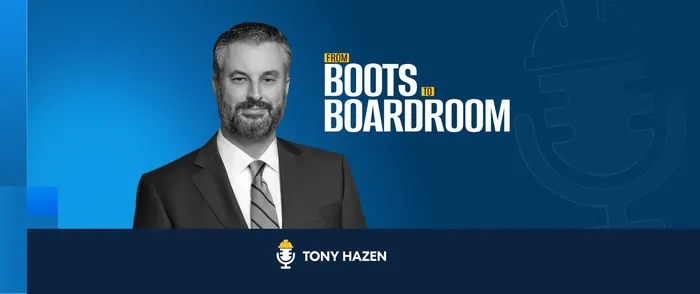
Hari Vasudevan, PE, is a serial entrepreneur and engineer focused on AI-driven solutions for utilities, construction, and storm response. As Founder and CEO of KYRO AI, he leads the development of AI-powered software that helps utility, vegetation, and field service teams digitize operations, improve storm response and restoration, and reduce operational risk. He also serves as Vice Chair and Strategic Advisor for the Edison Electric Institute’s Transmission Subject Area Committee and holds bachelor’s and master’s degrees in civil engineering with professional engineering licensure in multiple states.